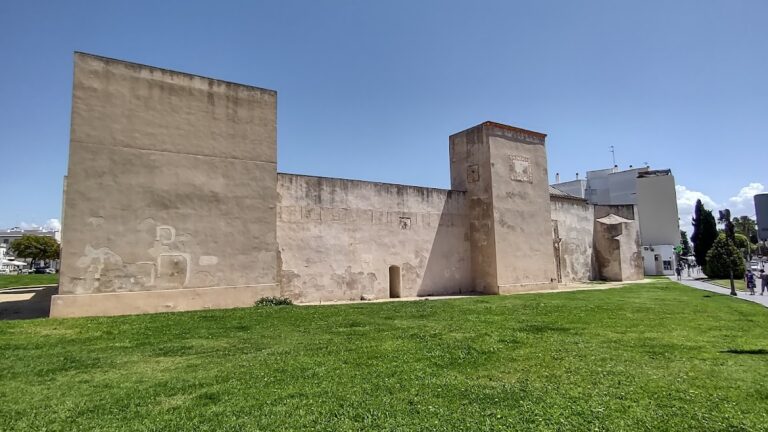
Ermita de los Santos Mártires (Medina-Sidonia): A Mudéjar Catholic Chapel


Site at a Glance
- Rating
- 4.3
- Popularity
- Very Low
- Country
- Spain
- Primary era
- Medieval
- External website
- Open
- Eras represented
- Classical, Medieval
- Civilizations
- Crown of Castile, Roman, Umayyad
- Site type
- Religious
- Remains
- Chapel
On this page10 sections
History
Late Antique origins and dedication
Ermita de los Santos Mártires (Medina-Sidonia) is a Catholic chapel in Spain whose surviving building has a predominantly Mudéjar character, while its history reaches back to Late Antiquity. Tradition identifies it as Medina-Sidonia’s oldest religious establishment and attributes its foundation to Saint Paulinus of Nola, a late Roman Christian writer and bishop, shortly after AD 394. AD 403 is also given as the foundation date. These traditional dates concern the establishment’s origins rather than the construction date of the present chapel.
On December 16, 630, Bishop Pimenio of Asidonia consecrated the establishment during the second year of his episcopate. The dedication was carved on a reused Roman pedestal and named saints whose relics were said to have been placed there. The actual presence of those relics remains uncertain. An earlier Roman villa and a seventh-century Visigothic religious building have been proposed beneath the chapel, but the evidence does not securely establish either interpretation. The quantity of reused Roman and Late Antique material nevertheless points to an earlier structure at the site.
Islamic rule and the Castilian period
During the Moorish occupation, Christians are said to have celebrated Mass at this establishment rather than in the church or churches of the town. After the arrival of the kings of Castile, the church was enlarged into a building with three naves. The attached tower sacristy is generally dated to the tenth century, although its lower body may preserve part of a Roman-period rural watchtower. Its relationship to a possible Roman villa and a possible Visigothic building remains unresolved.
Modern history and protection
The chapel is protected as a Bien de Interés Cultural, a Spanish category for protected cultural heritage. Its protection was recorded in 1949 under legislation concerning Spanish castles and under Spain’s Historical Heritage Law of 1985; registry information also records a declaration in 1993.
Carlos García de Paredes occupied the site as a hermit after Bishop Antonio Ceballos consecrated him to that role. Accounts differ over whether the diocese expelled him at the end of 2017 or whether he retired because of his age. The chapel also suffered several thefts. Between July 8 and 9, 2005, a Sacred Heart of Jesus figure and a polychrome wooden image of Saint Anne teaching the Virgin to read were stolen. Police recovered the Saint Anne sculpture in December 2005, and the investigation dismantled an organized art-theft network in Cádiz province. An 80-kilogram bell was stolen from the entrance in late April or early May 2019, followed by reports of further thefts amid concern about the building’s abandonment and lack of assigned custodial staff.
Remains
Church layout and construction
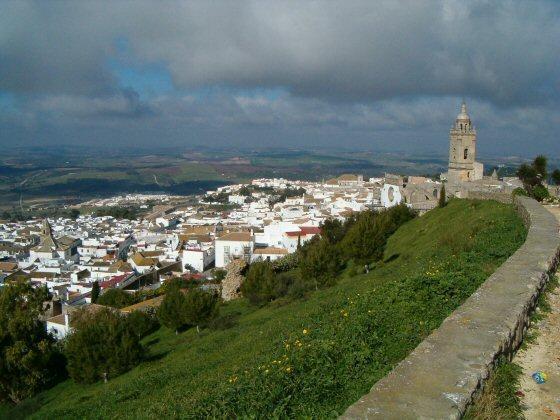
The chapel stands south of Medina-Sidonia, at the foot of a slope, approximately 2 kilometers from the town center. Its three naves are divided by columns belonging to different periods and styles. Raised brick arches rest on these supports, while the nave is covered by a wooden coffered ceiling, formed from recessed panels, with transverse tie beams that brace the roof structure. This combination of brick arcades and timber construction expresses the building’s dominant Mudéjar character, meaning the medieval Christian use of methods and forms developed under Islamic rule.
Tower sacristy
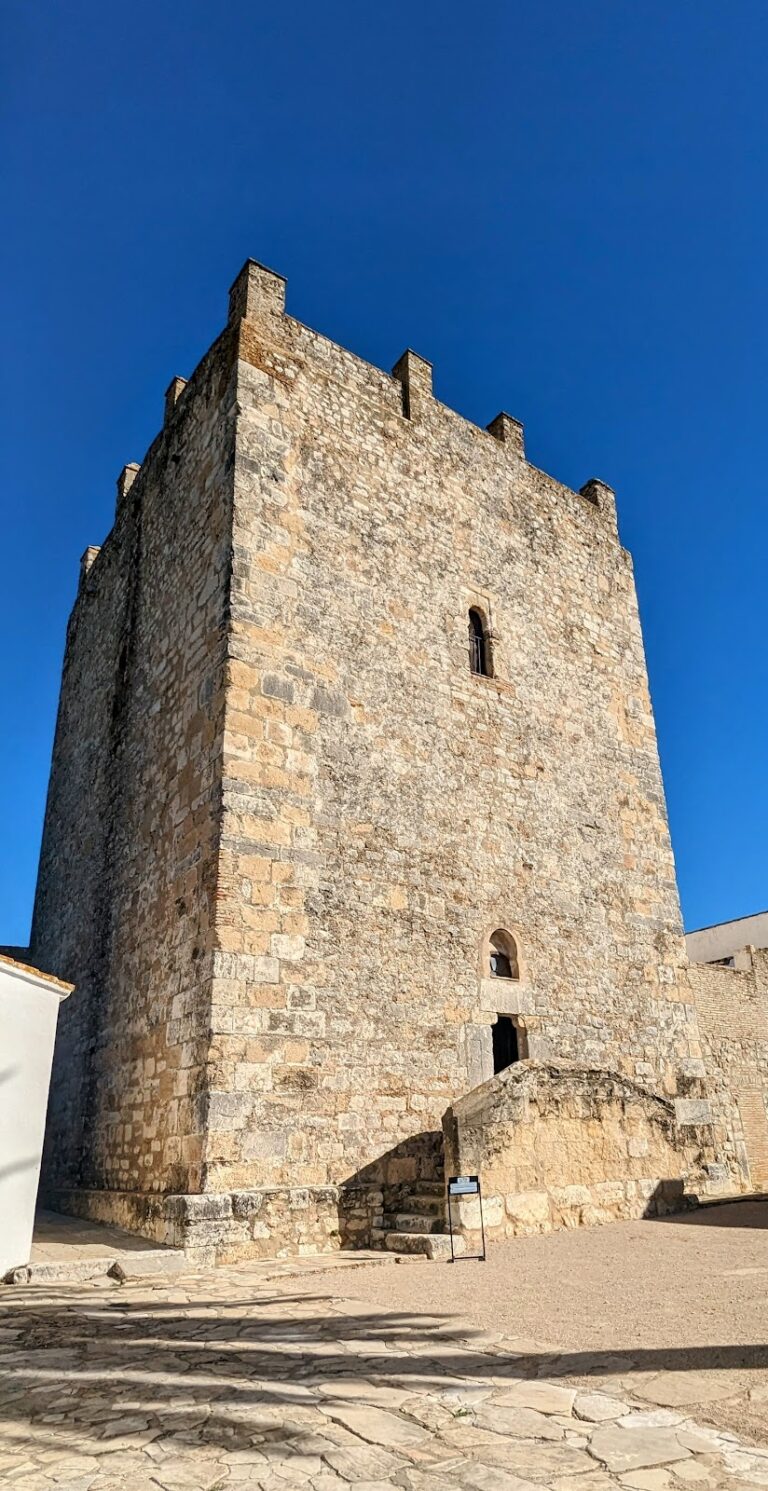
The church joins the tower at an angle, and the tower serves as its sacristy. Its lower body is built from regularly cut ashlar blocks using a Roman-style technique. The taller upper body uses smaller blocks and ends in Moorish-style crenellations. The lower construction has been interpreted as the remains of a watchtower associated with a large Roman rural estate, while the tower as a whole is commonly dated to the tenth century. These interpretations preserve the building’s connection with earlier structures without resolving whether the tower, a possible villa, and a possible Visigothic building formed part of one complex.
Reused columns and capitals
The enclosure contains a long series of column shafts and several Corinthian capitals, whose foliage derives from the acanthus plant. The variety of these pieces has been interpreted as material from a Roman peristyle, a colonnade surrounding a court or building, reused at least a second and possibly a third time. One capital belongs to the Late Antique or Late Roman Corinthian tradition. Other reused or difficult-to-date elements include a groove carrying a high-relief hexafoliate motif and an unusual stone cross that crowns the present well enclosure. The cross has no clear parallel in Late Antiquity or the medieval Iberian Peninsula.
Inscriptions and the 630 dedication
Access to the sacristy passes through a lowered arch bearing the inscription “LEPERORE · VOMII SED SACR.” A later reading understands the text as a statement that Lepero rebuilt the sanctuary’s small altars. Earlier interpretation treated the name as that of a patrician who had donated a villa, but the rereading gives the inscription a different meaning.
A second inscription, or a fragment resembling the first, was formerly recorded on the tower doorway. It was reportedly carved on black jasper before the surface was smoothed with the surrounding wall. Confused traces, possibly beginning with “LEP,” remain visible on the stone threshold. The reused Roman pedestal bearing the 630 dedication lists relics attributed to Stephen, Julian, Felix, Justus, Pastor, Fructuosus, Augurus, Eulogius, Acisclus, Romanus, Martin, Quiricus, and Zoilus. The claim that these relics were housed in the chapel remains unresolved.
Altars and surviving images
The main altar venerates an image of the Virgin of Loreto, brought from Italy by the hermit Juan de Viera in 1666. Other altars are dedicated to images of Saint Isidore the Laborer, Saint Anne, Saint Anthony the Abbot, and a Pietà. The recovered Saint Anne is a polychrome wooden sculpture from the seventeenth or early eighteenth century. Before its theft and recovery, it stood in a niche or small chapel in the left nave. A Sacred Heart of Jesus figure and an entrance bell approximately four meters high also belonged to the chapel; the bell weighed 80 kilograms before it was stolen in 2019.