Castillo de Gigonza: A Medieval Andalusian Fortress in Spain


Site at a Glance
- Rating
- 4.4
- Popularity
- Very Low
- Country
- Spain
- Primary era
- Medieval
- External website
- Open
- Eras represented
- Medieval
- Civilizations
- Unclassified
- Site type
- Military
- Remains
- Castle
On this page9 sections
History
Castillo de Gigonza is a medieval Andalusian fortress in Spain near San José del Valle, built on a site fortified since antiquity. Its present form belongs to the medieval period, while the wider settlement grew beside a cold sulfurous-acid spring whose waters were regarded as beneficial for bodily ailments.
Saguntia in antiquity
As settled communities developed around the spring and its baths, a Turdetanian city called Saguntia grew there. The Turdetanians were a pre-Roman people of the lower Guadalquivir region, and the name Saguntia means “strong.” This ancient settlement should not be confused with Sagunto in present-day Valencia Province.
During Roman expansion, Saguntia became the scene of the final offensive associated with Cato, a Roman consul and military commander, and Publius Manlius, a praetor who also served as a senior provincial commander. Their campaign was directed against Turdetanian and Celtiberian tribes in the Guadalquivir Valley. Saguntia later supported Viriathus, the Lusitanian leader who resisted Roman expansion in Hispania, and was consequently reduced to the status of a stipendiary city, a community subject to Rome and required to pay tribute or fulfil other obligations.
After the Balbo brothers arrived in Gades, the ancient city corresponding to Cádiz, the inhabitants of Saguntia took part in constructing the aqueduct that carried water from Tempul to Gades.
Visigothic, Byzantine, and Muslim rule
Under Visigothic rule, Saguntia became part of the Asidonense bishopric, the Christian diocese associated with Asido, the ancient settlement identified with Medina Sidonia. Byzantine forces, representing the eastern Roman Empire, took control of the area in 555. Their rule ended in 609, when the Visigothic king Suintila expelled them. Saguntia continued minting coins and had episcopal representation at the Third Council of Toledo in 589, the major church council associated with the Visigothic kingdom’s formal adherence to Nicene Christianity.
Under Muslim rule, Saguntia became known as Xisgonza. From 1248 to 1492, the settlement stood within the frontier zone bordering the Kingdom of Granada. It served as a refuge during raids launched by both sides. The urban settlement later disappeared, but the castle remained standing.
Castle, lordship, and frontier warfare
The Battle of Gigonza took place near the castle in 1371. It ended in a victory for knights from Jerez over Granadan and African forces, placing the fortress within the military history of the frontier between Castile and Granada.
In 1312, the castle belonged to Don Alonso de Guzmán, identified as the successor of Guzmán el Bueno, the medieval Castilian nobleman remembered as a military commander. After Alonso de Guzmán died in 1351, the property passed to the Council of Jerez. In 1477 it belonged to Alonso Enríquez, Admiral of Castile, a senior naval and court office. In 1492, it entered the estate of Rodrigo Ponce de León, Duke of Arcos, a high-ranking hereditary Spanish title, by then in a depopulated area.
The spa and modern ownership
By the end of the nineteenth century, Gigonza had become a prestigious spa founded by Francisco Ponce de León, Marquis of the Valley of Sidueña. After his death, the castle and baths passed to his son Diego Ponce de León Carrizosa, who died during a civil war. The spa then ceased operating in that capacity.
In 1945, the marquise sold the property to Salvador Pineda Lobato, known as “el Rondino.” His heirs are the current owners. Restoration work carried out in 2009 included the castle tower, chapel, adjoining houses, and courtyards. The Socialist Workers’ Party of San José del Valle denounced the work as illegal and unlicensed and also alleged undeclared labor. Castillo de Gigonza was declared a Spanish Asset of Cultural Interest in 1993, and the castle hosts cultural activities.
Remains
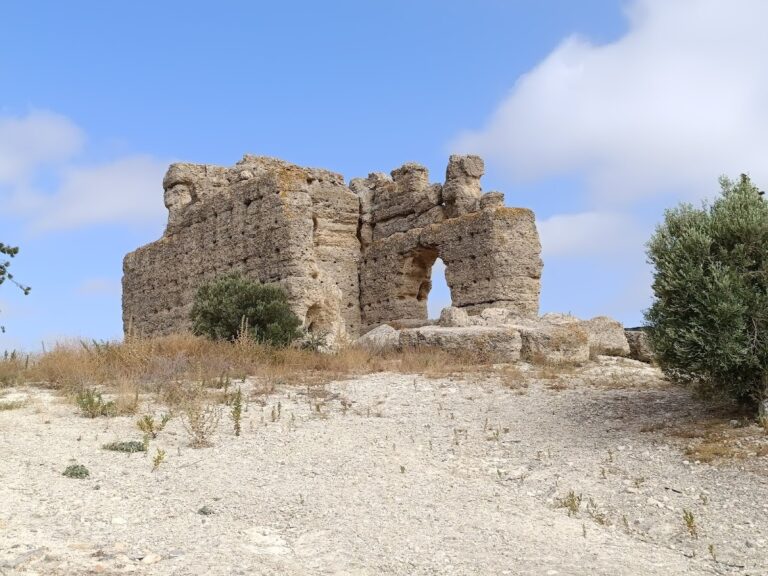
The present fortress has an almost square plan divided into two structural parts. It stands on the road between Medina Sidonia and Arcos de la Frontera, approximately 12 kilometres from Paterna de Rivera. A perimeter wall encloses the complex, while the nearby cold sulfurous-acid spring and the baths that developed around it remain part of the site’s physical and historical setting.
Fortress layout
Entrance and upper floor
The entrance is narrow and low, with a lintel supported by two substantial imposts. An impost is the projecting member from which an arch begins. Above the entrance is a horseshoe-arch window. The upper floor contains a sail vault, a domical vault formed from a curved surface over a square space, together with windows.
Enclosure and courtyard
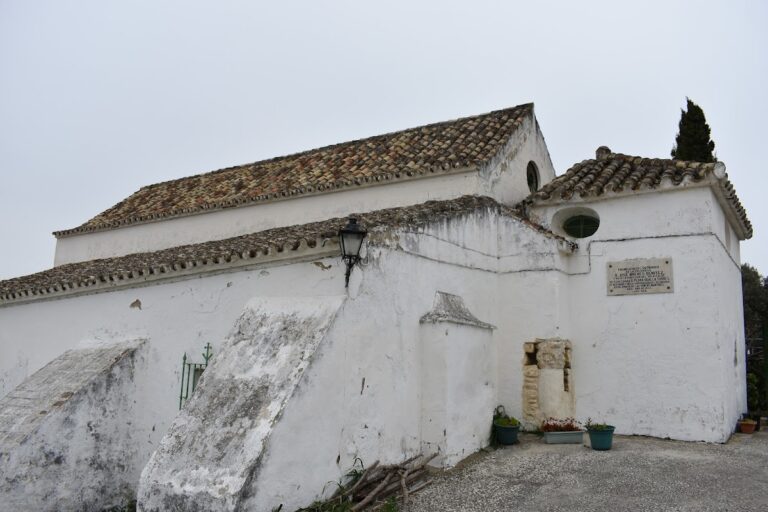
Within the perimeter wall lies an arms courtyard. Its gateway has a semicircular arch bearing the coat of arms of the House of Arcos, the noble lineage associated with the Duke of Arcos. The courtyard, adjoining houses, chapel, tower, and surrounding enclosure formed the principal elements addressed by the restoration work undertaken in 2009.
Nearby sites