Basilika St. Margareta: A Roman Catholic Collegiate Church in Düsseldorf


Site at a Glance
- Rating
- 4.6
- Popularity
- Low
- Country
- Germany
- Primary era
- Medieval
- External website
- Open
- Eras represented
- Medieval
- Civilizations
- Holy Roman Empire
- Site type
- Religious
- Remains
- Basilica
On this page12 sections
History
Basilika St. Margareta is a Roman Catholic parish church in Düsseldorf, Germany, built as a collegiate church in the Rhenish transitional style between late Romanesque and early Gothic architecture from 1220 to 1230. The church stands on the site of a ninth-century predecessor and developed from the convent of Gerresheim, one of the oldest communities of canonesses in the Archdiocese of Cologne.
Foundation and Early Destruction
The institution was originally dedicated to Saint Hippolytus, an early Christian martyr and theologian whose relics formed its first religious focus. It was mentioned in connection with the Cologne Synod in 870 and appears in a charter from 905 or 906. The Frankish nobleman Gerrich is regarded as its founder, and his daughter Regenbierg, who lived from 870 to 905, became its first abbess. His name is also associated with Gerresheim, while the convent itself was regarded after Kaiserswerth as the second-oldest ecclesiastical institution in the Rhineland.
Hungarian invaders destroyed the convent in 919. The canonesses fled to St. Ursula in Cologne and took Saint Hippolytus’s valuable relics with them. Reconstruction was completed in 970, when Gero, Archbishop of Cologne, consecrated the rebuilt church. His predecessor, Wichfrid, had provided substantial financial support for the rebuilding.
Medieval Expansion
After the beginning of the second millennium, Gerresheim entered another period of prosperity. This was partly connected with a temporary relationship with the neighboring convent of Essen. The Essen abbess Theophanu, a granddaughter of Emperor Otto II who died in 1058, governed Gerresheim at the same time.
The present church was erected between 1220 and 1230 during the abbacy of Guda, who led the convent from 1212 to 1232, and was probably consecrated in 1236. It continued the dedication to Saint Hippolytus under the name Monasterium Santi Hippolyti. During the thirteenth and fourteenth centuries, the convent acquired extensive possessions and income throughout the Rhineland. Only women from the high nobility were admitted as canonesses, and revenue from the convent’s landholdings supported the community until the beginning of the nineteenth century.
Religious Change and Parish Use
A fire destroyed Gerresheim in 1568. The church also became associated with the annual Blood Procession, held since 1598 in veneration of a relic believed to contain earth from Golgotha mixed with Christ’s blood. Arnold von Eller had donated the relic in 1319.
The collegiate church was initially reserved for the canonesses. From the eighteenth century it also served as a parish church, and parish services were held there from 1790. Parishioners had previously worshiped in a small Church of Saint Margaret to the south, where the bones of the blessed Gerrich were kept. The collegiate church was transferred finally to the parish in 1810, and the older parish church was demolished in 1892.
The convent was abolished during secularization, the transfer of church property to secular authorities, by Elector Maximilian IV Joseph on 12 September 1803. Many of the church’s treasures were lost during this process. On 14 September 1982, Pope John Paul II granted the church the title of basilica minor, an honorary papal designation for a church of particular historical, religious, or pastoral importance. Since 1 January 2011, the parish has also included the former parish of St. Cecilia and its branch church of St. Victor, together with the former parishes of St. Catherine, St. Mary Queen of Peace, St. Reinold, and St. Ursula in eastern Düsseldorf.
Restoration and Continuing Worship
Heinrich Wiethase restored the church in 1873, followed by work under Heinrich Renard in 1894. Further restoration and structural measures took place in 1932 and 1950. Since 1975, continuing work has helped secure the building against unstable ground. Measures between 1974 and 1985 added plaster and paint to the exterior walls, probably reflecting their original coloring.
Remains
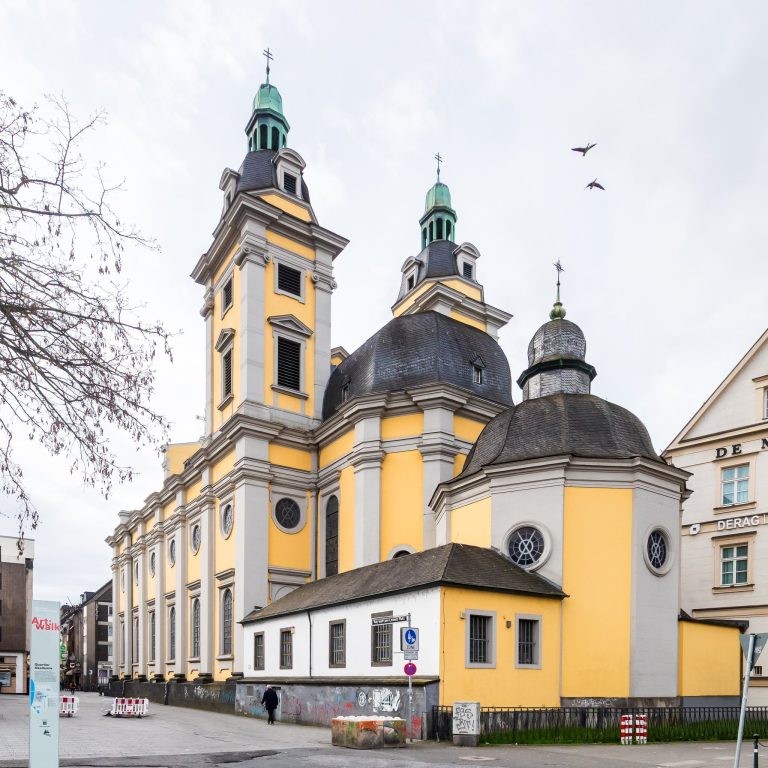
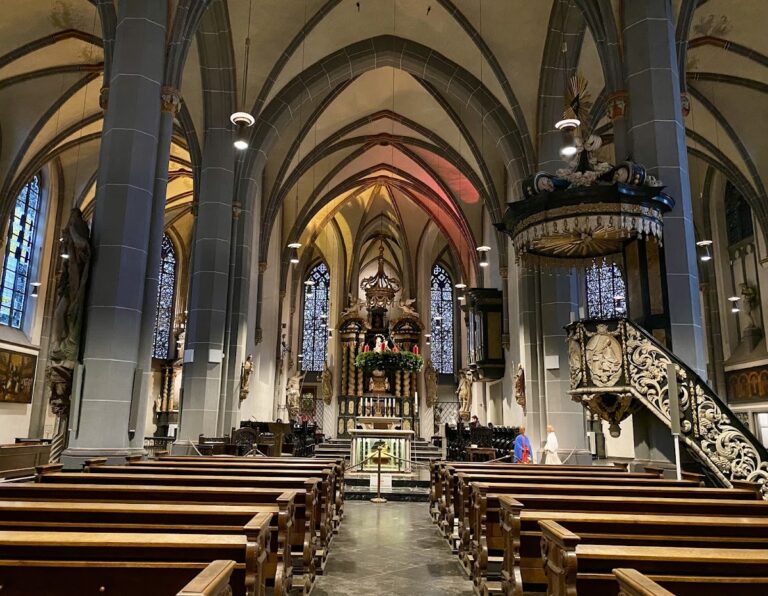
The basilica is a three-aisled pillar church with a transept, ribbed vaults, and a raised central nave flanked by lower side aisles. Its crossing is crowned by a two-story octagonal tower with a pointed folded roof. The exterior has a regular and unified appearance, while the interior combines richly varied forms and colors with the lighter structural treatment associated with early Gothic architecture. The plan brings together a cross-shaped basilica and a centralized building. Half-rosettes and cross-shaped windows give the church an unusual character, described as exceptionally rare in the Rhineland and comparable there only to the windows of St. Peter in Sinzig. Both churches lack a crypt.
Medieval Fabric and Tomb
Part of the thirteenth-century convent cloister survives as a remnant of the community that surrounded the collegiate church. The Gerricus Sarcophagus is a high-Gothic raised tomb, or tumba, carved from one block of trachyte. Made around 1270 to 1280, probably in a Cologne workshop, it has sides decorated with pointed-arch blind arcades, crockets, and small battlement turrets.
Apse Painting and Crucifix
The apse paintings date from the period when the present church was built. At the center of the vault, the Trinity appears as the Throne of Mercy, with God the Father holding the crucified Christ and a dove representing the Holy Spirit between them. The composition is framed by the four Evangelists. The Gerresheim image is regarded as the earliest example of this form in German monumental painting.
An oversized oak crucifix hangs above the altar. Probably made around 960, it measures 2.10 by 1.80 meters and retains traces of its original paint. Its corpus has a relatively small body and softly modeled facial features. The work came from the predecessor church and was probably donated by the Archbishop of Cologne. It is regarded as one of the oldest surviving high crosses north of the Alps, alongside the Gero Cross in Cologne, and possibly as the oldest surviving monumental sculpture in Germany.
Altar, Madonna, and Reliquary
The high altar predates 1236 and survives in its three-part lower structure of trachyte. Columns and trefoil panels decorate this surviving portion, while the altar slab is made of bluestone. Beside a crossing pillar at the entrance to the choir stands a late-Gothic Madonna with a halo. Created at the end of the fifteenth century, the sculpture is mounted on a 2.13-meter-high wrought-iron candelabrum and probably came from the workshop of Kersten Woyers of Venlo, who lived approximately from 1470 to 1531.
The Hippolytus shrine, made in 1871 by the Cologne artists Heinrich and Johann Bong, is a gilded Neo-Gothic reliquary containing the saint’s relics. Figures of the Apostles, the Madonna and Child, and Saint Hippolytus decorate it. The relics had remained at St. Ursula in Cologne after the attack of 919 and returned to the basilica in 1953.
Treasury
The treasury has occupied the former baptistery since 2013. Its holdings include the Gerresheim Gospels, an extensively illuminated Ottonian manuscript from the Cologne school of book illumination dating from 1020 to 1040. Other objects include a Limoges enamel reliquary from around 1210, a Cologne tower monstrance from around 1400, busts of a young couple from the early sixteenth century, a Holy Blood reliquary from around 1410 to 1420, a Baroque ciborium dated 1670, a silver altar cross from 1841, and chalices dated 1868 and 1880.
Organ and Bells
The Austrian firm Rieger of Schwarzach in Vorarlberg installed the basilica’s organ in 1982. It has mechanical action, 40 stops, three manuals, and a pedal. All its windchests are slider chests, and digital equipment permits complete organ works to be stored. Six bronze bells hang in the tower. The oldest is the Marian Bell, cast in Cologne in 1717 by Gottfried Dinckelmayer. Two others date from 1828, and the remaining three were cast during the twentieth century. Together, the bells follow the melody of the medieval Latin hymn Veni Creator Spiritus.
Stained Glass and Memorials
Hermann Gottfried created the basilica’s stained-glass windows between 1959 and 1964. Their subjects include the Last Supper, the Apocalypse of Saint John, and the Mass. The windows also depict Christ in suffering, Saints Margaret, Catherine, Hippolytus, Gertrude, Cecilia, Henry, Sebastian, and Boniface, as well as the Archangels and the blessed Gerrich. Numerous epitaphs, commemorative monuments to the dead, are also preserved in the church.