Sant’Onofrio: A Roman Catholic Church and Holy Sepulchre Order Mother Church in Rome


Site at a Glance
- Rating
- 4.5
- Popularity
- Low
- Country
- Italy
- Primary era
- Medieval
- External website
- Open
- Eras represented
- Medieval, Early Modern
- Civilizations
- Papal States
- Site type
- Religious
- Remains
- Monastery
On this page18 sections
History
Sant’Onofrio is a Roman Catholic church in Rome, Italy, dedicated to Saint Onuphrius, a fourth- or fifth-century Egyptian hermit, and developed in the Renaissance from a hermitage founded on the Janiculum. It is both a titular church, assigned to a cardinal as the symbolic center of his ecclesiastical title, and a rectoral church administered within the parish of Saint Dorothy.
Foundation and Renaissance development
Blessed Nicola da Forca Palena established a hermitage on the Janiculum in 1419 after acquiring the land through alms. Pope Eugene IV approved the foundation in a bull dated 4 October 1437. In 1439, the hermitage was entrusted to the Congregation of the Poor Hermits of Saint Jerome, and construction of the present church began. The initial building work was completed in 1446, while finishing and decoration continued into the sixteenth century.
The approach to the isolated hermitage was gradually improved. The Salita di Sant’Onofrio was constructed in 1446. In 1588, Pope Sixtus V laid out a road from Porta Santo Spirito, and it was paved during the pontificate of Clement VIII around 1600. Inscriptions within the complex commemorate both the road’s construction and its paving.
Nicola da Forca Palena was buried beneath the church floor after his death. His remains were ceremonially transferred to the high altar in 1712, and he was beatified in 1771. The church became a cardinalatial deaconry on 6 July 1517 and was elevated to a cardinal-priest title on 13 April 1587. Its Latin title is Titulus Sancti Honuphrii in Ianicullo, held since 2023 by Pierbattista Pizzaballa.
Tasso and the convent
Torquato Tasso, the Italian Renaissance poet known especially for Gerusalemme Liberata, spent the final years of his life in the convent. He died there on 25 April 1595, before the planned ceremony to crown him as a poet on the Capitoline Hill. His connection with Sant’Onofrio later drew artists and writers to the complex.
The convent museum devoted to Tasso was established by the Governorate of Rome and transferred to the ownership of the Holy See in 1930. It preserves manuscripts, editions of his works, and his death mask. In 1849 Giuseppe Garibaldi saved the smallest of the church’s three bells, traditionally called Tasso’s bell. A fountain was installed in 1924 for the anniversary of Tasso’s death and rebuilt in 1930, when its original antique components were replaced with copies.
Tradition connects Tasso with the oak now known as the Tasso Oak, which stands a short distance from the convent on the opposite side of the Janiculum promenade. The promenade was laid out between 1865 and 1868. Saint Philip Neri later used the spot for walks, and his congregation adapted it as an outdoor theatre for religious entertainments. The oak is now dry but has been preserved as a monumentalized feature.
Changes in ownership and religious administration
The church and convent originally belonged to the Congregation of the Poor Hermits of Saint Jerome, a community of the Hieronymite tradition. In 1873, the Kingdom of Italy took over the convent and converted it into the Bambino Gesu children’s hospital, while a small number of religious retained the church. The Lateran Treaties returned the convent to the Holy See in 1929. Pope Pius XI dissolved the congregation in 1933.
On 15 August 1945, Pope Pius XII assigned Sant’Onofrio and its convent to the Equestrian Order of the Holy Sepulchre of Jerusalem, a papal order of knighthood connected with the Christian Holy Sepulchre in Jerusalem. The complex became the order’s official mother church and the principal seat of its administrative authorities. It is an extraterritorial possession of the Vatican and forms part of the UNESCO World Heritage properties of the Holy See in Rome.
Since 1946, the Franciscan Friars of the Atonement have cared for the church and convent. This Catholic Franciscan congregation, devoted particularly to Christian reconciliation and unity, established its general procuration, the office handling its relations with the Holy See, in the convent in 1952. A major restoration of the complex took place in 1946 and 1947 under the Equestrian Order of the Holy Sepulchre of Jerusalem.
Remains
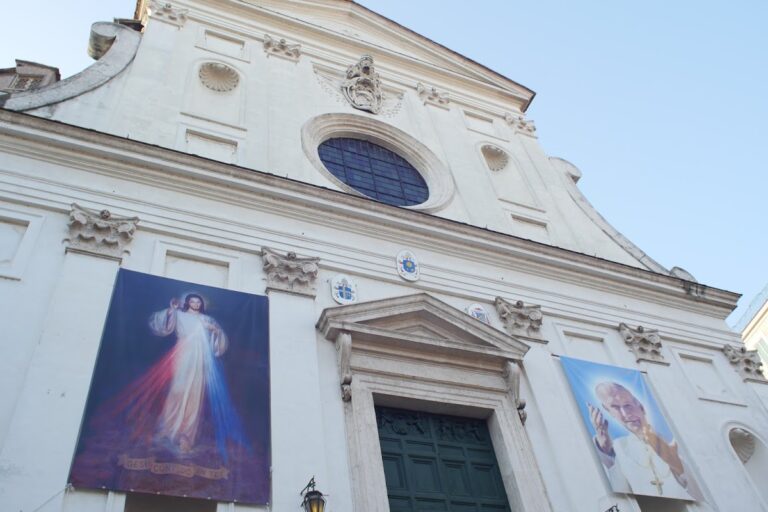
The complex combines a Renaissance church and convent around a grassy forecourt. An L-shaped external portico encloses two sides of the forecourt. Its short arm has four arches, two of which were blocked to create a chapel, while its longer arm has nine arches and leads toward the convent. The portico lunettes contain scenes from the life of Saint Jerome painted by Domenichino in 1605. Above the principal church portal is a lunette, a semicircular wall surface used for decoration, with Claudio Ridolfi’s Madonna and Child, painted in 1600.
The church and chapels
Main church and apse
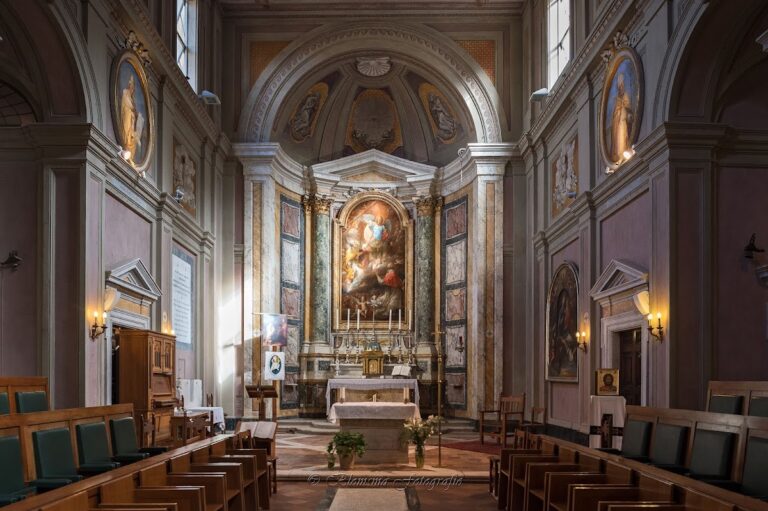
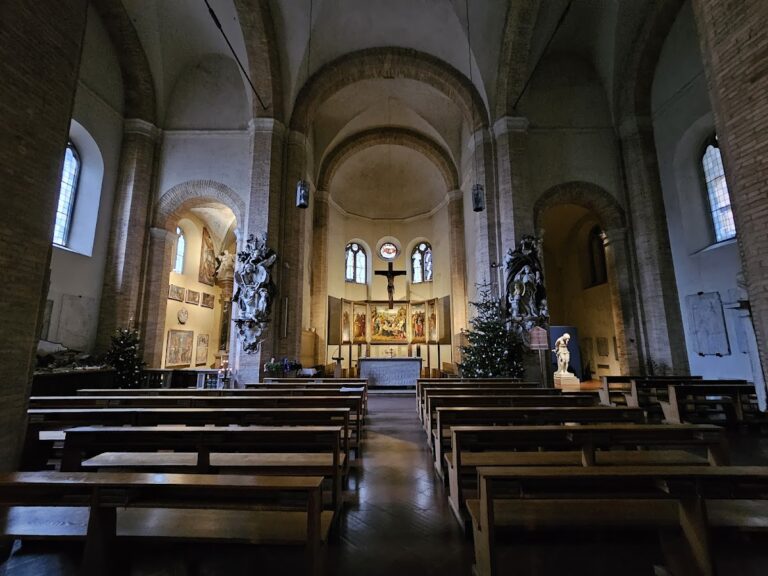
The church has a single nave covered by a cross vault, five lateral chapels, and a polygonal apse. The apse preserves a fresco cycle devoted to the life of Mary. Its scenes include the Adoration of the Magi, the Flight into Egypt, a sacred conversation with a donor, Pentecost, the Dormition, the Assumption, and the Coronation of the Virgin. The cycle is associated with Bernardino Pinturicchio and Baldassare Peruzzi. Pinturicchio and his workshop carried out much of the upper section, Peruzzi was chiefly responsible for the lower section, and artists of the Lombard school also contributed.
Near the high altar stands a high-relief sarcophagus containing the remains of Giovanni Sacco, Bishop of Ragusa in Dalmatia. The work is attributed to the school of Andrea Bregno and is accompanied by frescoes of Saint Anne Teaching the Virgin to Read by a painter of the Umbrian school. A lunette fresco of the Madonna and Child with a Donor by Cesare da Sesto, once attributed to Leonardo and later to Giovanni Antonio Boltraffio, is now held in the Tasso Museum.
Chapel of Saint Onuphrius
The Chapel of Saint Onuphrius contains Antoniazzo Romano’s fresco of the Annunciation on its vault. The chapel forms part of the church’s group of side spaces dedicated to saints and devotional subjects.
Chapel of Our Lady of Loreto
The Chapel of Our Lady of Loreto was designed in 1605. Giovanni Battista Ricci painted its frescoes, and its altar contains a Madonna of Loreto attributed to Annibale Carracci and his pupils, although another attribution identifies Agostino Carracci. The vault bears a Coronation of the Virgin by a painter from the Carracci school.
Chapel of Saint Jerome
The Chapel of Saint Jerome has two domes and an altar painting of Saint Jerome by Filippo Balbi. Tasso’s tomb is near the entrance. Cardinal Bonifacio Bevilacqua commissioned its funerary plaque in 1608, and Giuseppe De Fabris created the poet’s funerary monument in 1857.
Chapel of Saint Pius X
The Chapel of Saint Pius X contains Francesco Trevisani’s fresco of the Holy Trinity on its vault and the burial of Cardinal Nicola Canali.
Chapels of the Crucifix and Cardinal Filippo Sega
The Chapel of the Crucifix contains the burials of Cardinals Filippo Sega and Giuseppe Gasparo Mezzofanti. Another chapel contains Cardinal Filippo Sega’s funerary monument, including a portrait attributed to Domenichino.
Portico and devotional features
Chapel of the Madonna of the Rosary
Opposite the church, the Chapel of the Madonna of the Rosary stands within the forecourt. Guido Vaini erected it at the beginning of the seventeenth century for himself, his wife Lucrezia Magalotti, and their twelve children and descendants. Its facade received a Baroque form in 1620. The external portico contains Francesco Bassano the Younger’s Nativity in the chapel, together with frescoes of Sibyls attributed either to Giovanni Baglione or Agostino Tassi.
Funerary monuments and inscriptions
A tomb slab of Nicola da Forca Palena is preserved in the external portico near the church entrance. Attributed to an anonymous Tuscan artist, it shows the influence of Donatello. Heraldic emblems of families who protected the church are nearby. The passage leading to the cloister contains Alessandro Guidi’s tomb and Giuseppe Rondinini’s funerary monument, while a monument to Lorenzo Vitturi is positioned above an entrance door.
The church also contains tombs or funerary monuments associated with Franciscus Patricius, Bernardo Guglielmi, Luigi Frezza, and Cardinal Lorenzo Vitturi, as well as the monuments already connected with Nicola da Forca Palena, Torquato Tasso, Giovanni Sacco, Giuseppe Rondinini, Filippo Sega, Giuseppe Gasparo Mezzofanti, and Cardinal Nicola Canali. The sacristy ceiling has frescoes by Girolamo Pesci, and its walls contain a Saint Peter of Pisa by Francesco Trevisani.
Convent cloister and museum
Renaissance cloister
The convent’s small Renaissance cloister probably represents the oldest part of the complex. It dates from the foundation period in the mid-fifteenth century and has a porticoed gallery on its upper level. Its arcades incorporate several kinds of granite and marble, including a red-granite column from Aswan in Egypt and two white-marble columns from the Greek island of Thasos. Ancient columns are surmounted by fifteenth-century capitals.
The cloister lunettes were frescoed for the Jubilee of 1600 with scenes from the life and legend of Saint Onuphrius. Giuseppe Cesari, known as the Cavalier d’Arpino, and his school carried out the cycle, with contributions from Vespasiano Strada and Claudio Ridolfi.
Tasso Museum
The Tasso Museum preserves several manuscripts by the poet, a collection of editions of his works, and his death mask. Its holdings form part of the convent’s material association with the poet, whose tomb and funerary monument remain within the church.
Nearby sites