Église Saint-Leu-Saint-Gilles de Paris: A Gothic Parish Church


Site at a Glance
- Rating
- 4.5
- Popularity
- Low
- Country
- France
- Primary era
- Medieval
- External website
- Open
- Eras represented
- Medieval, Early Modern, Modern
- Civilizations
- French
- Site type
- Religious
- Remains
- Church
On this page15 sections
History
Église Saint-Leu-Saint-Gilles de Paris is a Roman Catholic parish church in Paris, France, built and enlarged through medieval and later Gothic phases. It stands on Rue Saint-Denis in the city’s 1st arrondissement and belongs to the Archdiocese of Paris. Its history began on a feudal domain owned by the Monastery of Saint-Magloire, where the monks established a chapel for the inhabitants of their estate.
From monastic chapel to parish church
The Saint-Magloire community, then based on the Île de la Cité, restored the chapel in 1118. In 1138, the monks transferred their community to the domain along Rue Saint-Denis, between Rue Aubry-le-Boucher and Rue Greneta. The chapel initially functioned as an annex of the former Church of Saint-Barthélemy on the Île de la Cité and served the population living within the monastic estate.
A larger church was built outside the monastery enclosure in 1235, after the nearby Champeaux market contributed to population growth. The building was reconstructed on a larger scale around 1319 and 1320. Its original dedication was to Saint Gilles, a sixth-century hermit and abbot associated with Saint-Gilles in southern France. The church later also took the name of Saint Lupus, or Saint Leu, a seventh-century bishop of Sens.
Parish independence and rebuilding
The church became an independent parish in 1617, having previously remained attached to Saint-Barthélemy. Major rebuilding or modification followed in 1611, 1727, and 1780. The present choir belongs to the 1611 campaign, while the Gothic character of the nave vaulting was renewed in 1727. In 1780, the architect Charles de Wailly created a large crypt beneath the choir for the Knights of the Order of the Holy Sepulchre of Jerusalem, a Catholic chivalric order associated with the protection and commemoration of Christian holy places in Jerusalem and the Holy Land.
The Knights established their headquarters or chapter association at the church in 1780. They departed in 1830 but returned ceremonially on 16 October 1928, when Cardinal Louis-Ernest Dubois, Archbishop of Paris, celebrated their “Reintegration.” The church later became the chapter church of the order’s French lieutenancy, which continues to use the former baptismal chapel for ceremonies.
Revolution, urban alteration, and restoration
During the French Revolution, the church was seriously damaged and converted into a food storehouse. It returned to religious worship in 1802. The Knights had transferred the relics of Saint Helena from the Abbey of Saint-Pierre d’Hautvillers to the church in 1819. Saint Helena, the mother of the emperor Constantine, is traditionally associated with the discovery of relics of the True Cross in Jerusalem.
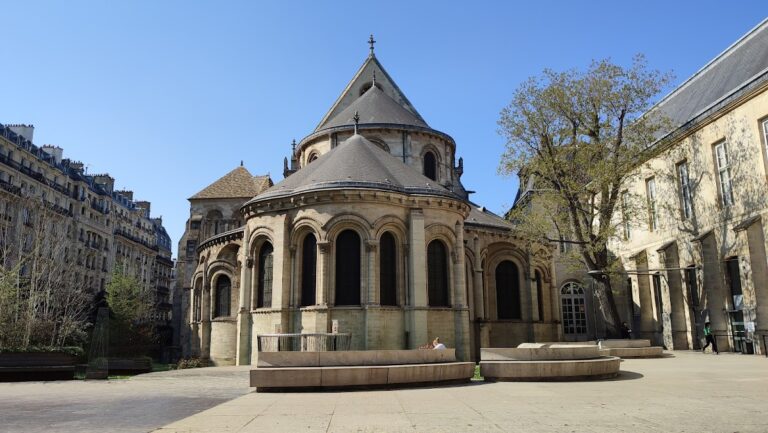
Urban works connected with the construction of Boulevard de Sébastopol and the extension of Rue du Cygne in 1857 and 1858 altered the eastern end of the church. Three apsidal chapels and parts of the eastern structure were demolished or substantially reduced. Étienne-Hippolyte Godde began the resulting work, and Victor Baltard continued it. Houses along the south side of the nave were removed, allowing the presbytery and ancillary buildings to be constructed there.
The church was damaged and closed again during the Paris Commune, the revolutionary municipal government and uprising in Paris in 1871. Restoration followed, including repairs to the stained glass between 1875 and 1881. In 1875, the reliquary of Saint Helena was opened for anatomical examination. Archbishop Richard de La Vergne concluded that it contained almost the entire trunk of the saint’s body, without the head, with the limbs compressed and flattened. The reliquary was then placed above and behind the high altar, at the foot of the large crucifix.
Recent religious use and protection
On 17 March 2000, the relics of Saint Helena were moved to the crypt of the Knights of the Holy Sepulchre, where they could be venerated more readily. The first Eastern Orthodox liturgy before the relics took place on 22 February 2003, and a community under Saint Helena’s patronage was subsequently founded.
The parish is entrusted to the Trinitarian Order and gives particular attention to homeless people in the Les Halles district, alongside its regular religious activities and spiritual sessions. The church has been protected as a French historic monument since 20 May 1915, and its principal organ is also protected as a historic object. Its construction history is commonly summarized as beginning in 1235 and reaching its final major works in 1780.
Remains
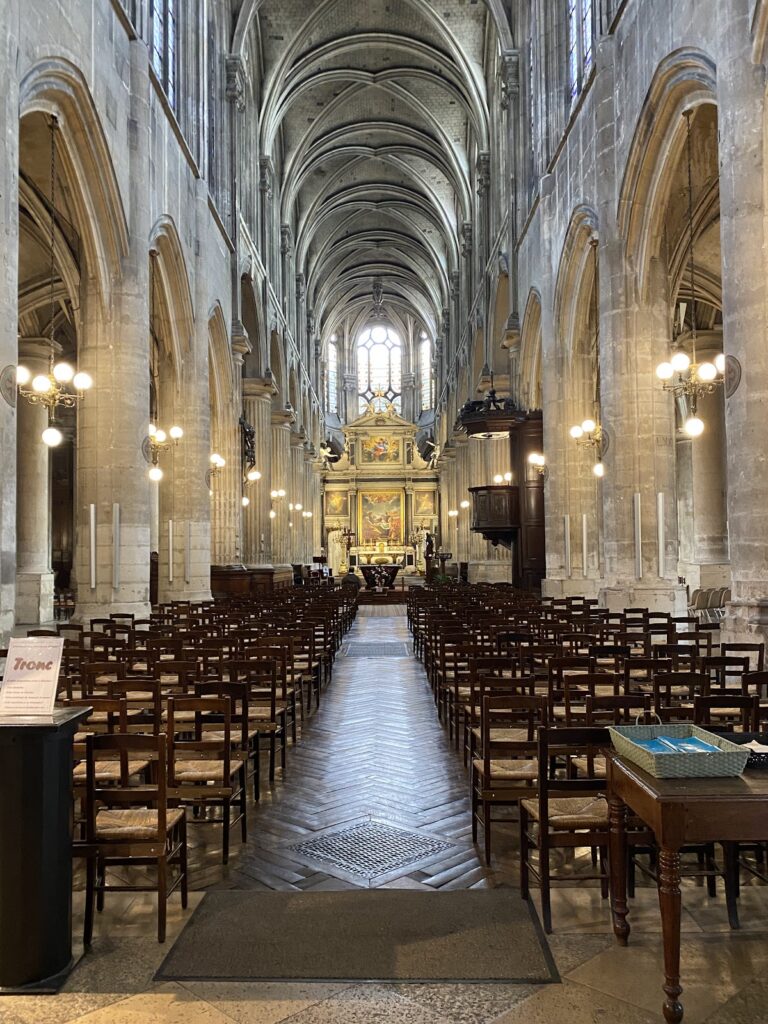
Église Saint-Leu-Saint-Gilles is a Gothic building whose west façade is framed by two tall, pointed towers or tourelles. Narrow surrounding streets make the exterior difficult to view in full. Inside, a single nave and two aisles form three longitudinal spaces divided by pointed arches. There is no transept. The aisles and chapels were added during the sixteenth century, probably replacing earlier external buttresses.
Nave and chapels
The nave is covered by four-part Gothic rib vaults. Intersecting stone ribs support the vault surfaces and carry their weight downward and outward through rows of columns. The vaulting was renewed in a Gothic manner in 1727. The chapels preserve sculpture, painting, and later ceremonial decoration associated with the church’s changing religious use.
Former baptismal chapel
The first chapel on the lower left aisle dates from the sixteenth century and was initially used for baptisms. It was later assigned exclusively to the Knights of the Holy Sepulchre for ceremonies and meetings. A cast-iron gate bears the order’s cross emblems, while nineteenth-century murals by Jean-Louis Bézard include The Baptism of Christ and The Original Sin.
Saint Anne and the Virgin
The second chapel of the south aisle contains the sixteenth-century marble group Saint Anne and the Virgin, attributed to Jean Bullant. Saint Anne is shown teaching the Virgin Mary, who appears as a smiling child holding an apple, while Saint Anne holds a book.
Saint Jerome and Christ in the tomb
A third south-aisle chapel contains Saint Jerome in Prayer, attributed to Trophime Bigot and based on the work of Georges de La Tour. The crypt also contains a recumbent figure of Christ in the tomb, probably dating from the seventeenth century.
Choir, crypt, and ambulatory
The present choir was built in 1611 above a large crypt. Its Renaissance design incorporates Gothic elements, including rib vaulting, and it is surrounded by an ambulatory, a passage running around or behind the choir. Nineteenth-century street works considerably shortened the eastern end.
Crypt of the Holy Sepulchre
Charles de Wailly created the crypt in 1780 for the Knights of the Holy Sepulchre and for the presentation of Saint Helena’s relics. The relics are now associated with the crypt and the Knights’ chapel. Sculptures on the choir pillars date from the nineteenth century and represent Saint Gilles, Augustine of Hippo, John Chrysostom, Vincent de Paul, the apostles Peter and Paul, and Charles Borromeo.
Alabaster retable
The ambulatory displays a fifteenth-century alabaster retable, an altar backdrop with sculpted panels, made in Nottingham, England. Its three small bas-reliefs depict the Last Supper, the Kiss of Judas, and the Flagellation of Christ. Tradition places the retable originally in the Cemetery of the Holy Innocents, a former major cemetery in central Paris that was closed and cleared in the late eighteenth century.
Paintings and stained glass
Paintings associated with the church include Jean Jouvenet’s God the Father and The Pilgrims of Emmaus, dated 1763 and attributed to Jean Restout the Younger. Frans Pourbus the Younger’s The Last Supper, dated 1618, is now preserved in the Louvre.
Many stained-glass windows date from about 1861 to 1869 and were made by Eugène-Stanislas Oudinot, Prosper Lafaye, and Paul Nicod. Their subjects include the Apostles, the Creation, the Tree of Jesse, the Sacred Heart, the Archangel Michael, Saint John the Baptist, the life of the Virgin, and Saint Geneviève praying for the defenders of Paris against the Huns. The choir windows represent the Evangelists, with some executed by Paul Nicod from designs by Jean-Paul Balze.
Organs
The principal organ existed before 1603, and parts of its original case remain incorporated into the present instrument. Guy Jolly enlarged it between 1637 and 1659 by adding a positive, a smaller organ division, giving the instrument three manuals and a pedalboard with 27 stops. Enocq added a fourth manual and enlarged the pedal section in 1671.
François-Henri Clicquot substantially rebuilt the organ between 1786 and 1788, producing most of the present case and an instrument with 28 stops. Louis Suret modified it in 1855 while retaining much of Clicquot’s mechanism and sound material, and Mutin carried out the next major intervention in 1911 and 1912. The principal organ now has three manuals and a pedalboard, with a positive of ten stops, a great organ of eight, an expressive swell of five, and a pedal section of two. A fire damaged it in 1974 and left it unusable; a condition survey followed in early 2011.
A choir organ was built by Louis Suret in 1855. It was modified in the early 1990s with an electro-pneumatic console and new stops.