Soleilmont Abbey: A Cistercian Monastery in Belgium

Site at a Glance
- Rating
- 4.5
- Popularity
- Very Low
- Country
- Belgium
- Primary era
- Early Modern
- External website
- Open
- Eras represented
- Early Modern
- Civilizations
- Habsburg, Spanish
- Site type
- Religious
- Remains
- Monastery
On this page12 sections
History
Soleilmont Abbey is a Cistercian community of nuns in Belgium, located in the Bois du Roy at Fleurus-Vieux-Campinaire near Charleroi. Its history reaches back to a religious house mentioned in 1185, while its incorporation into the Cistercian Order took place in 1237. The monastery stood in Gilly until a fire in 1963 led to the construction of a new house within Fleurus.
Origins and Cistercian incorporation
An unverified tradition places Soleilmont’s foundation in the late eleventh or twelfth century. It attributes the establishment to a Count of Namur for women whose husbands had joined Godfrey of Bouillon, a leading commander of the First Crusade. The first recorded reference to a religious house at Soleilmont is a charter issued in 1185.
On 11 January 1237, Baldwin, Count of Namur and Hainaut, asked the Cistercian Order to accept Soleilmont as a daughter house under Aulne Abbey. Abbots from Villers, Val-Saint-Lambert, and Grandpré inspected the community and gave favorable judgments. Soleilmont was incorporated in May 1237, and its transfer and papal protection were confirmed by Pope Gregory IX in the late 1230s. Aulne retained authority over the abbey until the eighteenth century, while nuns from Flines Abbey helped enlarge its small community.
The early endowments included 18 bonniers of land from Bastien of Heppignies and another 40 bonniers granted or sold by his son Wautier in 1237. Yolande of Hainaut donated a fishpond, mill, and meadow, with the gift confirmed by Baldwin of Courtenay, Marquis of Namur. A bonnier was a historical land measure whose area varied by locality. Although later gifts added to its property, Soleilmont remained poor compared with neighboring monasteries.
Reform, plague, and wartime disruption
During the fourteenth-century decline in monastic discipline, religious life at Soleilmont weakened. Closure was considered around 1414, but Marie de Senzeille, an abbess sent from Marche-les-Dames, restored observance so effectively that Soleilmont became an example during the monastic revival of the fifteenth century.
In 1482, plague killed all the resident nuns, and the monastery remained deserted for 21 years. Five nuns from the monastery of Le Mans then re-established the community. Later centuries brought repeated requisitions, pillage, and military occupation. Around 1580 the nuns sought refuge in Mons, and in 1583 they moved to Aulne’s refuge house at Thuin. Their agricultural holdings were pillaged in 1639, and their poverty resulted in exemption from Cistercian contributions in 1640.
Financial hardship continued through the seventeenth century. Around 1650, soldiers and marauding bands preyed on the surrounding region. During the construction of the fortress of Charleroi, French forces confiscated 30 bonniers cultivated by Soleilmont without compensation. Dom Louant, abbot of Aulne from 1728 to 1753, supported the community financially, helped build the guest quarter, and arranged for Aulne’s bakery to supply Soleilmont for more than six months.
Administration and the late eighteenth century
The abbot of Aulne supervised both the temporal and spiritual administration of Soleilmont. He visited annually, oversaw observance of the Rule, installed abbesses, and received the nuns’ vows. Among the recorded abbesses were Oda de Virsel, Magdeleine Bulteau, who resigned in 1603, Jacqueline Colnet, who served from 1603 to 1639, Isabelle Wolffs from 1694 to 1712, Josèphe Stainier from 1712 to 1730, Bernarde Levêque from 1765 to 1775, and Scholastique Daivier, who served from 1775 to 1805.
Jacqueline Colnet gave a Holy Nail relic to Archduke Albert of Austria and the Infanta Isabel of Spain. She also authorized processions of the image of Our Lady of Rome through Châtelet during plague outbreaks in 1628 and 1636. On 1 June 1776, Dom Scrippe received the solemn profession of Scholastique Daivier, the last abbess of the ancien régime, the political and social order that existed in France before the French Revolution.
In 1790, fearing revolutionary armies, Daivier moved the community and its most important religious objects first to La Ramée and then to Liège. The nuns returned to Soleilmont in 1794, shortly before the Battle of Fleurus on 26 June. The battle took place immediately beneath the abbey’s walls. The French Republic confiscated the community’s property, and the nuns were expelled in January 1797.
Philippe Drion offered his château at Farciennes, about four kilometres away, where the nuns maintained their communal life for five years. The abbey buildings were looted and burned, and the community returned to Soleilmont as tenants in 1802. Daivier died in 1805.
Reconstruction and renewed Cistercian life
With help from the Cistercian nuns of Mariënlof at Borgloon, the impoverished community repurchased Soleilmont in 1837. Under the influence of the Aumôniers du Travail, a Catholic movement supporting religious and social work among laboring communities, the nuns became Bernardines. They opened a girls’ boarding school, which continued its educational role until 1916. The period brought new vocations and the restoration or reconstruction of the buildings.
In 1916 the community decided to resume its contemplative Cistercian vocation. Soleilmont was definitively affiliated with the Trappist branch of the Cistercian Order in 1922 under the supervision of Westmalle Abbey, because Aulne was no longer functioning. Trappistines belong to the Order of Cistercians of the Strict Observance, a stricter Cistercian branch. In 1950, thirteen Soleilmont nuns helped establish the monastery of Nazareth at Brecht.
Fire and the modern community
On Christmas Eve 1963, shortly after the night office, fire spread through the monastery and severely damaged its artistic heritage and original complex. A new monastery was built a few hundred metres from the ruins and completed in 1973. The new house remains the home of an active community.
About thirty nuns were recorded at the beginning of 2009. The community operates a farm and bakery, makes liturgical vestments, and provides accommodation for women undertaking prayer and retreats. Soleilmont also has a daughter foundation at Makkiyad in Kerala, India. The image of Our Lady of Rome continues to be carried in procession through Châtelineau on the last Sunday of August, recalling the town’s reputed protection from plague in 1628 and 1636.
Remains
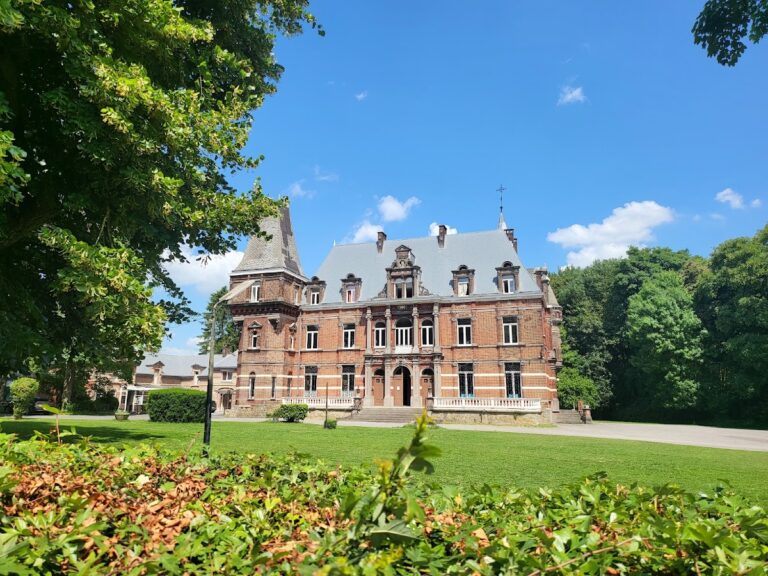
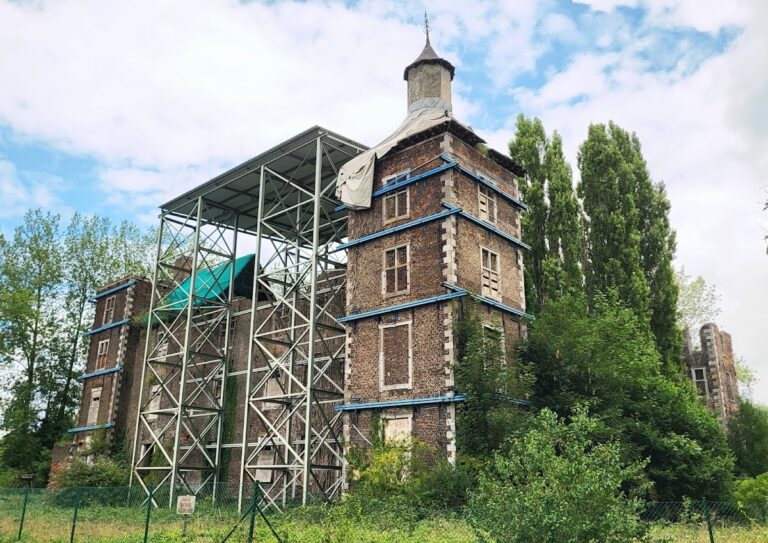
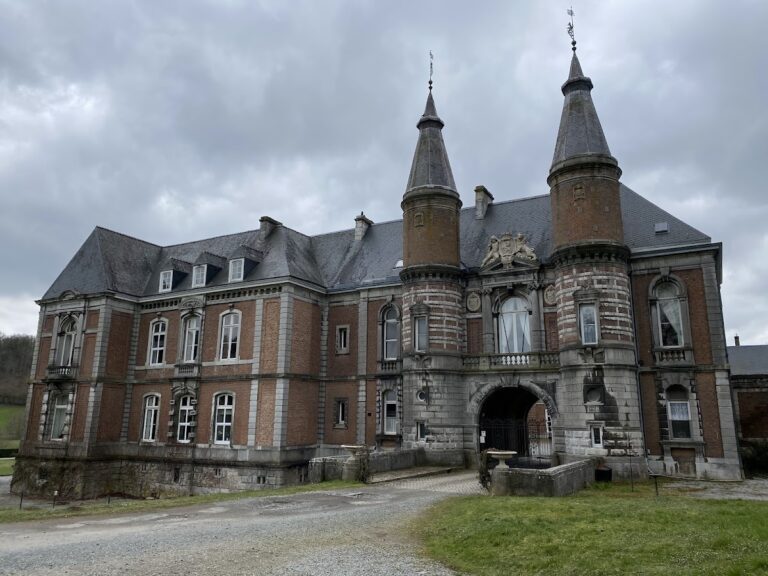
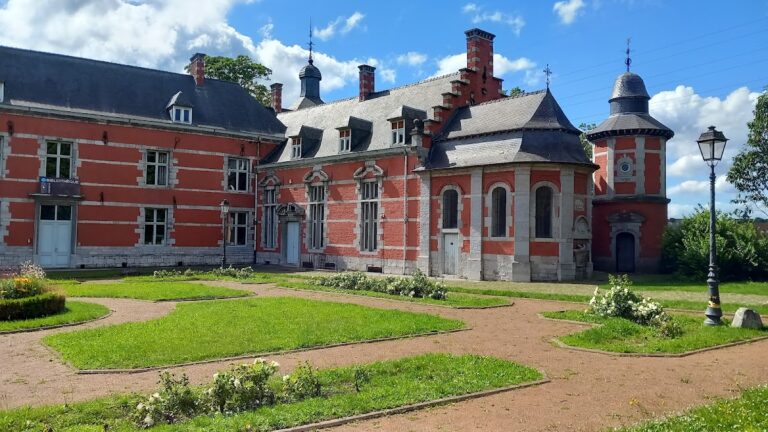
The surviving former abbey complex occupies a historical site of 89 ares and includes the remains of the abbey church, a cloister, tomb slabs, and the abbey house. Buildings from the seventeenth and eighteenth centuries stand beneath a Gothic chapel spire, while a stone boundary with a rust-colored surface encloses the complex. The former buildings have been substantially restored and are used for cultural and heritage purposes.
Former abbey buildings
Church and Our Lady of Rome chapel
The former church or sanctuary retains an exposed wooden vault and artistic features associated with the abbey’s religious life. These include choir stalls dated 1750, funerary slabs, paintings, portraits of abbesses, and sculptures of the Stations of the Cross. Identified architectural remains include the inner face of the northern wall of the former abbey church and a southern side chapel dedicated to Our Lady of Rome.
Cloister and memorials
The cloister, a covered walkway surrounding an inner court, was reconstructed between 1937 and 1939 in the Neo-Gothic style. Among the memorials is a funerary slab for Abbess Eugénie de la Halle, who died on 21 April 1694. The surviving cloister and tomb slabs form part of the restored former-abbey complex.
Abbey house and boundary
The abbey house belongs to the group of surviving former monastic buildings. Together with the church remains and cloister, it lies within the enclosed site marked by the stone boundary. The former complex is now divided among private occupants and the Charleroi circus school, while its heritage remains are associated with organized public visits.
New monastery and farm
The monastery built after the 1963 fire stands in the Bois de Soleilmont and was completed in 1973. Its design is radically modern, simple, luminous, and airy, with concrete as its identified construction material.
The former farm has a very large courtyard entered through an arched portal. The adjoining farm once formed part of an 80-bonnier property. The farm buildings are occupied by Circomedie, while the former abbey complex is used by private occupants and the Charleroi circus school. The association Ancienne Abbaye de Soleilmont promotes and operates the surviving former-abbey site.
Nearby sites