Wasserkirche: Zürich’s Late Gothic Church on the Limmat


Site at a Glance
- Rating
- 4.6
- Popularity
- Low
- Country
- Switzerland
- Primary era
- Medieval
- External website
- Open
- Eras represented
- Medieval, Modern
- Civilizations
- Holy Roman Empire, Swiss
- Site type
- Religious
- Remains
- Church
On this page13 sections
History
Wasserkirche is a late Gothic church in Zürich, Switzerland, standing on the right bank of the Limmat in the city’s Old Town. Built by Zürich’s medieval community, its present structure was constructed in the fifteenth century after a Romanesque predecessor had occupied a small river island. The church is traditionally associated with Felix and Regula, Zürich’s patron saints and Christian martyrs, whose legendary execution was said to have taken place at this site.
Ancient and Early Medieval Origins
Archaeological discoveries in the crypt indicate that a religious cult site existed on the island in antiquity. Medieval tradition relates that Felix and Regula were executed and beheaded there around AD 300 after converting to Christianity. According to the same tradition, they carried their severed heads uphill and were buried where the Grossmünster was later built.
A small Romanesque church was erected on the island around the year 1000. With the Grossmünster and Fraumünster, it formed a processional axis connected with the veneration of Felix and Regula. Its original purpose remains uncertain. The church had such a poor endowment that it could not support a permanent priest, while a longstanding interpretation identifies it as the baptistery of the Grossmünster, a place intended for the Christian rite of baptism.
Medieval Development
The church appears in written records around 1250 under the Latin name ecclesia Aquatica Turicensi, meaning the water church of Zürich. The German form wazzirkilcha followed in 1256. That year, a gift from the Counts of Kyburg and the knights of Hottingen transferred the church to the provostry of the Grossmünster.
During the thirteenth century, the Romanesque building was remodeled in the Gothic style. In 1477, Zürich’s city council decided to demolish it and replace it with a more imposing church. Hans Felder oversaw construction of the new late Gothic building, which was consecrated around 1486.
The new church became an important place of veneration because it marked the traditional execution site of Felix and Regula. A sulfurous spring discovered during construction was credited with healing powers and attracted pilgrims seeking relief from illness and other ailments. After the late Gothic church was completed, it also held banners captured by Zürich during the Swabian War and the Milanese Wars.
Reformation and Secular Use
During Zürich’s Reformation in 1524, a movement that established a Reformed religious order in the city, the church’s paintings, altars, and organ were removed. The banners were transferred to the city arsenal, and the spring was filled in. Wasserkirche was then secularized and used as a warehouse, with a market held there at times.
In 1634, the former church became the Gemeinen Bürger-Bücherei, Zürich’s first city library. The city council ordered the removal of the warehouse’s intermediate floors in 1717 and installed a Baroque wooden gallery, using the later period’s richly ornamented woodwork to adapt the interior for library use.
The spring was rediscovered in 1791. The city library remained in Wasserkirche until 1917, when the new Zentralbibliothek opened at Zähringerplatz. Some of the former Wasserkirche library furniture is preserved in that building.
Restoration and Modern Memorials
Between 1928 and 1940, after prolonged debate, Wasserkirche underwent extensive renovation intended to restore its earlier appearance. The intermediate floors and the attached Water House were removed, the original divisions of the windows were reconstructed, and the Baroque wooden library galleries were destroyed. Since this restoration, the building has again served as an Evangelical Reformed church. The church and Helmhaus are listed together in the Swiss inventory of cultural property of national and regional significance as a Class A object of national importance.
A competition for a monument to Huldrych Zwingli, the Swiss religious reformer whose preaching helped establish Zürich’s Reformed order, was launched in 1881. The jury selected Heinrich Natter’s design in 1883 over Ferdinand Schlöth’s proposal. The monument was inaugurated outside the church, at the extension of the choir, in 1885. Its funding came from nationwide collections, concerts at the Grossmünster and Fraumünster, and contributions from Protestant countries including Germany, the Netherlands, and the United States.
The area behind the church was proposed for a memorial to the 75 women and four men executed as witches in Zürich between 1478 and 1701. The location was associated with the route used to take condemned people from the riverside to Wellenberg prison, where they were confined and tortured before execution. In 2004, an additional memorial plaque commemorating the persecution of Anabaptists was installed on the Limmat embankment at Schipfe. Anabaptists who advocated the restoration of what they considered true Christianity in the 1520s were persecuted by church and civic authorities, with penalties that included fines and death sentences. Some were drowned in the Limmat.
Helmhaus and the Riverfront
Helmhaus was first documented in 1253 as a court site. Its position beside the island, the spring, and a probable pre-Christian cult site has been interpreted as evidence of a long-established judicial tradition. The building’s earliest form was a small covered extension of the bridge leading to Wasserkirche.
In 1563 and 1564, Conrad Bodmer built a larger wooden structure in place of that extension to provide space for the linen market. Its ground-floor market hall contained Zürich’s standard ell measure and a statue of the builder, which is now in the Swiss National Museum. Hans Conrad Bluntschli the Elder erected the existing stone Helmhaus between 1791 and 1794.
The construction of the new Münster Bridge in 1838 changed the building’s circulation. Traffic across the Limmat subsequently passed in front of Helmhaus rather than through its ground floor. The former court and market building is now a municipal museum and gallery for contemporary Swiss art, including work by artists living or working in Switzerland.
Wasserkirche originally stood on a small island, but that setting disappeared in 1839 when the channel between the island and the city was filled during construction of the Limmatquai. The church is now joined to Helmhaus on its northern side and stands beside the Limmatquai and Münster Bridge.
Remains
Wasserkirche is a late Gothic building whose present form occupies the former island site beside the Limmat. Only a few fragments of the Romanesque predecessor survive. The late Gothic interior was once decorated with costly frescoes and ornament, of which fragments remain. The surviving church, its crypt, attached Helmhaus, and the former Water House site together reflect the building’s changing religious, civic, and library functions.
Church and Crypt
Crypt and Execution Stone
The crypt belongs to the first Wasserkirche, built around the year 1000, and was designed as a lower church around an erratic boulder revered as the execution stone of Felix and Regula. Water penetration and later expansions to the upper church altered the arrangement. The stone eventually became accessible only through a shaft. The crypt also contains graves of nobles dating from the early eleventh century.
Archaeological excavations in the crypt began in 1940, followed by further investigations in 2004 and 2005. The crypt has been publicly accessible since 1988, and its archaeological exhibition reopened in 2006.
Late Gothic Church
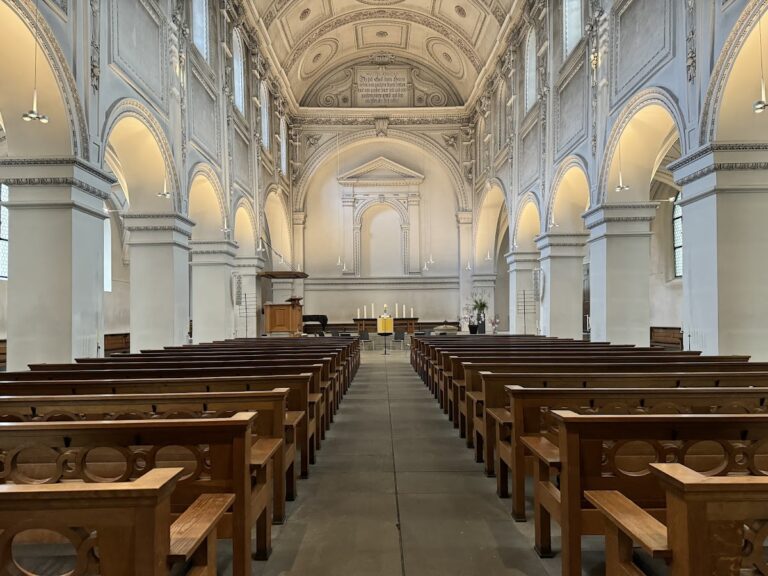
The present church was constructed under Hans Felder and consecrated around 1486. It is a late Gothic structure positioned between the Grossmünster and Fraumünster, beside the Limmatquai and Münster Bridge. Three choir windows were designed by Augusto Giacometti during the twentieth-century restoration.
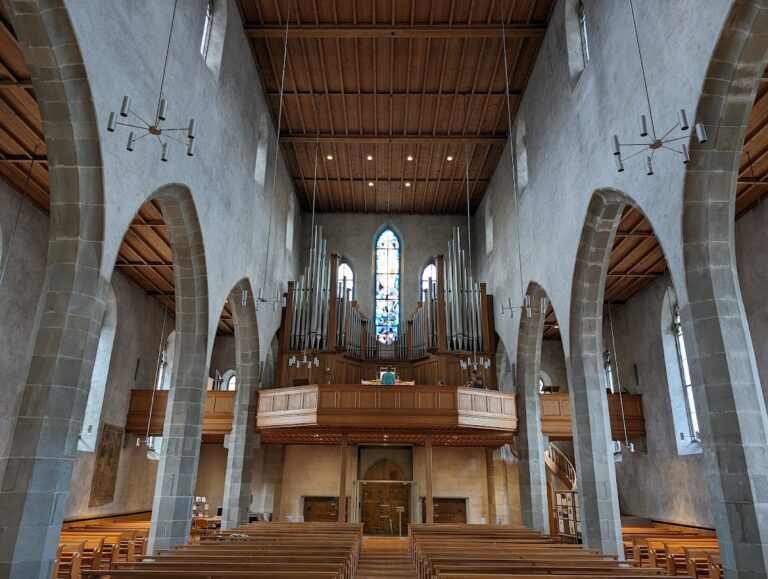
A bell in the roof turret sounds the note C two. It hangs from a cranked yoke with a counterweighted clapper. The organ was built by Kuhn Organ Builders in 1943. It has 28 stops distributed across two manuals and a pedal, with mechanical key action and pneumatic stop action.
Helmhaus
Helmhaus is attached to the north side of Wasserkirche. Its first form was a covered bridge extension leading to the church. The larger wooden market building of 1563 and 1564 contained a ground-floor market hall, while the present stone building was erected by Hans Conrad Bluntschli the Elder between 1791 and 1794.
The broader arch on the Limmat side preserves the former passage through which the road originally ran. The building’s present use as a municipal museum and gallery follows its earlier functions as a court site, bridge extension, and market building.
Water House Site
Until 1940, the Water House stood on the east side of Wasserkirche. A weighing house formerly occupied the position and was demonstrably replaced by a Kaufhaus in 1570. The name Water House referred to its location over the water between the church island and the former imperial road, now the Limmatquai.
After the Water House was demolished in 1794, a new annex for the citizens’ library was built there. The annex was removed in 1940, exposing the church’s east side and widening the Limmatquai.
Zwingli Monument
The monument to Huldrych Zwingli stands outside the church at the extension of the choir. Heinrich Natter’s 1885 design depicts the reformer larger than life as both a warrior and a religious reformer, holding a sword and a Bible. The monument originally identified him only by name and life dates. An additional information plaque was installed in 2005.