Santa Maria della Neve Church: A Romanino-Frescoed Marian Shrine in Italy


Site at a Glance
- Rating
- 4.6
- Popularity
- Low
- Country
- Italy
- Primary era
- Medieval
- Eras represented
- Medieval, Early Modern
- Civilizations
- Venetian
- Site type
- Religious
- Remains
- Church
On this page22 sections
History
Santa Maria della Neve Church is a Roman Catholic shrine in Pisogne, Italy, dedicated to the Madonna della Neve, or Madonna of the Snow. Built outside the medieval settlement during the second half of the fifteenth century, the church is Romanesque in style and became an important Marian religious center along the Valeriana road.
A Shrine on the Valeriana Road
The church stood beside the Valeriana, an ancient valley road and trade route, at a junction connecting Pisogne with an Alpine pass, the mines, and the Trompia Valley. This busy position brought travelers and pilgrims to the site and helped the church develop as a popular shrine dedicated to the Virgin Mary.
Its construction belonged to a period of prosperity in the valleys after the Venetian conquest. From 1428, Pisogne formed part of the Community of Valle Camonica and received particular privileges. The rebuilding and creation of religious buildings during the later fifteenth century reflected the area’s social and economic growth. Gian Pietro Federici, then the town’s archpriest and a member of the nobility, was associated with this setting.
Romanino’s Commission
Girolamo Romanino, a Renaissance painter from Brescia and a leading representative of the Lombard school, worked at Santa Maria della Neve in 1534. His fresco cycle was commissioned by the Disciplini, a lay penitential confraternity devoted to repentance and the imitation of Christ, together with other religious orders in Valle Camonica.
The decoration was intended to communicate the Gospel to ordinary people through a direct and popular visual language. Its religious purpose acquired added urgency because the valleys opened toward regions beyond the Alps where the Reformation was spreading rapidly. The cycle has therefore been understood as part of a Catholic response to the need for Christian spirituality and resistance to the Reformation.
The church was administered as a communal institution by local men and syndics. A 1534 document records a credit of 150 lire involving the men of Pisogne, while another document, dated 24 February 1546, records Romanino and his assistant Daniele Mori seeking payment from the syndics of Santa Maria in Pisogne.
Romanino’s work at Pisogne is regarded as one of the highest achievements of his artistic language and as one of the most unconventional fresco cycles in Italian art. Giovanni Testori later called the church the “Sistine Chapel of the poor,” while Alessandro Nova described the paintings as an exceptionally heterodox cycle.
Religious Administration and Later Changes
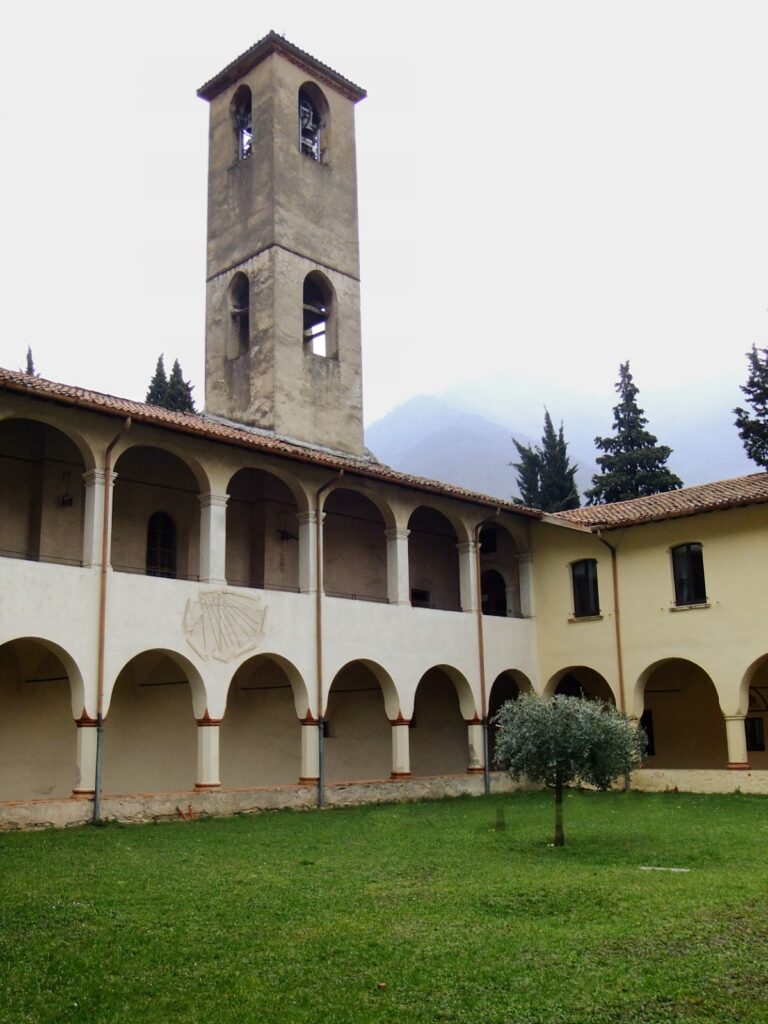
In 1588, at the urging of Carlo Borromeo, the Catholic cardinal and archbishop associated with the Catholic Reformation, Augustinian friars took charge of the church. The Augustinians, a Catholic order following the rule attributed to Saint Augustine, built a convent beside it. The convent was later extensively remodeled and converted into a retirement home.
During the sixteenth century, a southern porch was closed and thereafter served as a private church. In the early 1630s, the building was renovated extensively to accommodate pilgrims. Two porticos were joined to the central structure, and a chapel was added at the southern end of one portico.
Santa Maria della Neve is recognized as a national monument. In May 2025, an Art Bonus fundraising campaign began to support the restoration of Romanino’s fresco cycle, whose condition has been affected by humidity, water infiltration, dust, and damage associated with the bell tower and external chapel.
Remains
Exterior and Entrance
Facade and Portal
The church stands at the edge of Pisogne below a rock spur cut by the road to Fraine. Its simple gabled facade is decorated with polychrome diamond patterns. The restrained entrance portal is made from red Gorzone sandstone, with candelabra carved on its jambs. Its lintel carries a Bernardine monogram and two saintly heads.
Madonna Niche
Above the portal, a semicircular niche contains a statue of the Madonna and Child. Two angels are frescoed behind the statue, creating a devotional focus above the main entrance.
Side Porch and Lost Exterior Painting
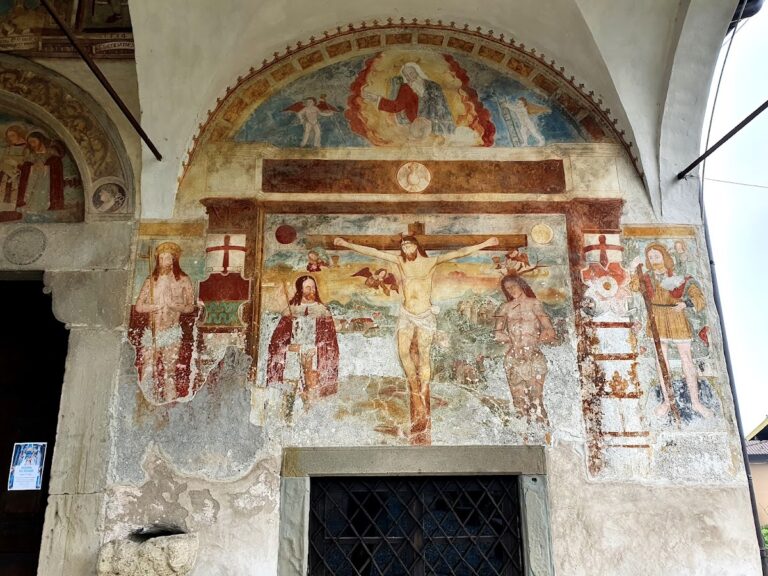
A small porch on the left side preserves traces of frescoes attributed to Giovanni da Marone. Among the remnants is part of a Madonna and Child with saints dated 1486. Beside the portal, a late-fifteenth-century Triumph of Death was once painted on the exterior. The scene has almost entirely disappeared, but a drawing made in the mid-nineteenth century preserves its appearance.
Interior Organization
Hall, Arches, and Light
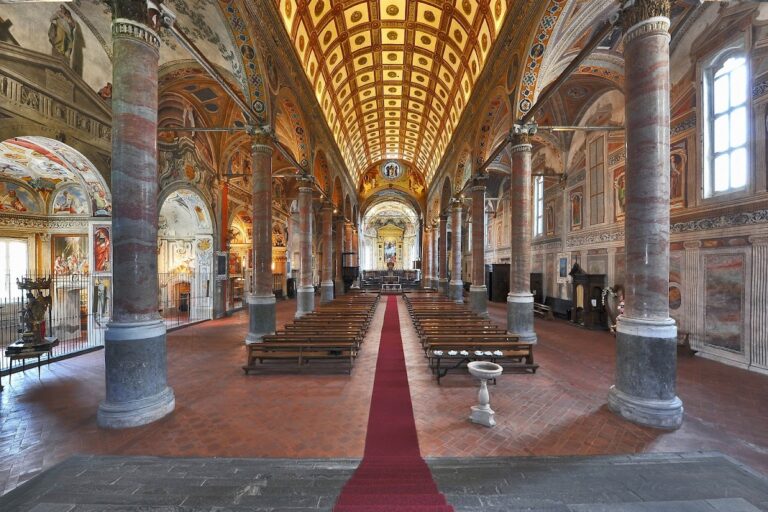
The interior is formed by a single hall divided into three bays. Pointed arches lead toward the triumphal arch, the arch marking the transition from the main hall to the sanctuary, and the apse, the curved end of the church. Three earlier side windows were closed so that the walls could serve as a continuous surface for painting. The stated natural light enters through the oculus, or round window, in the facade.
Vault and Prophetic Figures
Romanino’s decoration covers the vault, the arches crossing the interior, the side walls, and the counter-facade, meaning the interior wall opposite the main entrance. Prophets and sibyls appear on the curved sections of the vault and on the transverse arches. A sibyl is a prophetic female figure, while a prophet is a biblical or religious messenger. Each holds a mysterious scroll announcing the coming of Christ, as part of a carefully planned iconographic program.
Romanino’s Fresco Cycle
Triumphal Arch and Presbytery Wall
The triumphal arch and the wall leading toward the presbytery, the area around the main altar, show God the Father, the Archangel Gabriel, and the Virgin in the Annunciation. Lower on the same wall are the Descent of the Holy Spirit and the Deposition, which served as altarpieces.
Large Gospel Scenes
The larger compositions occupy the upper portions of the pointed Gothic arches along the side walls. They include the Capture of Christ in the Garden of Olives, the Ecce Homo, the Road to Calvary, the Resurrection, the Descent into Limbo, and the Ascension. Limbo is represented here as the realm where the righteous dead awaited redemption. The Crucifixion occupies the counter-facade and forms the dramatic climax of the cycle.
Smaller Narrative Panels
Below the large scenes, a lower zone combines a faux-marble dado with rectangular framed panels resembling a gallery of paintings. These scenes include the Supper in the House of Simon, Christ before Pilate, the Flagellation, the Crowning with Thorns, the Last Supper, the Washing of the Feet, and the Entry into Jerusalem.
Cross-Shaped Arrangement
The episodes do not follow the chronological sequence of the Gospel narratives. Instead, the larger and smaller compositions correspond with one another, creating a cross-shaped system of relationships between different moments in Christ’s story.
Style and Everyday Detail
The figures are rapidly and broadly painted, mainly directly onto fresh plaster without preparatory cartoons. Silky colors and controlled lighting effects shape the garments and their fluttering drapery. Gospel scenes are joined by details from ordinary life. Dogs appear among the crowd at the Crucifixion, while children fight at the foot of the staircase in the Ecce Homo, apparently unaware of the surrounding drama.
Crucifixion
The Crucifixion fills the counter-facade. Christ hangs at the center, with the two thieves on either side, while a dense crowd gathers beneath the crosses. In the foreground, a peasant-like Magdalene embraces the cross. The pious women stand apart on one side, and Roman soldiers cast dice for Christ’s tunic on the other. Mounted soldiers gather around the center, while Longinus, the centurion who pierced Christ’s body with a lance, stands in front wearing silvery armor.
Lost and Damaged Paintings
Apse and Exterior Fragments
The apse formerly contained Romanino’s Stories of Mary, but those frescoes have been lost. His exterior wall paintings have also largely disappeared. Detached fragments survive, including two scenes of the Adoration of the Magi preserved in the apse.
Conservation Condition
Humidity has damaged the base of the apse and affected both its interior and exterior surfaces. Pigeons in the bell tower have caused hygiene problems and damage to plaster and roofing. The external chapel has detached plaster, probably because of water infiltration, while vehicle traffic has contributed to dust accumulation. These conditions threaten the preservation and use of the paintings, which the 2025 restoration initiative seeks to address.