St Nicholas Church: An Orthodox Parish in Kavala


Site at a Glance
- Rating
- 4.7
- Popularity
- Low
- Country
- Greece
- Primary era
- Early Modern
- Eras represented
- Early Modern, Modern
- Civilizations
- Greek, Ottoman
- Site type
- Religious
- Remains
- Mosque
On this page14 sections
History
St Nicholas Church is an active Greek Orthodox church in Kavala, Greece, housed in a building erected by the Ottoman administration as a mosque in 1530. The site has served successive pagan, Christian, Byzantine, Islamic, and Orthodox communities, linking the modern city with the ancient settlement of Neapolis and the Byzantine city of Christoupolis.
From Neapolis to Christoupolis
In antiquity, when Kavala was known as Neapolis, a small pre-Christian sanctuary probably dedicated to a female deity occupied the site. After the end of the persecutions and the Christianization of the population, the sanctuary was probably converted into a Christian church around AD 312 to 342.
During the sixth century, under Justinian I, the Byzantine emperor whose reign included extensive building programs, a basilica was constructed here in honor of the Apostle Paul. A basilica is a church organized around a long central hall. The size of the building and its association with Paul suggest that it may have served as the cathedral of Christoupolis, although that role remains conjectural.
Destruction and medieval reuse
The Norman capture of Christoupolis in 1185 devastated the city and destroyed the basilica. After the Norman withdrawal, local inhabitants built a smaller church, incorporating many structural and architectural elements from the earlier buildings. Between 1204 and 1261, the church was converted into a Roman Catholic building, possibly dedicated to Saint Lazarus, before later returning to Orthodox use.
Ottoman forces captured Christoupolis in 1391, after which the city was abandoned. Almost a century later, Turkish settlers from the fortified town of Kavalla near Iconium repopulated the settlement and gave it the name Kavala.
The Ottoman mosque
In 1530, Ottoman vizier Ibrahim Pasha, also known as Pargalı Ibrahim Pasha, erected the present building as the Ibrahim Pasha Mosque. A vizier was a senior Ottoman state official. The mosque was the largest in Kavala and an important Muslim religious building in the Old Town, forming part of a wider complex that included a madrasa, inns, and shops. A madrasa was an institution for Islamic religious and scholarly education.
Conversion into an Orthodox church
Kavala became part of Greece in 1913. After the population exchange of the 1920s, the former mosque first housed refugees from Asia Minor and Pontus. It was then converted into a Christian church, probably in 1926 or 1928, and dedicated to Saint Nicholas, the fourth-century bishop of Myra traditionally associated with sailors and maritime protection. The church was consecrated in 1945. Priest Nikolaos Sidiropoulos celebrated the first service in the converted building in 1928.
Archimandrite Kornelios Vasileiou served approximately from 1929 to 1941, organizing renovation work and fundraising beyond Kavala. Bulgarian occupation authorities expelled him, and he died in Thessaloniki in February 1942. Archimandrite Alexandros Parisis served approximately from 1941 to 1944 after being expelled from another Kavala church by the same authorities. During this period, Saint Nicholas was the city’s only Greek-language church.
Parish development and conservation
Archimandrite Anthimos Arabatzoglou served from 1946 to 1973 and oversaw fundamental renovation of the church’s annexes, including the interior narthex and the Chapel of Saint Demetrius. A narthex is an entrance or vestibule area. At his initiative, the cantor Matthaios Tsamkiranis served as chief cantor from 1964 to 1987.
During the tenure of Father Konstantinos Koidakis, approximately from 1950 to 1956, the church operated a catechetical school. The school was later re-established in 2021. Father Charalampos Neochoritis served from 1984 to 2001, when many portable icons for the liturgical year were painted and the main 1530 building underwent internal and external renovation. Father Petros Tsetinis carried out interior improvements from 2001 to 2003, while Hieromonk Timotheos Kakanis arranged further improvements and conservation of older icons between 2007 and 2012.
Since 2021, Archimandrite Evangelos Yfantidis has served the parish. During his tenure, the catechetical school was restored, the charitable initiative known as “Saint Nicholas’s Basket” was created, and restoration studies were prepared for the historic building. The studies received approval from the Metropolis of Philippi, Neapolis, and Thasos, the Kavala Ephorate of Antiquities, and the Ministry of Culture. The church remains within the Greek Orthodox tradition and is administered by the Metropolis.
Remains
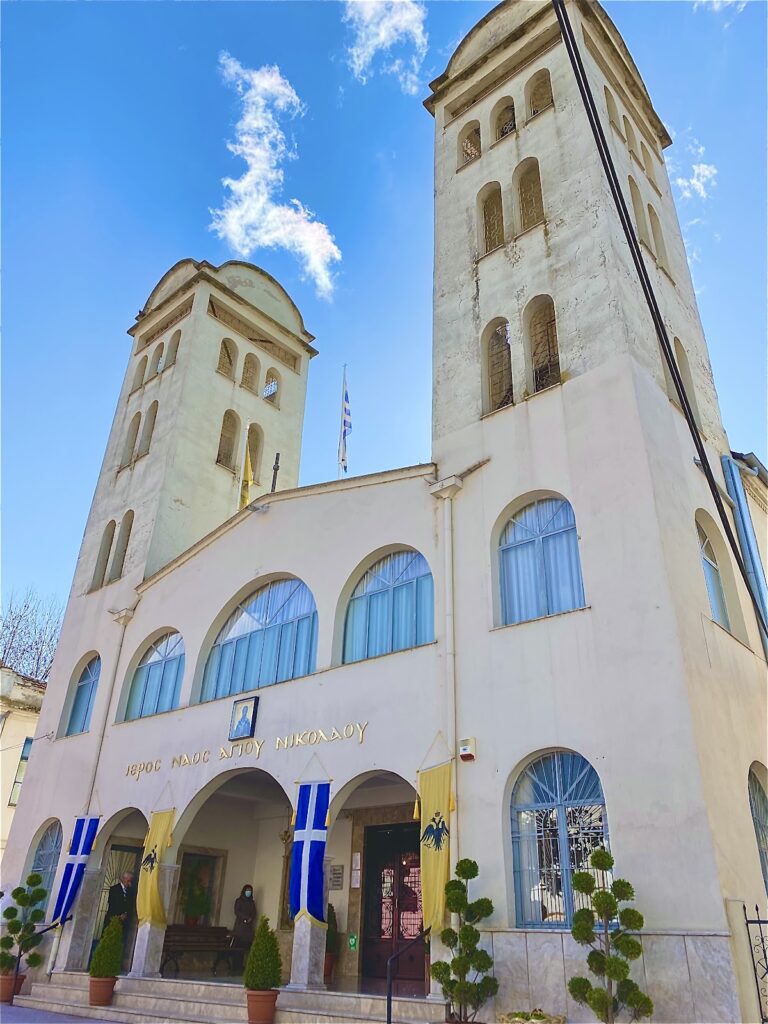
The church stands in central Kavala on a site whose physical fabric brings together remains and adaptations from several periods of worship. The present structure is built of brick and stone in Ottoman architectural style. Its layout includes the main former mosque building, a bell tower, a pronaos, an interior narthex, and chapels dedicated to Saint John Chrysostom and Saint Demetrius.
Earlier sacred structures
Pre-Christian sanctuary
The small pre-Christian sanctuary probably occupied approximately the area now taken by the bell tower. Marble elements from this early structure remain embedded in the exterior masonry, especially in the lower part of the bell-tower base.
Byzantine basilica
The sixth-century Byzantine basilica dedicated to the Apostle Paul was a large church that archaeological interpretations describe as modeled on the Church of the Holy Apostles in Constantinople. Its destruction in 1185 was followed by the construction of a smaller church that reused numerous elements from the earlier buildings.
Ottoman and Orthodox fabric
Former mosque building
The principal building was completed in 1530 as the Ibrahim Pasha Mosque. Brick and stone form its construction, and the structure remains the core of the present church. Its later Orthodox conversion brought changes to its use and interior organization, including the addition or adaptation of spaces serving the church.
Bell tower and chapels
The mosque’s former minaret was destroyed, and the present bell tower was built on its base. A minaret was a mosque tower traditionally used for the call to prayer. The church complex also contains a pronaos, meaning an entrance porch, an interior narthex, and chapels dedicated to Saint John Chrysostom and Saint Demetrius.
Pauline commemorations and icons
A mosaic on the eastern side of the church depicts the arrival of the Apostle Paul at the port of Kavala. Nearby, a monument erected in 2000 commemorates the place traditionally identified as where Paul first set foot in Europe. The church’s portable icons for the liturgical year were produced during Father Charalampos Neochoritis’s tenure, while older icons were conserved during the tenure of Hieromonk Timotheos Kakanis.
Nearby sites