Wehrkirche Pomßen: Evangelical-Lutheran Church and Picture Church


Site at a Glance
- Rating
- 4.4
- Popularity
- Very Low
- Country
- Germany
- Primary era
- Early Modern
- External website
- Open
- Eras represented
- Medieval, Early Modern
- Civilizations
- Holy Roman Empire
- Site type
- Religious
- Remains
- Fortified Church
On this page10 sections
History
Medieval origins and the Reformation
Wehrkirche Pomßen is an Evangelical-Lutheran church in Pomßen, Germany, whose oldest surviving parts date from the thirteenth century and belong to the Romanesque period. Romanesque capitals, the apse, and Romanesque windows preserve the early character of the building. The church received its first Evangelical visitation in 1527 and was already Evangelical when the Lords of Ponickau took control.
Later medieval work is represented by the opening between the nave and tower, a doorway arch made from Rochlitz porphyry, and the baptismal font. These elements belong to the fifteenth-century fabric and reflect the church’s development before and around the Reformation.
Ponickau patronage and seventeenth-century renewal
The Lords of Ponickau owned the Pomßen estate and castle from 1536 to 1782 and held the church patronage during that period. A patronal gallery was a private elevated seating area for the patron and his household. Much of the church’s present interior was created under Ponickau patronage.
A Renaissance altar made in 1560 by Andreas Lorenz of the Freiberg school of sculpture was probably the first major acquisition of this phase. After the church suffered serious damage, including the partial collapse of its tower, an extensive building and furnishing campaign began in 1660. The work added or renewed the ceilings, pulpit, organ, bells, and patronal gallery. It concluded in 1686 with the construction of the two-storey patronal gallery and its private staircase.
The organ, built by Gottfried Richter in 1671, became a central part of the church’s musical history. Richter was a Saxon organ builder who later served as mayor of Döbeln. Johann Sebastian Bach performed his cantata Ich lasse dich nicht, du segnest mich denn, BWV 157, at Pomßen for the first time on 6 February 1727. He adapted it for the Feast of the Purification of Mary during the funeral service of Johann Christoph von Ponickau, owner of the Pomßen estate. The second part of the service included Liebster Gott, vergisst du mich, BWV Anh. I 209. Bach was a German Baroque composer and church musician whose cantatas were written for Lutheran worship; BWV numbers identify works in the catalogue of his compositions.
Modern repair and continuing use
Renovation continued between 1889 and 1934, when old wall paintings were uncovered. The exterior was renewed in 1974, and the interior artworks were restored during the 1990s. From 2004 to 2006, the Wegscheider organ workshop restored Richter’s instrument and returned it to its original state. In 2014 and 2015, a defective steel bell frame installed in 1982 was replaced by an oak frame based on the historical model, while surviving parts of the earlier frame were incorporated. The three bells were repaired at the same time.
Wehrkirche Pomßen belongs to the Evangelical-Lutheran parish of Pomßen-Belgershain, administered together with the parish of Köhra by the Pomßen parish office. Its painted ceiling, with 56 paintings, has made it a rare picture church. The organ and the interior have also brought recognition beyond the region through organ concerts and the European Organ Academy of Leipzig, a recurring organ-performance and educational program organized by Leipzig University of Music and Theatre.
Remains
Massive tower and medieval church plan
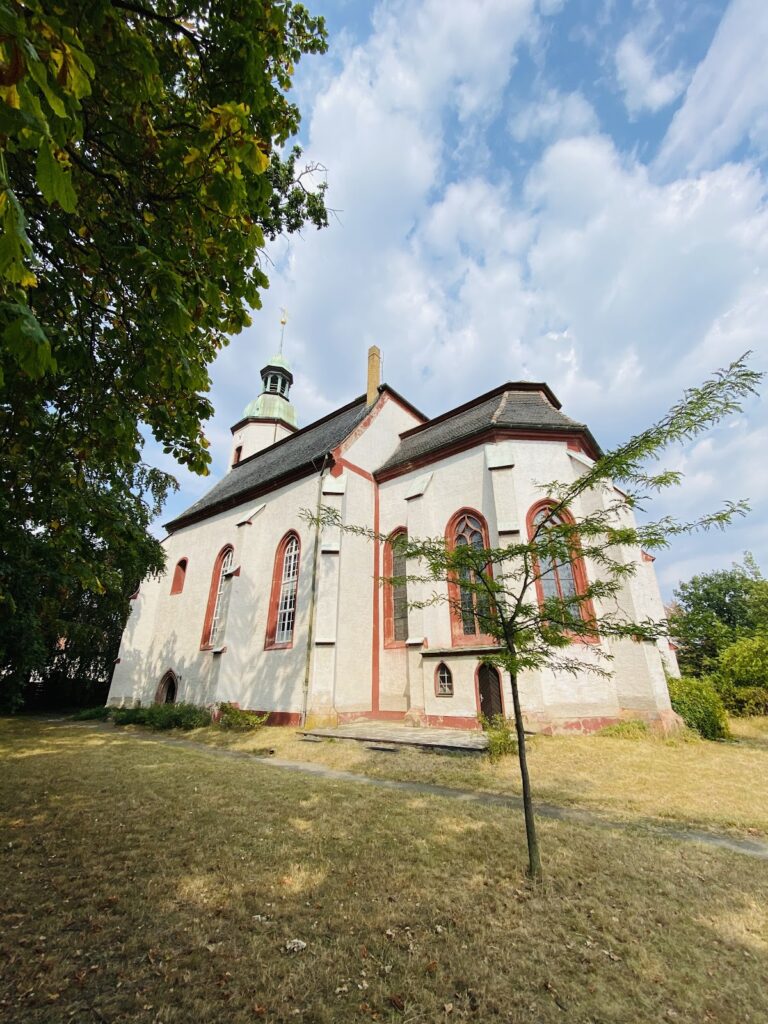
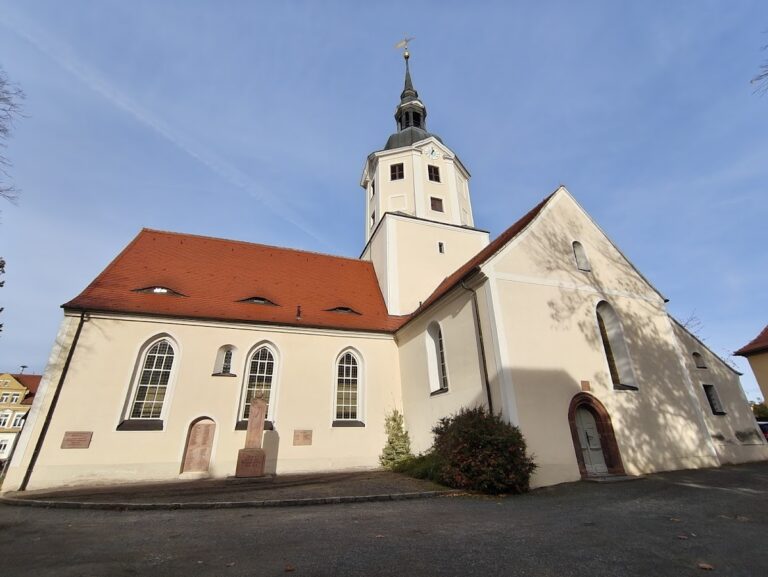
The building is dominated by a massive transverse tower measuring about 11.5 by 6.5 metres. It spans the width of the main nave and gives the church its defensive character. The tower is almost windowless apart from the round-arched sound openings in the belfry. Its slate-covered hipped roof carries a roof turret with a bell-shaped cap. One clock face is set in a small south-side roof gable, while the other is mounted on the north wall at belfry level.
The main nave is 11.5 metres long and joins the tower. On the south side it extends beyond the tower’s width to form a side aisle, which opens into the nave through a large round arch. The chancel, measuring 6.5 metres in length, is lower than the nave and terminates in a semicircular apse with three round-arched windows. A small stair tower north of the apse provides external access to the patronal gallery.
Altar and chancel furnishings
The 1560 altar is made from polychromed sandstone. Its decorated structure behind the altar is divided by columns and has the form of a triptych. The panels show scenes from the life and Passion of Jesus, including the Nativity, baptism, arrest in Gethsemane, scourging, Crucifixion, Descent from the Cross, entombment, and Resurrection. Hans von Ponickau, his wife, and their daughters and sons appear together at the centre as the donor family. Hans was a sixteenth-century member of the Ponickau family.
A stucco-decorated patronal gallery occupies the north side of the chancel, while elaborate epitaphs, commemorative monuments for deceased members of the Ponickau family, hang opposite it. The flat chancel ceiling contains 20 recessed panels showing angels carrying the instruments of Christ’s Passion. A large Baroque baptismal angel hangs from the ceiling by a rope. Designed to hold or present baptismal equipment, it could formerly be lowered during baptisms.
Nave ceiling, screen, and pulpit
A screen with substantial turned and carved wooden balusters separates the chancel from the nave. Above it, on the column between the main nave and side aisle, stands a white-and-gold pulpit supported by a carved angel. Its panels depict the Evangelists, Paul, Joel, and Jeremiah, while Aaron and Moses appear on the pulpit door. The Evangelists are the traditional authors or attributed authors of the four canonical Gospels; Paul, Joel, Jeremiah, Aaron, and Moses are biblical apostles, prophets, and leaders of ancient Israel.
The main nave has a coffered ceiling divided into 56 recessed fields. Fifty-three contain allegorical figures from the Old and New Testaments, extending from Adam to Christ, together with early Church Fathers. The scenes are painted in grisaille, a technique using shades of one colour to imitate relief sculpture, on a gold-ochre ground.
Galleries and organ
The side aisle has a wooden barrel vault and a gallery. Floral ornament painted in the same technique as the ceiling coffers appears on its panels and on those of the two galleries in the main nave. A second gallery rises above the first at the west wall and houses the organ. Seven panels on its balustrade show angels playing contemporary instruments in the composition known as the “Angels’ Concert.” Music-related paintings cover the organ’s wing doors, and the galleries and organ share a unified painted design.
Richter’s original organ had one manual and twelve stops. Johann George Gordt of Mittweida added a pedal stop in 1727, while Gottfried Hildebrand of Leipzig removed two stops and installed new keyboards in 1887. Richter gave the five-part organ front a historicizing Renaissance design. Three long central bossed pipes have twisted feet and gilded lips, and the façade pipes have keel-arched upper and lower lips. The side doors are painted in grisaille. A Palm Sunday 1671 organ sermon by the Pomßen pastor Immanuel Weber preserves the original specification, while separate cases house the manual and pedal divisions.
The present instrument has a manual-to-pedal coupling probably dating from 1727, with a new mechanism installed in 2006. Its tremulant and bird-call stop were reconstructed in 2006, and its star mechanism was reconstructed in 2006 and 2016. The organ sounds at approximately 458 Hz for A and uses meantone temperament with a quarter-syntonic comma.
Seventeenth-century bells
The oldest known surviving bell peal dates from 1685. It consists of three bronze bells cast by Johann Jakob Hoffmann of Halle on the Saale. They form a G-minor peal, with the largest weighing 775 kilograms and sounding G-flat one, the middle bell weighing 350 kilograms and sounding B-flat one, and the smallest weighing 150 kilograms and sounding D two. Hoffmann’s name or initials appear in their inscriptions.
The large and middle bells were requisitioned during the Second World War but escaped destruction and melting down. They returned to Pomßen in 1947 from the Hamburg bell cemetery, travelling partly by water along the Elbe. The peal was electrified in 1984.