Zubarah: An Eighteenth-Century Pearl-Trading Port in Qatar
Site at a Glance
- Popularity
- High
- Country
- Qatar
- Primary era
- Early Modern
- Eras represented
- Early Modern, Modern
- Civilizations
- Unclassified
- Site type
- City
On this page18 sections
History
Zubarah is an archaeological site preserving a former coastal town in Al Zubara, Qatar. Its development is generally placed in the mid-eighteenth century, probably the 1760s, when factions of the Bani Utbah settled there. The town became a major Gulf port and pearl-trading center.
Early settlement and the Bani Utbah
An early Islamic-period village has been found near Zubarah. Coastal settlements and trade expanded across the region in the centuries following Islam’s emergence in the seventh century. Much later, Portuguese naval forces led by D. Goncalo da Silveira burned neighboring coastal villages between September 1627 and April 1628. People displaced by those attacks may have contributed to Zubarah’s later growth.
Zubarah’s origins remain disputed. The Bani Utbah, a tribal confederation that included the Al Khalifa and Al Bin Ali families, migrated from Najd, apparently in response to prolonged drought. They travelled through Al Aflaj, Qatif and Al Ahsa before settling at Freiha in northwestern Qatar. There they allied with local groups, including the Al-Maadeed and Al Sulaim, and established a fortified coastal center. After clashes with the Al Musallam, a Bani Khalid clan, the Utub left for Iraq in 1716 and later moved to Kuwait.
In the mid-eighteenth century, probably during the 1760s, Al Bin Ali, Al-Maadeed and Al Jalahmah factions returned to Qatar’s northern coast and settled near Freiha. Zubarah was already a small, active village. A manuscript from 1766 records Sheikh Sulayman Al Humaid of the Bani Khalid prohibiting trade between Uyayna and coastal settlements under his control, including Zubarah, identifying the town as a port. A claim that Zubarah had been a self-governing settlement before the Utub arrived was based on documents later exposed as forgeries.
Port growth and regional conflict
Sheikh Muhammad bin Khalifa of the Al Khalifa family was invited by Zubarah’s inhabitants to settle there. As his family’s influence expanded, he resisted demands for tribute from the Al Musallam. The conflict led the Al Khalifa to fortify Zubarah. They also strengthened alliances through marriage with prominent families, including the Al Bin Ali and Al Bu Kuwara. After further fighting, they captured Al Huwaila, and the Al Musallam leadership fled to Najd.
With Bani Khalid power diminished across much of northern Qatar, Zubarah grew into a commercial center. Its ships carried pearls and dates, while merchants traded with India, Oman, Iraq and Kuwait, bringing in spices and metals. The Utub’s removal of trade taxes encouraged commerce. The Ottoman–Persian War of 1775–1776 and the subsequent Persian occupation of Basra disrupted trade in southern Iraq, bringing Basran merchants and refugees to Zubarah and accelerating its expansion.
The Basran merchant Muhammad ibn Husayn ibn Rizq al-Ruzayqi and his son Ahmad became influential in the town. Khalifa bin Muhammad, who succeeded his father in 1777, supported the elder ibn Rizq’s activities. Ahmad invited the scholar and jurist Uthman ibn Sanad al-Basri to serve as chief judge. Ibn Sanad’s biography, first published in 1813, described aspects of Zubarah’s administration and named residents, including the theologian Abd al-Djalil al-Tabatabai. The town also attracted people from Bahrain, Kuwait, Oman and elsewhere in Qatar amid regional attacks, disease and conflict.
Pearl diving shaped Zubarah’s seasonal economy. During the long summer season, Bedouin from inland Qatar and people from across the Gulf came to dive, trade and help protect the settlement while many local men were at sea. Zubarah’s boats travelled to pearl beds stretching from Bahrain to the United Arab Emirates, with journeys lasting several weeks. Divers worked in pairs, one diving while the other stayed aboard to haul him back. Date trading was another important activity. Thani bin Mohammed, founder of the House of Thani, was born during this period of growth and became a successful pearl trader, helping increase the influence of his Al-Maadeed tribe.
Fighting with Persian-ruled Bahrain escalated in 1782 after an attack on an Al Khalifa servant and his companions on Sitra. On 9 September, the Al Khalifa and allied Utub forces attacked and plundered Manama, returning to the mainland three days later with a captured gallivat, a small sailing or rowing vessel. Nasr Al-Madhkur, the Persian-appointed ruler of Bahrain and Bushehr, prepared a counterattack, with further troops ordered by Ali Murad Khan, governor of Shiraz.
Nasr’s fleet arrived near Zubarah in May 1783, and the town endured a siege lasting nearly a month. Negotiations mediated by Rashid bin Matar, a former ruler of Julfar, failed when Nasr rejected the proposed settlement. In December, Persian forces landed between Zubarah and Freiha for another assault. A coalition of local Qatari tribes, including the Al-Maadeed of Freiha, defeated them. Muhammad bin Khalifa, identified as Nasr’s nephew, was killed. Sheikh Ahmed bin Muhammad bin Khalifa then took control of Bahrain and appointed a governor there, while keeping his principal residence in Zubarah.
Despite the conflict, the town continued to prosper. By 1790 its port was larger than Qatif’s, and Zubarah had also become a center of Islamic learning. That year, Abd al-Rahman al-Zawāwī, a Maliki scholar of one of the major Sunni schools of Islamic law, produced the Zubarah Almanac. It described the calendar, prayer times, agriculture and seasonal changes, and is considered Qatar’s first almanac and one of the earliest surviving local literary works.
Wahhabi rule and decline
From about 1780, raids by the Wahhabi movement, an eighteenth-century religious and political force in Arabia, threatened Bani Khalid strongholds in Al Ahsa and Zubarah. The Wahhabis suspected Zubarah’s residents of opposing their authority with Bani Khalid support, objected to religious teachings practiced there and regarded the town as a gateway to the Gulf. Saudi general Sulaiman ibn Ufaysan led a raid in 1787. After the Wahhabis conquered Al Ahsa in 1792, refugees fled to Zubarah. Two years later, Wahhabi forces besieged the town and nearby settlements that had sheltered them. Local leaders retained administrative responsibilities but had to pay tax. Zubarah also faced attacks associated with Nasr Al-Madhkur in 1778 and 1782, as well as conflict with the Banu Kaab of Khuzestan in the late eighteenth century.
Wahhabi forces occupied Zubarah in 1809. In 1811, as hostile Egyptian troops advanced on the Wahhabi western frontier, the Wahhabi amir reduced garrisons in Bahrain and Zubarah. Said bin Sultan, ruler of Muscat, took the opportunity to attack Wahhabi positions in eastern Arabia. Zubarah’s fortifications were burned, and the Al Khalifa regained power. The town was briefly abandoned, although some residents may have left before the attack.
Resettlement and political struggle
Zubarah was resettled in the late 1820s as a smaller pearl-fishing community. In 1868, the Al Khalifa launched a major naval attack on eastern Qatar. A sovereignty treaty between the Al Thani, Qatar’s ruling family, and the British followed, placing the peninsula under Al Thani leadership and sharply reducing Al Khalifa authority at Zubarah. The Al Khalifa nevertheless maintained informal agreements with some local tribes.
In 1873, a false report by British assistant political resident Charles Grant claimed that Ottoman troops had been sent to Zubarah. The Emir of Bahrain responded by asserting authority over the town and the Naim, a Bedouin tribe with communities in Qatar and Bahrain. British officials disputed his right to intervene in Qatar. After Bahraini opposition leader Nasir bin Mubarak moved to Qatar in 1874, the Al Khalifa sent reinforcements to Zubarah and continued recruiting and supporting some Naim.
In September 1878, piracy involving Zubarah residents resulted in four deaths. Soon afterward, Jassim bin Mohammed Al Thani and Nasir bin Mubarak attacked the town with about 2,000 armed men. By 22 October, Jassim’s forces had sacked Zubarah and surrounded Murair Fort, where about 500 Naim tribesmen were defending themselves. The Naim surrendered on unfavorable terms, and most residents were moved to Doha. Jassim may have considered restoring Zubarah in 1888 as a base for an attack on Bahrain by his son-in-law, but he abandoned the plan after a British warning.
In 1895, at Jassim bin Mohammed’s request, members of the Al Bin Ali moved from Bahrain to Zubarah after renouncing allegiance to the Bahraini emir. British intervention included the seizure of seven of their boats. During the resulting tensions between the Ottoman Empire and Britain, British forces fired on Zubarah’s harbor and destroyed 44 dhows, traditional wooden sailing vessels of Arabia. Jassim and his forces surrendered on unfavorable terms, including an order to raise the Trucial flag, associated with the Gulf sheikhdoms known as the Trucial States, and pay 30,000 rupees.
Abandonment, archaeological work and recognition
Limited water supplies contributed to continued population loss, and by 1908 Zubarah was ruined and deserted. In 1937, conflict between Qatari loyalists and the Naim, who had defected to Bahrain, revived territorial claims. A proposal to develop Zubarah as an oil terminal added to the tensions. Qatar’s emir, Abdullah bin Jassim, began building Al Zubarah Fort to strengthen the reduced garrison. Its completion shifted the town’s principal defensive role away from Qal’at Murair.
By the middle of the twentieth century, only a few members of the Naim tribe remained among the ruins, living nomadically. The area was gradually abandoned toward the end of the century and used mainly for beach camps. Al Zubarah Fort served as a coast guard station until the 1980s. Danish archaeologists surveyed Zubarah in 1956, followed by investigations led by Hans Jørgen Madsen of the Moesgård Museum in 1962. Qatar Museums and its predecessor excavated in the early 1980s and again in 2002–2003.
In 2009, Qatar Museums and the University of Copenhagen began a ten-year project of survey, excavation, research and conservation at Zubarah and Murair. The work included landscape studies and three-dimensional recording of architectural remains by a University of Hamburg team. Conservation used salt-resistant mortar and plaster to protect the historic fabric. On 22 June 2013, Al Zubarah Archaeological Site was inscribed on the UNESCO World Heritage List for its evidence of cultural traditions, architectural development and a traditional settlement and landscape. Its preserved town plan and buildings provide evidence of Gulf urban life and regional society and commerce before the discovery of oil and gas.
Remains
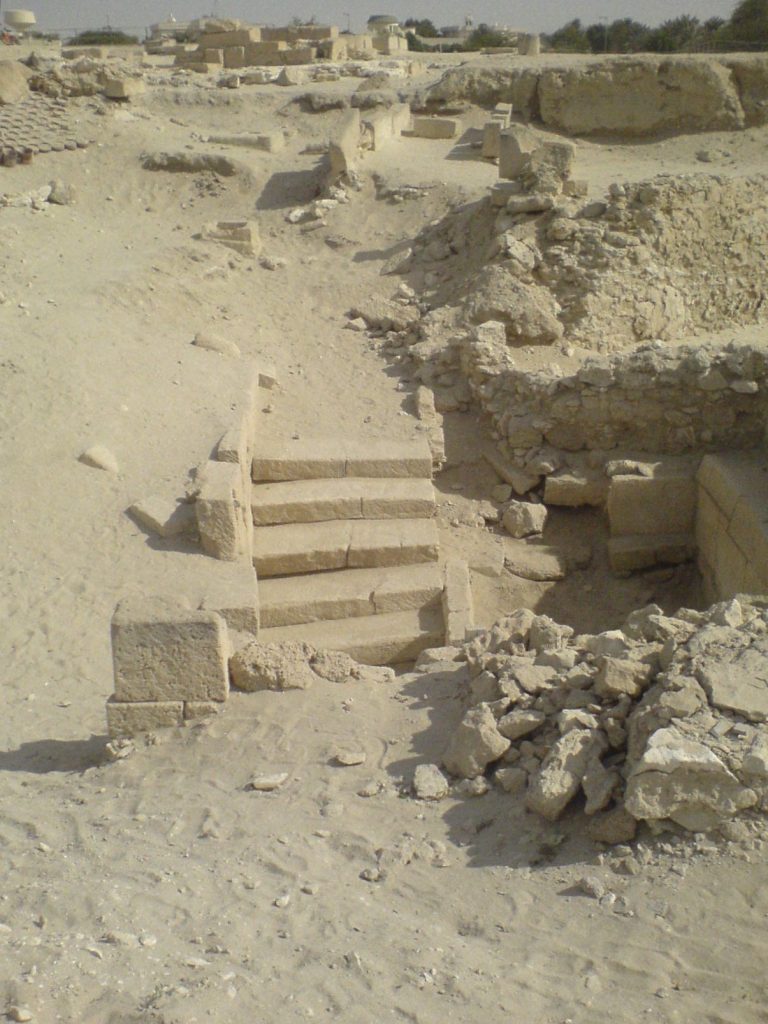
The archaeological site covers about 400 hectares, including approximately 60 hectares within the outer town wall. Its remains include the fortified town, an earlier outer wall and a later inner wall, a harbor and sea canal, two screening walls, Qal’at Murair and Al Zubarah Fort. The town occupies a low coastal hillock. Coastal salt flats border it to the north and southeast, while stony desert extends inland. Fresh water came from shallow wells tapping underground water lenses. Deposits found around nearby salt flats and mud flats supplied building materials; limestone is more common farther inland.
Town and domestic architecture
Street plan and houses
The town’s streets and some neighborhoods followed a grid, probably laid out in closely spaced stages. Most houses had small rooms arranged around a large central courtyard, where household activities took place. A shaded portico commonly faced the courtyard from the south. Builders used soft local stone or limestone quarried at Freiha, then protected the walls with thick gypsum plaster. Geometric decorative plasterwork embellished doorways and niches. A bent entrance corridor restricted views into the home and helped limit blowing sand. Traces near the beach may represent tents or huts made from palm leaves and mats, perhaps used by seasonal residents, pearl fishers or mariners.
Houses constructed during the late-1820s resettlement were smaller and more irregular, and the streets followed a less orderly pattern than in the earlier town.
Palace complex
The largest building complex, commonly called the palace, measures approximately 110 by 100 metres. Nine connected compounds each had a courtyard surrounded by rooms. Decorative plasterwork marked interior entrances and rooms, while internal staircases indicate that the compounds rose above a single storey. A high circuit wall enclosed the complex, with a circular tower at each corner; every tower could support a small cannon.
Defensive features
Town wall and harbor
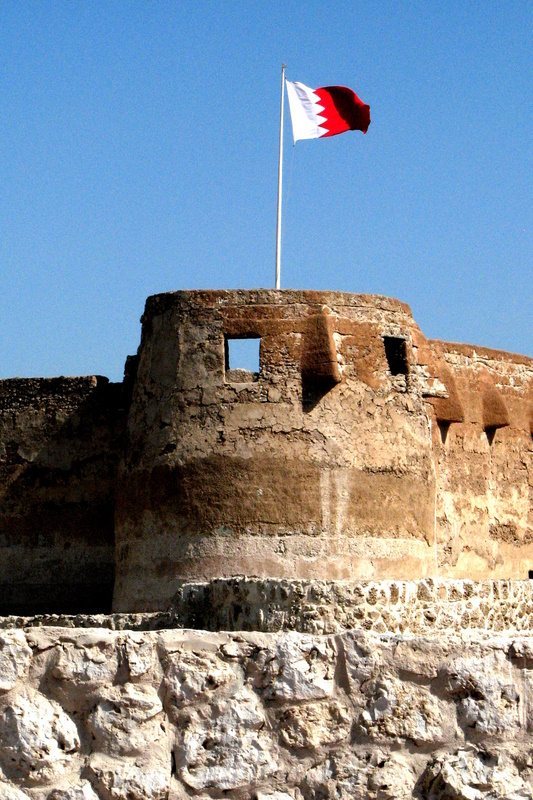
A curved wall ran about 2.5 kilometres from shore to shore, enclosing the town and its bay. Twenty-two semicircular towers stood at regular intervals along it. A parapet and walkway provided defenders with a position from which to fire. Entry was through a small number of defended gates on land or from the harbor. A sea wall did not enclose the coast, but a strong fort protected the main landing area on the sandy beach.
Qal’at Murair
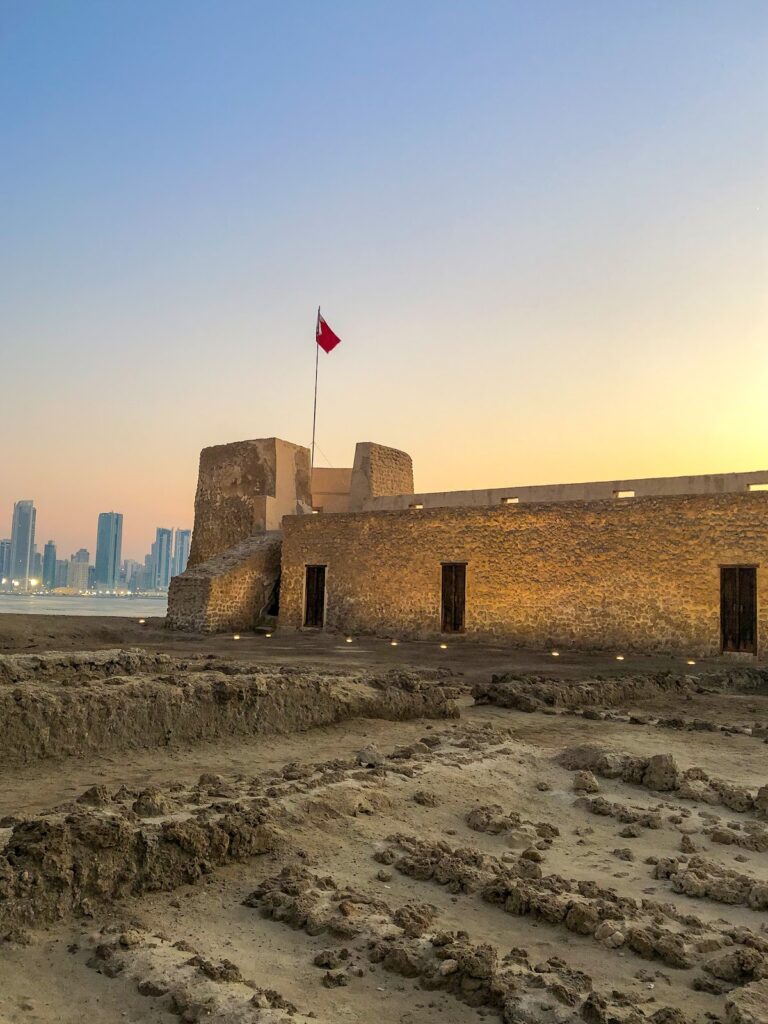
Qal’at Murair stood about 1.7 kilometres east of the town. Built soon after the settlement and completed as a stronghold by 1768, it guarded Zubarah and its principal freshwater source. The fort enclosed a mosque, domestic buildings and at least one large well. Enclosures outside its walls may have served as fields, plantations or animal pens. A creek may once have connected the fort with the sea, allowing boats to unload at its gate; the inlet had silted up by 1908.
Screening walls
Two walls ran east to west from the outer town wall toward Qal’at Murair. Towers with round plans stood at regular intervals. The walls may have protected water carried from the fort’s wells to the town and may also have directed movement across the open salt flats.
Al Zubarah Fort
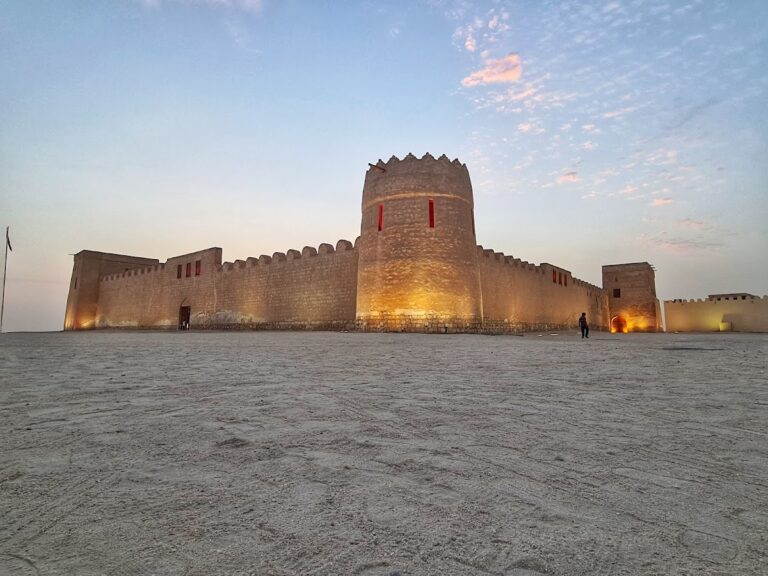
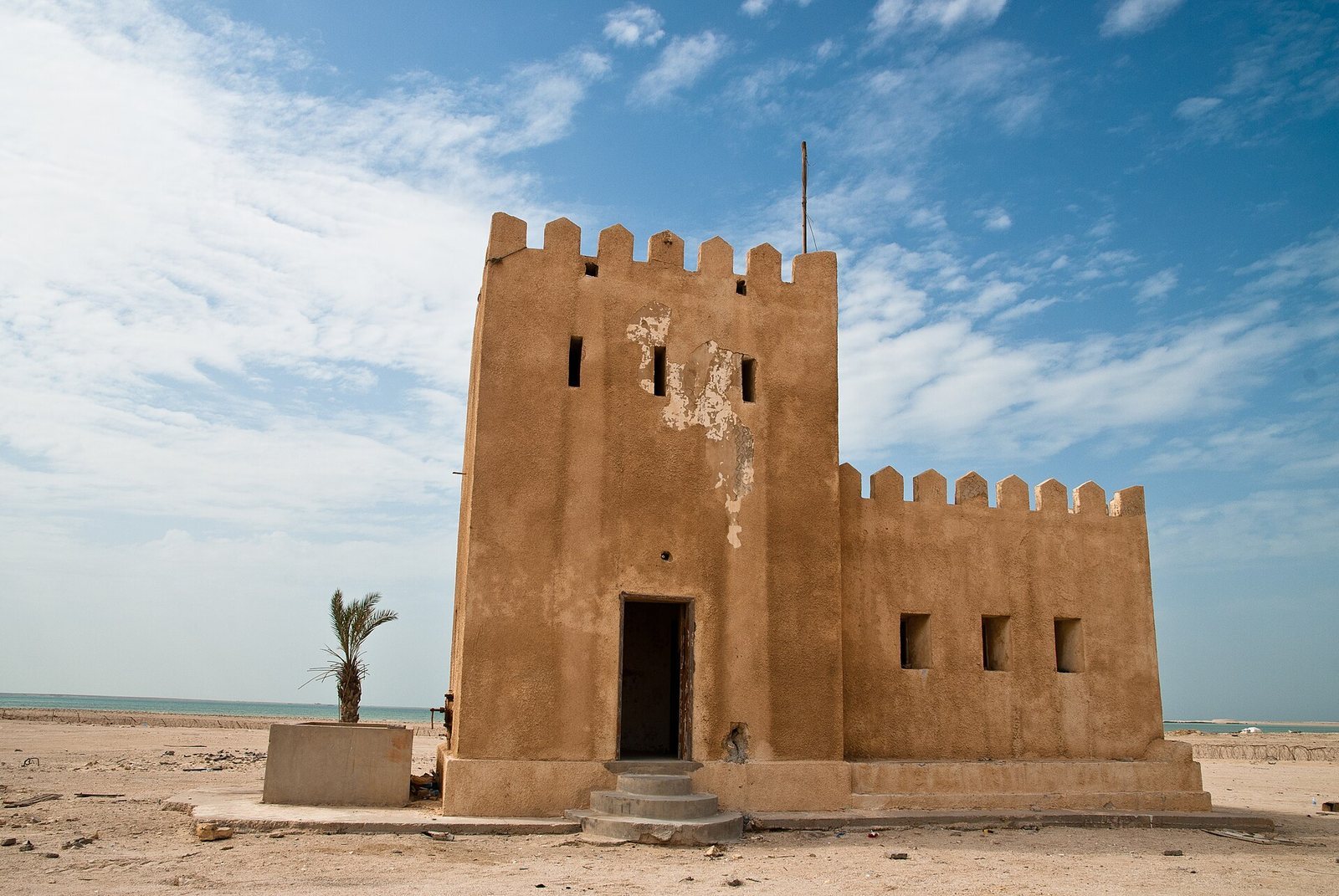
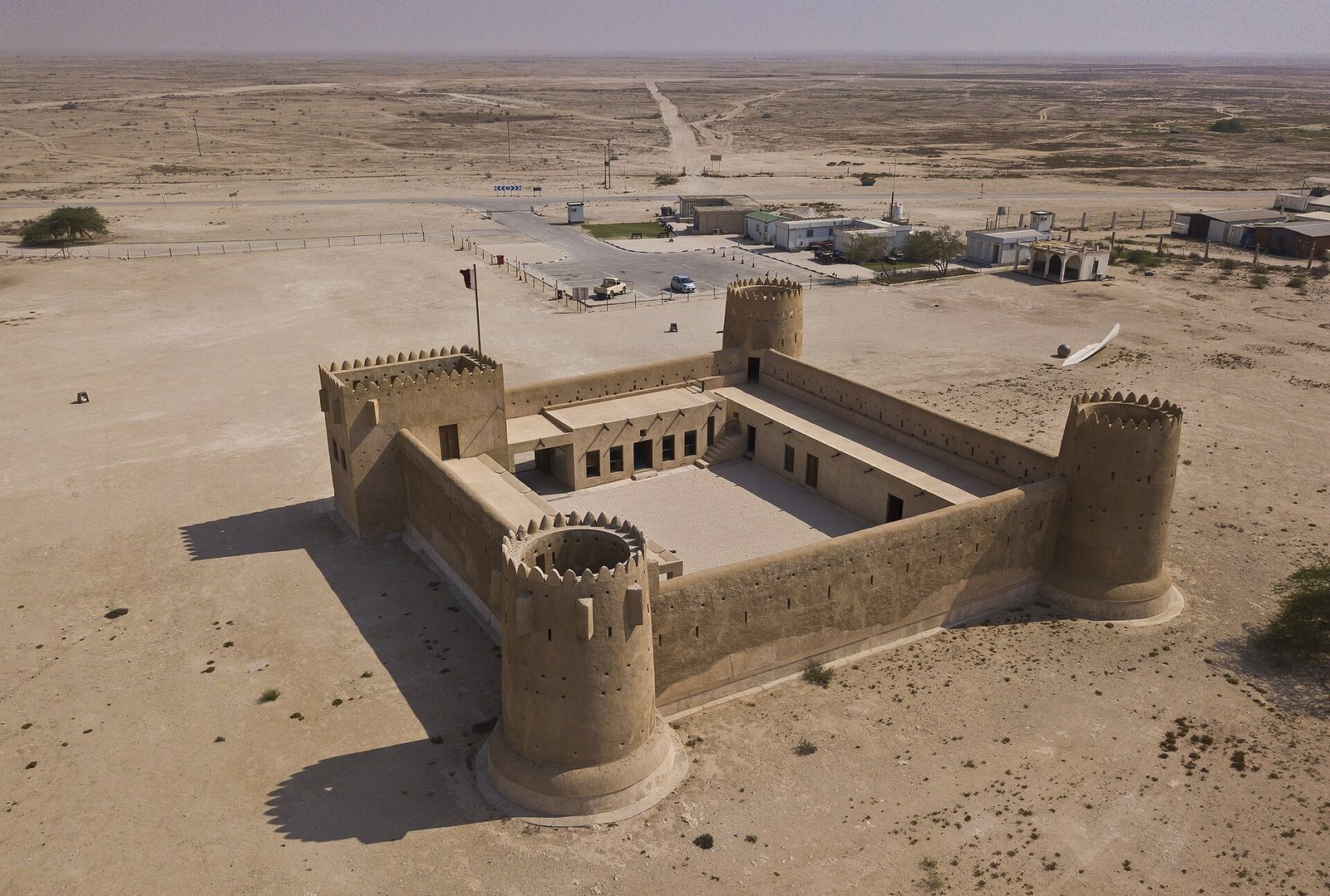
Built in 1937–1938 as a military and police base protecting Qatar’s northwestern coast, Al Zubarah Fort has a square plan and sloping walls. Three of its corner towers are round, while the southeastern tower is rectangular. All have raised, notched defenses along their tops; the southeastern tower has the greatest provision of openings through which defenders could attack below. The fort combines traditional Arab and Gulf defensive forms with concrete foundations, reflecting a shift from all-stone construction toward cement-based building. It was restored in 1987, and later auxiliary buildings erected for Qatari forces were removed. The fort subsequently served for a time as a local museum. Finds were moved to Doha in 2010 because the conditions were unsuitable for their display and storage, and monitoring and restoration work began in 2011.
Market, food production and finds
Market and date presses
Small storage rooms identified as part of the market contained a variety of trade goods. The market included commodities such as ironwork and is thought to have been the town’s economic center. Date presses were found in houses throughout Zubarah. Each occupied a small room with a ridged plaster floor sloping toward a jar in one corner. Workers packed dates into sacks and weighted them to draw out syrup for storage, eating or cooking. Excavations in 2014 uncovered 27 presses, 11 within a single complex.
Trade and everyday life
Objects from excavations show that late-eighteenth-century Zubarah traded with eastern Asia, Persia, the Ottoman Empire, Africa, Europe and other Gulf communities. The finds include ceramics, coins, food remains, pearl boxes, diving weights and small weights used in commerce. Coffee vessels, many made in China, and bowls from ceramic tobacco pipes provide evidence of consumption practices. In one courtyard building, someone incised an image of a merchant’s dhow into plaster. Food remains suggest differences in diet: wealthier residents relied more heavily on livestock, while poorer residents depended chiefly on fish.