Zhvantsem Castle: A Polish Crown Frontier Fortress in Ukraine


Site at a Glance
- Rating
- 4.3
- Popularity
- Low
- Country
- Ukraine
- Primary era
- Early Modern
- Eras represented
- Medieval, Early Modern, Modern
- Civilizations
- Kingdom of Poland, Polish–Lithuanian Commonwealth
- Site type
- Military
- Remains
- Castle
On this page9 sections
History
Zhvantsem Castle is a ruined frontier fortress in Ukraine, north of Zhvanets, whose defensive development began in the fifteenth century under Polish rule. Its position near the Dniester frontier and the Ottoman fortress at Khotyn made it an important link in the southern defensive chain of the Polish Crown. The castle took its lasting military form during an early seventeenth-century rebuilding for contemporary artillery warfare.
Foundation and early development
In 1431, King Władysław II Jagiełło granted Zhvanets to the knight Świeczka of Łęczyna. By 1469, the settlement had become royal property leased by Michał Buczacki. During Buczacki’s tenure, the first fortress was built, although its original form is unknown.
Zhvanets passed to the Kalinowski family at the end of the sixteenth century. During the first quarter of the seventeenth century, Walenty Aleksander Kalinowski, the general starosta of Podolia, substantially rebuilt and modernized the castle. A starosta was a royal official who administered a district or held a royal estate. The work strengthened the fortress with stone-and-earth ramparts along the courtyard side of its walls, stone casemates beneath them, and towers remodeled into artillery-oriented bastions. A bastion is a projecting fortification designed to allow defensive fire along adjoining walls, while a casemate is a fortified chamber used for protection, storage, or weapons.
Kalinowski’s rebuilding gave the castle a largely definitive form, although its defenses were altered and strengthened several times afterward. Stanisław Lanckoroński later acquired the property through the dowry of Kalinowski’s sister. After the Lanckoroński family regained the castle, it was rebuilt.
Sieges and destruction
In 1653, the castle sheltered Polish troops besieged by the forces of Hetman Bohdan Khmelnytsky, the Cossack leader whose uprising against the Polish-Lithuanian Commonwealth began in 1648. In 1672, as the Ottoman army approached, the garrison withdrew to the more strongly fortified nearby city of Kamianets-Podilskyi, judging the smaller fortress indefensible.
Military operations involving King Jan III Sobieski in 1673 and 1684 caused major damage to the fortifications. Polish forces recaptured the castle in late August 1684. Following the Treaty of Karlowitz in 1699, it officially returned to Poland.
During the Bar Confederation, a Polish noble confederation formed in 1768 against Russian influence and the authority of King Stanisław August Poniatowski, the castle was briefly occupied by confederate forces. Russian troops then took it from them. A Turkish-Tatar invasion destroyed the castle again in 1768, and Ottoman and Tatar forces also made its final capture that year.
Loss of military importance
After 1793, Zhvanets became part of the Russian partition, and the castle no longer had military importance. In 1844, the Russian government purchased it with plans to establish a major military fortress, but the project was abandoned. The derelict castle was gradually dismantled for building materials.
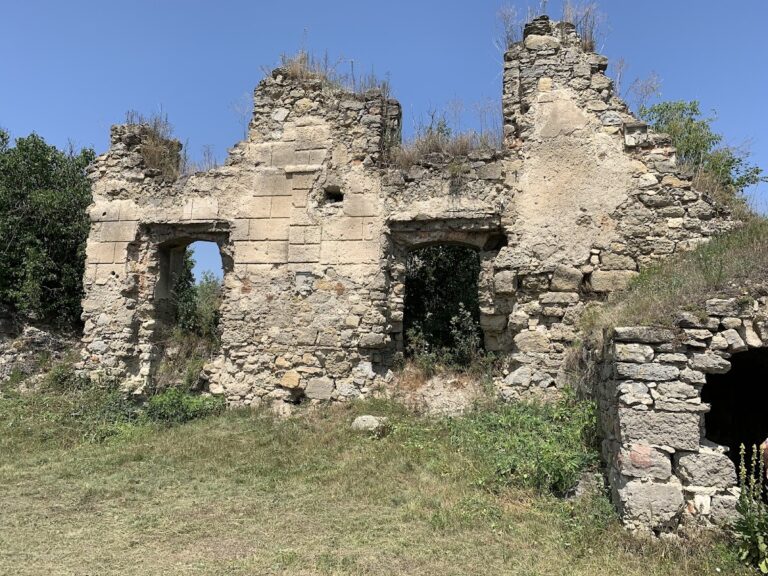
The fortifications suffered heavy damage and were reduced to ruins during the twentieth century. Archaeological excavations identified an earlier defensive structure beneath the surviving northern tower, while comprehensive scientific study of the castle remains limited. The ruins are designated a monument of architecture of national significance in Ukraine.
Remains
The castle occupied a steep rocky promontory north of Zhvanets, descending toward the Zhvančyk River. Its irregular pentagonal enclosure stood between Kamianets-Podilskyi and Khotyn. The north-western and north-eastern walls followed the edge of the precipice, while the other sides were separated from the town by a deep dry ditch.
Enclosure and defensive works
Walls, towers, and gate
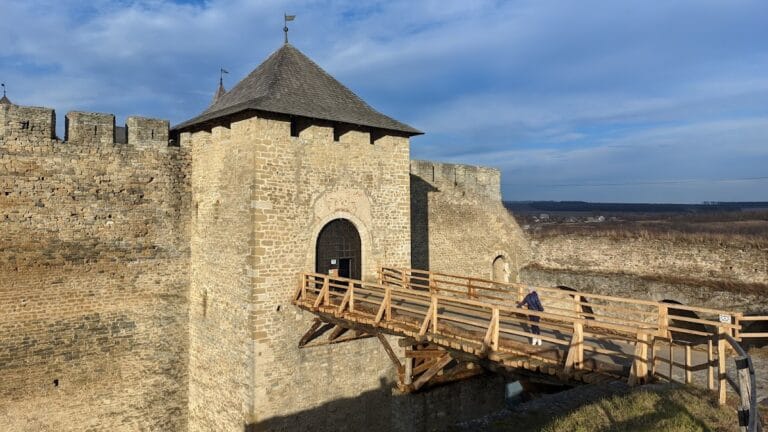
Five pentagonal towers occupied the corners of the enclosure. A two-story gate building stood in the middle of the south-western curtain wall, the main wall connecting the towers, and a sixth tower rose above the entrance. Along the courtyard side, stone-and-earth ramparts reinforced the walls and contained stone casemate rooms. These defenses belonged to the early seventeenth-century modernization, when the towers were adapted as bastions for artillery.
Northern tower
The northern pentagonal tower is the best-preserved part of the castle. Four of its sides measure 9 metres each and stand on the steep slope; the fifth side, facing the courtyard platform, measures 7.5 metres. At the level of the first tier, the walls are 2 metres thick. Each tier had its own entrance, and the embrasures on the two lower tiers have rectangular light openings.
Excavation beneath the northern tower revealed an earlier defensive structure. It had the form of a bastion open toward the interior of the fortress, showing that the surviving tower was built over an older phase of the castle’s defenses.
Surviving structures and later military use
The surviving architectural remains consist of the northern tower, part of the eastern tower, and relics of the gate building. Together with fragments of the fortified enclosure, they form the ruined remains of the castle’s irregular defensive plan.
A World War II machine-gun emplacement belonging to the Stalin Line also stands within the castle grounds. The Stalin Line was a Soviet system of fortified defensive installations constructed along the western frontier before 1939. This position was placed to cover the valleys of the Dniester, Zhvančyk, and Zbruch across many kilometres, providing an elevated observation and defensive post within the earlier fortress site.