Yeh Pulu: A Hindu Rock-Relief Site in Bali
Site at a Glance
- Popularity
- Low
- Country
- Indonesia
- Primary era
- Medieval
- Eras represented
- Medieval
- Civilizations
- Balinese, Majapahit
- Site type
- Religious
- Remains
- Sanctuary
On this page9 sections
History
Yeh Pulu is a Hindu archaeological site in Bedulu, Bali, Indonesia, whose carved reliefs are usually dated to the 14th or 15th century and linked to the late Majapahit period. Majapahit was a major Javanese kingdom that flourished from the 13th to the 15th centuries. Other interpretations place the carvings in the 14th century or as early as the 13th, before Majapahit’s invasion of Bali, during the rule of an earlier Balinese kingdom.
A reading of the carvings as a story about Krishna, a Hindu deity traditionally regarded as an avatar of Vishnu, has also been proposed, but the connection is uncertain. Local tradition relates that around 1343, after the king of Bedaulu was defeated in battle by Majapahit, he meditated in the cave at Yeh Pulu.
Discovery and preservation
In 1925, a local administrative official from Ubud brought Yeh Pulu to the attention of the Dutch colonial authorities. Nieuwenkamp soon described the site in a report for the Dutch colonial antiquities service, noting that water running down from the rice fields had damaged it. Preservation work led by W. F. Stutterheim followed a further examination in 1929. Repairs in 1949 and 1953 included steps to shield the sandstone wall from runoff from the fields above.
Remains
The site covers about 400 square metres and measures roughly 40 m long by 10 m wide. At an elevation of approximately 175 m, it lies about 500 m southeast of Goa Gajah. Rice fields surround the area, while the Petanu River is to the west.
Spring and name
A spring on the western side was covered by a barrel-shaped vessel. The name Yeh Pulu means “water barrel” and refers to this feature.
Sandstone relief wall
Carved surface and northern scenes
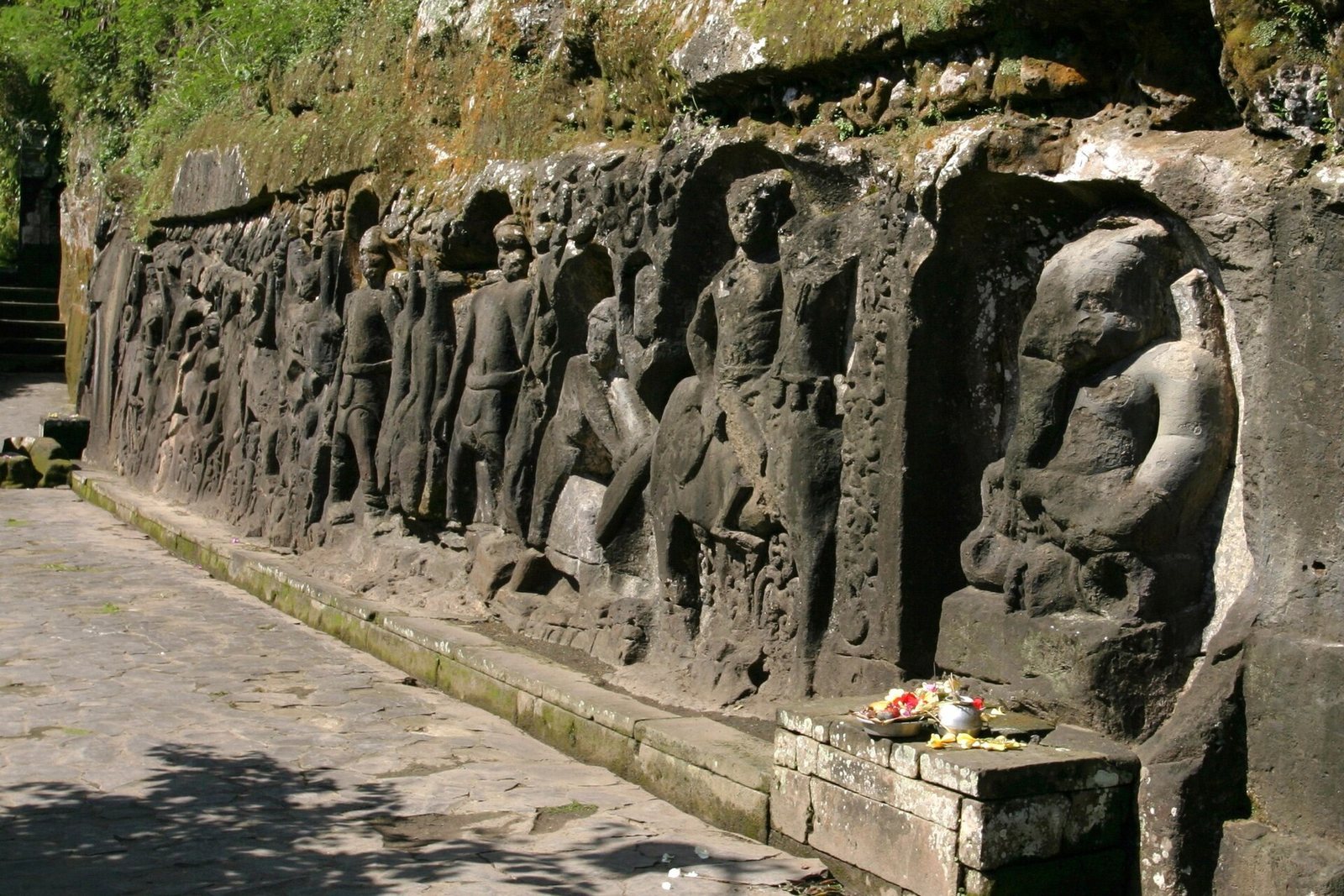
A sequence of carvings runs along the rock wall for about 25 m. The reliefs rise to roughly 2 m, and their carved depth is about 50 cm, with measurements ranging from 30 to 60 cm. The scenes occupy a single face and proceed from north to south, divided into an estimated six to nine groups. They show people, animals, and plants in symbolic scenes. Many figures recall wayang kulit, Indonesian shadow-puppet theatre. Unlike the 15th-century Kamasan style, a traditional Balinese visual art known for epic scenes of gods and kings, the carvings here emphasize symbolic portrayals of everyday life, including a figure resembling a noblewoman.
At the northern end, a standing man raises his right hand and places his left palm on his hip beside a stylized tree motif used in shadow-puppet theatre. The figure has been identified by some as Krishna, though that identification and the proposed Krishna narrative remain uncertain. Farther south, a man carries two pots on a shoulder pole as a woman walks ahead of him. She wears ornaments, and part of a crown-like headdress can be seen. Another scene shows a woman looking out through the partly open doorway of a house.
Ascetic and seated figures
A turbaned ascetic sits in a crouch, shown in profile and facing south. Nearby, a man with a hoe over his shoulder reaches toward a woman seated on a stone; she extends her right hand toward him. Three monkeys appear below her. Behind the seated woman, another woman stands with her back to the ascetic and raises her right hand. Farther south, a fearsome-looking man sits on a square pedestal with his left knee raised and a club in his right hand.
Hunting and southern scenes
In a hunting scene, a mounted man holds a knife-like weapon. Ahead of him, another man stands with his legs apart, ready to throw a spear. Farther along, a man struggles with a tiger, which bites his right hand. Two men carry hunted pigs upside down, their feet tied to a pole. In a scene farther south, a woman grips the tail of a horse ridden by a man. The sequence ends with Ganesha, a widely worshipped Hindu deity associated with wisdom and the removal of obstacles, seated on a rectangular pedestal.
Meditation cave
A cave or niche at one end of the relief wall is about 9 m wide, 2 m high, and 2 m deep. A central support divides the space. It is regarded as a place for meditation.