Klungkung Palace: Royal Court and Ceremonial Complex in Bali
Site at a Glance
- Rating
- 4.5
- Popularity
- Low
- Country
- Indonesia
- Primary era
- Early Modern
- External website
- Open
- Eras represented
- Early Modern
- Civilizations
- Balinese
- Site type
- Domestic
- Remains
- Palace
On this page9 sections
History
Klungkung Palace, officially Puri Agung Semarapura, is a Balinese royal palace in Semarapura, Indonesia, built at the end of the seventeenth century as the court of the Klungkung kingdom. It succeeded the older Gelgel kingdom and retained considerable political prestige on a Bali divided among several royal states.
From Gelgel to Klungkung
Dalem Di Made, regarded as the last king of Gelgel, ruled after the death of his father, Dalem Seganing, around 1623. During his reign, aristocratic factions gained strength. Gusti Anung Maruti, the king’s chief minister and a member of the powerful patih family, eventually seized power, although the date of this event is uncertain. A patih was a high-ranking minister or vice-regent in a Balinese court.
The political succession that followed was troubled. Di Made may have escaped confinement at Gelgel and reached Guliang in southern Bangli. Dewa Pacekan may then have succeeded him, while his brother Dewa Cawu was crowned nominal king in 1651 during civil war. Dutch records place Maruti’s rule at Gelgel in 1665–1667 and again in 1686. A letter received in Batavia in 1656 had already announced him as Bali’s new ruler.
Dewa Agung Jambe I, the son of Dalem Di Made, recovered Gelgel with support from nobles in Badung, Karangasem, and Tabanan. After defeating Gusti Anung Maruti in 1686, he established a new court about three kilometres north of Gelgel. He named its capital Puri Semarapura, meaning “Abode of the Gods.” The new palace was built as the political heir of Gelgel, although Klungkung no longer possessed all of its predecessor’s powers.
The dynasty traced its genealogy through the Kapaisan line to Majapahit, a major Javanese kingdom that flourished from the late thirteenth century into the sixteenth century. This tradition appears in the Babad Dalem, a Balinese royal chronicle associated with Klungkung history and genealogy. Descendants of Dewa Agung Jambe I ruled for more than two centuries under the title Dewa Agung. The title was used by the rulers of Klungkung and by members of their dynastic line.
Royal succession and regional politics
Dewa Agung Gede, also known as Surawirya, ruled about 1722–1736 and joined the king of Mengwi in an expedition to Java. After his death, conflict between his sons, Dewa Agung Gede and Dewa Agung Made, ended when Dewa Agung Made defeated the Karangasem allies of his rival.
Dewa Agung Made was followed by his son, Dewa Agung Sakti, who suffered from mental illness. Dewa Agung Sakti’s wife fled to Karangasem, where their son Dewa Agung Putra I was raised. Near the end of the eighteenth century, Karangasem supporters placed him on the Klungkung throne. He became a strong ruler and died during a minor war at Bangli in 1809.
His son, Dewa Agung Putra II, ruled from 1814 to 1850 alongside his daughter and co-regent, Dewa Agung Istri Kanya. In 1843, Dewa Agung Putra II signed a treaty with the Dutch colonial authorities. Conflicting interpretations of the agreement contributed to Dutch military expeditions in 1846, 1848, and 1849. The final expedition entered Klungkung territory, but Dewa Agung Istri Kanya led resistance that halted the Dutch advance. A general reconciliation between the Balinese rajas and the Dutch authorities followed.
Dewa Agung Putra III, a grandson of Dewa Agung Sakti, ruled from 1851 to 1903 and intervened actively in the affairs of other southern Balinese kingdoms. He imprisoned the Raja of Gianyar in 1885 and was heavily involved in the destruction of the Mengwi kingdom in 1891. Dewa Agung Jambe II succeeded him in 1903 and adopted a defiant position toward the expansion of Dutch colonial control.
The 1908 puputan and the palace’s destruction
The alleged plundering of the stranded ship Sri Kumala in 1904 helped lead to a renewed Dutch military campaign in 1906. After a related incident at Gelgel, the Dutch launched a punitive expedition against Klungkung in 1908.
On 18 April 1908, Dewa Agung Jambe II, members of the royal dynasty, and their retainers left the palace and made a final puputan, a Balinese last stand in which a defeated community fights to the death rather than surrender. The fighting continued until the last combatants died, including women and children. Members of the royal group also killed some people who had not been killed by Dutch gunfire.
After the puputan, surviving members of the royal family were exiled and the palace was largely razed. In 1929, the family received permission to return and settled in the newly built Puri Agung west of the old palace. Puri Agung is distinct from the surviving old-palace complex. A nearby museum commemorates Klungkung’s history and the events of 1908, while a monument north of the palace commemorates the same puputan.
Remains
Palace layout and surviving entrance
The palace complex followed a square plan measuring about 150 metres on each side. Its principal gate faced north, and the compound was divided into blocks with separate ritual and practical functions. The complex was conceived as a replica of the older Gelgel palace, according to the Babad Dalem. The main gate is one of the principal surviving elements and carries the date Saka 1622, corresponding to 1700.
Court and ceremonial pavilions
Kertha Gosa Pavilion
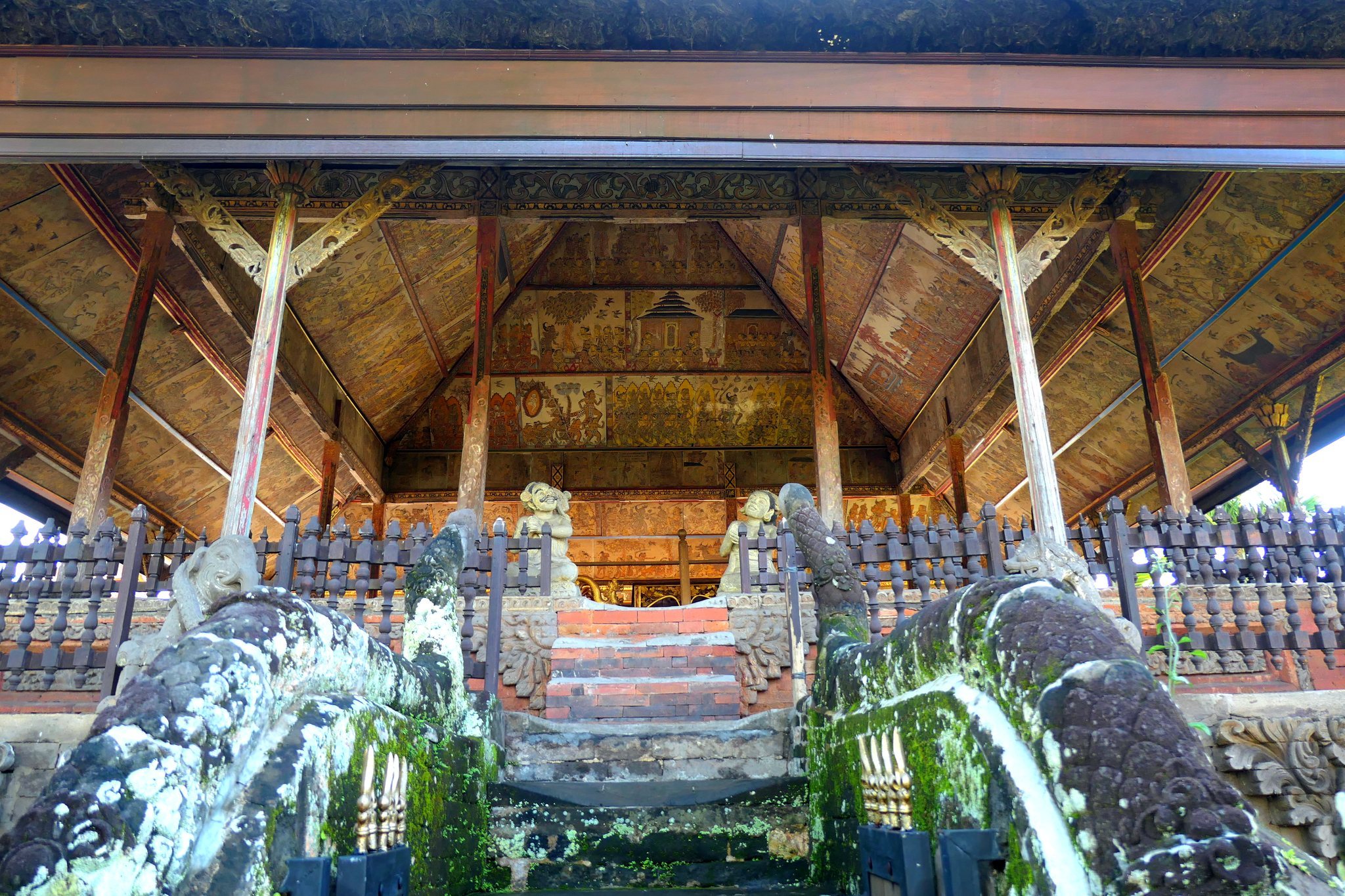
Kertha Gosa stands in the northeastern corner of the palace compound. Built at the end of the eighteenth century, it exemplifies the Klungkung style of architecture and painting. It served as the court of the high king of Bali, where cases that could not be resolved elsewhere on the island were transferred. Three Brahmana priests, members of the priestly class in Balinese Hindu society and religious practice, presided over the court.
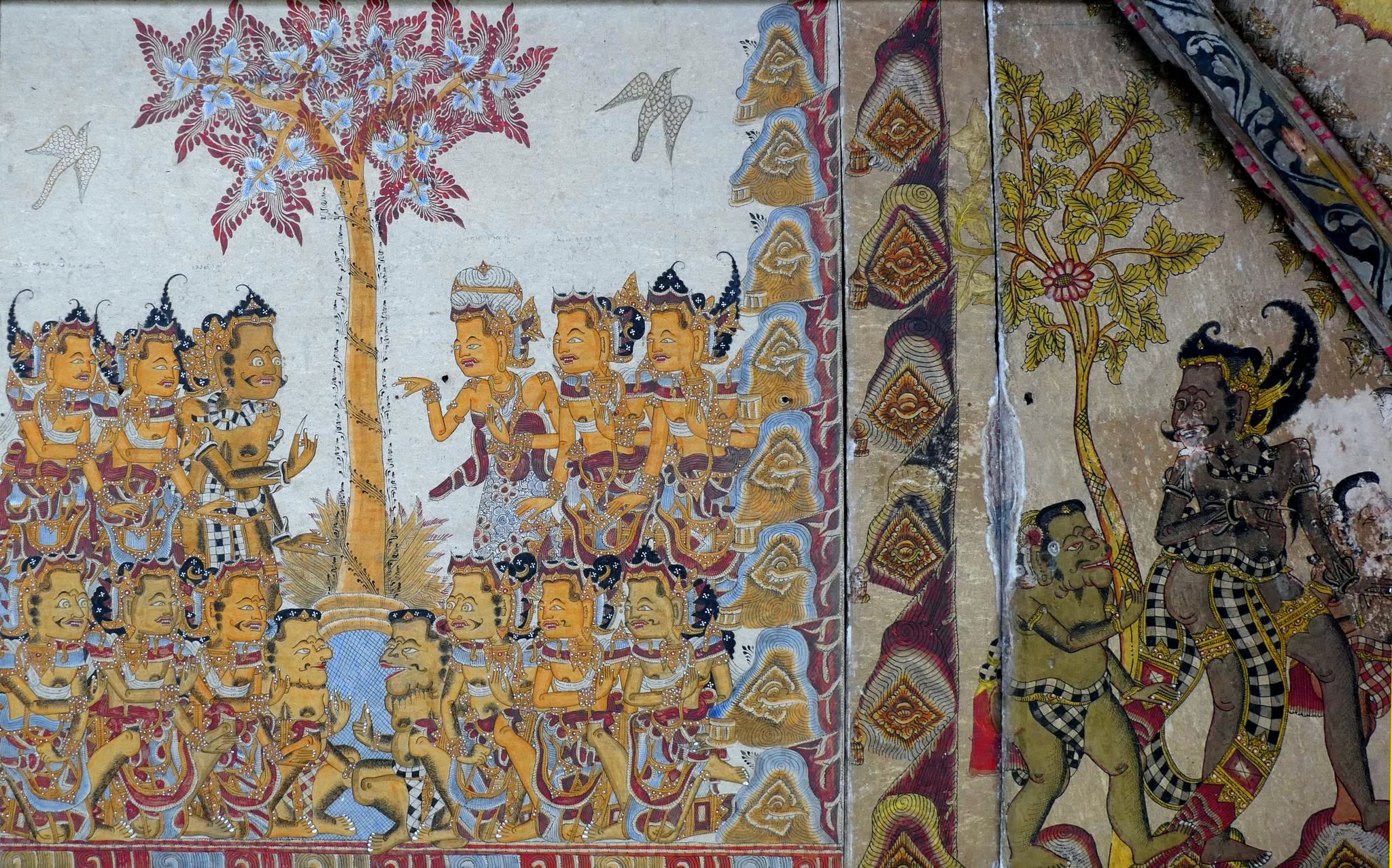
The pavilion’s ceiling paintings portray punishments in the afterlife and the consequences of karma, the moral effects of actions, including their effects after death. They are outstanding examples of the Kamasan Wayang tradition, a Balinese narrative painting style associated with the village of Kamasan. The scenes include the story of Bima in heaven and hell, the Tantri and Garuda stories, and Palindon, images of earthquake portents.
The paintings were probably first produced in the mid-nineteenth century. They were renewed in 1918, 1933, and 1963, and individual panels were repaired during the 1980s and 1990s. Twentieth-century repainting was carried out by artists from Kamasan, including Kaki Rambut, Pan Seken, Mangku Mura, and Nyoman Mandra.
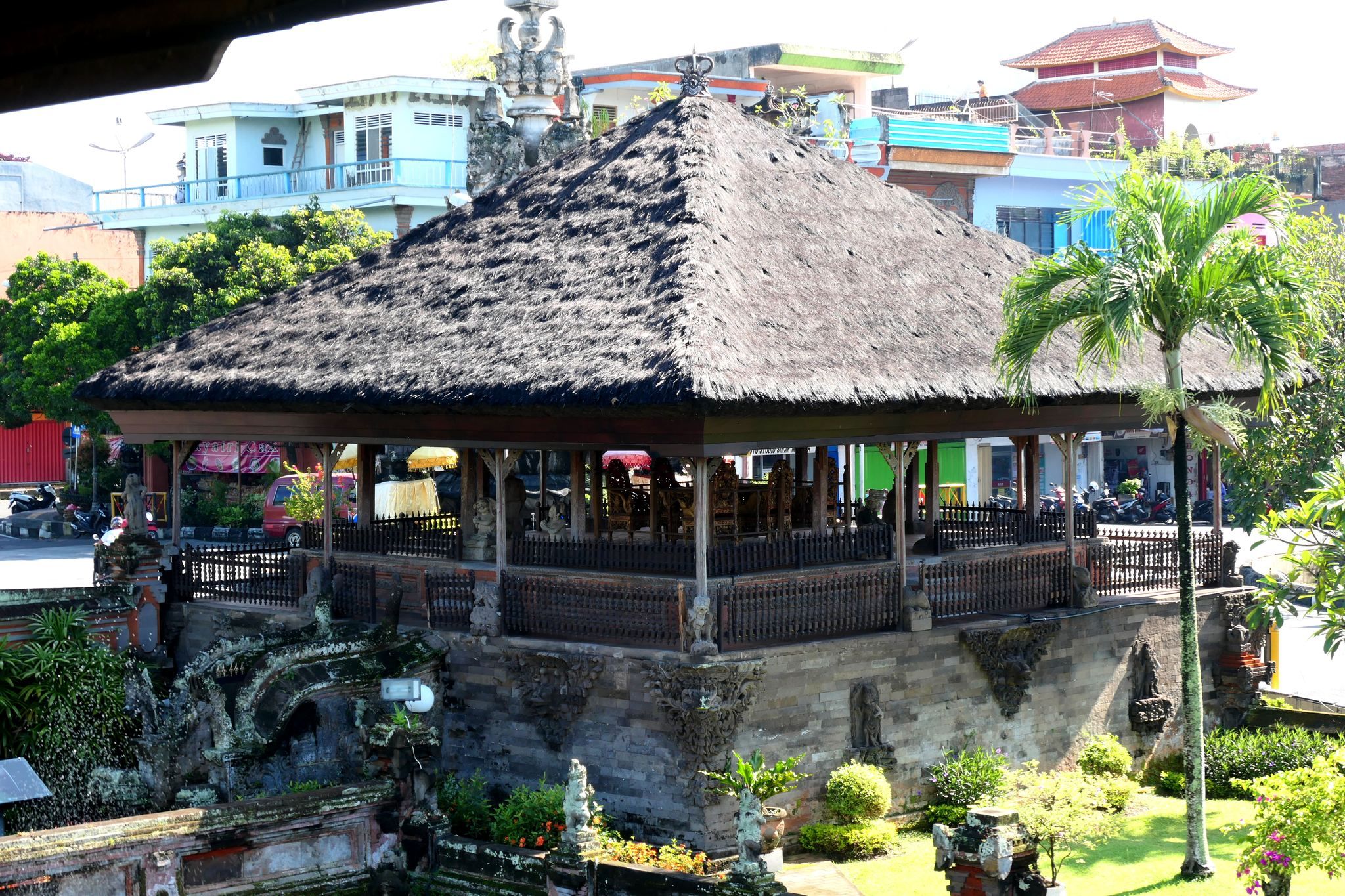
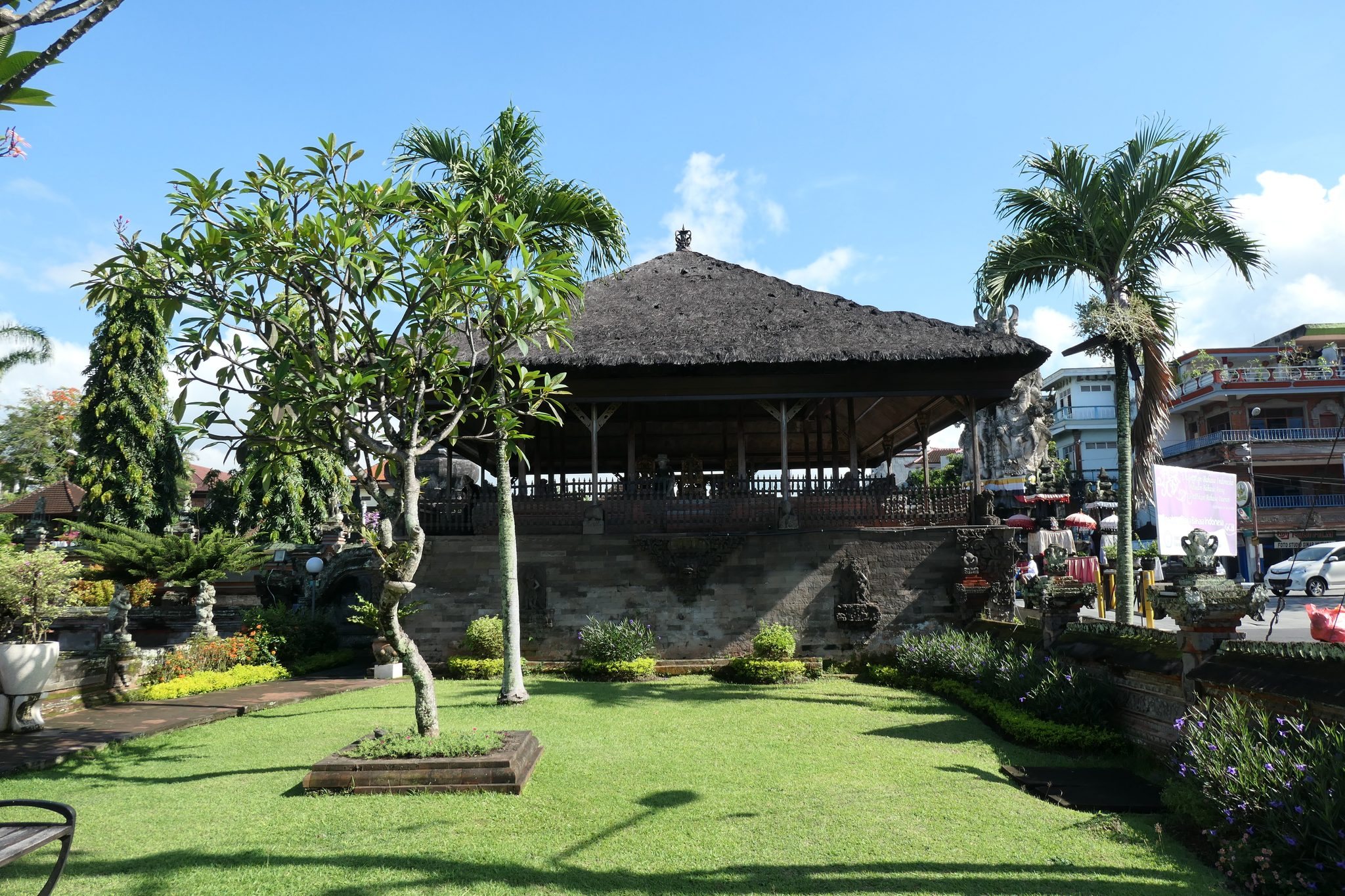
Bale Kambang
Bale Kambang, also called the Floating Pavilion, is a wall-less pavilion in the same courtyard, next to Kertha Gosa. A moat surrounds it and creates the impression that the structure floats. Its ceiling carries complex paintings arranged in six levels. The lowest level shows Palalintangan, Balinese astrological charts. The second presents the Men Brayut tale of the ideal family, while the four upper levels depict the Sutasoma epic.
The pavilion’s exact function is uncertain. It has been interpreted as a headquarters for the royal guards, an antechamber for royal visitors, a place where the royal family relaxed and entertained themselves, and a setting for meditation. The last interpretation connects the two highest levels of paintings with overcoming obstacles, resisting temptation by nymphs, and attaining self-realization as Mahavairocana, a cosmic Buddha associated with universal Buddhahood in Mahayana Buddhist thought.
Bale Kambang’s design represents Mount Meru, the cosmic mountain regarded in Hindu and related traditions as the centre of the universe. Its surrounding moat represents the cosmic ocean and the life-giving source Anavatapa. The symbolism also links the syllable me, or meme, with the mother and earthly existence, and ru with the teacher, father, and human realm. Together, these associations express the power of ancestral lineage.