Gunung Kawi: An Eleventh-Century Hindu Funerary Complex in Bali
Site at a Glance
- Rating
- 4.7
- Popularity
- Low
- Country
- Indonesia
- Primary era
- Medieval
- Eras represented
- Medieval
- Civilizations
- Balinese
- Site type
- Religious
- Remains
- Tomb
On this page12 sections
History
Gunung Kawi is an eleventh-century Hindu temple and funerary complex at Tampaksiring in Gianyar, Bali, Indonesia, carved into the cliffs along both sides of the Pakerisan River. Its rock-cut sanctuaries belong to the period associated with King Udayana and his son Anak Wungsu, rulers of the Warmadewa dynasty, the medieval ruling house of Bali. The complex is interpreted as a royal funerary monument, although its shrines have not yielded human bones or ashes and may therefore have served a symbolic rather than literal burial purpose.
The Warmadewa royal family
Gunung Kawi is linked with Udayana, who ruled Bali and married the Javanese princess Gunapriya Dharma Patni, also known as Mahendradatta. Their sons included Airlangga, who later ruled East Java, and Anak Wungsu, who became king of Bali. A theory concerning the eastern group of shrines associates its five monuments with Udayana, Mahendradatta, Airlangga, Anak Wungsu, and another son, Marakata. The four shrines on the western side are connected with lesser queens or concubines of Anak Wungsu.
The clearest written clue appears on a false door belonging to the northern shrine in the eastern group. Its inscription, in Kediri script, reads haji lumah ing jalu, a phrase interpreted as “the king who is symbolically buried at Jalu.” The king is identified, or thought to be identified, with Udayana. The word “Jalu” means a rooster’s spur and has also been associated with a kris and with the Pakerisan River. Other inscriptions on the false doors are largely unreadable and may have contained personal names or royal titles.
Ritual meaning and traditional accounts
The complex was connected with Bali’s sacred-water traditions, including pura tirta, or water temples associated with springs and waterways. Its religious identity was also related to the subak system, Bali’s cooperative method of managing irrigation through agricultural and religious institutions. Sacred water described as amritha, a divine nectar associated with immortality, formed part of this ritual understanding.
The name Gunung Kawi is traditionally explained through words referring to a mountain and sculpture, reflecting the sanctuaries cut into the cliff. Local folklore gives the work a different origin, attributing the carving to the legendary figure Kebo Iwa. According to the tradition, he shaped the cliffs with his fingernails in a single day and night. This story belongs to local tradition rather than the archaeological dating of the complex.
Rediscovery and interpretation
Dutch archaeologists rediscovered Gunung Kawi in the forest near Tampaksiring around 1920. Since then, the site has been understood through its inscriptions, carved architecture, royal associations, and relationship with the surrounding sacred-water landscape. The complex is generally described as containing ten funerary monuments or sanctuaries. The main eastern and western groups account for nine shrines, while Geria Pedanda is regarded as the additional “tenth tomb.” An inscription containing the title rakryan, a high-ranking official or ministerial title, has led to the view that this area may have been associated with a prime minister or another senior royal officer.
Remains
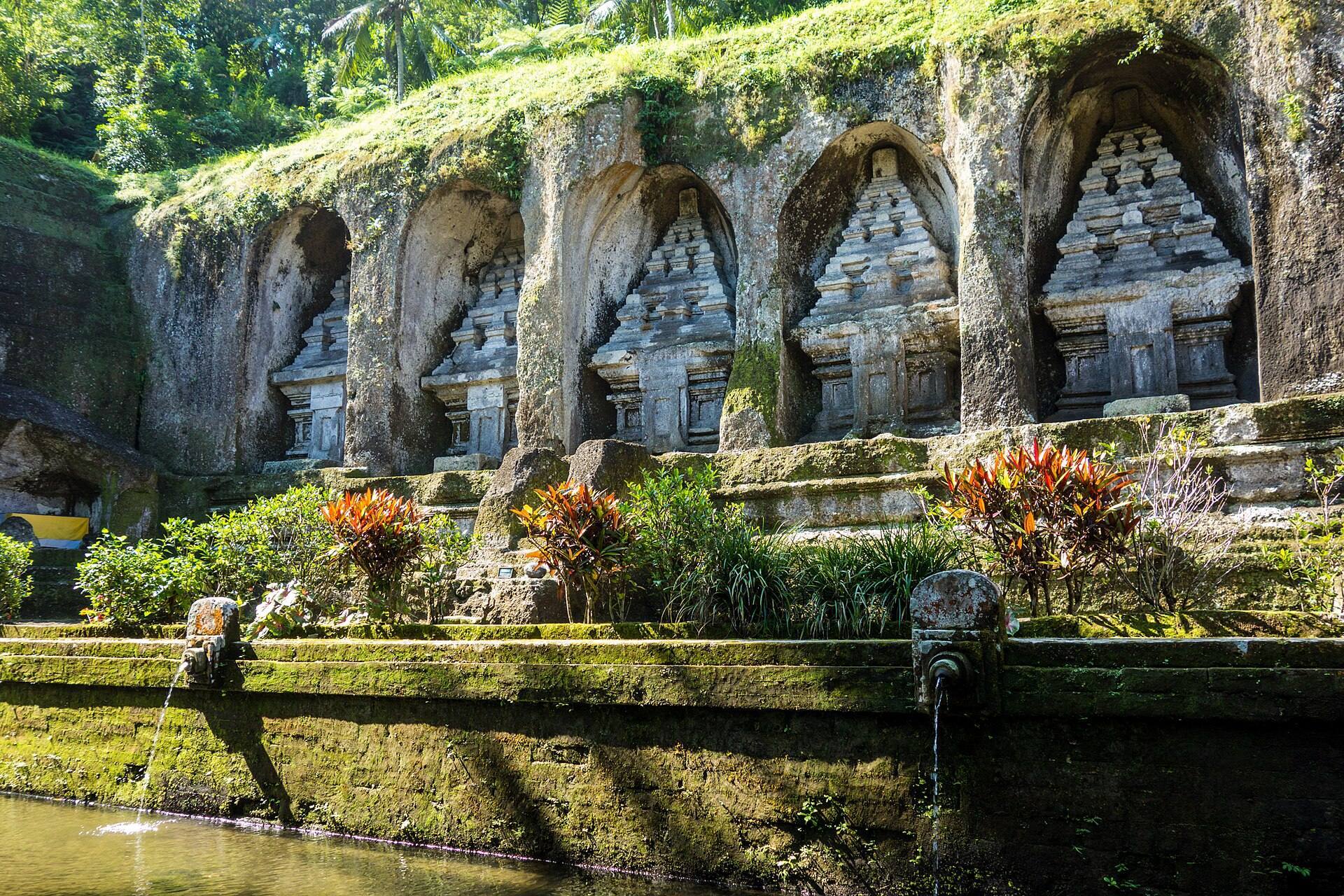
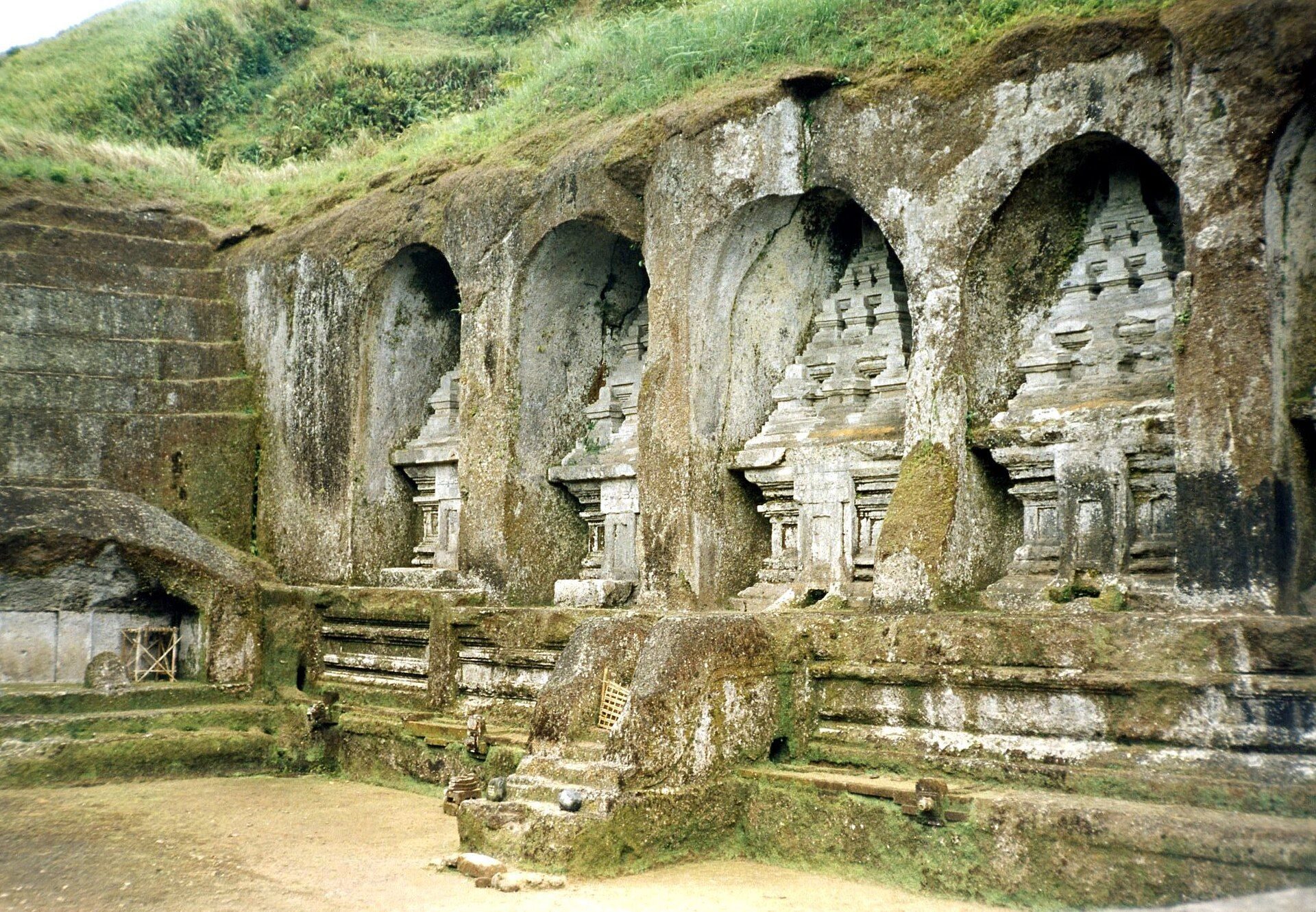
Gunung Kawi occupies both banks of the Pakerisan River, where steep cliffs and rice terraces frame a sequence of rock-cut religious spaces. The approach descends beside the river through roughly 315 stone steps bordered by masonry walls. Unlike temples assembled from separate blocks, the principal sanctuaries were carved directly into the cliff. They occupy sheltered niches about 7 metres high, while their recessed positions provide protection from weathering and erosion.
The eastern and western shrine groups
Eastern shrines
The eastern group faces west and consists of five shrines set within broad, carefully shaped niches. Their façades imitate temple architecture while remaining part of the cliff itself, creating enclosed architectural forms in the rock. The shrine at the left end stands slightly higher than the others and is associated with Anak Wungsu. The false doors carry inscriptions, including the readable text linked with the symbolic burial of a king at Jalu. The remaining inscriptions are difficult to read and are thought to have recorded names or titles.
Western shrines
The western group faces east and contains four shrines cut into the opposite cliff. This side also includes a spring, a bathing or ritual pool, and fountains, linking the monuments with the sacred-water practices associated with the Pakerisan River and the subak irrigation system. The shrines are recessed within curved or arched rock settings, whose form both frames the carved façades and shelters them from erosion.
Hermitages and religious spaces
Rock-cut vihara
The western side contains a rock-cut vihara, a monastic or religious residence, arranged around a courtyard. Small chambers resemble cells, and openings in the walls and roof supplied ventilation and daylight. These rooms may have supported meditation, prayer, rest, or meetings involving religious figures and royal officials. The carved rooms preserve a different aspect of the complex from the funerary shrines, showing how cliff-cut spaces could accommodate religious and administrative activity.
Geria Pedanda
Geria Pedanda lies on the eastern side of the river and consists of a gateway with several rock-cut hermitage spaces. It is identified with the additional monument called the “tenth tomb.” Its rakryan inscription connects the feature with a high-ranking official, although the precise funerary purpose of the area remains an interpretation rather than a settled identification.
Southeastern hermitages
Additional hermitage niches and a partly unfinished vihara extend farther southeast of the main complex, beyond the rice fields. These spaces include carved rooms and cliff-cut areas that appear incomplete. Together with Geria Pedanda and the principal shrine groups, they form a wider complex of sanctuaries, residences, and ritual spaces rather than an isolated row of monuments.