Goa Gajah: An 11th-Century Hindu Sanctuary in Bali
Site at a Glance
- Rating
- 4.2
- Popularity
- High
- Country
- Indonesia
- Primary era
- Medieval
- Eras represented
- Medieval
- Civilizations
- Unclassified
- Site type
- Religious
- Remains
- Sanctuary
On this page9 sections
History
Goa Gajah is an 11th-century Hindu sanctuary and cave temple in Bedulu, Bali, Indonesia, associated with religious activity during the period of the Balinese Warmadewa dynasty. Its exact origins remain uncertain, but the sanctuary is generally placed in the 11th century through its inscriptions and artistic style. It may have been established as a place for spiritual meditation. A local tradition attributes its creation to the legendary giant Kebo Iwa, whose fingernail was said to have carved the cave.
Warmadewa-period religious center
Goa Gajah functioned as a Hindu sacred center while the surrounding area also supported Buddhist religious activity. Nearby Buddhist remains indicate that the wider Bedulu landscape was an important center for both traditions during the Warmadewa period, broadly from the 10th to the 14th centuries. The sanctuary’s proposed 11th-century setting also falls within the reign of Airlangga, the ruler of Java who was born to the Balinese ruler Udayana and the Kediri princess Mahendradatta.
The name Goa Gajah means “Elephant Cave.” It may refer to the elephant-like appearance once attributed to the principal entrance figure, to the image of Ganesha inside the cave, or to the earlier name Lwa Gajah, meaning “Elephant River,” possibly linked with the nearby Petanu River. Lwa Gajah and Bedahulu appear in the Desawarnana, also known as the Nagarakretagama, a Javanese court poem composed by Mpu Prapanca in 1365. The poem lists them among Balinese territories acknowledging the authority of the Majapahit kingdom, a powerful Javanese polity that extended influence across parts of the Indonesian archipelago.
Several Balinese inscriptions may preserve related place names. The 1022 Songan Additional Inscription and the 1324 Cempaga Inscription mention Er Gajah, while the 1053 Dawan Inscription and the 1071 Pandak Badung Inscription mention the sacred place Antakunjarapadda. These references have contributed to the historical interpretation of the sanctuary and its surrounding religious landscape.
Rediscovery and continuing religious use
The cave was first reported by an official of the Dutch colonial administration and was rediscovered by Dutch archaeologists in 1923. Further investigation followed in 1925. Archaeological research and excavation continued from the early 1950s through 1979. Work in 1951 and 1952 exposed a rectangular ancient foundation in front of the cave, with the cave facade forming one of its long sides. The buried bathing complex was excavated and reconstructed in 1954 under the direction of J. L. Krijgman.
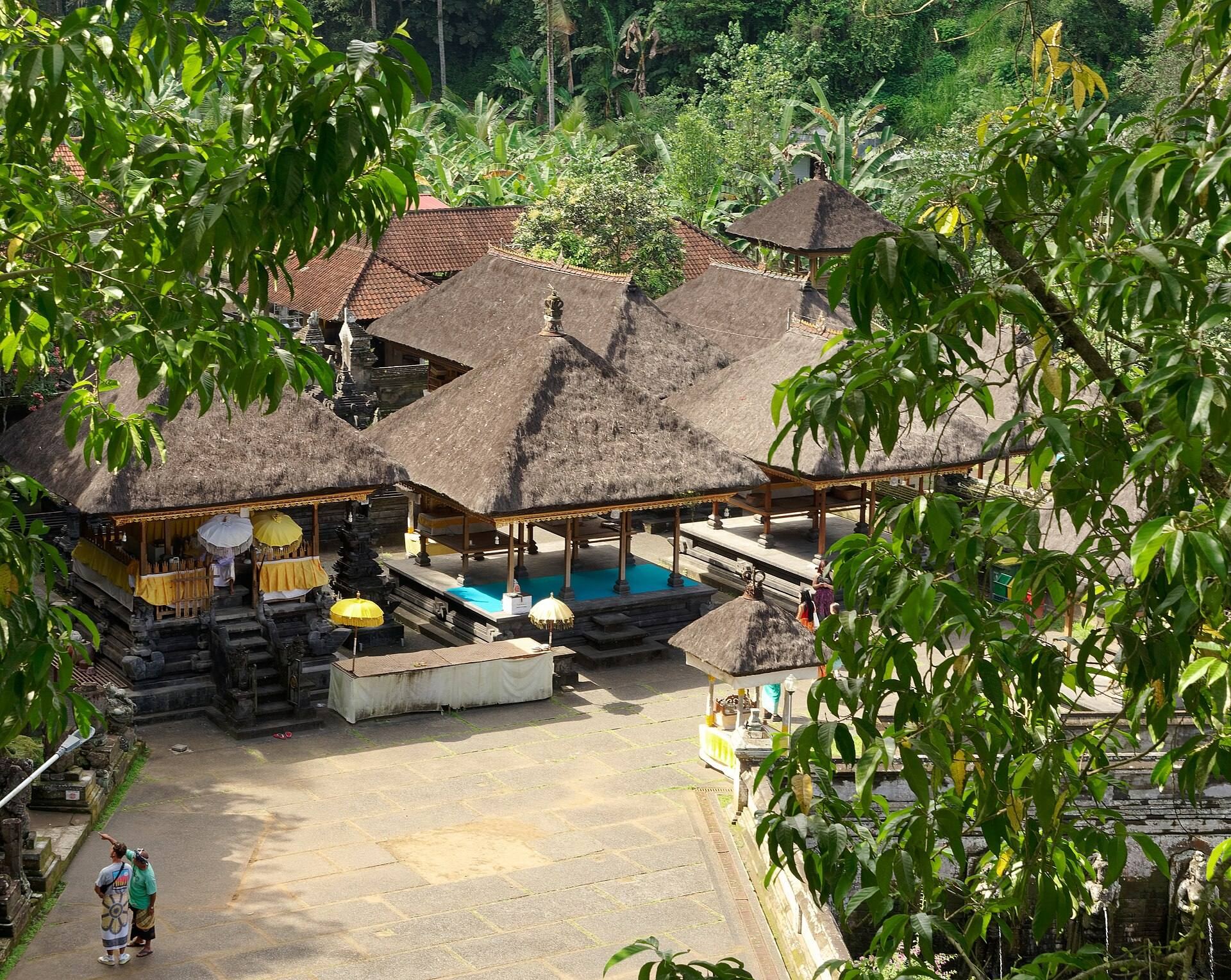
In 1931, Conrat Spies identified important Buddhist remains in the Tukad Pangkung complex, including a three-branched stupa carved into a rock face that had collapsed into the ravine. Goa Gajah was placed on UNESCO’s World Heritage Tentative List in the cultural category in 1995 and removed from the list in 2015 along with eleven other sites. It remains a living Hindu religious monument and continues to function as the temple locally known as Pura Goa Gajah.
Remains
The complex is divided principally between a northern cave-temple area and a southern area in the Tukad Pangkung ravine. The northern section represents Shaiva Hindu use, while the southern section contains Buddhist remains. Together, the two areas preserve evidence of a religious landscape that included Hindu and Buddhist worship, with the Buddhist reliefs in Tukad Pangkung considered substantially older than the northern cave complex.
Northern cave sanctuary
Cave facade and entrance
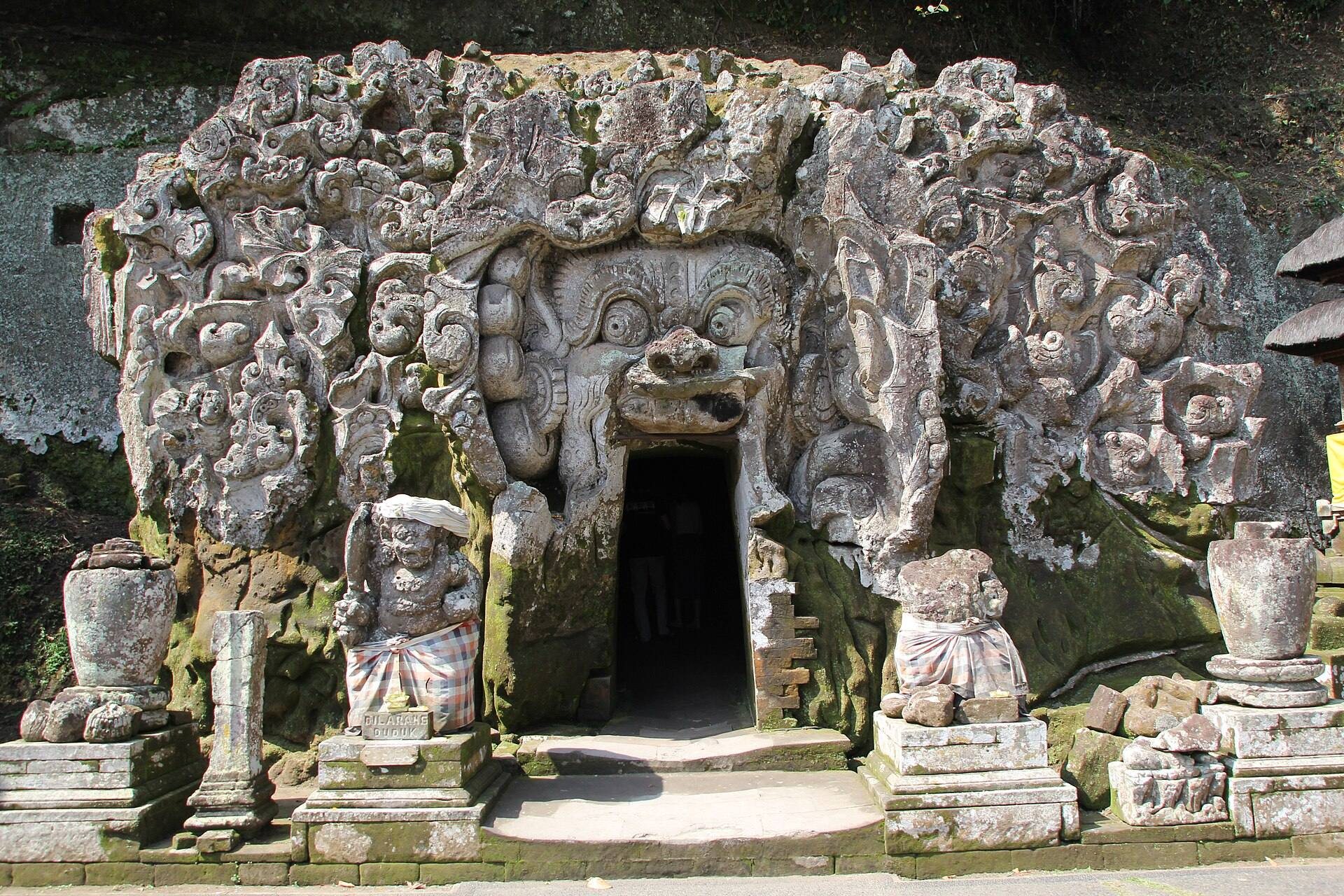
The cave was cut into projecting hard stone, and its south-facing facade extends about 5.75 metres from the rock wall. It is approximately 6.75 metres high and 8.6 metres wide. Dense carvings of foliage, rock formations, giants, monkeys, and pigs surround the opening, which is about 1 metre wide and 2 metres high. Above it is a large menacing face with round eyes turned to the right, coarse hair and eyebrows, a prominent nose, and an upper lip lined with teeth. The image is understood as a protective figure guarding the sacred space from harmful forces. It has been identified as either Bhoma or Kirtimukha and, because of its earrings, has also been associated with the Balinese witch Rangda.
Two lines of writing on the eastern cave wall read “kumon” and “sahy(w)angsa.” Their letter forms are characteristic of the 11th century. Excavations also recovered fragments from the upper part of the giant head above the entrance, a carved section of the eastern wall, and a stone sword that belonged to the giant figure in front of the cave. Cracks in the ceiling were attributed to the roots of frangipani trees growing above the cliff on the right side of the entrance.
Cave interior and images
The interior is about 2 metres high and has a T-shaped plan. An entrance passage runs northward before meeting an east-west cross-passage approximately 13.5 metres long, 2.75 metres wide, and 2 metres high. Seven niches line the northern wall. The largest, opposite the entrance passage, measures about 1.26 metres high and 1.35 metres deep, with its base 0.7 metres above the floor. It contained fragments of a giant figure and an image of Shiva, a major Hindu deity.
Niches at the eastern and western ends of the cross-passage contain a Trilingga, a group of three lingas associated with Shaiva worship, and a seated image of Ganesha, the elephant-headed deity associated with wisdom, beginnings, and the removal of obstacles. The present placement of these images reflects later installation or reinstallation. In front of the cave are images of Hariti, Ganesha, and giants. Hariti is shown seated cross-legged, making a gesture of generosity with her right hand, holding one child on her lap, and surrounded by six other children. In Buddhist tradition, Hariti became a protective figure associated with children.
Sacred bathing complex
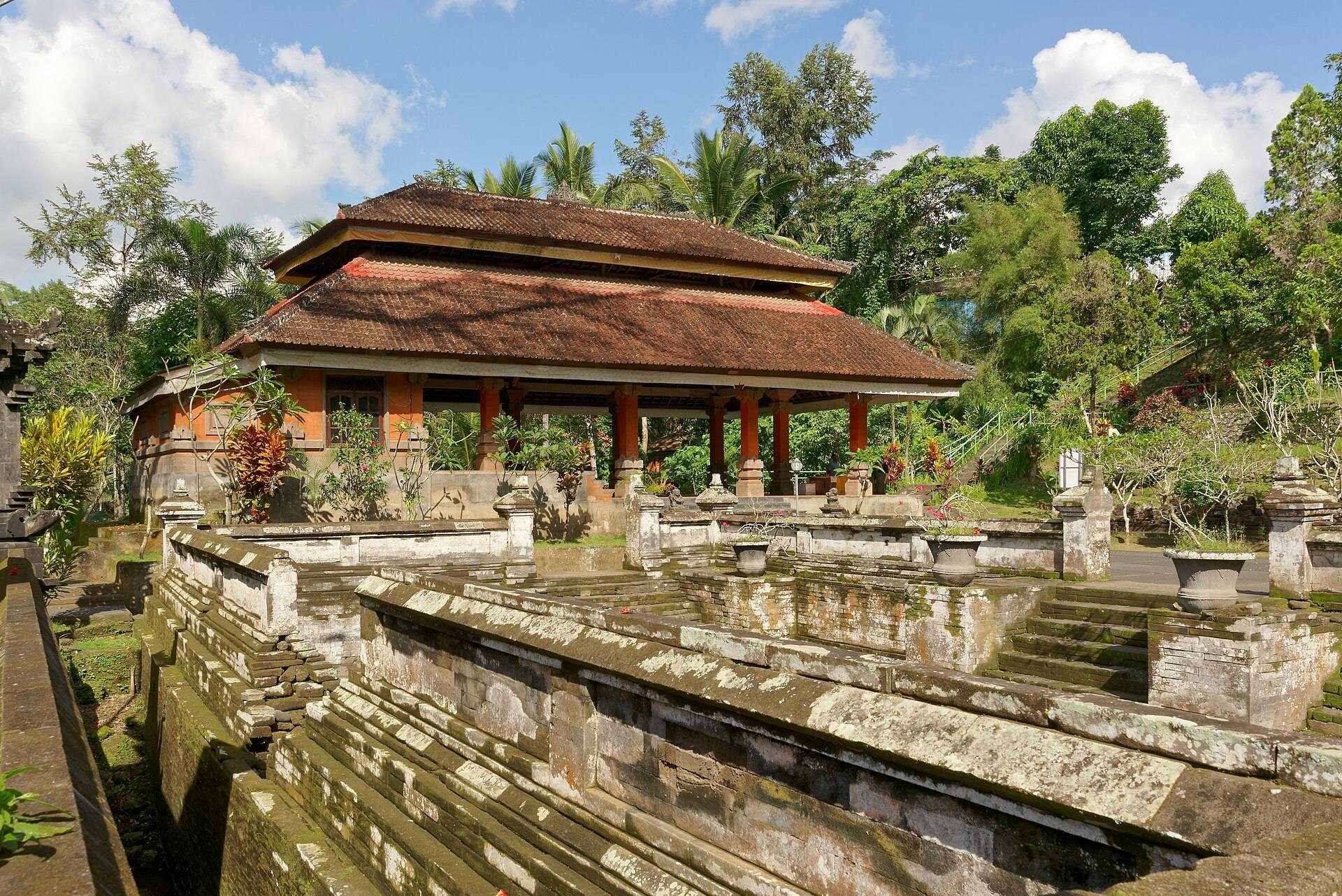
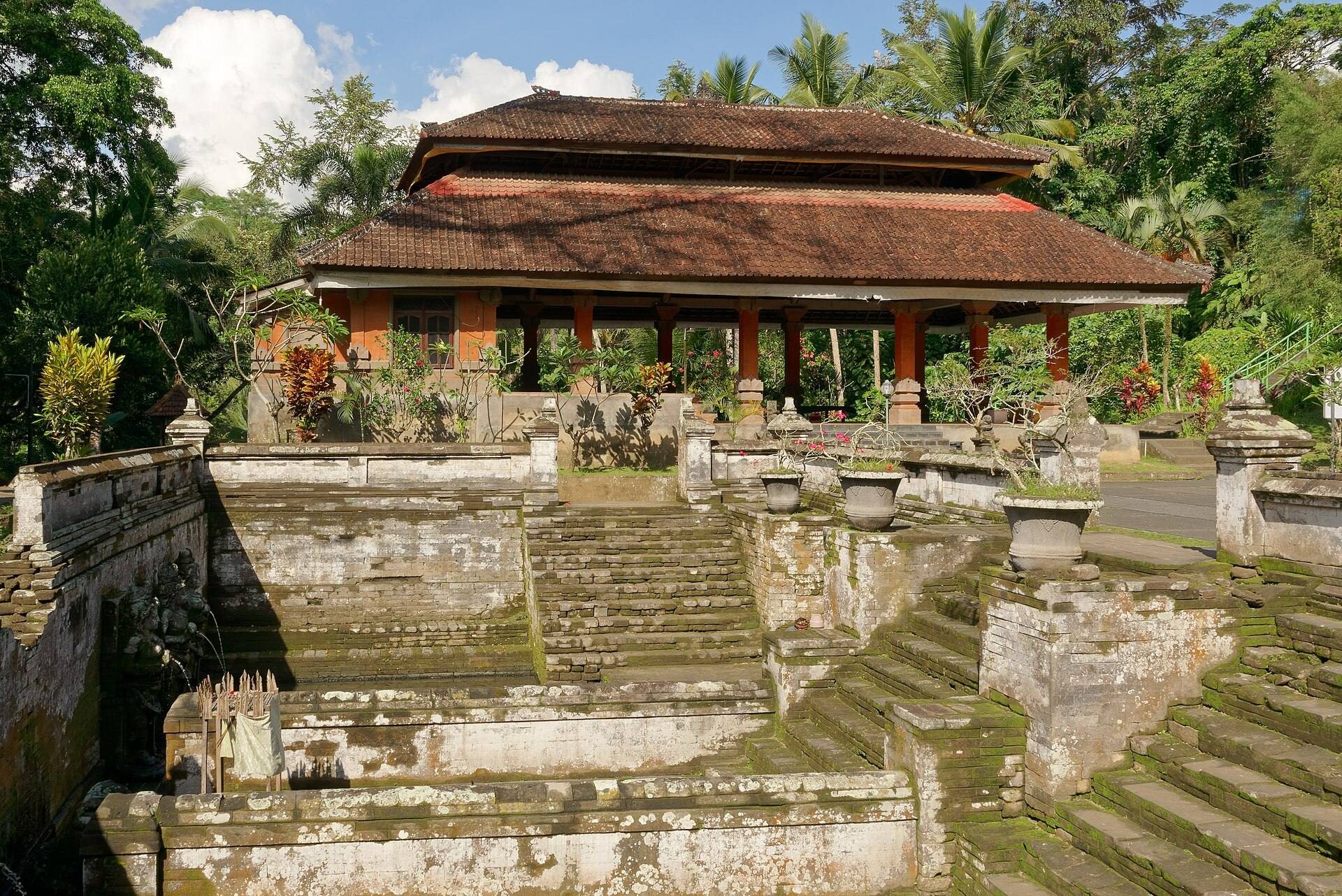
The bathing complex lies in front of and somewhat below the cave. It forms a rectangular sacred bathing area about 20 metres from north to south and 7 metres from east to west, with three pools arranged along a north-south axis. The complex originally included seven female figures holding water vessels or producing fountains at their breasts. They represented the seven sacred rivers of India: the Ganges, Sarasvati, Yamuna, Godavari, Sindhu, Kaveri, and Narmada. Six figures survive, and the central figure in the original arrangement may have been a fountain-bearing Ganesha.
The bathing figures stand on lotus bases. Each group consisted of a male celestial figure flanked by two female celestial figures facing a large pool, with the central figure identified as a celestial male. The complex had been buried and partly obscured by later construction before its excavation and reconstruction in 1954.
Tukad Pangkung Buddhist remains
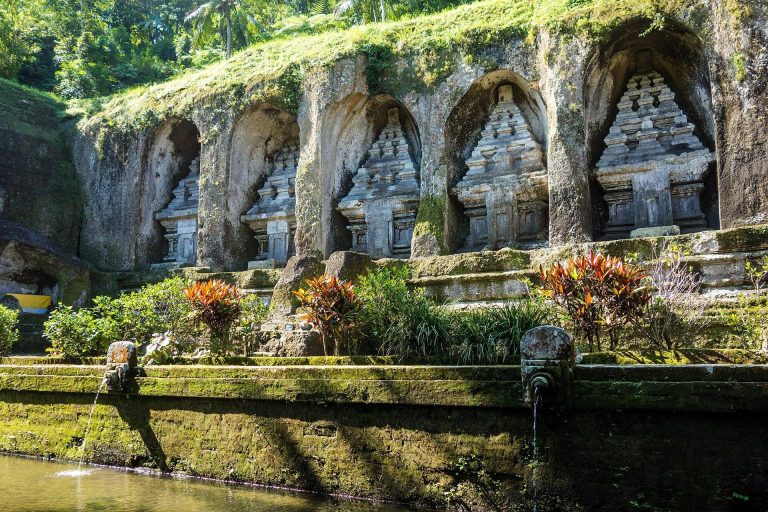
The southern Tukad Pangkung area occupies a ravine or valley associated with the Patapan temple area. It contains Buddhist images and the collapsed remains of a large rock-cut relief that may once have formed part of a cliff temple. The surviving fragments include a three-branched stupa with tiered umbrella finials, another stupa with a single tiered umbrella finial, and the lower portion of a Buddha image. A nearby collapsed relief fragment has thirteen tiers of umbrellas and may have formed the summit of another stupa. A stupa is a Buddhist monument associated with relics, veneration, and meditation, while its umbrella-like finials are called parasols or umbrella motifs.
Conrat Spies identified the three-branched stupa in 1931 after a rock face had collapsed into the ravine. The Buddhist reliefs are considered substantially older than the northern cave complex and may date from the early 10th century, providing physical evidence for the earlier Buddhist activity in the wider Goa Gajah landscape.