Worcester Guildhall: A Municipal and Judicial Hall
Site at a Glance
- Rating
- 4.7
- Popularity
- Medium
- Country
- United Kingdom
- Primary era
- Early Modern
- Eras represented
- Early Modern, Modern
- Civilizations
- British
- Site type
- Civic
- Remains
- Town Hall
On this page10 sections
History
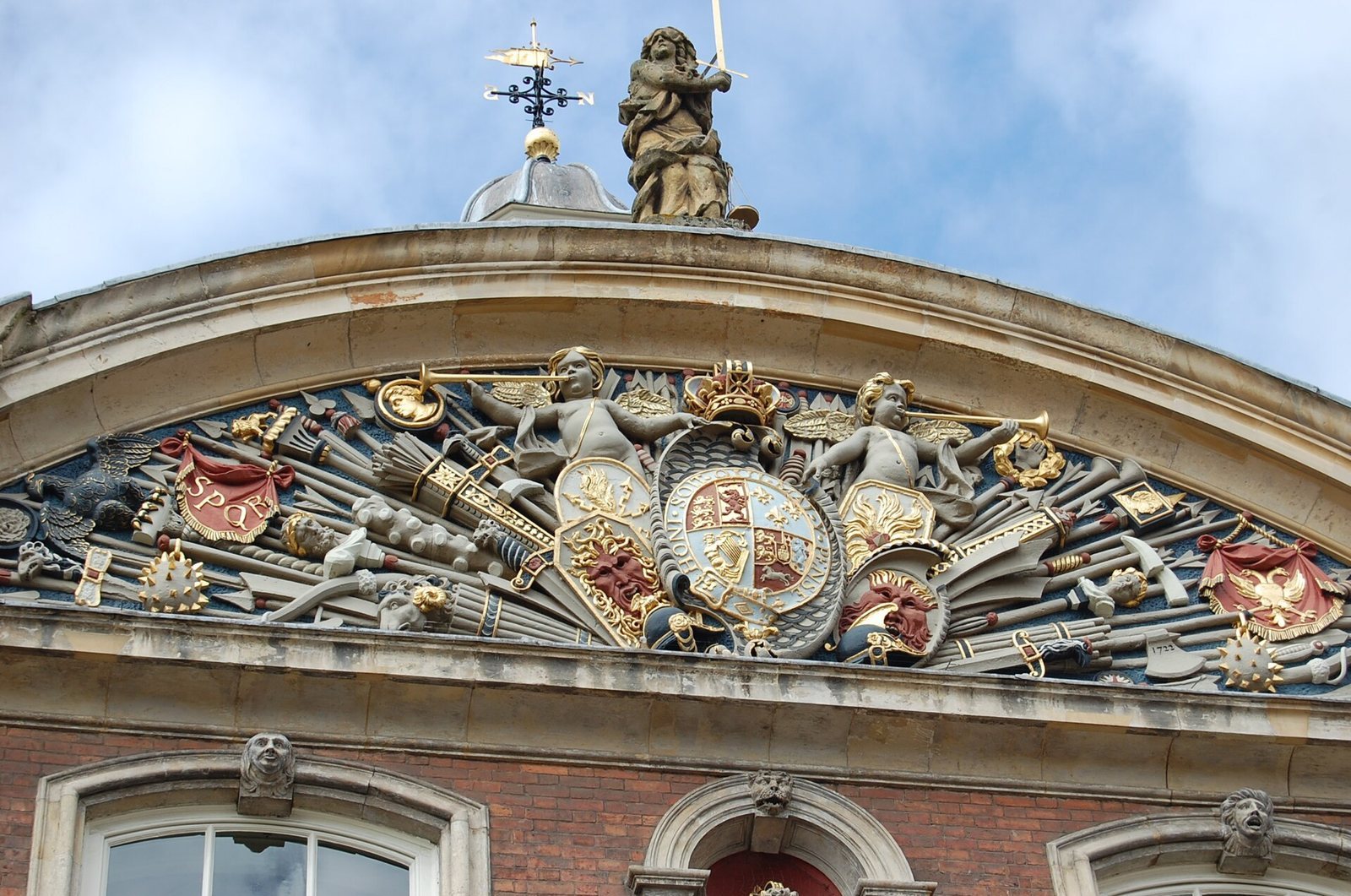
Worcester Guildhall is a municipal building on High Street in Worcester, United Kingdom. A timber-framed guildhall stood on the site by about 1227 as a meeting place for the city’s merchants. Civic leaders decided in 1717 to replace it with a grander building, and the present hall was built in 1721–1723. Thomas White is credited as its architect and signed the sculpture on the pediment, though other craftsmen may also have contributed to the design.
Civic and cultural life
The Guildhall combined municipal and judicial work. Its courtroom served the Crown Court and a nisi prius court, which heard civil cases at first instance. The building also had a prison where citizens could be held instead of in the town jail, except when accused of the most serious offences.
Choirs from Gloucester, Hereford, and Worcester regularly performed at the Guildhall for the Three Choirs Festival, a choral music festival associated with those cities, until the mid-18th century. Worcester’s parliamentary elections were also held there during the 18th century. Voting eligibility required freehold property worth at least 40 shillings a year, and the winner was determined by the loudest shouting rather than a show of hands.
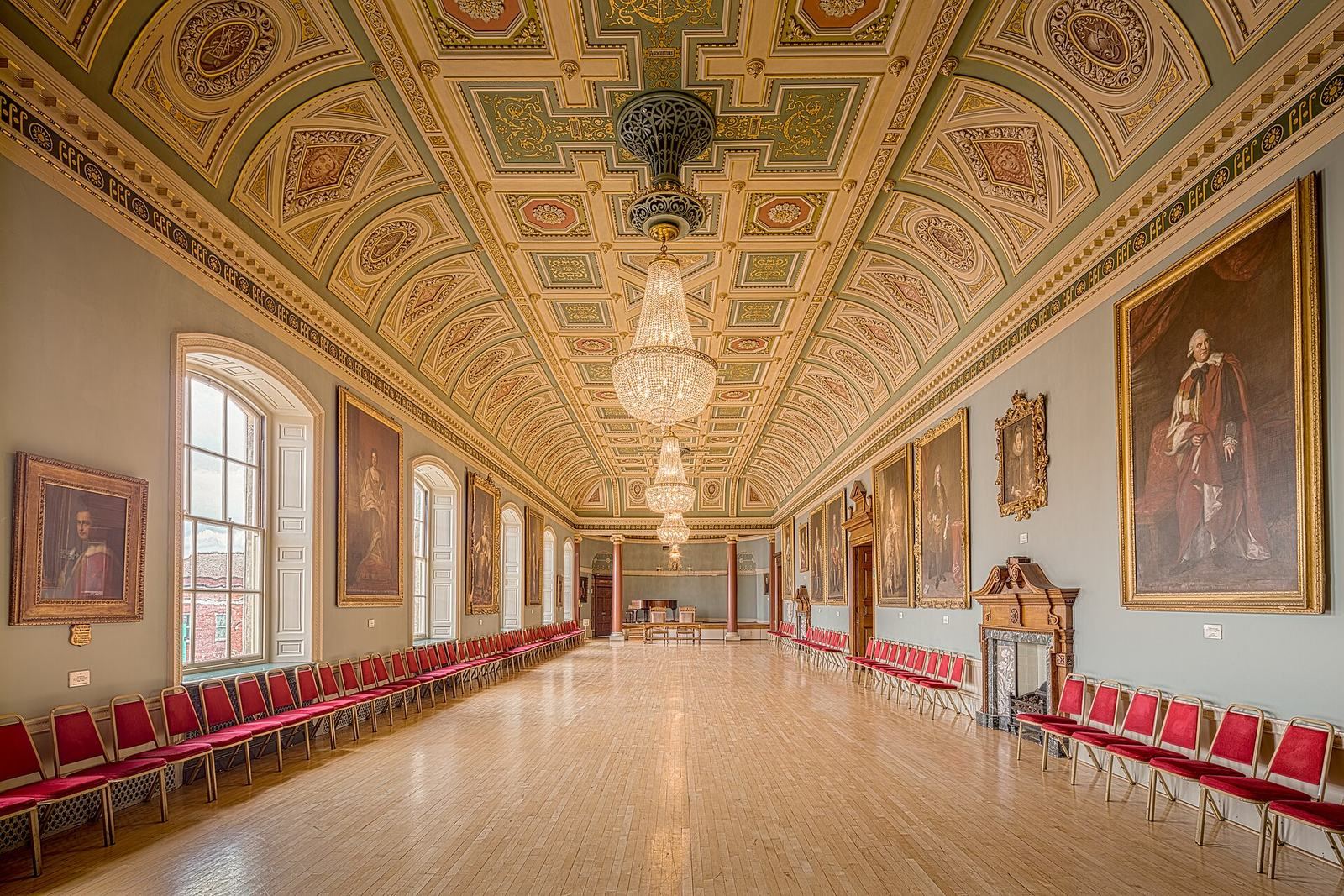
King George III, who reigned from 1760 to 1820, visited in August 1788 and praised the assembly room as an elegant gallery.
Renovation and modern civic use
In 1876, the city government considered replacing the Guildhall because of the expected expense of extending and renovating it. Edmund Lechmere and architect George Gilbert Scott opposed demolition. Public protest helped secure a different decision, and work to extend and renovate the building took place in 1877–1880. Scott died during the project; Henry Rowe is believed to have carried out the larger share of the work.
The Guildhall served as the county borough of Worcester’s headquarters for much of the 20th century. On 20 May 1950, Winston Churchill received the Freedom of the City, a civic honour, there. The building became Grade I listed on 22 May 1954, placing it in England’s highest listing category for buildings of exceptional interest; its forecourt gates and railings have a separate Grade I listing. Following the Local Government Act 1972, which reorganized local government, the Guildhall became the meeting place of the enlarged Worcester City Council. It remains a municipal building and cultural venue.
Remains
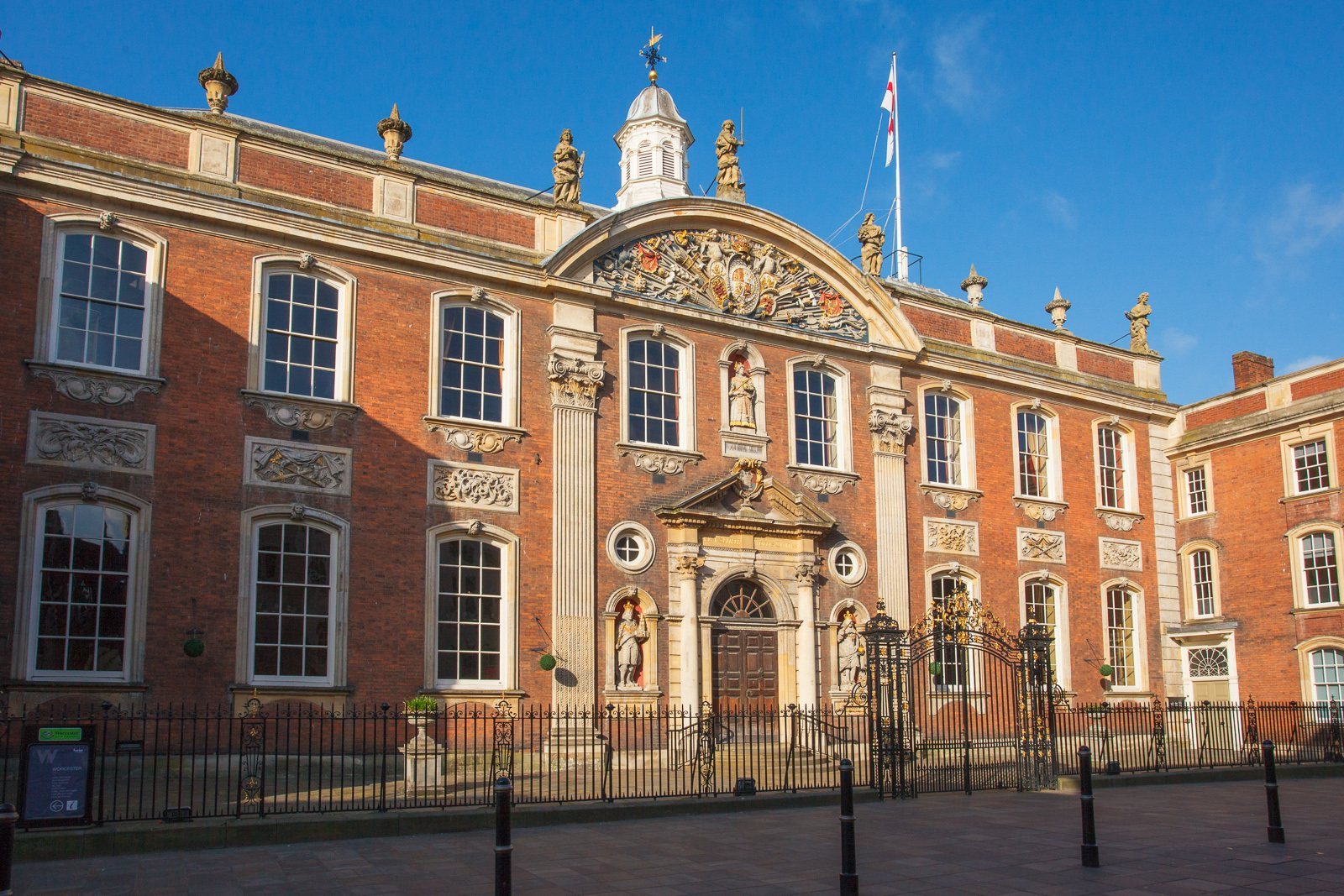
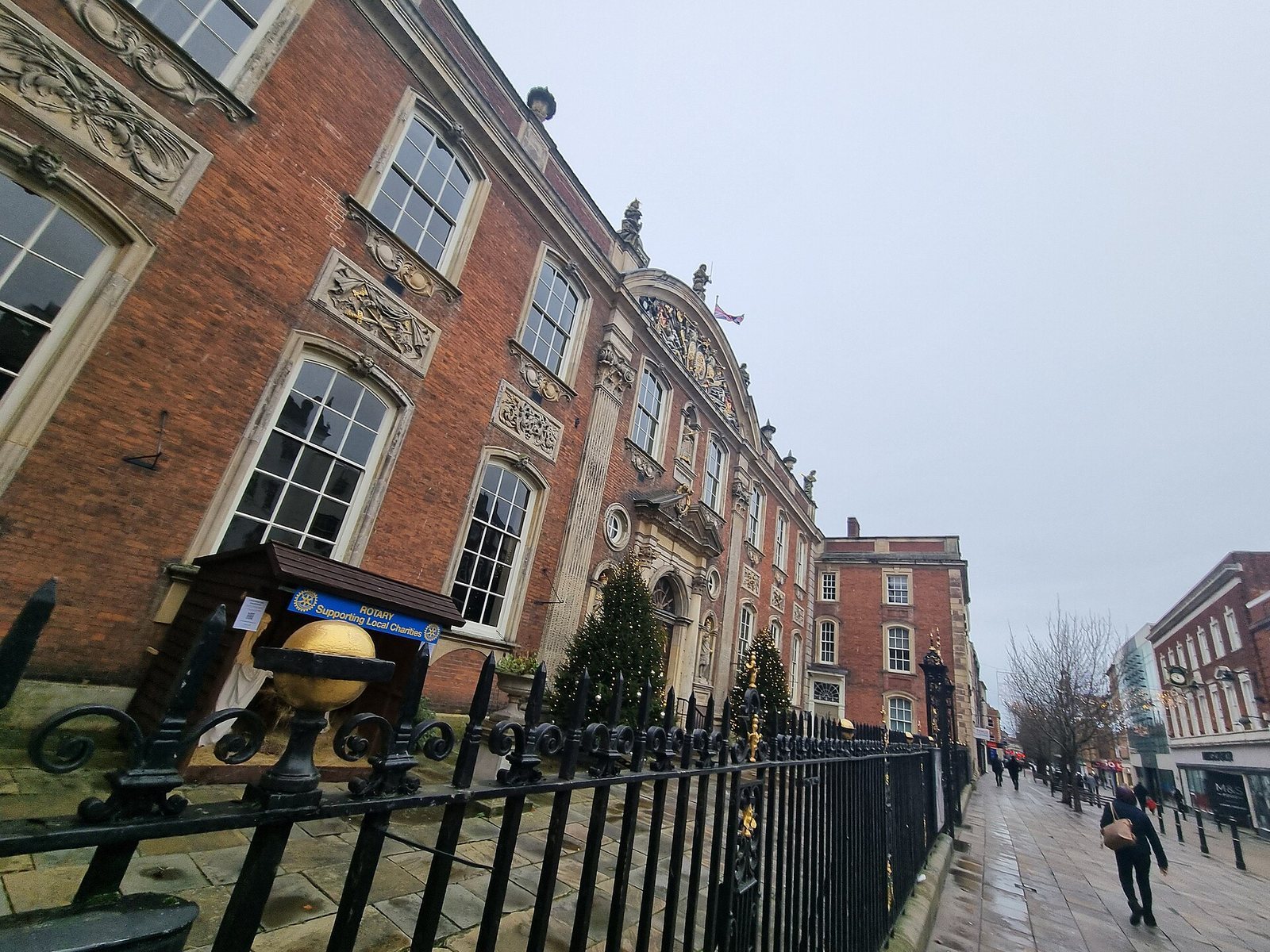
The Guildhall has a U-shaped plan, with wings that project slightly to define a forecourt facing High Street. Its nine-bay front is built of red brick and white natural stone.
Exterior
Forecourt
Wrought-iron railings enclose the forecourt, which is entered through a wrought-iron gate decorated with gilding.
Front facade and entrance
The windows have shallow curved arches and stone surrounds. Two full-height supports in the Composite order, a classical column style combining Ionic and Corinthian forms, flank the central bay. Above them, a semicircular pediment, a curved gable-like feature, displays flute-playing cherubs, the Royal Arms, and the civic motto expressing the hope that the faithful city will prosper.
Carved figures of Justice, Peace, Plenty, and Chastisement, together with Hercules, the hero of Greek mythology, stand above the projecting cornice, or horizontal molding, alongside four urns. Composite-order half-columns frame the main entrance. Its upper details include a fanlight, a glazed panel above the doorway, a decorative frame, and a broken triangular pediment. Recessed wall niches beside the entrance contain statues of the successive Stuart kings Charles I and Charles II; a niche above it holds a statue of Queen Anne, who reigned from 1707 to 1714.
Interior
Civic rooms
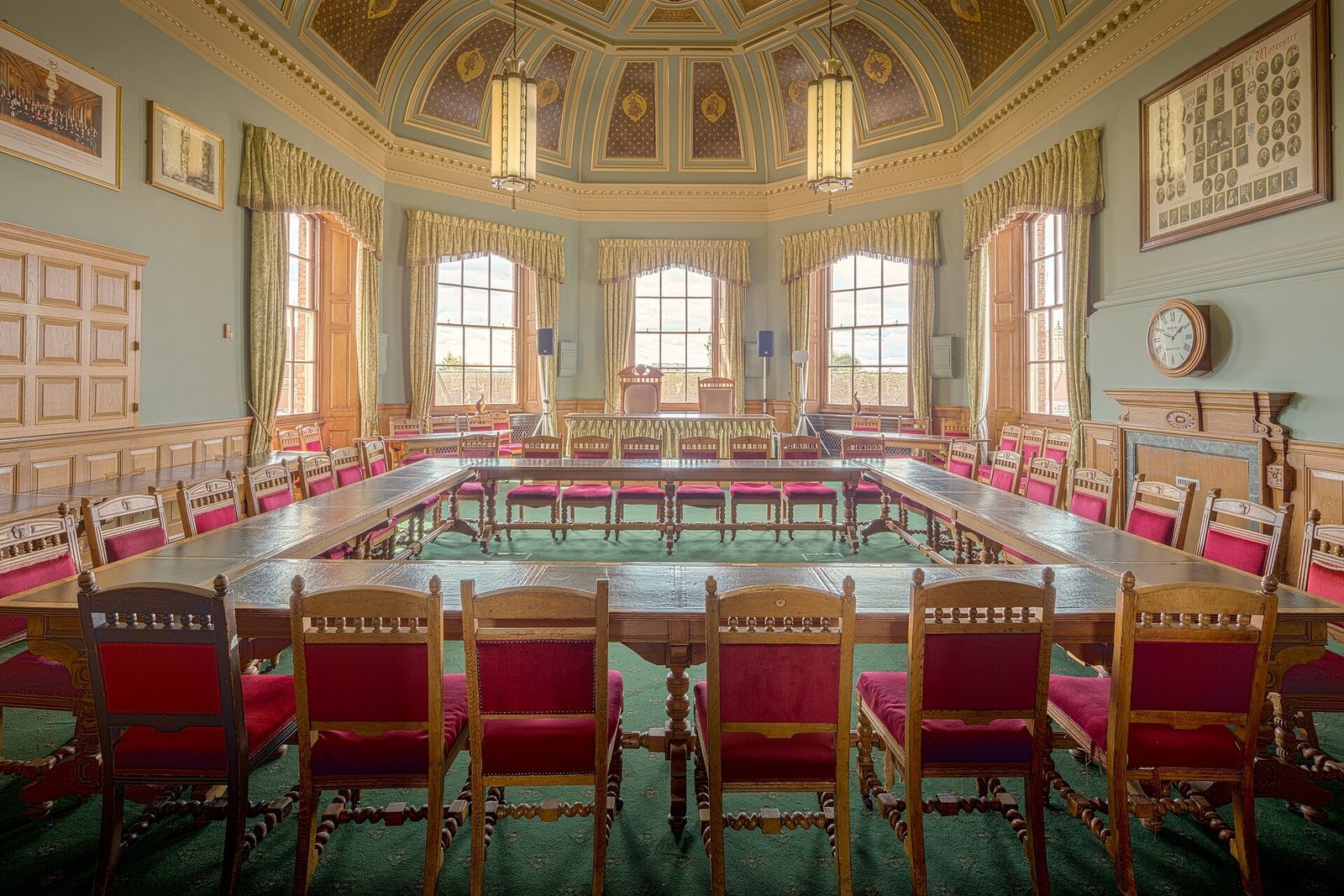
The ground floor contains a courtroom and a lower hall. The first floor holds a council chamber and a large assembly room, which George Byfield redesigned in 1791. Prison accommodation was situated beneath the Guildhall.
Portraits and architectural interpretation
Portraits inside the building include George III and his consort, Queen Charlotte, painted by Christopher William Hunneman, and Queen Victoria, painted by James Sant. Architectural historian Nikolaus Pevsner admired the Guildhall’s lavish effect but considered its magnificence close to excess.