Wardon Abbey: A Cistercian Monastery in Bedfordshire
Site at a Glance
- Popularity
- Medium
- Country
- United Kingdom
- Primary era
- Early Modern
- Eras represented
- Early Modern
- Civilizations
- English
- Site type
- Domestic
- Remains
- Elite Residence
On this page7 sections
History
Wardon Abbey, also known as Warden Abbey, was a monastery of the Cistercians, a Catholic order that emphasized communal religious life and manual labour, at Old Warden in Bedfordshire, England. It was founded around 1135–36 and consecrated in 1135, and was dedicated to the Virgin Mary. Anglo-Norman landholder Walter Espec invited monks from Rievaulx Abbey, which served as Wardon’s parent monastery, to establish the community on land he had inherited. Stephen, king of England, confirmed the foundation charter early in his reign. Wardon was Bedfordshire’s first Cistercian abbey and became one of England’s senior houses of the order.
Foundation and growth
Simon, Wardon’s first abbot, had studied under Aelred, then abbot of Rievaulx. Wardon went on to establish communities at Sawtry in 1147, Sibton in 1150 and Tilty in 1153. The monks cleared and cultivated their land, and Old Warden village grew under the abbey’s protection. By 1252, its cultivated holdings exceeded what the monks could manage through their original system of labour. Nineteen granges, or monastic farms, were recorded.
Influence and late medieval change
Wardon’s abbot received papal assignments to oversee the election of the abbot of Bury St Edmunds in 1215 and the abbess of Shaftesbury in 1217, and to investigate suspicions concerning the abbot of Tewkesbury in 1224. Adam, the ninth abbot, became bishop of Connor, a historic Irish diocese, in 1242 and died in 1244. Around 1250, military leader and royal official Falkes de Breauté attacked the monks, wounding several and killing one. He later repented.
The abbey’s accumulated wealth supported an ambitious rebuilding campaign that began in the early 1320s and was completed in 1366. Its cost strained the monastery’s finances, and a bishop authorized a collection that helped the monks finish the work. The Black Death, the plague pandemic that devastated Europe in the mid-fourteenth century, was followed by retrenchment and decline at Wardon.
Produce from the abbey’s orchards included the Warden pear, regarded as one of England’s finest pears and associated with Warden pies. Shakespeare’s The Winter’s Tale refers to these pies, and a cookbook dated to 1430–50 includes a recipe for quinces or Warden pears baked in pastry.
Dissolution and later ownership
Wardon closed in 1536 and was dissolved by 1537 during Henry VIII’s suppression of the monasteries, which followed his break with the Catholic Church. The estate was assigned to Robert Gostwick and sold for £389 16s 6d. Most of the abbey buildings were demolished in 1552 for their materials.
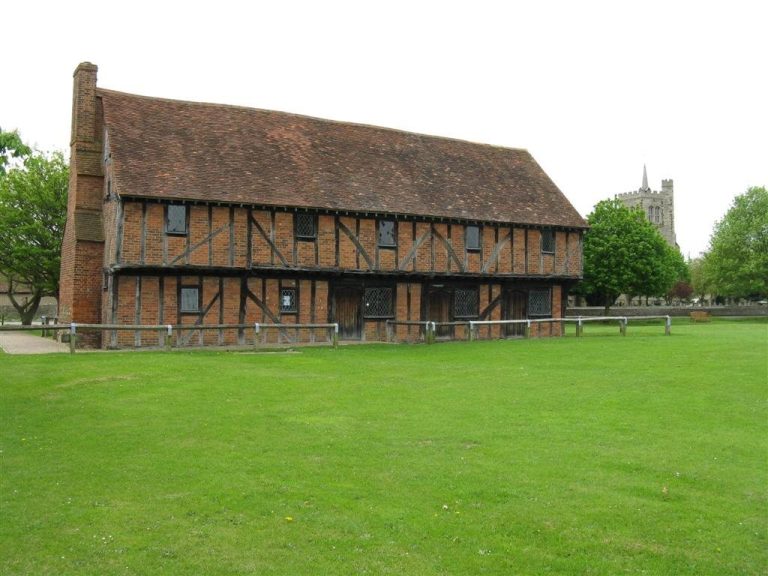
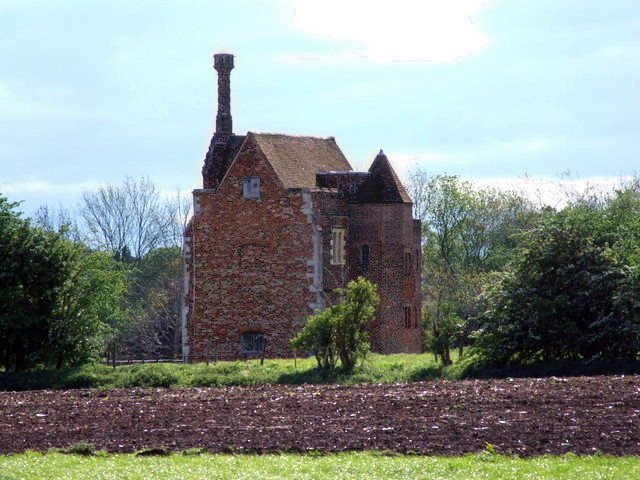
Construction of Warden Abbey House, a red-brick mansion using abbey materials, began around 1560. Samuel Whitbread acquired the estate in the eighteenth century, and his family demolished most of the house in 1790. The Landmark Trust, a British charity that preserves historic buildings, renovated the surviving wing in 1974 under a long lease. Wardon Abbey is a Grade I listed building, England’s highest category of listed-building protection.
Remains
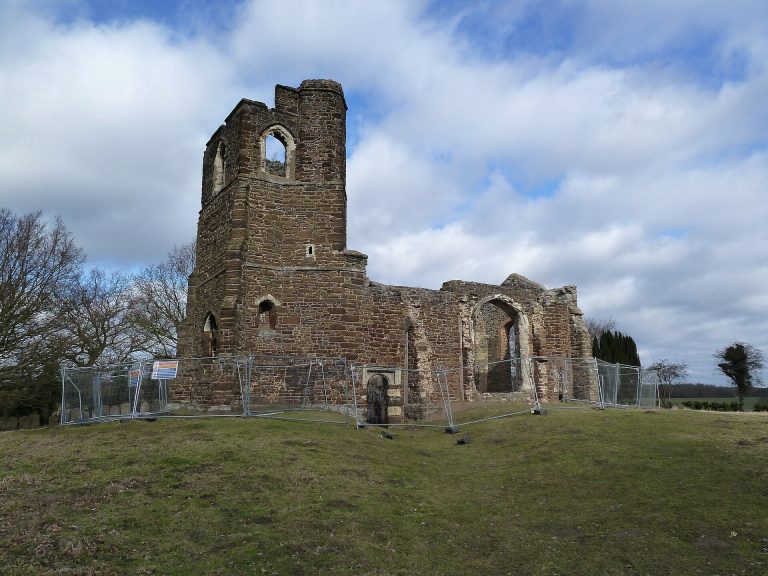
The remains relate to two building phases: the abbey, rebuilt on a scale described as approaching that of a cathedral, and the later red-brick Warden Abbey House. Decorated floor fragments provide evidence of the abbey’s elaborate interior, while the mansion’s north-east wing survives.
The abbey’s decorated floors
The abbey floors included elaborate tiles arranged in carpet-like patterns and pictorial scenes. Shaped pieces were assembled into compositions resembling large mosaics, and carved details were lavishly gilded. Fragments recovered in 1848 after demolition and burial still retained bright gilding. A display at Bedford Museum includes a reconstructed pavement, tiles from a life-size figure, two lions, decorated tiles and examples bearing impressed lines.
Warden Abbey House
The surviving north-east wing is the remaining part of the red-brick mansion built with materials from the abbey. Most of the house was demolished in 1790, and the wing was renovated in 1974.