Casas Grandes (Paquimé): A Mogollon Settlement in Chihuahua, Mexico
Site at a Glance
- Country
- Mexico
- Primary era
- Medieval
- Eras represented
- Medieval
- Civilizations
- Unclassified
- Site type
- City
On this page19 sections
History
Casas Grandes (Paquimé) is a prehistoric settlement in northern Chihuahua, Mexico. Its construction is attributed to the Mogollon culture, a prehistoric tradition of the American Southwest and northern Mexico. Settlement began after 1130, and Paquimé became one of the region’s largest and most complex Mogollon sites.
Settlement and regional growth
Between about 1130 and 1300, people lived in small communities across the fertile valley, with the largest settlement developing at Paquimé. Around 350 smaller settlements have been identified across the wider region, some as far as 70 kilometres from the city. Estimates suggest that the area directly controlled by Paquimé extended about 30 kilometres, with roughly 2,500 residents in the city and perhaps 10,000 across the broader zone.
Residents used irrigation to grow crops and made copper bells and ornaments, pottery, and beads from marine shells. These products were probably exchanged through trade. Paquimé pottery circulated across northern Mexico and into what is now New Mexico and Arizona. Exchange connected Mesoamerica, the ancient cultural region of Mexico and Central America, with Aridoamerica, the drier cultural region to its north, and the American Southwest. This trade is generally understood to have been less extensive and systematically organized than long-distance commerce in the Aztec Empire.
Origins and cultural connections
Several explanations have been proposed for Paquimé’s growth. Charles C. Di Peso argued that it remained a minor settlement until about 1200, when long-distance merchants from the Aztec Empire or other Mesoamerican states helped turn it into a major trading centre. Another proposal holds that Ancestral Puebloan leaders, Indigenous people of the American Southwest whose descendants include present-day Pueblo communities, migrated from Chaco Canyon and other northern areas to establish the settlement. A third interpretation sees Paquimé as a local community that grew in place while adopting some Mesoamerican religious and social customs. Its association with the Mogollon cultural sphere, including through comparisons with regional sites such as Forty Houses and Gila Cliff Dwellings, is more widely accepted.
Archaeologist Stephen Lekson drew attention to the approximate north-south alignment of Paquimé, Chaco Canyon, and Aztec Ruins in New Mexico. Aztec Ruins is an Ancestral Pueblo site, not a settlement of the Aztec Empire. Chaco reached its cultural peak first, followed by Aztec Ruins and then Paquimé. Lekson proposed that ceremonial ties among elites, and the movement of leaders from one centre to another, might help explain similarities among the sites. His interpretation remains controversial and is less widely accepted than Paquimé’s Mogollon connections. The language spoken by Paquimé’s inhabitants is unknown. Nahuatl, an Indigenous language of central Mexico, may have been used under Mesoamerican influence, but it was probably not the community’s primary language.
Fire, rebuilding, and abandonment
A fire destroyed the settlement around 1340. From about 1350, people rebuilt it with multistory homes in place of the earlier, smaller buildings. Paquimé was abandoned around 1450. Whether residents left over a short period or gradually remains uncertain.
Spanish encounter and later recognition
At the time of the Spanish conquest, artificial mounds in the district were looted for stone axes, maize-grinding stones, and pottery vessels. Spanish explorer Francisco de Ibarra reached the site in 1565. Nearby Indigenous groups, probably Suma or Jano, told him that conflict with Opata villagers four days’ journey to the west had led to the settlement’s abandonment, and that its inhabitants had moved six days north. This story has been taken to suggest that they joined Pueblo communities along the Rio Grande in New Mexico. Other proposals are that they moved west to Sonora and joined or associated with the Opata, or left in search of better opportunities elsewhere.
UNESCO inscribed the Archaeological Zone of Paquimé, Casas Grandes, on the World Heritage List in 1998. The listing recognizes its evidence of a cultural tradition and its value as a type of site illustrating a stage in human history. The zone is under the care of Mexico’s National Institute of Anthropology and History (INAH).
Remains
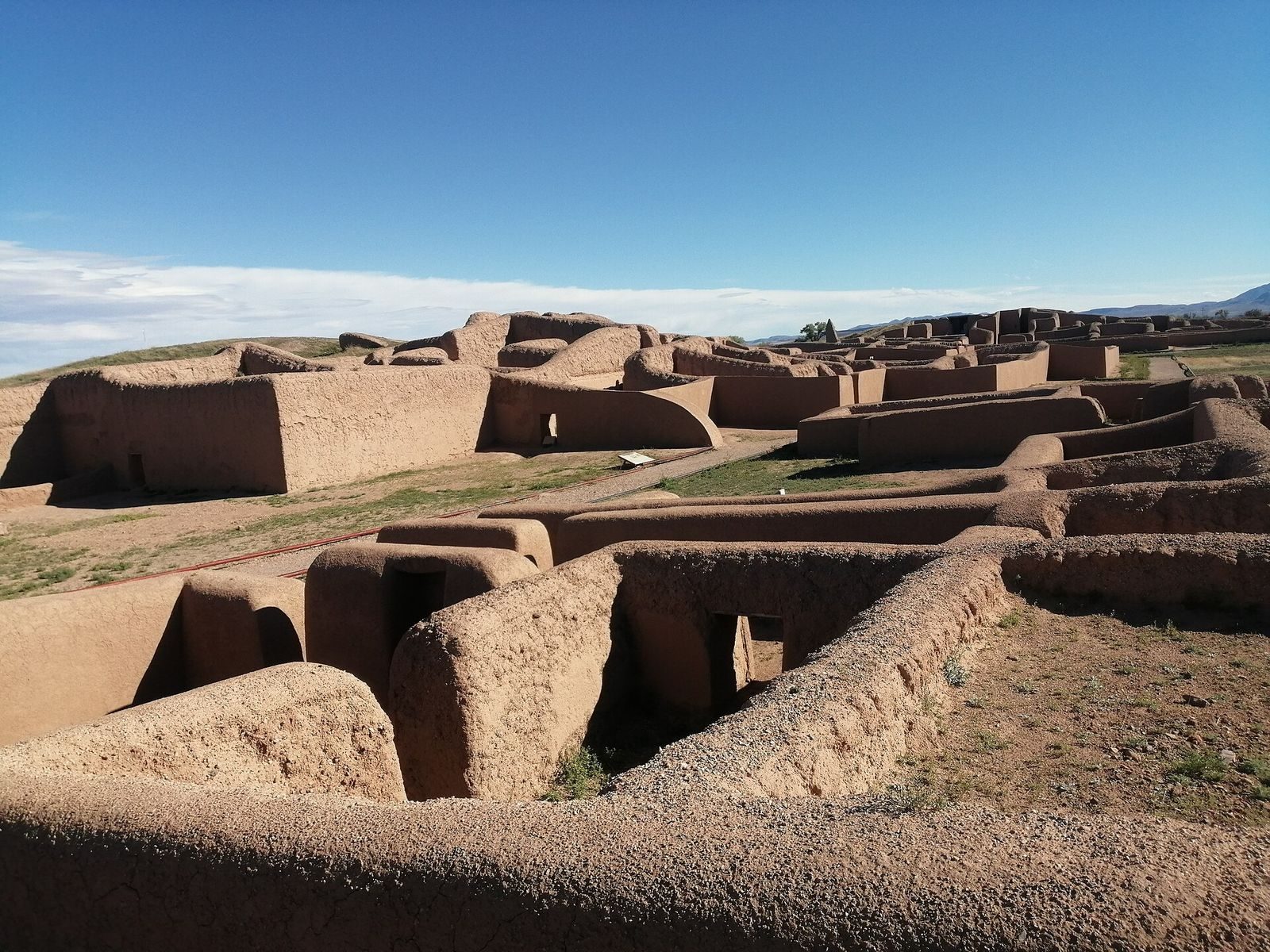
The archaeological zone covers 146.72 hectares at an elevation of about 1,476 metres. It occupies a broad, fertile valley along the Casas Grandes River, also called the San Miguel River, about 56 kilometres south of Janos and 240 kilometres northwest of the state capital, Chihuahua. The settlement’s buildings and public spaces formed a large complex of earthen construction, divided into eastern and western sectors by a stone wall and reservoirs.
Settlement plan and water system
Early house clusters
The earliest settlement included at least 20 clusters of single-storey adobe homes. Each cluster had a plaza and an enclosing wall, and the houses shared a water system.
Waterworks
Water infrastructure included underground drains, reservoirs, channels carrying water to residences, and a sewage system. Together, these features served the settlement’s homes and supported life in the valley.
Residential architecture
Main complex
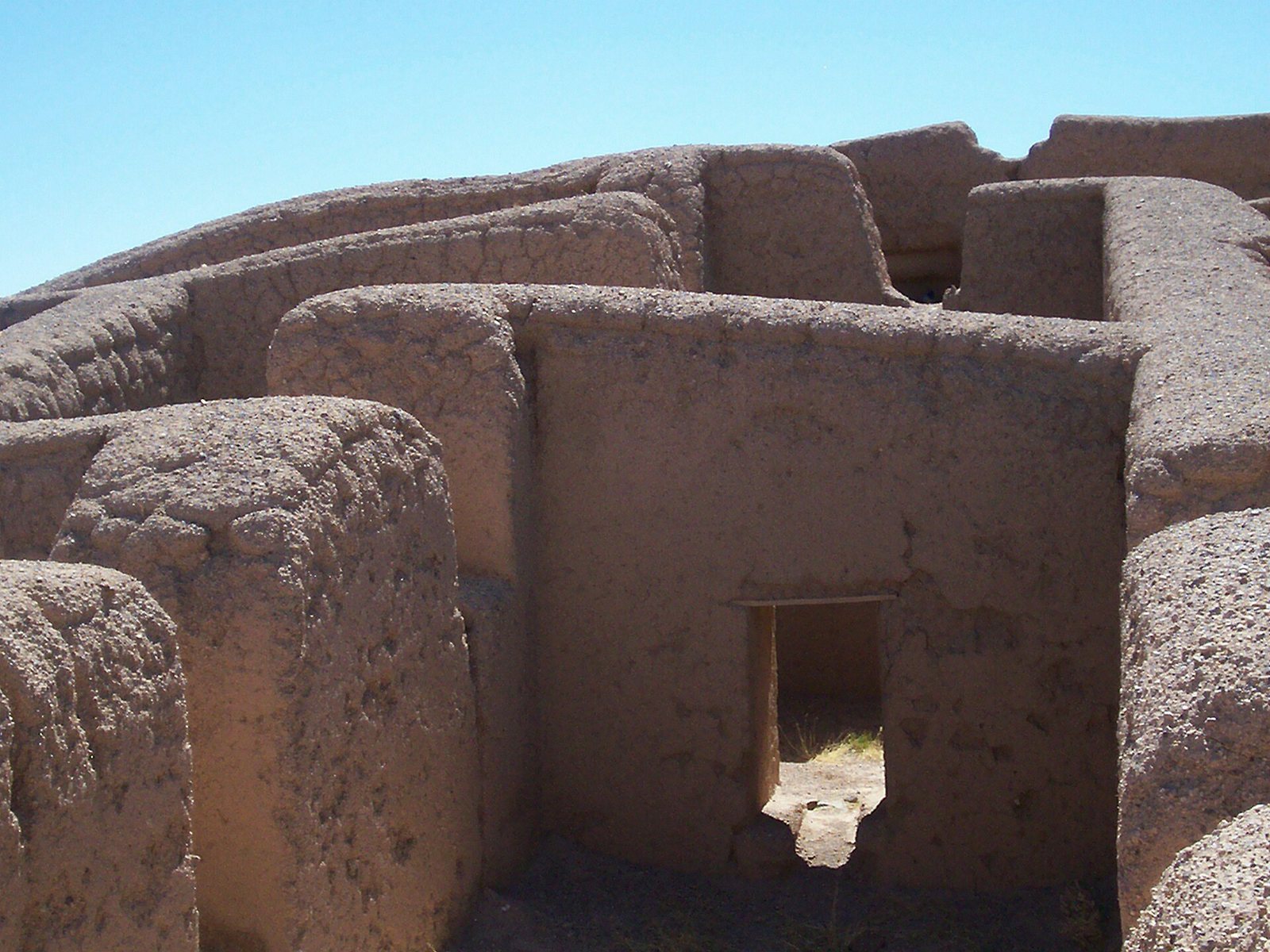
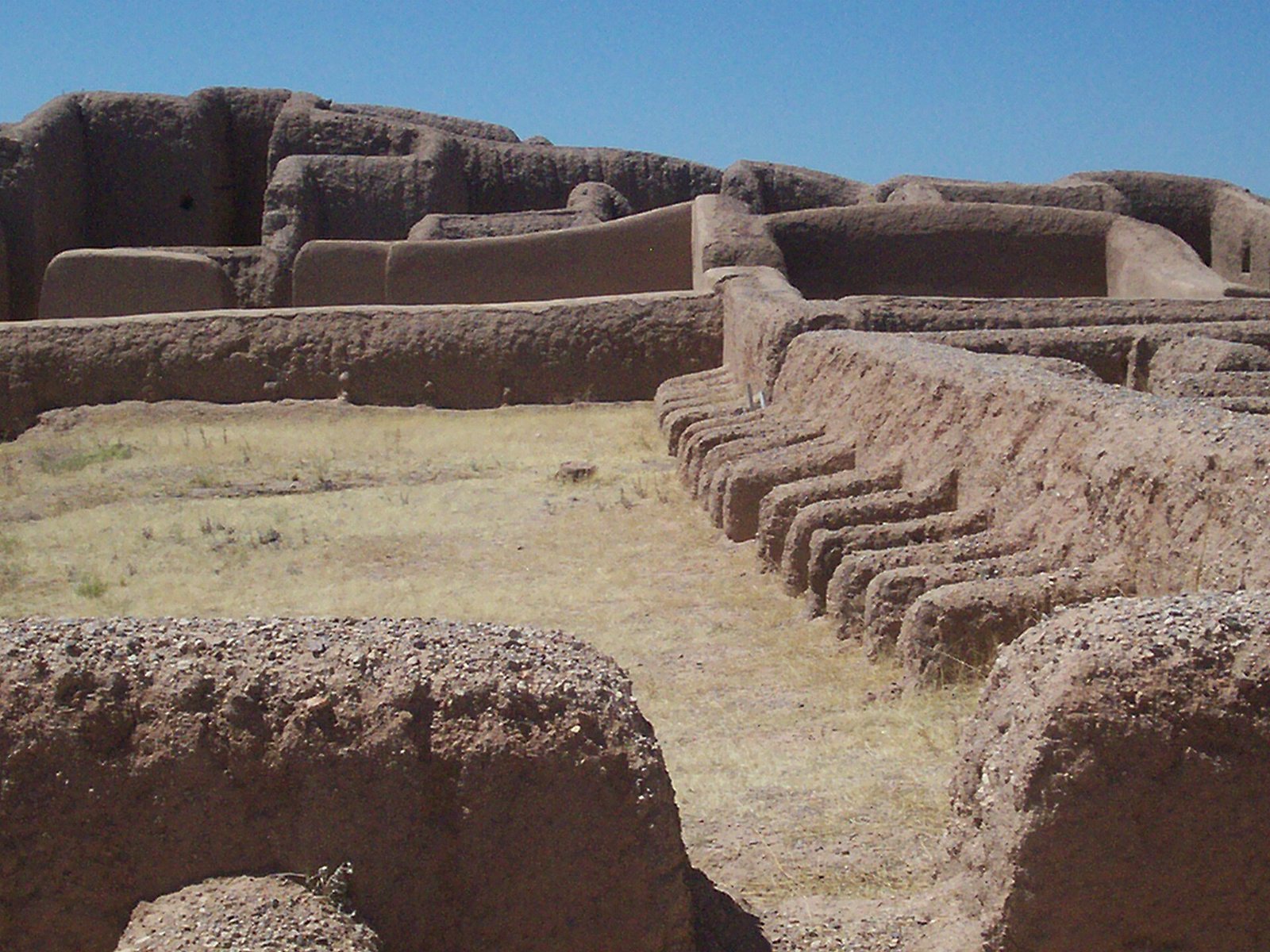
The principal building group was about 240 metres from north to south and 76 metres from east to west. It had a generally rectangular plan and appears to have consisted of three units connected by galleries or rows of lower buildings. Its walls were built from sun-dried blocks of mud and gravel, roughly 56 centimetres thick and usually about a metre long. The blocks seem to have been shaped and dried in place, and the thick walls were plastered on both sides. The main ruins lie about 800 metres from the modern community.
Rooms and separate court group
Residential spaces included circular and semicircular dwellings set partly below ground, as well as blocks of rooms built in horizontal layers of adobe around plazas. Rooms ranged from small enclosed spaces to large courtyards. Some surviving walls reach 12 to 15 metres; their height suggests that the buildings may originally have had six or seven storeys. A separate group of ruins, about 140 metres from the principal cluster, consists of rooms around a square court. Each side has seven rooms, with a larger apartment at each corner. T-shaped doorways and stone disks at the bases of columns that supported ceilings are features of the settlement’s buildings.
Public and communal areas
Eastern and western sectors
A stone wall and reservoirs divided the settlement into two sides. Rectangular adobe buildings on the eastern side were used mainly for domestic life and manufacturing. The western side contained open earthen mounds faced with stone and used for public displays. Some interpretations associate this arrangement, respectively, with Pueblo peoples to the north and Mesoamerican cultures to the south. Similar patterns at other sites on a comparable north-south axis have also been linked to shared cultural influences.
Ballcourts and mounds
The settlement had I-shaped ballcourts, spaces for a formal game that also carried ritual meaning in Mesoamerican cultures. These courts were relatively small compared with those at other major sites. Their I-shaped plan resembles ballcourts in Mesoamerica, rather than the oval form associated with Hohokam sites in Arizona. The complex also included stone-faced platforms, effigy mounds (earthworks shaped as figures or associated with them), and a market area.
Crafts and excavated objects
Pottery
Casas Grandes pottery has white or reddish surfaces decorated in blue, red, brown, or black. Some bowls and vessels take the form of painted human figures. Collections of pottery from the site are held by the Museum of Peoples and Cultures at Brigham Young University and Stanford University. The British Museum acquired 23 vessels in 1979. Other material recovered at Paquimé is held in Casas Grandes and Chihuahua City under the care of INAH, the state of Chihuahua, and the city government.
Macaw pens
A row of pens for macaws stood near the centre of the settlement. In one compound, excavations recovered eggshell fragments, bird skeletons, and traces of wooden perches. These finds have led archaeologists to infer that scarlet macaws were brought from Mesoamerica and raised at Paquimé. Their feathers held sacred importance in Mesoamerican rituals.
Meteorite and figurines
A 2,300-kilogram iron meteorite was found in a room, carefully wrapped in linen. It is now displayed in the Janet Annenberg Hooker Hall of Geology, Gems and Minerals at the Smithsonian National Museum of Natural History in Washington.
Small figurines show varied postures, proportions, facial designs, and activities. Male figures include examples with legs drawn toward the body, smoking, or displaying genitalia, and some bear pound-sign or horned-serpent imagery. Female figures are often shown with larger midsections and extended legs; their designs include modified pound-sign and bird motifs. Some hold children or pots, and others appear to be nursing. The figures have informed interpretations of social behavior, work, ritual, and belief at Paquimé.