Vogrie House: A Scottish Baronial Country House in Midlothian
Site at a Glance
- Popularity
- Medium
- Country
- United Kingdom
- Primary era
- Modern
- Eras represented
- Modern
- Civilizations
- British
- Site type
- Domestic
- Remains
- Castle
On this page5 sections
History
The Vogrie lands
Vogrie House is a Victorian Scottish Baronial country house near Pathhead in Midlothian, Scotland, United Kingdom. Andrew Heiton designed it for James Dewar and his family, and it was built in 1876. The name Vogrie appears in records from 1337 and derives from the Gaelic Bhog Chrioch, meaning “boggy borderland.” The lands later formed part of the Barony of Crichton.
In February 1566, the Vogrie lands were included in the marriage contract of Scottish nobleman James Hepburn, 4th Earl of Bothwell, and his wife, Jean Gordon. At that time, the lands were held by the heirs of Sir Robert Carnegie. In 1590, John Lumsden of Blanerne sold them to Samuel Cockburn of Templehall and his wife, Elizabeth Douglas, with the agreement of members of the wider Lumsden family.
The Dewar estate and house
A man named James Dewar acquired the Vogrie lands in 1719, and his descendants continue to hold parts of them. In the 1750s, the family also acquired nearby Stobbs, where coal mining continued until 1938. The surrounding parkland was laid out in the early 19th century. James Dewar belonged to the Scottish family associated with the whisky business.
James Cumming Dewar was the last member of the family to live at Vogrie House. He died in 1908, and his widow sold the house in 1928. In 1926, architect Ernest Auldjo Jamieson oversaw its conversion into a nursing home for the Royal Edinburgh Hospital, serving patients with nervous disorders.
Later uses
The house passed to local government in the 1950s. It later served as a communications centre during the Cold War, the postwar geopolitical rivalry between the United States and the Soviet Union and their allies. British military use dates from 1963; the building subsequently housed a police station and is now the headquarters of the Midlothian Ranger Service. Vogrie Park opened to the public in 1980.
Vogrie House received Category A listed-building status in 1979, Scotland’s highest category. It applies to buildings of special architectural or historic interest that are outstanding examples of a period, style or building type.
Remains
Vogrie House stands about 1.5 kilometres southwest of Pathhead and forms the centrepiece of Vogrie Country Park. The estate borders the lands of Oxenfoord Castle to the north and extends west to the River Tyne.
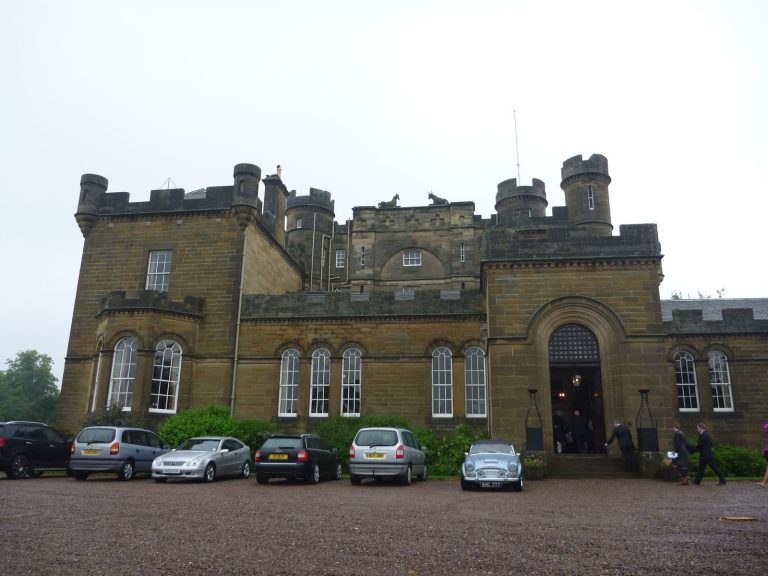
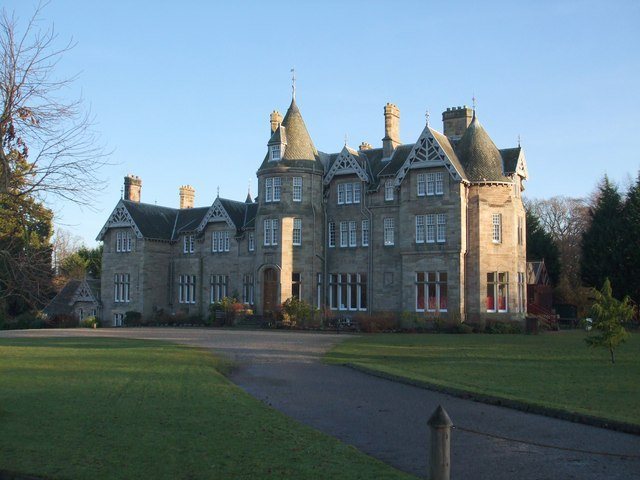
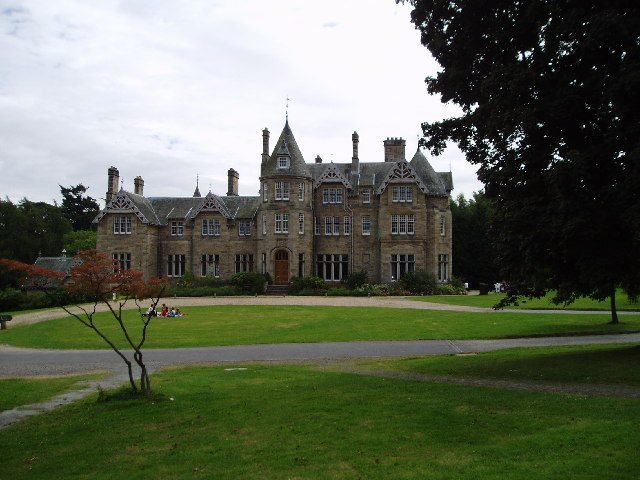
The house is built of sandstone laid in regular horizontal courses and rises two to three storeys. Its northwest-facing front is asymmetrical, with an entrance tower projecting near the centre and topped by a conical roof. The overhanging gables feature prominent ornamental timberwork. The building’s Scottish Baronial style is a revival drawing on historic Scottish castles and manor houses. Its country-house accommodation included a library, servants’ quarters and numerous bedrooms.