Visconti Castle in Invorio: A Medieval Fortress and Visconti Residence
Site at a Glance
- Popularity
- Low
- Country
- Italy
- Primary era
- Medieval
- Eras represented
- Medieval, Modern
- Civilizations
- Holy Roman Empire
- Site type
- Military
- Remains
- Castle
On this page9 sections
History
Visconti Castle in Invorio is a medieval fortified site in Italy, first explicitly named in a charter dated 29 June 1039. Its position midway between Arona and Gozzano, at the lower edge of the Vergante, made it a bulwark against Novara’s expansion around the middle of Lake Maggiore.
Early ownership and the Counts of Biandrate
The first known proprietor was Gotefredo of Invorio Inferiore, a vassal of Aupaldo, Bishop of Novara, in the late tenth century. Gotefredo belonged to the bishop’s circle of magistrates and public administrators. The property later passed to Giovanni, a religious man and son of Ildeprando. Six of Giovanni’s relatives and fellow townsmen inherited it and gave it to the chapter of canons at San Giulio di Orta, a body of clergy attached to a church. The donation charter is the earliest document to name Invorio’s castle explicitly.
Before 1140, the fortress came under Guido III of the Counts of Biandrate, a medieval noble family. Imperial diplomas confirmed his possession and that of his heirs through 1209. In 1211, Guido’s four nephews swore not to transfer any of their fortresses, including Invorio Inferiore.
Novara and the Visconti
The castle later passed to the commune of Novara. After the Visconti annexed the city, it became their property and a residence of the Visconti di Invorio, a collateral branch of the ruling family of Milan. Matteo I Visconti, Lord of Milan, was born at the castle in 1250.
Damage and later history
Between 1356 and 1358, the castle was badly damaged during the war between the Visconti and the Marquess of Monferrato, the ruler of a historic territory in northwestern Italy. As the castle declined, members of the Visconti di Invorio moved to the nearby area and built new houses and a villa in the sixteenth century. In 1742, Alberto Visconti d’Aragona, from another Visconti branch, received the title of Marquess of Invorio.
By the beginning of the twentieth century, the castle had largely fallen into ruin. Local tradition connects its tower with the imprisonment of Margherita Pusterla, a Milanese noblewoman whose story became known through historical and literary tradition.
Remains
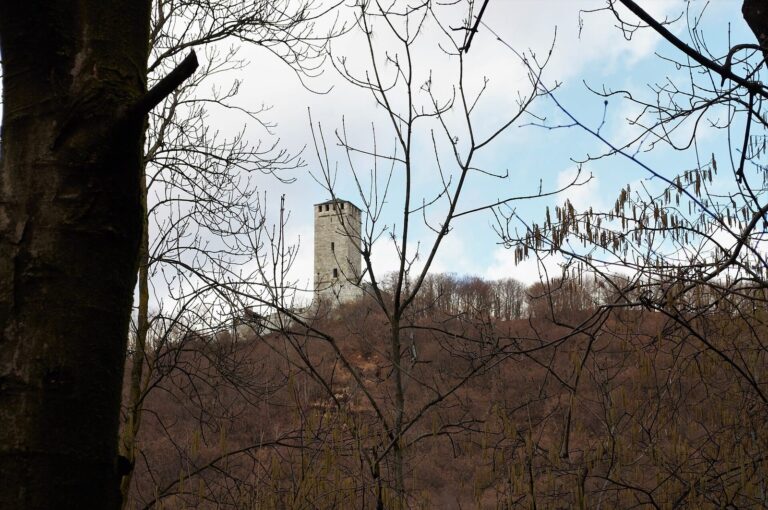
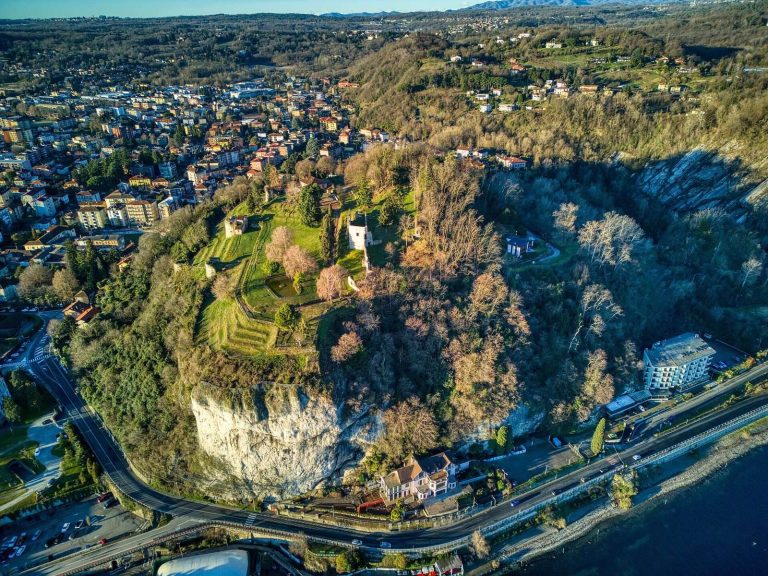
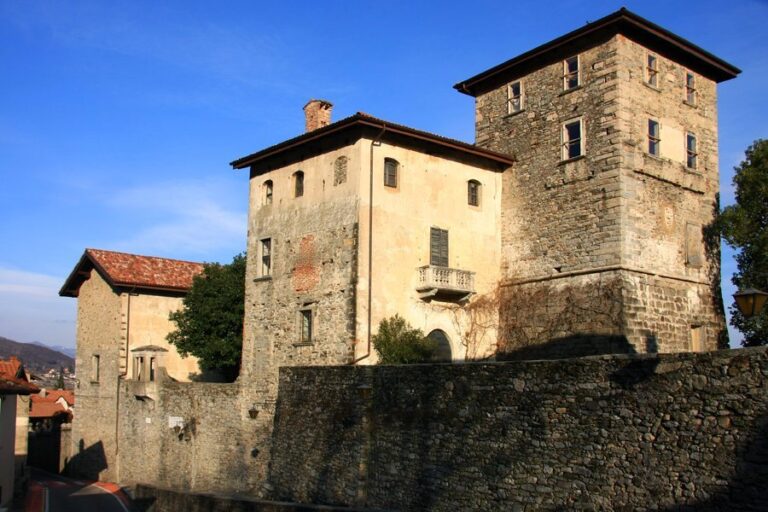
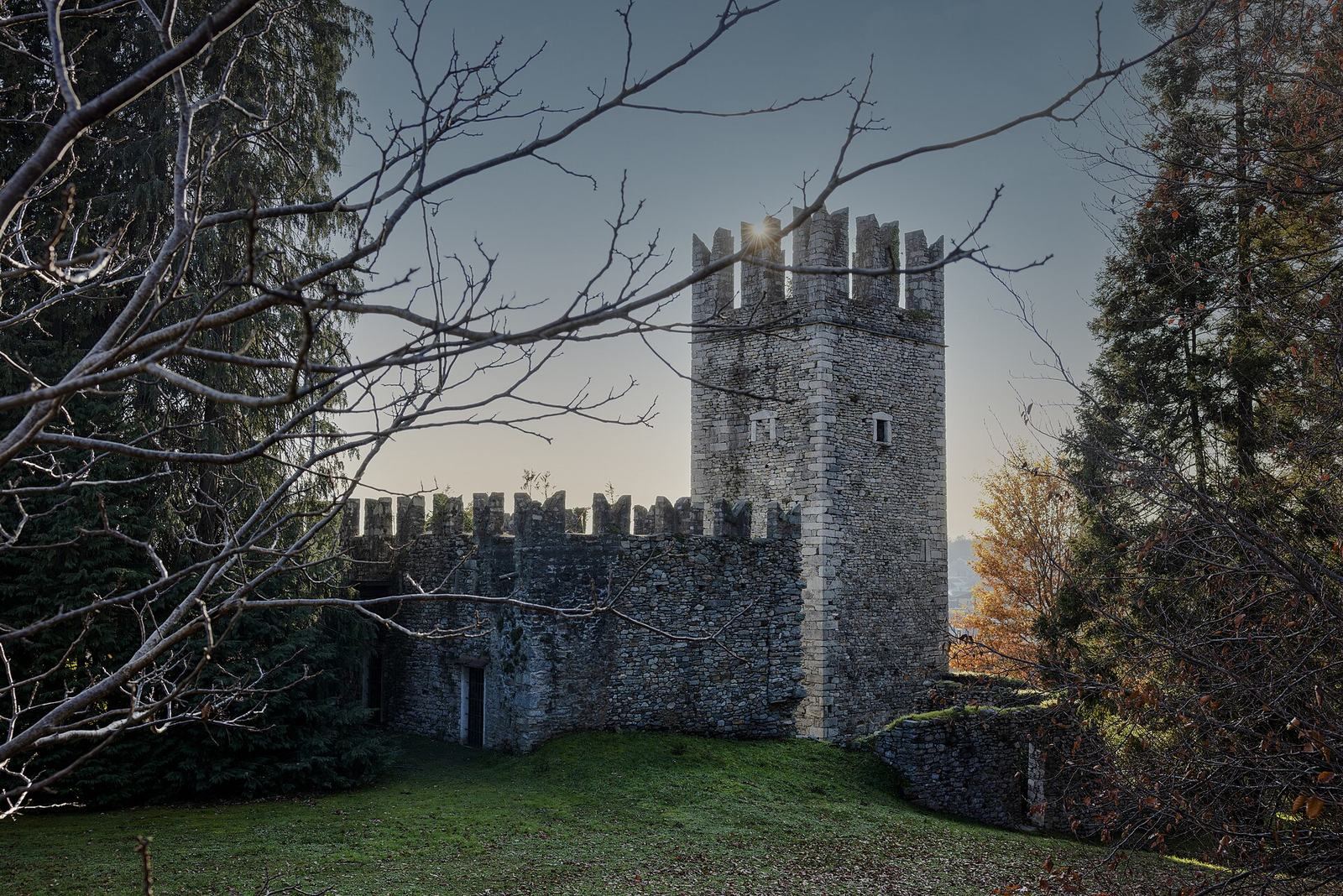
The castle occupied an elevated area of about 460 square metres on a rise above the village of Invorio Inferiore. Its fortified complex had two towers, two circuits of walls, and buildings attached to the walls. The surviving remains include a tower, sections of both enclosures, and part of the upper gallery’s painted decoration.
Fortified complex
Surviving tower
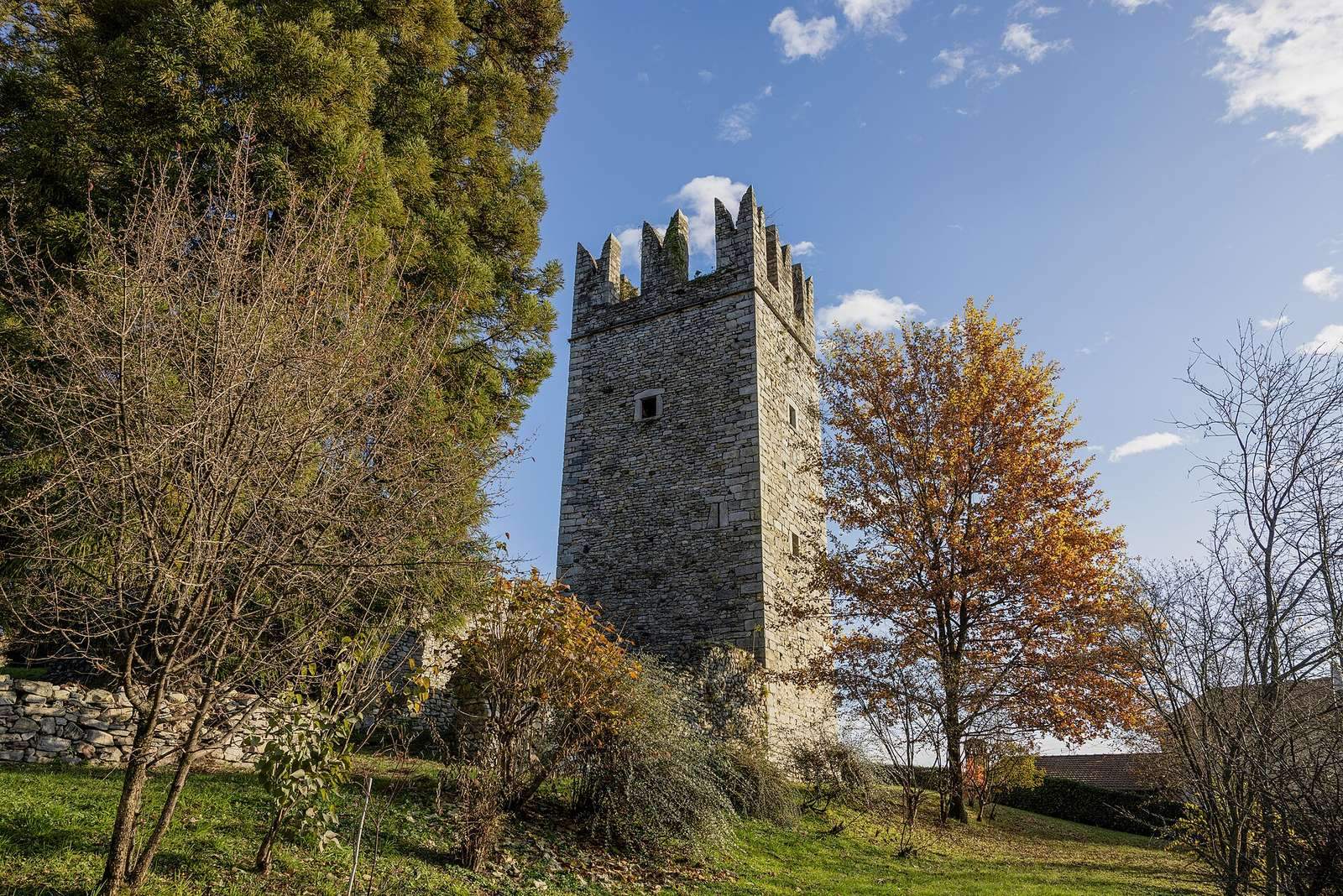
The square tower stands more than 16 metres high and is divided into three internal floors, with a battlemented level above them. Its swallowtail-shaped battlements were added later than the main tower. The original entrance, about five metres above ground, has a horizontal lintel topped by a shallow arch that does not open through the wall. A marble plaque added in the fourteenth century sits above the doorway. It shows the Visconti coat of arms, a serpent swallowing a child, surrounded by three-lobed motifs. The tower was restored and remained standing in 2020.
Walls and entrances
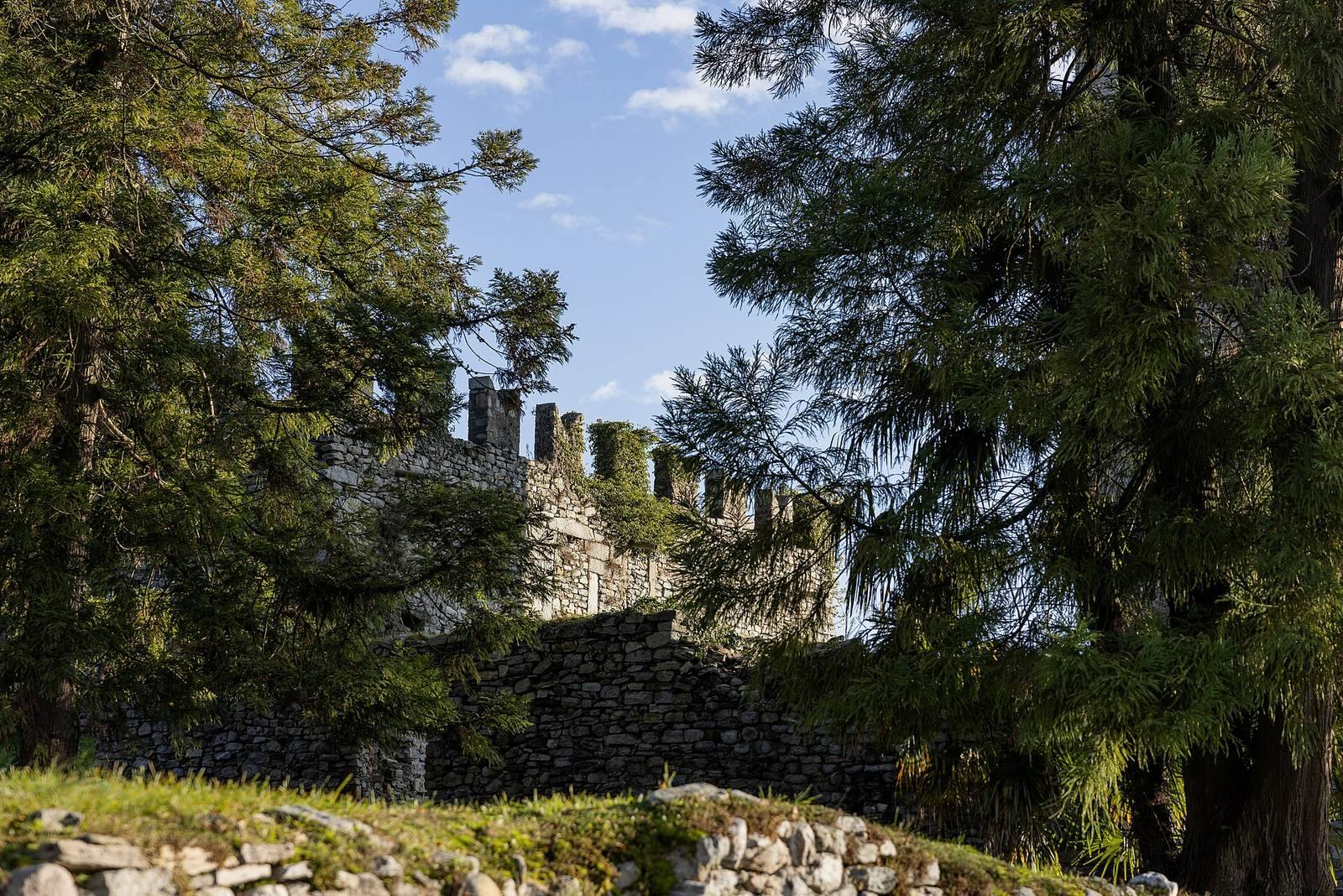
Traces around the tower likely mark its original enclosure. Around the fourteenth century, a building was added against the eastern wall and later given battlements like those of the tower. A larger outer wall circuit, probably built around the same period, enclosed the whole rise. A substantial stretch of its northern wall survives, with remains of attached buildings; one probably served as a water-storage cistern. The enclosure entrance stood at the southwestern corner and opened onto a road that climbed beside the walls. Its upper section was later altered. Another possible entrance lies on Via Martinotti, a few metres before the tower. The visible gate there bears a stone carving of the Visconti serpent emblem. Some fourteenth-century enclosure walls were later replaced by modern walls supporting garden terraces.
Painted upper gallery
An open gallery on the upper floor had a painted decorative band about one metre high along its interior wall. Sirens, centaurs, and fantastic creatures framed six portrait medallions of prominent Visconti and Sforza dukes. The paintings were in the style of fifteenth-century Lombard art. In the early twentieth century, the gallery was used as a hayloft, damaging or destroying part of its decoration, while the medallions suffered no substantial harm. Antonio Massara wrote about the paintings in 1909 and later alerted the Ministry of Public Education to their vulnerable condition. With the Ministry’s participation, local patron Marco De Marchi bought the paintings and donated them to the Museum of the Landscape in Pallanza. After authorization from the monuments superintendent in Piedmont, they were detached, transferred onto canvas, and mounted on frames prepared by restorer Francesco Annoni. They were installed in the museum’s hall of honor in spring 1919.