Vescovile Palace: A Renaissance Bishop’s Palace in Pienza
Site at a Glance
- Popularity
- Medium
- Country
- Italy
- Primary era
- Medieval
- Eras represented
- Medieval
- Civilizations
- Republic of Siena
- Site type
- Religious
- Remains
- Palace
On this page4 sections
History
Vescovile Palace, also known as Palazzo Borgia, is a Florentine Renaissance palace in Pienza, Italy. Its construction is dated to 1459 and attributed to Bernardo Rossellino. The palace forms part of the Renaissance city envisioned by Pope Pius II, the papal name of the humanist Enea Silvio Piccolomini.
An older Gothic palace on the site served as the bishopric’s seat. Pius II gave it to Cardinal Rodrigo Borgia, then the pope’s vice-chancellor and close collaborator. Borgia renovated the palace during the fifteenth century for use as his residence; he later became Pope Alexander VI.
The palace has housed the Diocesan Museum since 1998.
Remains
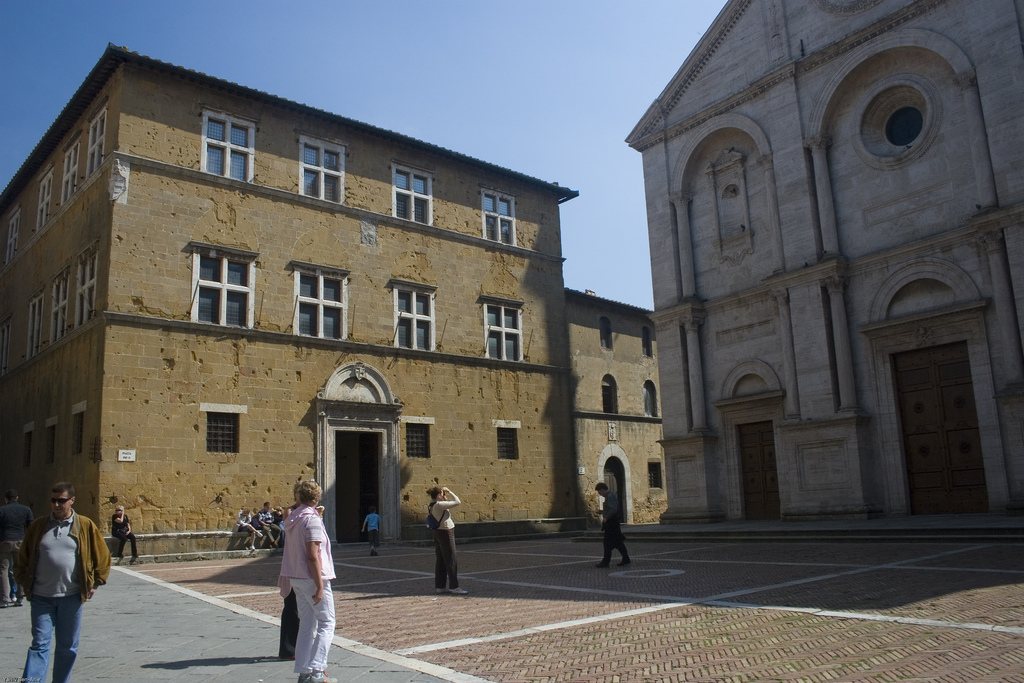
The three-storey palace stands on the left side of Piazza Pio II, beside the cathedral and opposite Palazzo Piccolomini. Corso Rossellino runs along its left side.
Façade
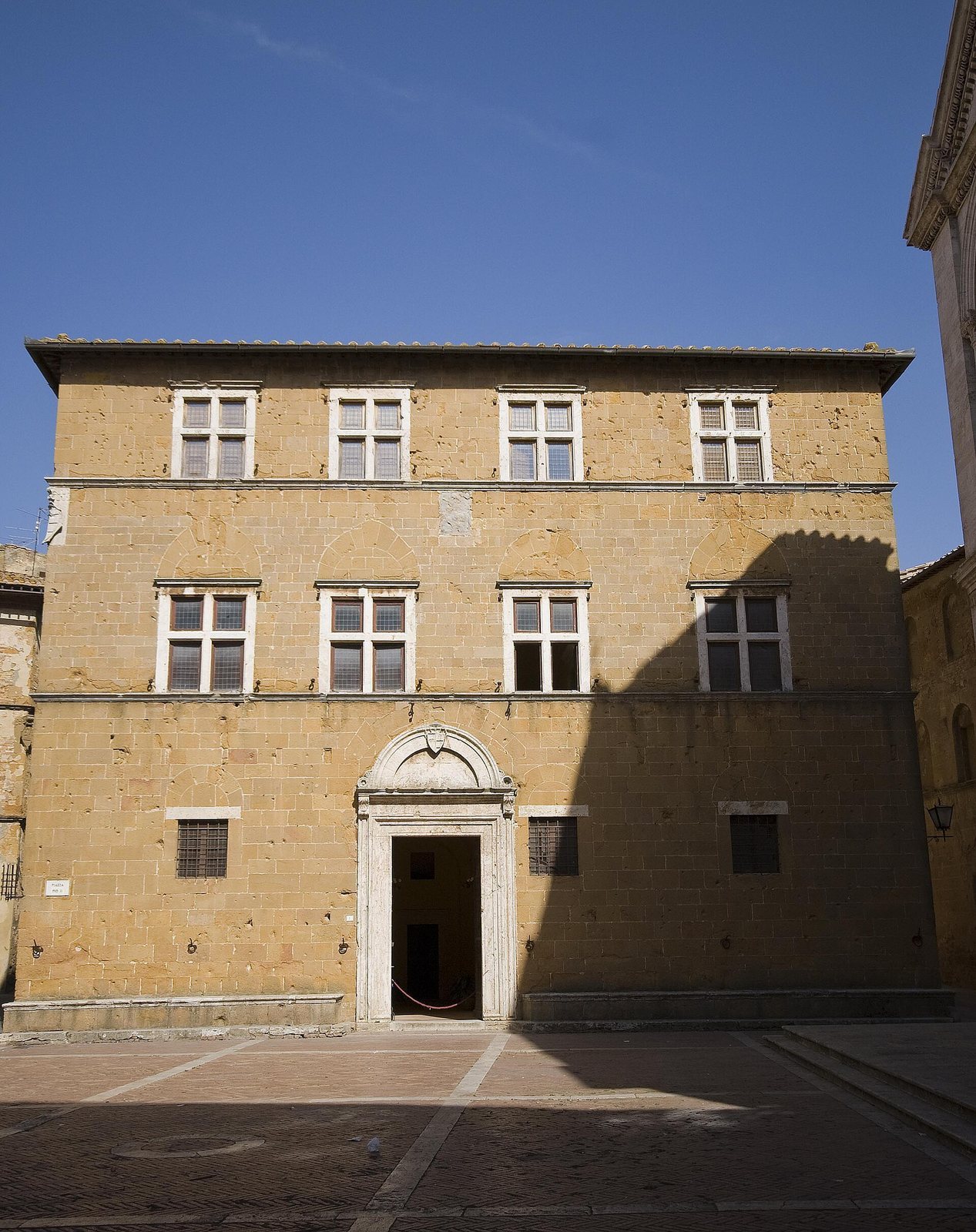
The restrained façade has two tiers of windows divided by vertical and horizontal bars in a cross pattern. A horizontal band separates the tiers. At ground level, a large, slender portal is topped by a tympanum, the architectural feature above a doorway. The Borgia family coat of arms is set at the corner facing Corso Rossellino.
Diocesan Museum Collection
The museum’s principal holdings include The Flight into Egypt by Fra Bartolomeo and Pietro Lorenzetti’s Madonna and Child, also called the Madonna of Monticchiello. Dated to 1320, the latter formed part of a multi-panel altarpiece and came from the parish church of Saints Leonard and Christopher at Monticchiello. Other works include Vecchietta’s Madonna and Child Enthroned among Saints Blaise, John the Baptist, Nicholas, and Floriano (1460), from Spedaletto, and Luca Signorelli’s Madonna of Mercy between Saint Sebastian and Saint Bernardino (1490).