Fort Douaumont: A First World War Fortress at Verdun


Site at a Glance
- Rating
- 4.6
- Popularity
- Medium
- Country
- France
- Primary era
- Modern
- External website
- Open
- Eras represented
- Modern
- Civilizations
- French, German
- Site type
- Military
- Remains
- Fort
On this page13 sections
History
Fort Douaumont is a French fortress at Douaumont-Vaux, France, built between 1884 and 1886 as part of the Séré de Rivières system and the fortified place of Verdun. The Séré de Rivières system was France’s late nineteenth-century network of forts, batteries, shelters, and related works created after the Franco-Prussian War of 1870–1871 to strengthen the eastern frontier. Douaumont became the northernmost major fort on the right bank of the Meuse and was supported by the Thiaumont and Vaux positions.
Construction and modernization
The fort was briefly renamed Fort Gérard by a decree issued by War Minister Georges Boulanger on 21 January 1887. The new name commemorated Marshal Étienne Maurice Gérard. Boulanger’s successor, Théophile Ferron, annulled the decree on 13 October 1887, restoring the name Fort Douaumont.
Its original rubble-masonry construction was soon challenged by high-explosive shells, which could penetrate earthworks and damage masonry fortifications. Major protection works followed in 1887–1889, including sand and concrete layers over vulnerable parts of the fort. Modernization and armament improvements continued between 1901 and 1913. By 1914, the planned wartime garrison was about 484 men, below the original capacity of approximately 891. Annex batteries begun in 1913 remained unfinished when construction stopped in July 1914.
The opening of the First World War
During the opening of the First World War, Douaumont exchanged artillery fire with German positions and came under repeated bombardment. On 8 October 1914, 137 impacts were counted in or immediately around the fort, including 23 on the barracks. Bombardments on 15 and 17 February 1915 damaged the bakery area, the access corridor to the 75 mm turret, and the 155 mm turret, which needed two days of repairs. On 4 February, the fort’s anti-aircraft firing position brought down an Aviatik aircraft, allowing two airmen to be captured.
In 1915, artillery pieces and ammunition were removed from the Verdun forts for mobile heavy-artillery units. At Douaumont, the Bourges casemate, a concrete flanking position designed to fire along the interval between forts, lost its two 75 mm guns. The garrison fell to about 56–70 territorial artillerymen under Adjutant Chenot. Territorial artillerymen were generally older reservists assigned to local defence and fortress duties. Douaumont was then used mainly as a rear-area transit and cantonment position.
Preparations were also made for demolition. Mines were installed and approximately five tonnes of black powder were stored, but the fort was not destroyed before the German offensive. This left one of Verdun’s major defensive positions intact when the Battle of Verdun began in February 1916.
German capture in 1916
The Battle of Verdun was a major campaign between France and Germany that lasted from February to December 1916. Douaumont became one of its principal strongpoints because its position affected observation, artillery control, morale, and the defence of the right bank of the Meuse.
German forces captured the fort on 25 February 1916 after heavy bombardment on 21 and 22 February, when approximately 800 shells struck the fort and its surroundings. German infantry entered through a breach in the northern wire and an inadequately occupied counter-scarp position, then advanced through the galleries and overcame the small French garrison. The capture involved little direct resistance and occurred before the planned demolition could take place.
The Germans converted Douaumont into an observation post, shelter, defensive strongpoint, rest area, and field hospital. By the evening of 25 February, 19 officers and 79 non-commissioned officers and soldiers from several companies occupied it. During 1916, as many as 3,000–3,500 German troops were sometimes housed inside.
The capture later produced a heroic legend centred on Oberleutnant Cordt von Brandis. Historical investigation by German Werth established that soldiers of Lieutenant Eugen Radtke’s company were probably the first German troops to enter, while von Brandis arrived later. Wartime reports and later commemorative propaganda obscured the exact sequence, and no official German correction was issued.
Explosion and the first French counterattack
On 8 May 1916, an accidental fire and explosion in German grenade and flamethrower stores caused several hundred deaths. Estimates range from about 700 to 900 German soldiers killed. The bodies of 679 men were placed in a sealed casemate inside the fort, creating the German cemetery and memorial that remains within the structure.
The first French attempt to retake Douaumont began on 22 May 1916. The 129th Infantry Regiment and supporting engineers reached the fort and seized sections of its western area, including the Bourges casemate and the north-west counter-scarp position. German resistance, machine-gun fire, artillery, shortages, and counterattacks forced the surviving French troops to surrender on 24 May. The regiment suffered extremely heavy losses.
French recapture
A second offensive was prepared in October 1916 by forces commanded by General Charles Mangin. After an exceptionally heavy artillery bombardment, including fire from 400 mm howitzers, German troops evacuated the fort on the evening of 23 October. French troops, principally the Moroccan Colonial Infantry Regiment supported by other units of the 38th Infantry Division, entered and reoccupied Douaumont on 24 October. The Moroccan Colonial Infantry Regiment, or RICM, was a French colonial infantry regiment whose forces included troops from different parts of France’s colonial formations.
The assault was supported by the 43rd Senegalese Battalion, two Somali companies, engineers, and flamethrower teams. Jean Ygon and Paul Dumont were among the first French soldiers to enter. Ygon captured German soldiers, machine guns, and guns, while Dumont captured German officers and soldiers. Both men received the Legion of Honour in December 1916. Major Pierre Nicolaÿ became commandant of the fort and was later killed at Louvemont.
After the recapture, French engineers restored lighting and ventilation, cleared debris and bodies, repaired defensive positions, rearmed the Bourges casemate and counter-scarp coffers, and improved the water supply. German shelling continued. On 14 December 1916, a German 420 mm shell collapsed two barrack casemates and killed 21 French soldiers. Seven remained sealed behind a wall.
Later military use and conservation
During and after the war, very large numbers of shells struck the fort and the surrounding battlefield. Estimates range from about 120,000 shells on the fort and glacis to approximately 400,000 in the wider area. The bombardment cratered the landscape and contributed to the designation of much of the Verdun battlefield as a restricted red zone, a postwar classification for heavily devastated land where unexploded ordnance, contamination, and human remains made ordinary settlement or agriculture unsafe.
After the war, architect André Ventre proposed converting Douaumont into an ossuary because human remains were scattered across the battlefield. Marshal Philippe Pétain rejected the proposal because the fort had not been declassified and was still regarded as a military installation. The Douaumont ossuary and necropolis were instead established near the former Thiaumont farm.
The fort was partially declassified in 1926 as its strategic value declined after the Franco-German frontier moved eastward. It remained part of a second-line fortified system while the Maginot Line, France’s interwar network of modern fortified works along the eastern frontier, was built. From 1937 to 1939, workers repaired turret armour and surrounding reinforced concrete, replaced damaged machine-gun turrets, and concreted sections of the underground galleries.
During the 1940 campaign, French troops used Douaumont as a delaying position while German forces advanced toward Verdun. The 155 mm turret fired several rounds before the garrison surrendered. Both the 155 mm and 75 mm turrets were sabotaged, reportedly by soldier Victor Chrétien. During the remainder of the Second World War, German occupation forces used the Verdun battlefield, including the fort, as a destination for military tourism.
Fort Douaumont was designated a French historic monument in 1970. The state retained ownership, while management was entrusted to the Meuse departmental authority. Clearance and excavation in 1985 uncovered the remains of a German soldier beneath debris near the movable bridge. Conservation and redevelopment between 2016 and 2018 included unexploded-ordnance clearance, earthworks, and the relocation of the entrance from the barracks courtyard to the former wartime entrance at the bottom of the gorge ditch. Since 20 September 2023, the fort has formed part of the UNESCO World Heritage serial property of First World War burial and memorial sites on the Western Front.
Remains
Layout and original defences
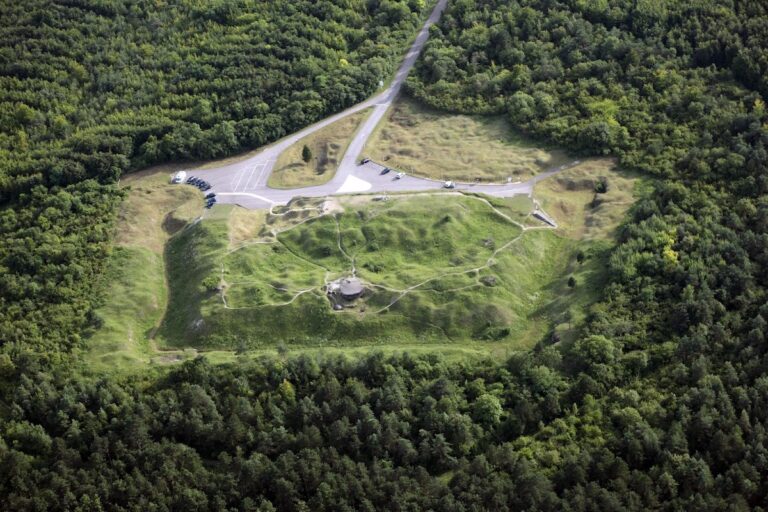
Fort Douaumont occupies a central fortified massif covering approximately 7.4 hectares. It stands at about 395 metres above sea level on a summit south-east of the former village of Douaumont, which was destroyed during the First World War. The dry ditch is approximately 14 metres wide and six metres deep. Its irregular polygonal outline has two projecting northern sides, nearly parallel flanks, and a recessed gorge facing the centre of the Verdun position.
The entrance was placed in the middle of the gorge and protected by a diamond ditch, a metal drawbridge, and a projecting guardhouse. Three caponiers originally defended the ditch. These were fortified positions projecting into or behind the outer ditch wall, allowing fire along the ditch. Two single caponiers stood at the north-west and north-east salient angles, while a double caponier occupied the northern point. In 1889, they were replaced by concrete counter-scarp coffers connected to the fort by underground passages beneath the ditch. Two flanking casemates were also built on either side of the entrance.
Central barracks and artillery platforms
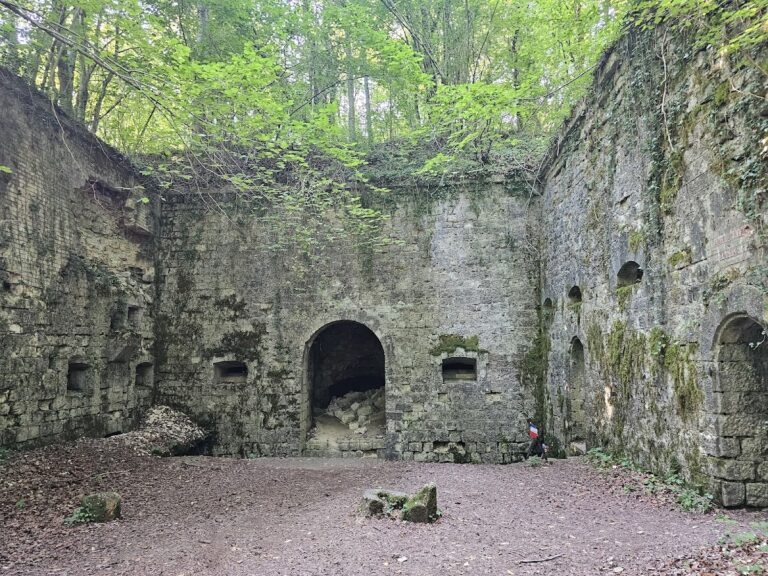
The central barracks consisted of vaulted casemates opening southward to the open air and connecting northward with a buried gallery. They contained kitchens, troop rooms, a bakery, an infirmary, a forge, stores, powder magazines, ammunition rooms, and water cisterns. Sanitation facilities, workshops, and electrical-generating equipment used during the First World War were also installed. A room used by the German garrison for steam disinfection of uniforms and personnel survives within the underground complex.
The original artillery platforms formed an arc around the central massif. Seven traverses, raised protective barriers separating artillery platforms, shielded personnel and ammunition from bombardment. The original armament comprised six 155 mm guns, six 120 mm guns, four 95 mm guns, and six revolver guns for ditch defence.
The original buildings and walls were made from rubble masonry using limestone from the Haudromont quarries and covered with a thick layer of earth. Between 1887 and 1888, a one-metre layer of sand and 1.5–2.5 metres of concrete were added above the barracks, entrance corridor, and traverses. Earth was then placed above the concrete, producing an overall protective layer that reached roughly six metres in places. The 1889 reconstruction replaced some exposed masonry with an inclined earth slope and a grille, reducing the surface vulnerable to bombardment. Five original hollow traverses were later converted into concrete ammunition stores.
Modernized guns and observation positions
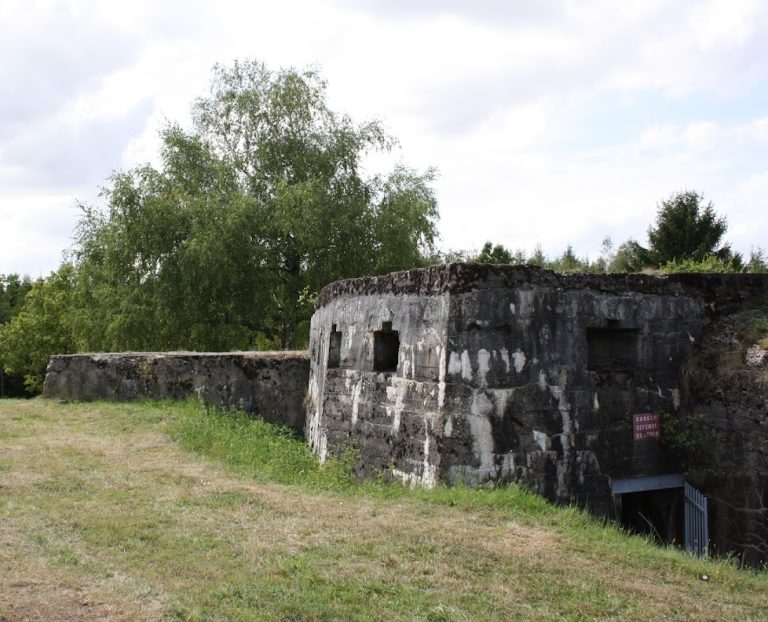
Between 1901 and 1903, a concrete Bourges casemate was installed on the western side. Its two 75 mm guns were intended for flanking fire toward Thiaumont and the intervening ground. Two machine-gun turrets were added to defend the glacis and upper surfaces at close range.
A Galopin turret installed between 1906 and 1909 carried a short 155 mm gun for long-range fire. A Galopin turret was a retractable armoured gun position that rose to fire and descended below the protective surface when not in action. Four artillerymen operated its counterweight and capstan mechanism. The 37-tonne turret was balanced by approximately 37 tonnes of counterweights. Its 155 mm shell weighed 43 kilograms and had a stated range of 7.2 kilometres. Two mechanical hoists raised ammunition from the magazines to the firing chamber.
A second artillery turret, installed between 1911 and 1913, carried two 75 mm guns for close defence. Five armoured observation posts and two armoured sentry structures supported the fort’s observation system. A barbed-wire belt approximately 30 metres wide surrounded the glacis from 1906.
Two further batteries were begun on the glacis from 1913. The eastern battery was intended for another two-gun 75 mm turret and had reached the masonry stage when work stopped in July 1914. The southern battery, intended for two armoured turrets carrying short 155 mm guns, remained an excavation later known as Quarry 2808.
Wartime alterations and underground works
German troops reinforced the barracks façade with several metres of sandbags and earth. Bombardment damaged the cisterns, making water scarce, and the garrison was at times restricted to about 250 millilitres per person per day. German troops installed generators, external latrines, and additional protective works. They also began a southern communication tunnel to reduce exposure when troops left the fort. About 60 metres had been completed by late October 1916.
After the French recapture, the southern tunnel was extended toward the Caillette ravine and given three outlets, including connections toward a quarry and a narrow-gauge railway. French engineers also excavated the “works of 1917,” a system of deep galleries and shafts within the Verdun forts. At Douaumont, these passages reached roughly 30 metres below ground and connected the barracks, command observation post, Bourges casemate, artillery turrets, machine-gun positions, and counter-scarp coffers. Work continued until 1918, and the completed system included approximately 800 metres of galleries and shafts reaching about 60 metres in total depth.
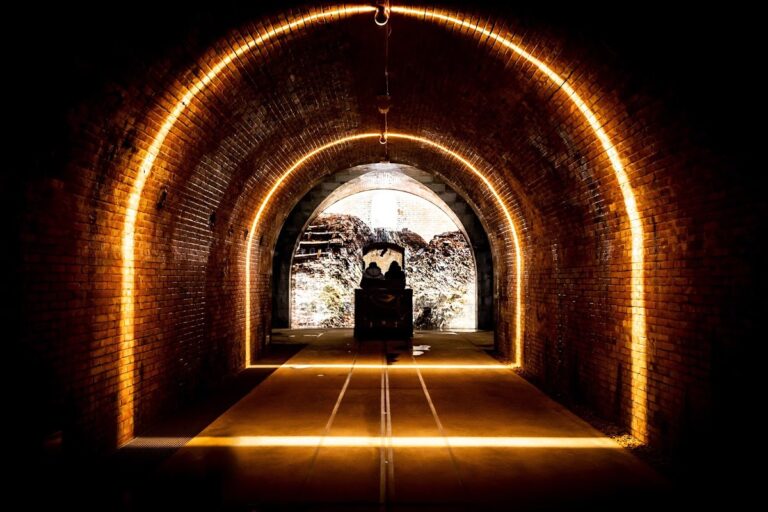
The underground system contained electrically lit and ventilated passages, dormitories, stores, and a workshop. Watertight doors allowed sections to be maintained under slight overpressure. A 40 cm railway entered through the wartime entrance, while a 60 cm railway ran near the more distant tunnel outlet. These lines supported the movement of supplies and the storage of ammunition. The system was intended to hold approximately 4,700 rounds for the 75 mm turrets and 1,500 rounds for the 155 mm turret.
Damage and memorials
The 155 mm turret survived the First World War in working order and fired 15 rounds in support of the French attack on the Côte du Poivre on 15 December 1916. The 75 mm turret was damaged and functioned poorly. The north-eastern machine-gun turret was converted into an artillery observation post, while the north-western turret, which had been destroyed, was also adapted for observation.
The protective covering and upper structures suffered extensive wartime damage. Much of the original sand and earth cover disappeared through bombardment and German extraction of sand. Shell craters covered the site, the ditches were badly damaged, half the turrets were out of service, the concrete was cracked, and the barracks became excessively damp.
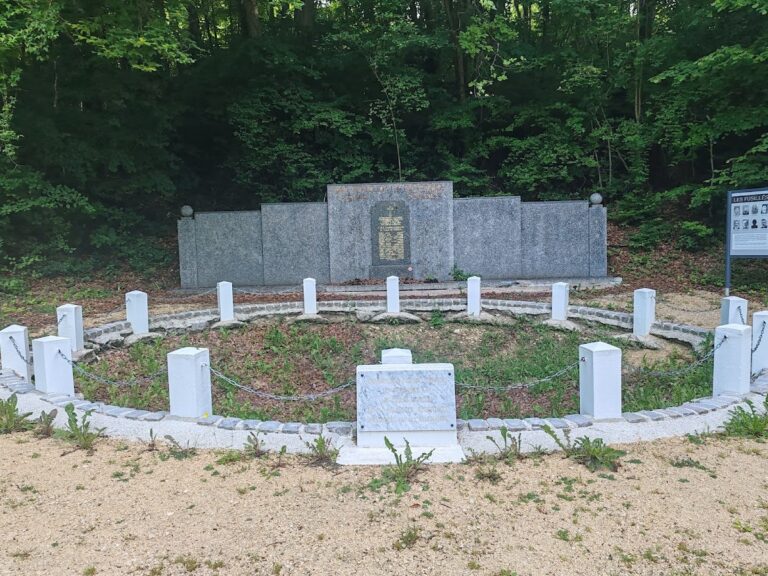
The explosion of 14 December 1916 left two collapsed barrack casemates sealed behind a wall. Fourteen bodies were recovered for burial elsewhere, while seven French soldiers remained behind the sealed wall. A memorial plaque records their names. The German cemetery inside the fort commemorates the 679 soldiers sealed in a former ammunition casemate after the explosion of 8 May 1916.
The present fabric includes dry ditches, damaged concrete and masonry, shell impacts, underground corridors, the former wartime entrance, turret mechanisms, the Bourges casemate, observation positions, and internal memorials. A bronze sculpture titled Der Abschied, meaning “The Farewell,” by Franz-Josef Ludwig was installed inside the fort in 2013.
Nearby sites