Velthusen Palace in Szczecin: A Merchant’s Residence and Music School
Site at a Glance
- Rating
- 4.6
- Popularity
- Medium
- Country
- Poland
- Primary era
- Early Modern
- Eras represented
- Early Modern, Modern
- Civilizations
- Kingdom of Prussia
- Site type
- Civic
- Remains
- School
On this page9 sections
History
Velthusen Palace in Szczecin is an eighteenth-century residence in Poland, built in 1778–1779 for merchant Georg Christian Velthusen in a blend of Baroque and neoclassical styles. The property had belonged to the city since the thirteenth century, when Szczecin was known as Stettin.
From city property to merchant’s residence
In 1559, Duke Barnim IX, also known as Barnim XI, gave Johann Eichorn permission to establish Stettin’s first printing press on the property. Eichorn’s son-in-law, Andreas Kellner, later operated it. By the early eighteenth century, the land had been divided into four parcels containing two modest tenement houses. The Russian Army destroyed them during its 1713 siege of Szczecin in the Great Northern War, a conflict from 1700 to 1721 between Sweden and a coalition that included Russia. A larger residence was built on the site around 1724 and subsequently housed several prominent citizens.
Velthusen arrived in Stettin in 1769 and acquired the property in 1778. He financed his residence in part with a loan of 2,160 thalers from his father-in-law. The building also became the base of his wine trade and cellar, which supplied Pomerania, northern Poland, and the Netherlands. He expanded his wealth through other enterprises, including granaries and factories producing tobacco, sugar, and vinegar.
Changing uses in the nineteenth and twentieth centuries
The street now called Staromłyńska was once Mill Street and was renamed Louise Street in 1806. It was regarded as one of the city’s most prestigious streets. During the first half of the nineteenth century, an imposing side wing was added along present-day Łaziebna Street.
Richard Wolkenhauer acquired the palace in 1874 and used it as his home as well as a piano shop and manufacturing facility until 1920. A photography studio occupied the first floor until 1888, first under Eduard Kiewning and later under Hermann Moellendorf and Christian Bachmann. It appears to have moved as the expanding piano business required more room.
From 1922, the building served as the headquarters of the Pomeranian Provincial Bank. An aerial bombing destroyed the palace on 21 April 1943. Poland added it to the national heritage list in 1954, and it was rebuilt between 1959 and 1962. Since 1963, the building has housed the Feliks Nowowiejski Music School.
Remains
Plan and exterior
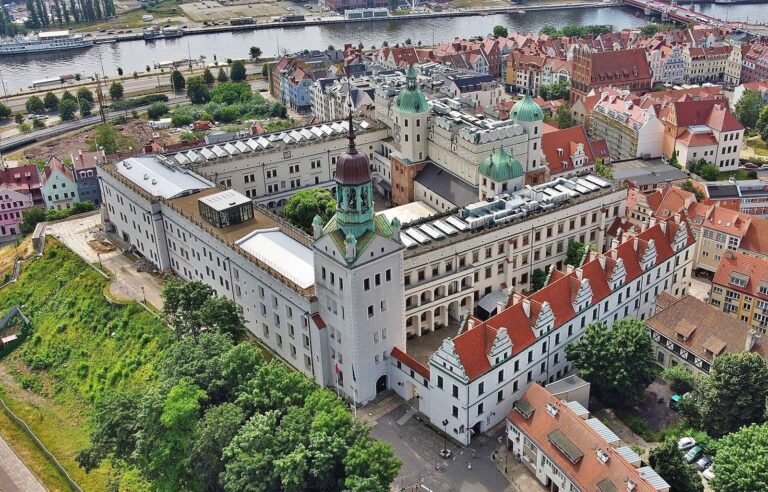
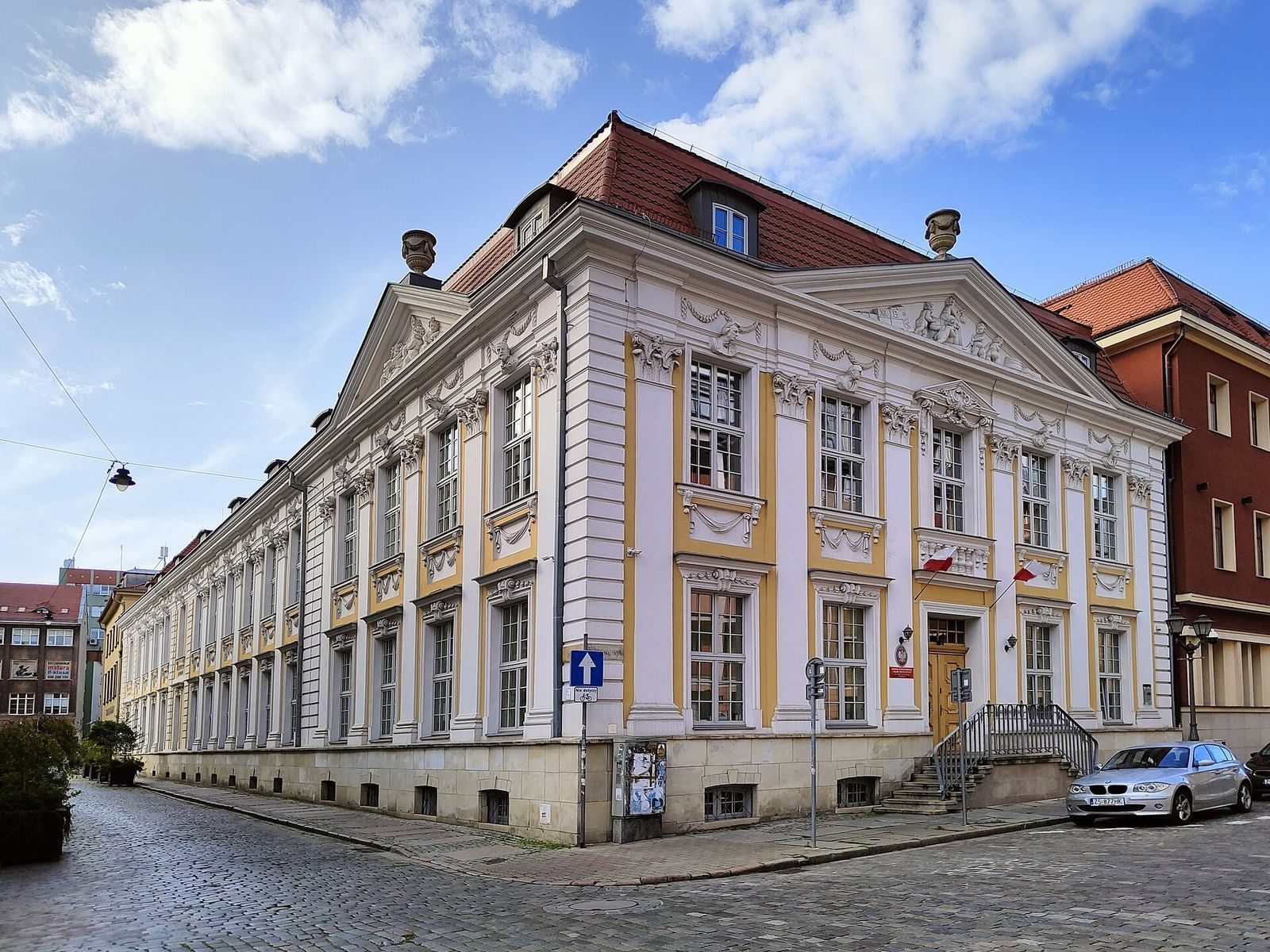
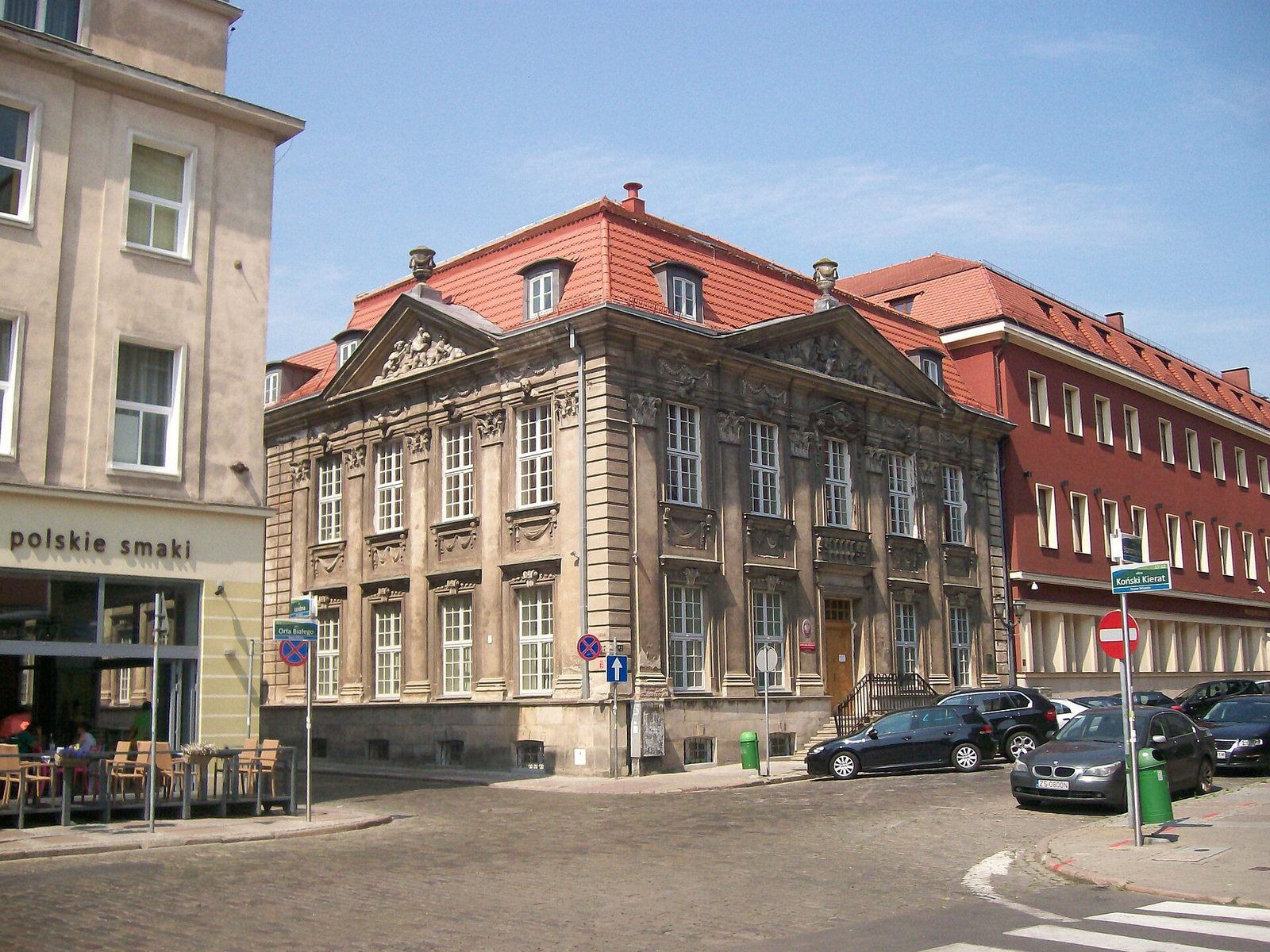
The palace stands beside White Eagle Square in Szczecin’s Old Town, at the junction of Staromłyńska and Łaziebna streets. It has a basement, several storeys above ground, a high masonry base, and a ceramic-tiled roof. The principal façade faces Staromłyńska Street, while the rear extends about 40 metres along Łaziebna Street, where the side wing also runs. Sandstone slabs face the façade. The design is attributed to Carl Philipp Christian von Gontard and is thought to have taken the Mauritshuis, a historic building in The Hague, as its model.
Architectural decoration
Façade details
The façades and side wing are articulated by shallow, wall-attached columns that extend across more than one storey. Other details include corner masonry with strongly emphasized faces and joints, window surrounds, and carved garlands beneath the first-floor windows. The central panels of the pediments on the two street-facing sides show grape harvesting and the transport of wine barrels, referring to the palace’s original wine business.
Composer busts
Twenty busts of composers decorate the stonework above first-floor windows. On the Łaziebna Street side are Edvard Grieg, Johann Sebastian Bach, Ludwig van Beethoven, Carl Loewe, Wolfgang Amadeus Mozart, Jean Sibelius, Claude Debussy, Mikhail Glinka, Antonio Vivaldi, Giuseppe Verdi, Igor Stravinsky, Sergei Prokofiev, Antonín Dvořák, Henryk Wieniawski, Ignacy Jan Paderewski, and Bedřich Smetana. The Staromłyńska Street side features Frédéric Chopin, Stanisław Moniuszko, Feliks Nowowiejski, and Karol Szymanowski. These portraits replaced earlier busts of Socrates, Seneca the Younger, and Hadrian.
Surviving fabric
The surviving prewar fabric consists of the front exterior walls and cellar vaults. The cellar vaults were renovated in 2010, and the façade was renovated in 2015.