Veien Cultural Heritage Park: An Early Iron Age Burial Ground in Norway
Site at a Glance
- Popularity
- Medium
- Country
- Norway
- Primary era
- Iron Age
- Eras represented
- Iron Age
- Civilizations
- Unclassified
- Site type
- Burial
- Remains
- Necropolis
On this page14 sections
History
Long human activity and early centers
Veien Cultural Heritage Park in Norway preserves an extensive burial ground and traces of settlement reaching back thousands of years. The cemetery was used chiefly during the Early Iron Age (500 BCE–550 CE), and is among the largest burial grounds of its period in the Nordic region and the largest in Buskerud. Finds also relate to the Bronze Age (1800–500 BCE) and Late Iron Age (550–1050 CE). The oldest human traces in the area are about 5,000 years old, and it appears to have been a gathering place for at least 3,000 years.
The burial ground takes its name from the large Veien farm beside it. The farm name may come from the Old Norse Vevínr, interpreted as “sacred meadow,” though the origin of the area’s early power center is uncertain. Veien may have separated from the older farm of Ve during the first centuries CE, which would make it too recent to be the sanctuary suggested by that interpretation. Ve, a few hundred metres to the west, may have been established at least a couple of centuries BCE, perhaps earlier. Its position for controlling movement through the valleys makes it a more likely source of the burial ground’s early importance, although the location of the original farm is unclear. Ve and Veien may each have held authority at different times.
The area seems to have remained a center of power until the beginning of the Viking Age, when Stein, especially, and Tanberg became more influential. Veien was also one of the district’s large farms. It is associated with the Bagler chieftain Philippus of Veigin, who died in 1207. The Baglers were a medieval Norwegian political faction. Philippus is said to have administered Borgesyssel, a district in southeastern Norway, and to have married a king’s daughter. Whether he was the same person as Filippus Simonsson, who died in 1217, is uncertain; the Bagler sagas describe them as separate people.
Excavations and the modern park
The burial ground has been known since the eighteenth century. In 1847, more than 150 mounds were recorded across an area exceeding 100 decares, a decare being 1,000 square metres. Professor Oluf Rygh of the University of Oslo’s Collection of National Antiquities excavated 87 mounds in 1870 and 1875. Buskerud County began further work in 1990. From 1992 to 1998, students from Veienmarka lower secondary school took part in annual two-week excavations with the university collection and the county archaeologist. Each year, 32 to 36 students participated. The last excavations took place in 2000, when two further houses were identified.
The park was established in 2004. The Hringariki Foundation, formed that year, initially operated the park, its burial ground and reconstructed longhouse, as well as the old Ringerike Museum at Norderhov Old Rectory. The foundation’s name came from an Old Norse name for Ringerike. In 2015, responsibility for running the museums passed to the Buskerud Museums Foundation. Ringerike Municipality and Buskerud County selected the park as a millennium site, and the Norwegian Cultural Council placed the burial ground on its list of ancient monuments given high priority.
Remains
The park occupies about 84 decares in the upper part of Veienmarka, just south of the Veien farms, with a road separating the farm from the burial ground. Its land includes 39 decares of woodland and 45 decares of cultivated ground. The archaeological landscape contains burial mounds and flat graves, traces of several houses, and a reconstructed longhouse.
The burial ground
Burial mounds
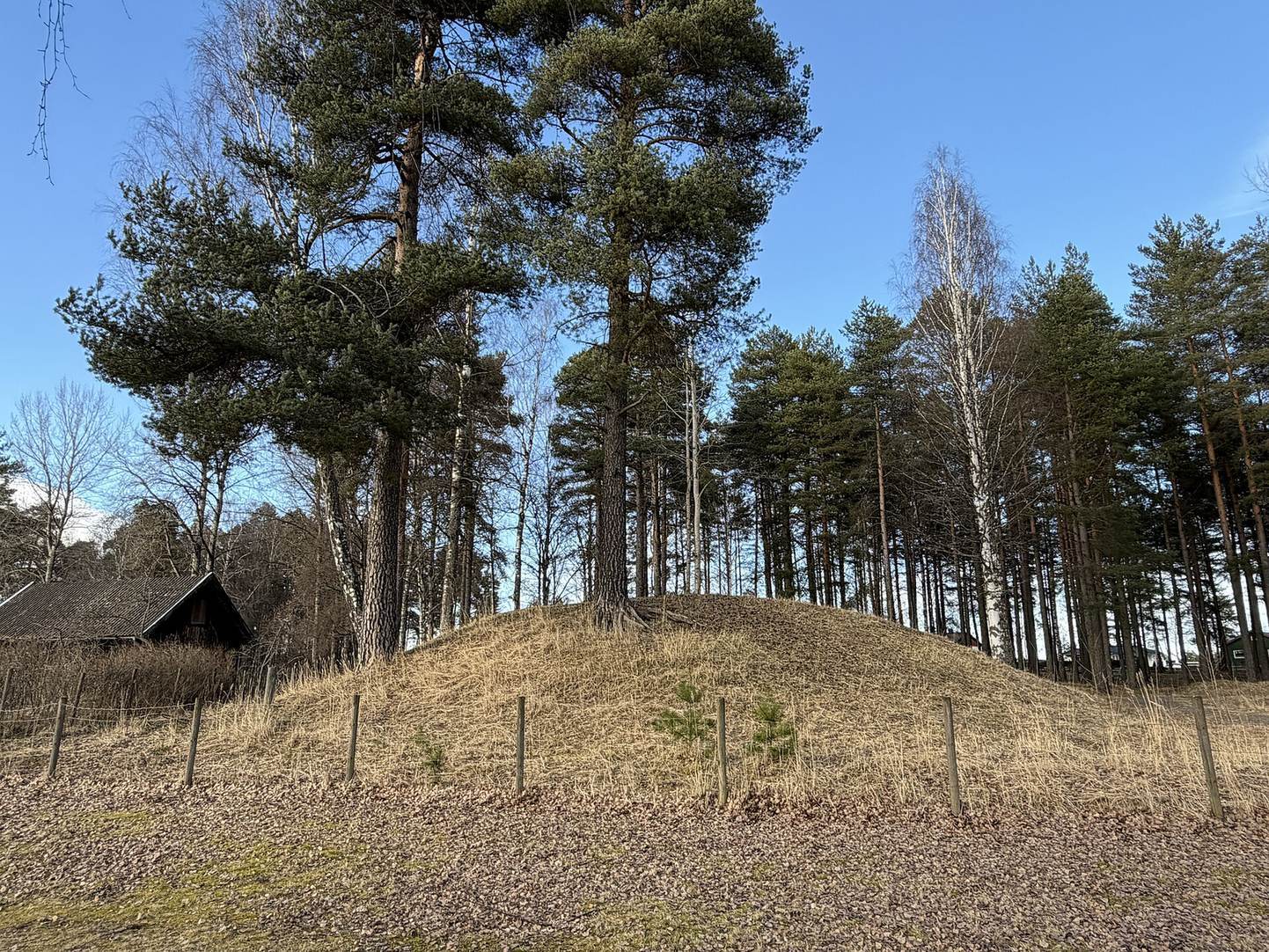
There are 107 surviving mounds, while the original total may have approached 200. They date from about 0 to 1000 CE, with most belonging to the period between 200 and 600 CE. Their tops are flattened, and every mound shows signs of looting. Jomfruhaugen is said to have been excavated as early as the eighteenth century.
Flat graves
Alongside the mounds, the burial ground contains an estimated 600 flat graves, most thought to date to the sixth century BCE. The oldest excavated grave dates to about 900 BCE.
Kongshaugen
Kongshaugen is the largest mound, and finds from it date to about 400 CE. Cremation was common at the time, but the burial has been interpreted as possibly belonging to a chieftain. It was richly furnished, and the wealth represented by its grave goods is thought to have accumulated over generations. The mound was first excavated in 1824 and explored again the following year by an amateur.
Excavated objects
Finds from the excavations include a complete balance scale with ten weights based on Roman units of weight, dated to the third century; a Roman coin from the fourth century; and a gilded-silver sword-sheath fitting from the fifth century. The fitting was found at Kongshaugen in 1824. Other objects include gold finger rings, rings made from gold used for payment, combs, pottery, weapons, shield bosses (raised metal fittings at the centers of shields), curved knives and drinking horns.
House remains and the reconstructed longhouse
The longhouse
Postholes, the holes that held wooden posts, revealed a longhouse facing south and measuring about 8 by 47 metres. Seventeen pairs of posts supported its roof. Charcoal from the postholes was radiocarbon dated, a method for estimating the age of organic material, to about 50–70 CE. Three hearths lay inside the building. At two, posts had been moved to the side to enlarge the rooms, while evidence at the northern end suggests that livestock may have been kept there. Its size and plan suggest it may have served as a guild hall, a meeting place for an organized group, as well as a dwelling with space for animals.
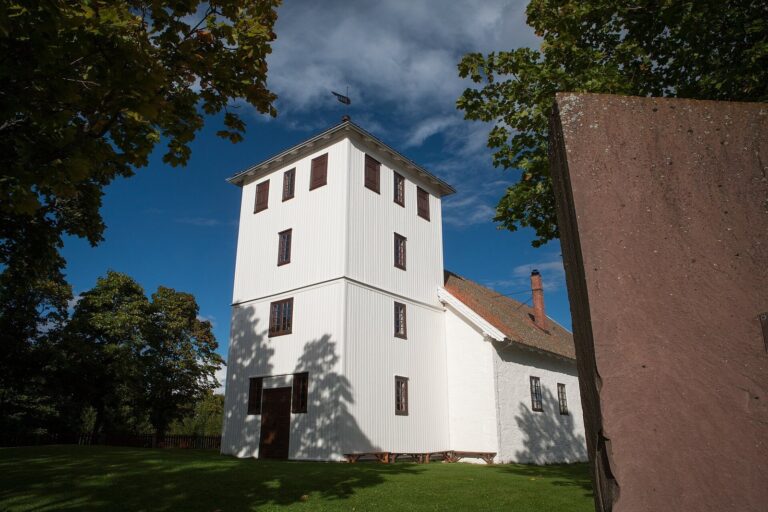
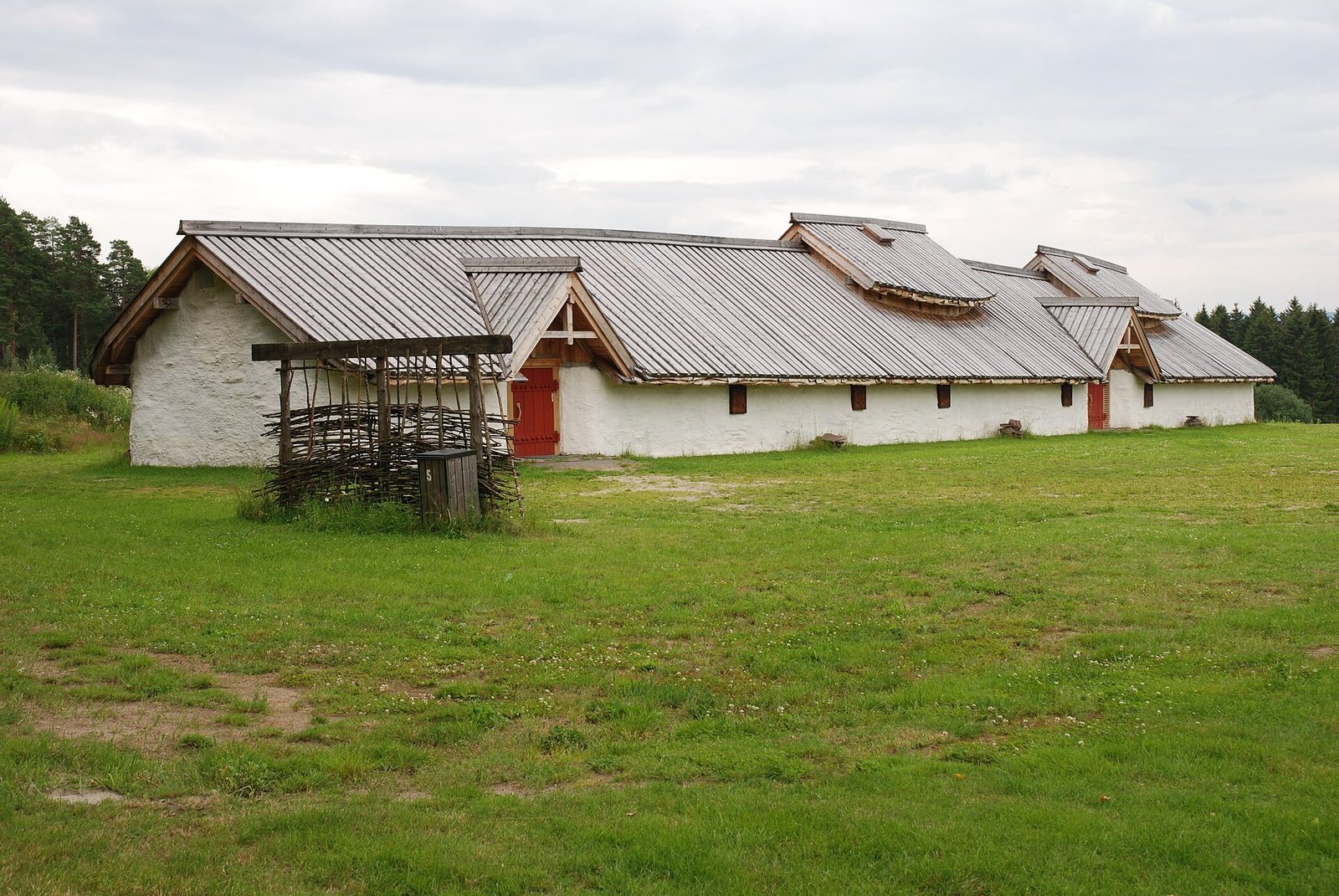
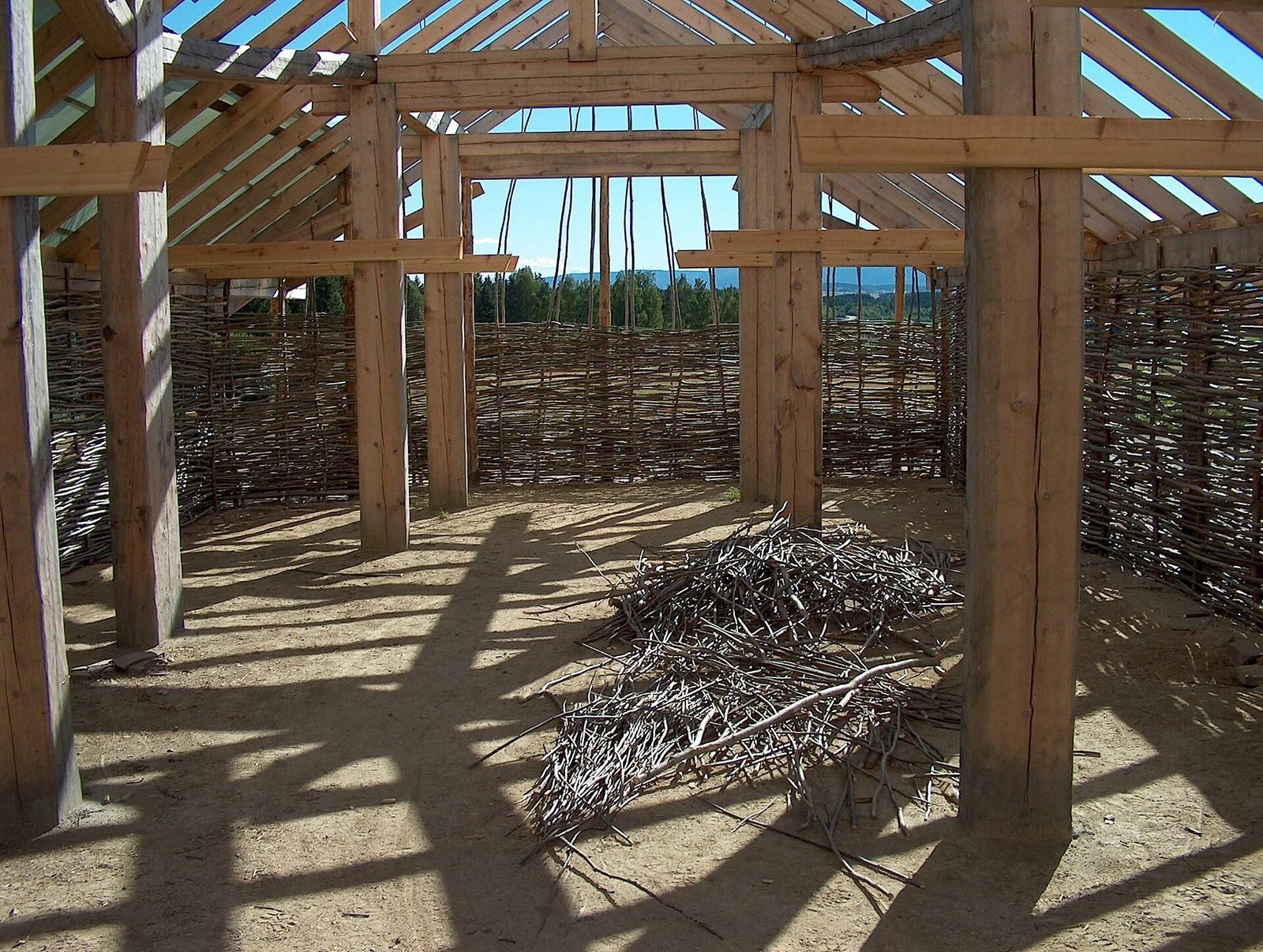
The reconstructed longhouse stands on the site of the original and was completed in spring 2005. Crown Prince Haakon laid its foundation stone on 22 April 2002, during celebrations for Hønefoss’s 150th anniversary. Its walls are 50 centimetres thick, with two layers of interwoven branches coated in clay on both sides. Construction used more than 100 tonnes of clay, 500 square metres of brushwood, about 2,500 square metres of birch bark and approximately 50,000 wooden pegs.
Other house remains
Postholes mark four additional houses, making five in all, probably built over roughly 500 years. House V is the oldest and may date to the centuries BCE. House I probably burned around 200 CE, and House II likely followed it; House II is thought to date to 200–400 CE and had a wall trench outside its roof-supporting posts. House III was later than the large longhouse and had four roof-supporting posts. It may have been an outbuilding, perhaps a storehouse.
The northern field
A geophysical survey in 2017 identified 11 ring ditches, circular ditches associated with burial features, in a field north of the main area toward Soknedalsveien and the E16. The survey was conducted by the Norwegian Institute for Cultural Heritage Research and Buskerud County in connection with the railway and E16 project. The area was protected from trenching to safeguard the heritage remains.
Museum exhibitions
The museum’s permanent exhibition, “Helena’s Three Lives,” follows the life of a fictional person across the Early Iron Age, around 1850, and the period from 1972 to the present. The Hringariki exhibition draws on finds from Kongshaugen.