Bagration House: An Early Nineteenth-Century Manor in Belarus


Site at a Glance
- Rating
- 4.5
- Popularity
- Low
- Country
- Belarus
- Primary era
- Modern
- External website
- Open
- Eras represented
- Modern
- Civilizations
- Russian
- Site type
- Domestic
- Remains
- Manor House
On this page6 sections
History
Bagration House is an early nineteenth-century manor in Volkovysk, Belarus, built in 1805 in the Classical style. Local tradition associates the house with the headquarters of the Second Russian Army, commanded by Pyotr Ivanovich Bagration, during the 1812 campaign.
Changing Uses in the Nineteenth and Early Twentieth Centuries
During the second half of the nineteenth century, the building was first used as a city hospital and later as a home for the elderly. At the beginning of the twentieth century, it belonged to private owners.
War Damage and Museum History
The house was partly destroyed during World War II and restored in 1949. That restoration changed the interior layout. The Volkovysk Military-Historical Museum named for Pyotr Ivanovich Bagration now occupies the building. Founded as a local-history museum in 1935, it was looted during World War II and restored in 1948. On 15 February 1949, a decision of the Volkovysk District Executive Committee assigned the former manor house to the museum.
A bronze bust of Bagration was placed in front of the house in 1950, and a memorial plaque was added to the building in 1957. On 14 May 2007, a resolution of the Council of Ministers of Belarus entered Bagration House on the State List of Historical and Cultural Values of the Republic of Belarus as a site of republican-level historical and cultural heritage. It is registered under code 412G000089.
Remains
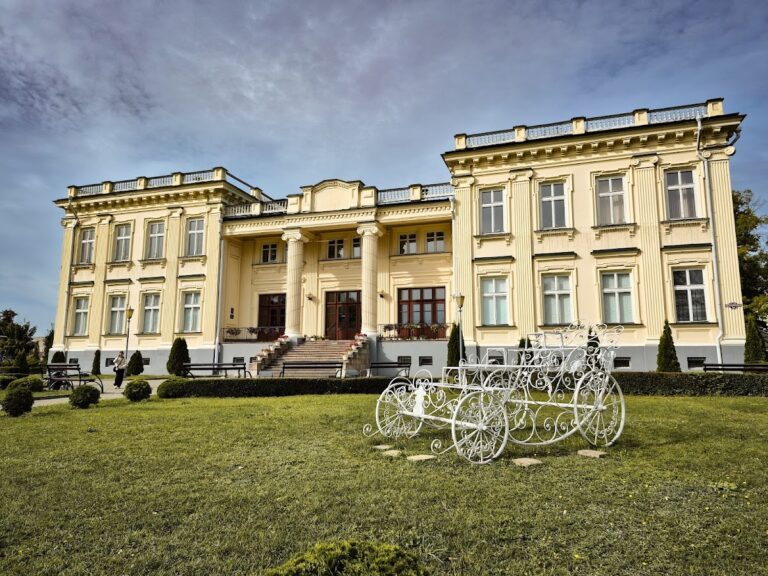
Bagration House is a one-story rectangular timber building on the outskirts of Volkovysk. Its Classical design is defined by a tall hipped roof and a central entrance composition, while plastered façades give the structure a finished exterior appearance.
Exterior
The central section is emphasized by a four-column stone portico, a columned entrance structure, topped by a curved pediment, the decorative upper section above it. A balcony stands above the entrance within the portico and is reached from the mezzanine rooms, which occupy part of the upper level. Before the entrance is a bronze bust of Pyotr Ivanovich Bagration made by Zair Azgur. The building also carries the memorial plaque installed in 1957.
Interior Arrangement
Inside, the rooms follow an enfilade layout, a sequence of spaces aligned through connecting doorways. A vestibule and staircase occupy the center of the plan. This interior arrangement belongs to the building as restored in 1949, when the earlier layout was altered.
Nearby sites