Vallée des Merveilles: Prehistoric Rock Art in the Mount Bégo Complex
Site at a Glance
- Popularity
- High
- Country
- France
- Primary era
- Stone Age
- Eras represented
- Stone Age, Bronze Age, Classical, Medieval, Early Modern, Modern
- Civilizations
- Roman
- Site type
- Civic
- Remains
- Rock Art
On this page11 sections
History
The Vallée des Merveilles is a prehistoric rock-art sector in Tende, France, within the cross-border complex around Mount Bégo. Its images span several millennia, from the Neolithic, the later Stone Age, through historical times. The wider complex contains Europe’s second-largest concentration of open-air Bronze Age rock engravings, after Val Camonica in Italy.
Prehistoric images
The oldest engravings include network-like designs and topographical compositions from the fifth and fourth millennia BCE. Many images of weapons, including daggers, axes, and halberds, belong to the Copper Age, the period between the Neolithic and Bronze Age, especially the third millennium BCE. Fewer images are assigned to the Early Bronze Age, around 2200–1800 BCE. Engraving continued in later periods, with medieval figures and historic inscriptions and drawings.
Counts across the Mount Bégo complex exceed 35,000 prehistoric engravings. A detailed count gives about 36,000 images, including roughly 20,000 figurative designs on 4,200 rocks. Including historic marks brings the count to about 50,000, while broader totals for pecked and less-studied incised images may approach 100,000.
Interpretations and research
Local tradition called the engravings Marvègie, meaning marvels, and a publication about them appeared in 1869. Clarence Bicknell, a British botanist and Anglican clergyman, identified important engraved rocks and the Fontanalbe complex. Over twelve summers from 1897 to 1912, he made paper rubbings that captured more than 12,000 figures and helped establish an early classification of the images. Piero Barocelli was the first to apply archaeological methods to the engravings. Sculptor Carlo Conti studied them from 1927 to 1942.
Some researchers interpret the images as a symbolic or religious system, perhaps a form of proto-writing: marks that communicate ideas without forming a complete writing system. They have proposed that the images relate to sacred rites connected with agriculture and pastoral life. Mount Bégo has been understood by some as a divine power, sustaining life through its waters but also feared for its violent storms. Many have associated the mountain with the ancient Ligurians, peoples of northwestern Italy and adjoining southeastern France.
Emilia Masson interpreted the engravings as expressing survival, with naturalistic scenes at Fontanalbe representing the mortal world and cosmological scenes at Merveilles the divine. She read three principal carved stones as a narrative in which sky and earth unite, separate, and give way to a new world after the victory of a storm deity. Chantal Jègues-Wolkiewiez argued that the orientations of human figures relate to the stars. In her 1997 thesis, she described the valley as an observatory associated with Taurus, the zodiac constellation represented by a bull, and proposed a late Neolithic bull cult connected with pastoral fertility and renewal. Other studies have considered astronomy, timekeeping, and comparisons with ancient religions. Archaeologist Richard Bradley cautioned against building broad interpretations around a few striking engravings.
From 1967, Henry de Lumley and teams linked to the French National Museum of Natural History and the Lazaret Prehistory Laboratory in Nice carried out systematic recording, continuing through 2009. The resulting corpus is preserved at the laboratory. Ten doctoral theses on the pecked engravings were produced from the early 1990s to the early 2010s.
Territorial change and protection
The territory belonged to the County of Nice, a historical territory under the House of Savoy, until 1861. It then became part of Italy and the province of Cuneo. The 1947 Paris treaties transferred it to France.
Protection developed in stages. The area was inscribed as a natural site in 1959 and classified as one in 1969; it became part of Mercantour National Park in 1979. The site received historic-monument status in 1987, followed by classification of the engravings in 1989. From 1990, regional cultural authorities and the park developed joint protective and management measures because the images are highly vulnerable. Creating new engravings is treated as damage to a protected site and may lead to prosecution.
Remains
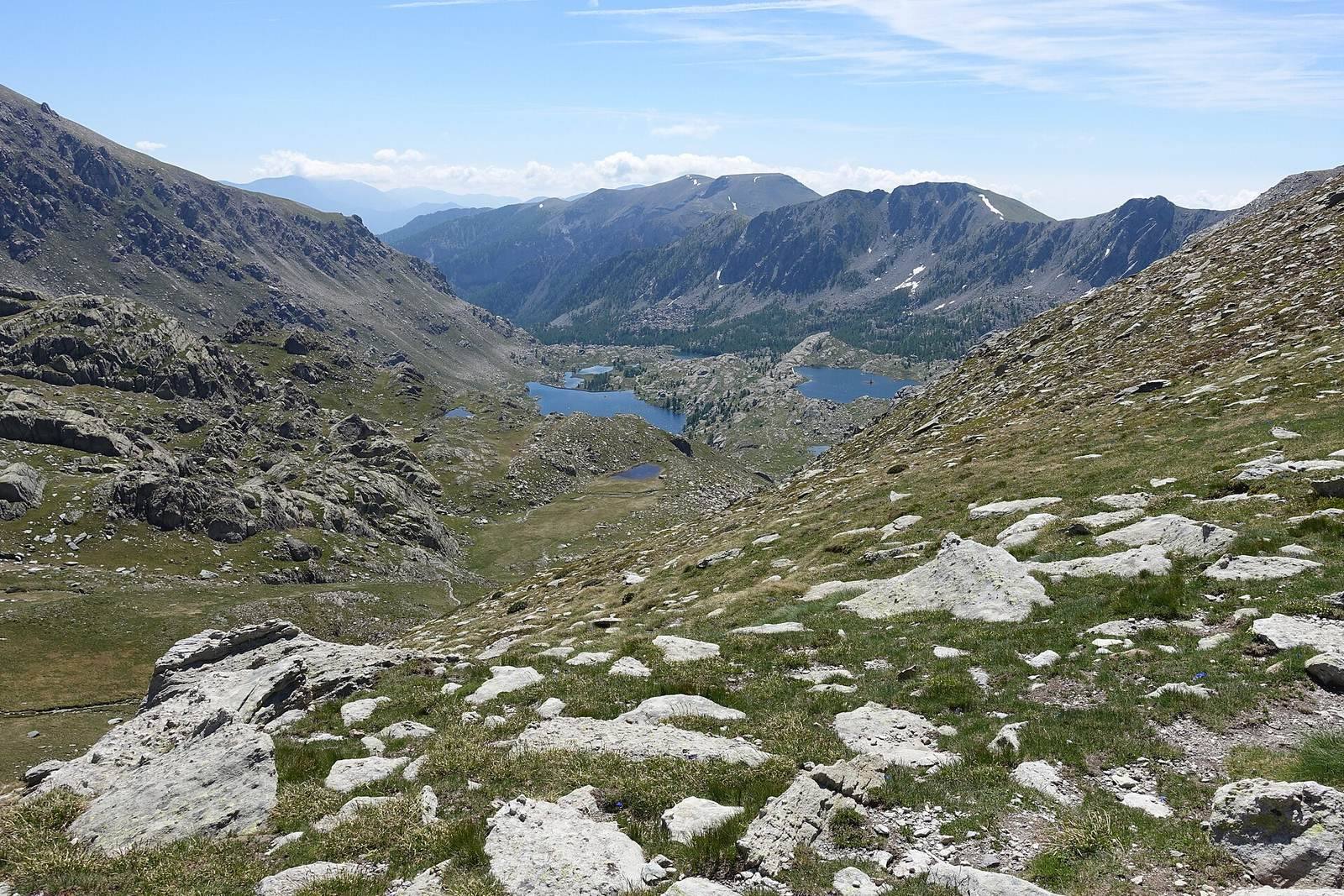
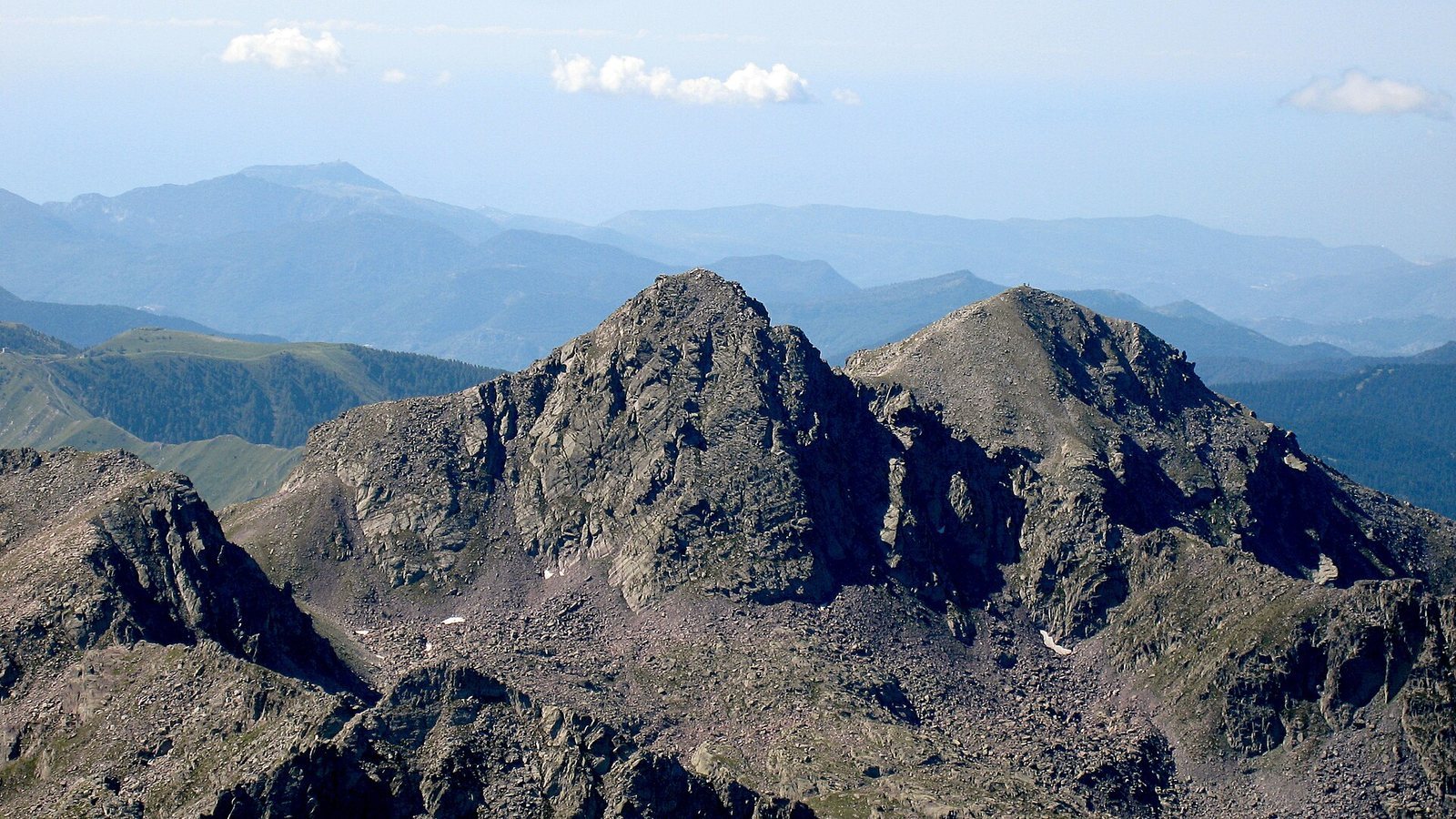
The Mount Bégo complex covers about 4,000 hectares, with its most intensively recorded area extending across roughly 1,400 hectares. It occupies seven high valleys above 2,000 metres around Mount Bégo, which rises to 2,872 metres, and the Pic des Merveilles, at 2,659 metres. Engravings are cut or pecked into naturally exposed rock surfaces shaped by glaciers.
High-valley layout
The complex has seven principal sectors: Merveilles, Fontanalbe, Valaurette, Col du Sabion, Lac Sainte-Marie, Valmasque, and Vei del Bouc. Six lie in France, Vei del Bouc is in Italy, and Col du Sabion crosses the border. About half the engravings are in Merveilles, west of Mount Bégo, and about half in Fontanalbe to the north. Merveilles covers around 972 hectares and Fontanalbe around 486. The Upper Lake and the Merveilles torrent are among the named natural features in the valley.
Geology and glacial surfaces
The valley lies within the crystalline Argentera–Mercantour massif. Its basement includes granite formed through the partial melting of older rock, beneath Permian river-and-lake deposits. The basal Inferno formation consists mainly of sandstone and conglomerate with finer silty layers. Above it, the Merveilles formation is chiefly green siltstone, the surface on which most Bronze Age images were made. It also contains layered structures and traces of sediment disturbance by organisms. The upper Bego formation alternates sandstone and conglomerate with finer siltstone and sandstone layers. Mesozoic carbonate rocks have been eroded from the area and occur farther down the Roya valley.
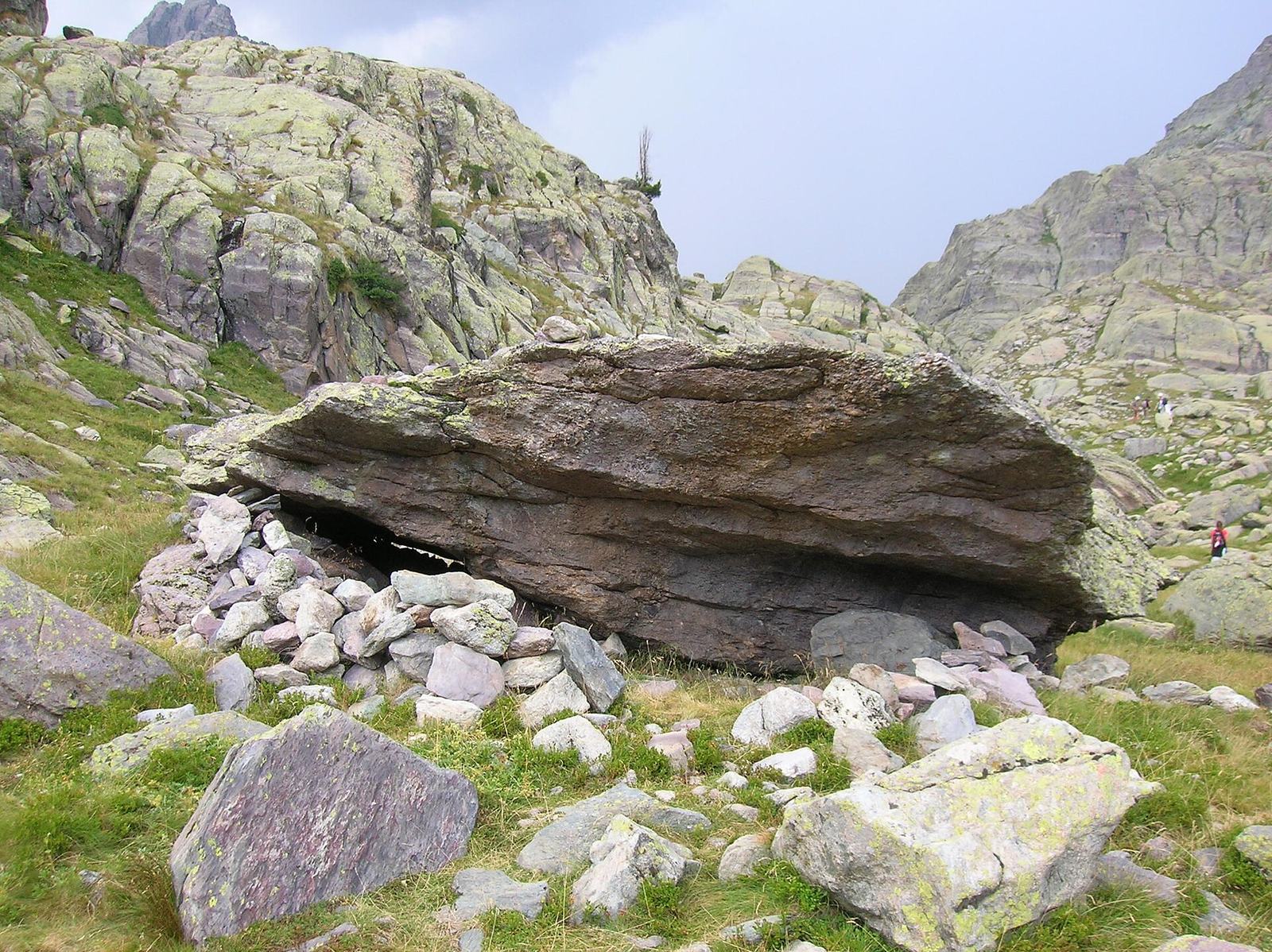
Glacial activity about 10,000 years ago shaped the landscape of polished rock, moraines, and scattered boulders carried by ice. Engravings appear on smoothed bedrock outcrops, including rounded forms shaped by glacial erosion, and on isolated blocks. The rock surfaces used most often are pelite, a fine-grained sedimentary rock, and sandstone.
Engraving methods and motifs
Pecked images were made with stone tools, using repeated impacts to remove tiny amounts of rock and form designs that sometimes include cupules, or small rounded hollows. Incised images were cut or traced into the surface, often as V-shaped grooves, and some combine grooves with cupules. The imagery includes horned figures often interpreted as cattle, sometimes shown with ploughs, as well as weapons, human figures, geometric designs, and uncertain marks. Fontanalbe is especially noted for its network-like patterns and topographical compositions.
The Vitrified Wall, stelae, and named figures
In the Merveilles sector, the Vitrified Wall is a rock face smoothed by glacial erosion and the densest concentration of incised engravings. It bears a Latin inscription dated to the second century CE and two Bronze Age dagger figures. Three principal carved upright stones, or stelae, stand at different elevations, the lowest beside the Merveilles torrent. In Masson’s interpretation, their images include solar, terrestrial, and human figures, along with pairs of daggers. Traditional or descriptive labels for other figures include the Sorcerer, Christ, the Tribal Chief, and the Dancer. The Sorcerer is in sector Z VIII, group II, rock 3(4), and Christ in sector Z VII, group I, rock 4. The enigmatic Tree of Life is in Fontanalbe.
Later marks
Later incisions include medieval human, tree-like, and crossbow-like figures. Historic carvings include shepherds’ inscriptions associated with summer stays in the valleys, detailed sailing ships, eighteenth-century soldiers with bayonets and tall, stiff grenadier caps, and marks attributed to smugglers. Modern examples include signatures by Italian Alpine soldiers and shepherds from the Roya Valley.
Casts and rubbings
Numerous casts of the engravings are held at the Musée des Merveilles in Tende. Bicknell’s more than 12,000 recorded figures are represented in paper rubbings, much of which is held at the Bicknell Museum in Bordighera.