Sharovkin Dormition Monastery: A Russian Orthodox Monastery at Ilyinskoye
Site at a Glance
- Popularity
- Low
- Country
- Russia
- Primary era
- Early Modern
- Eras represented
- Early Modern
- Civilizations
- Russian
- Site type
- Religious
- Remains
- Monastery
On this page11 sections
History
Foundation and Vorotynsky Patronage
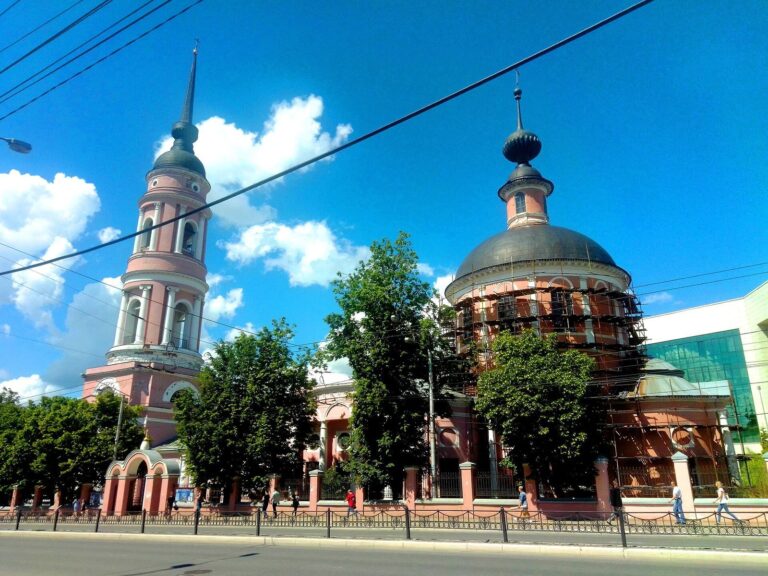
Sharovkin Dormition Monastery, also known as the Uspensky Monastery, is a Russian Orthodox monastery at Ilyinskoye, Russia. The monk Theognost Sharovka founded it in the early sixteenth century as a gathering place for hermits, whose spiritual father he became. The community took its name from him. Prince Alexander Ivanovich Vorotynsky became its personal patron and replaced its first wooden church with a building of white, specially shaped brick. By 1552, the monastery had a stone cathedral dedicated to the Dormition of the Mother of God.
Theognost died in 1545. In 1547, Alexander granted the monastery Bashkova and other villages. He also gave the church icons and furnishings for worship, and continued his support until his death in 1565. His brother, Prince Mikhail Ivanovich Vorotynsky, continued the family’s patronage. Around 1550, the monastery built a church dedicated to Saint Sergius the Wonderworker, with a communal dining hall and a chapel dedicated to John the Theologian. The church was consecrated in 1560. In 1564, the abbot Prokhor painted one of the churches.
Royal Support and Monastic Benefactors
Tsar Ivan IV, known as Ivan the Terrible, gave the monastery 200 rubles in 1565 in connection with Alexander Vorotynsky. During a visit in 1566, he provided 100 rubles for fish and oil. That year he also granted land measured at 300 quarters, a traditional Russian unit of land measurement, and in 1567 issued a charter for the monastery’s estate. In 1584, Alexander’s nephews added the village of Kozmenki.
Ivan Chicherin, a courtier who became a monk at the monastery, supported it from 1606 until his death on 28 September 1640. Vasily Koshelev, another benefactor, was killed near Smolensk and buried at the monastery in 1634. In 1648, Tsar Alexei Mikhailovich granted it estate lands and villages; in 1659, a royal order provided 80 rubles for church construction. Prince Ivan Alekseevich Vorotynsky, the last member of his family, continued to donate through 1670. Tsar Fyodor Alekseevich gave the monastery vestments in 1677, and Princess Evdokia Alekseevna donated two liturgical coverings and a veil used in the Eucharist.
Attachment, Suppression, and Later Use
In 1684, co-ruling tsars Ivan V and Peter I and their sister Sophia Alekseevna ordered the monastery and its estates attached to Donskoy Monastery. The order included its peasants, cultivated land, hay meadows, fishing grounds, and other estate rights and resources. In 1764, the monastery was classified as a non-staff institution, outside the regular ecclesiastical staffing establishment of the Krutitsy Diocese.
A fire brought the monastery’s independent life to an end in 1776. It destroyed wooden buildings, including the church of Saint Sergius, monks’ cells, a stable, livestock yards, and the enclosure. The abbot and monks were transferred to Zhabynsky Monastery at Belyov, taking some church furnishings with them. The churches later served as parish churches. The former monastery is now an active dependency of the Saint Nicholas Chernoostrovsky women’s monastery in Maloyaroslavets. Its Dormition church remains in use within the Russian Orthodox Church’s Kaluga Diocese.
Remains
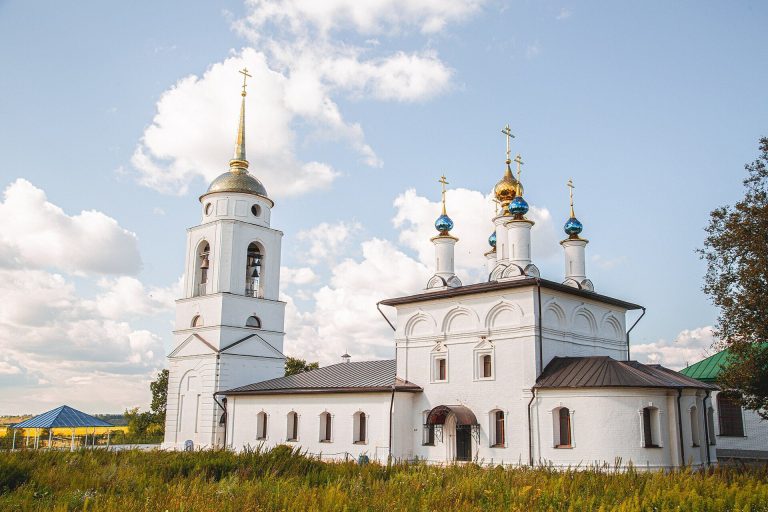
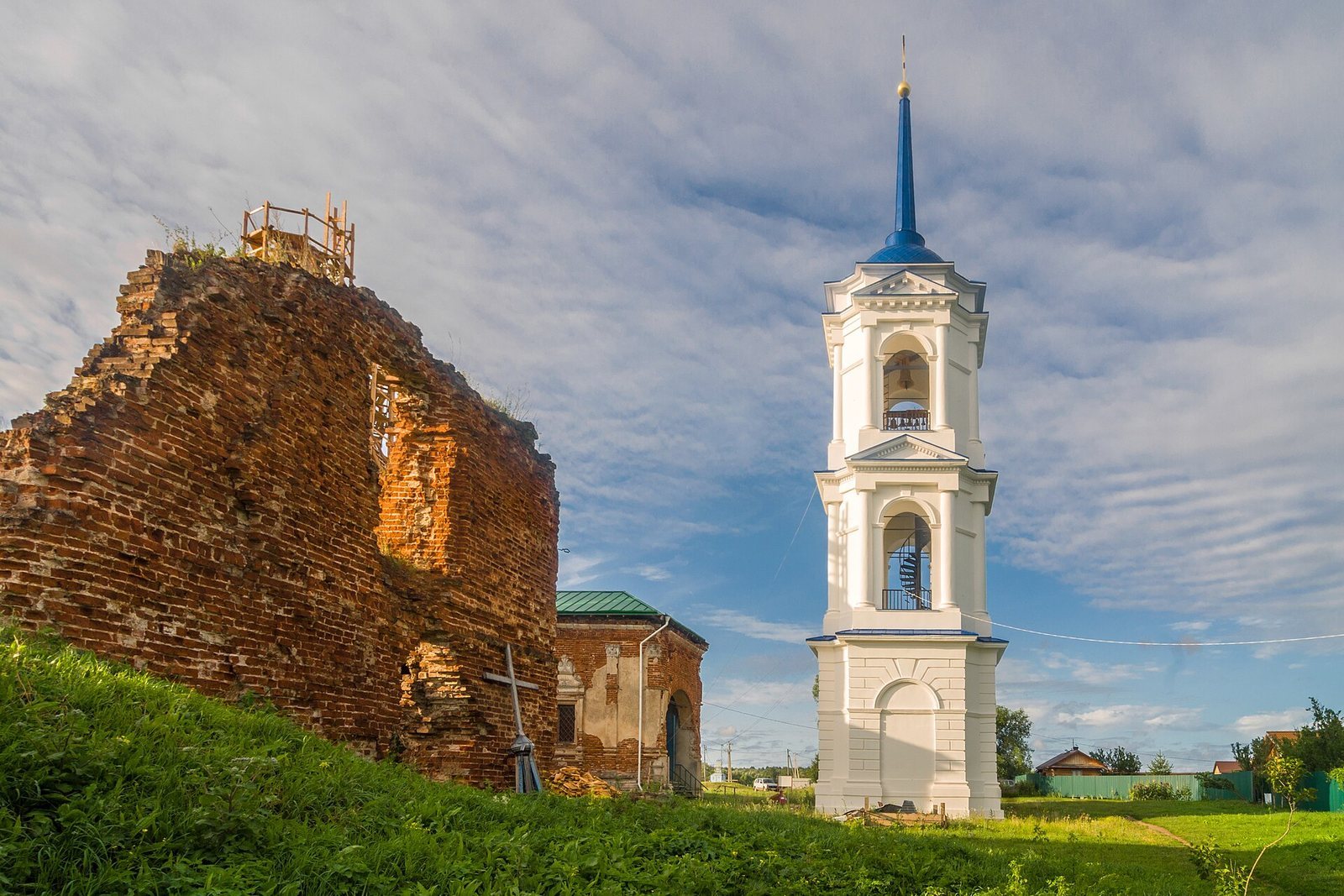
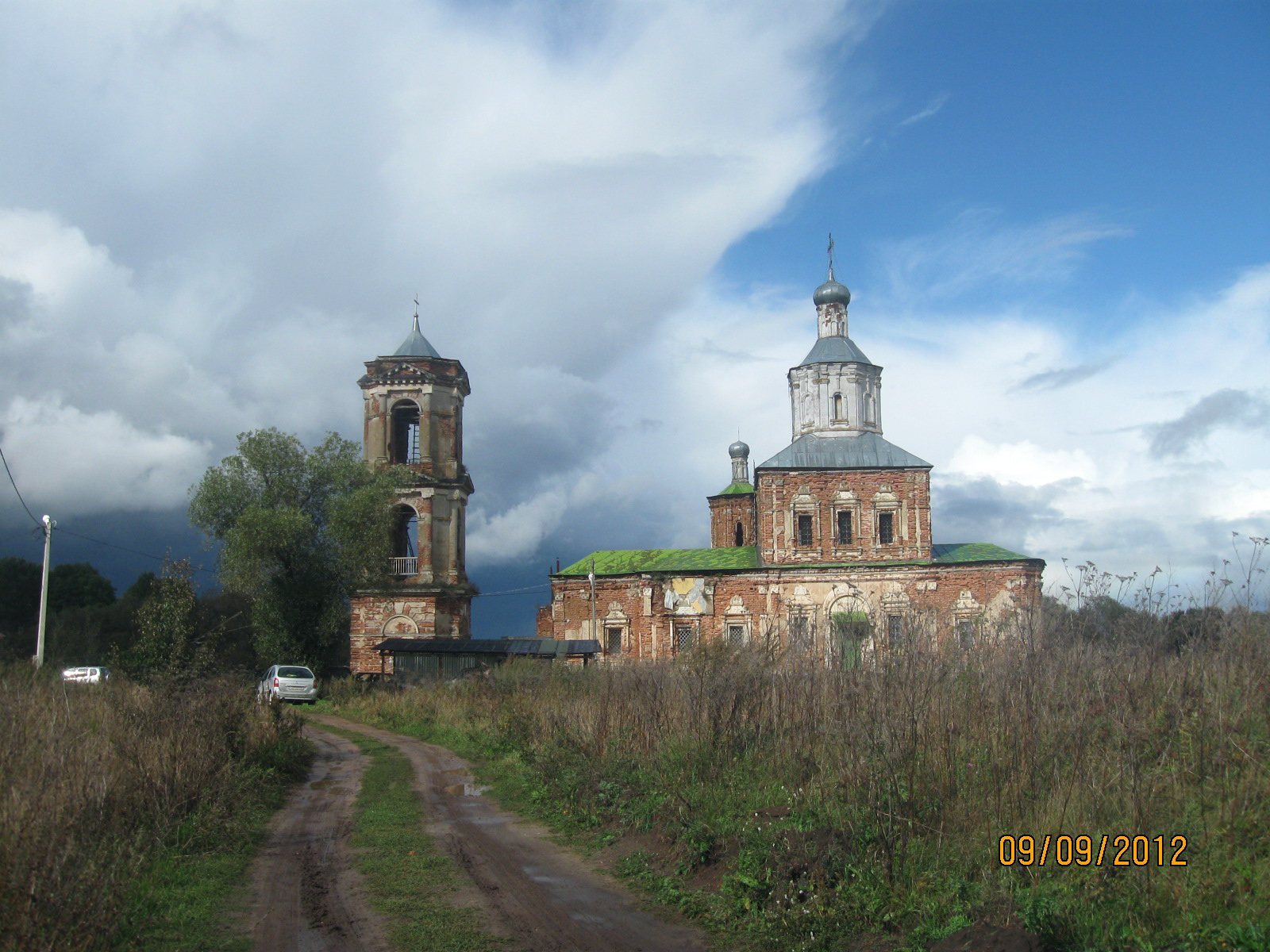
The monastery site lies on the right bank of the Zhizdra River, with its churches set some distance from the settlement. The surviving Dormition church has a single dome and retains an old wall with a dressed-stone base and stone side entrances. This wall is roughly executed in an early Renaissance style; the rest of the building has been substantially altered.
Churches, Memorials, and Roadside Features
Dormition Church
The surviving church preserves part of its sixteenth-century fabric in the old wall, stone base, and side entrances. Its present form reflects substantial later alteration, while the single dome remains a defining feature of the building.
Theognost’s Burial Slab
A stone slab set into the cathedral wall beside the south side of the altar marks Theognost’s burial. Its inscription gives the date of his death as 8 February 1545.
North Chapel and Royal Doors
The chapel on the north side contains old Royal Doors, the central doors in an Orthodox church screen separating the sanctuary from the worship space. The doors are made from thin limewood plates fixed to a door leaf. Gilded ornament frames their panels and the icon case, a frame for an icon, while the larger decorative fields around them are silvered.
Chicherin’s Burial Slab
A stone slab with a relief inscription in the west wall of the north chapel marks Ivan Chicherin’s burial.
Traditional Saint Nicholas Chapel Site
Local tradition placed a chapel dedicated to Saint Nicholas beside an old black poplar, halfway along the former road between Mitino factory and the village. The story held that an icon of the saint stood behind glass in a hollow in the tree. Another local custom called for travelers who had crossed the difficult forests on the way to the village to stop at the monastery and give thanks.