Tumulus de la Hogue: A Neolithic Burial Monument in Normandy
Site at a Glance
- Popularity
- Low
- Country
- France
- Primary era
- Stone Age
- Eras represented
- Stone Age
- Civilizations
- Unclassified
- Site type
- Burial
- Remains
- Burial Mound
On this page9 sections
History
The Tumulus de la Hogue is a Neolithic burial monument at Fontenay-le-Marmion in Normandy, France, dating to about 3600 BC. The Neolithic, the later part of the Stone Age, was associated in many regions with farming and settled communities. The mound’s chambers and burials have been interpreted as evidence of a single planned building project, with the intended number of burials perhaps decided from the start. Its alternate name, Butte de la Hogue, repeats the sense of a mound: in Old Norman, an earlier form of Norman, hogue meant a hill or mound, and sometimes a burial mound. The word comes from Old Norse haugr, and fell out of use around the 16th century. The related form hougue lasted longer in northern Cotentin and the Channel Islands.
Discovery and preservation
Workers came upon the mound in 1829 while removing stone for repairs to communal roads. At Arcisse de Caumont’s initiative, the Society of Antiquaries of Normandy excavated it in 1830 and 1831. Stone was taken from the monument again in 1834 and 1835, putting it at risk of complete destruction.
In 1840, M. Le Hardelay, the owner of Fontenay Castle, bought the site to prevent its destruction. The purchase followed the first excavations, but did not end later investigations or restoration work.
Twentieth-century investigation and local tradition
Léon Coutil excavated the monument in 1904, 1906, 1908, and 1917 as part of efforts to restore it. A decree of 26 December 1905 gave it France’s legal historic-monument protection. During restoration of the mound’s outer facing in the late 1960s, Édouard Lagnel excavated Chamber A.
Local tradition had identified the mound as a Roman cemetery. In 1902, Coutil recorded a legend that a Roman general killed in a battle on the plains of May and Fontenay lay buried there. Each soldier was said to have carried a stone to mark his grief, and people also told of apparitions at night. Excavations dispelled the belief that a great treasure lay beneath the mound.
Remains
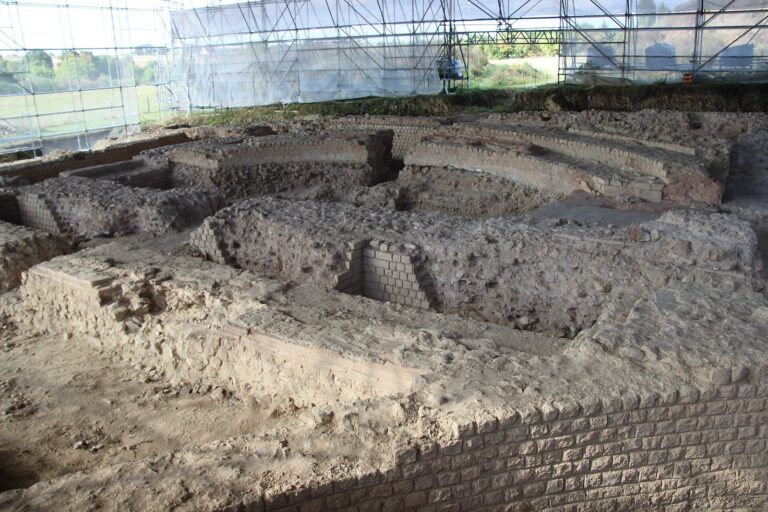
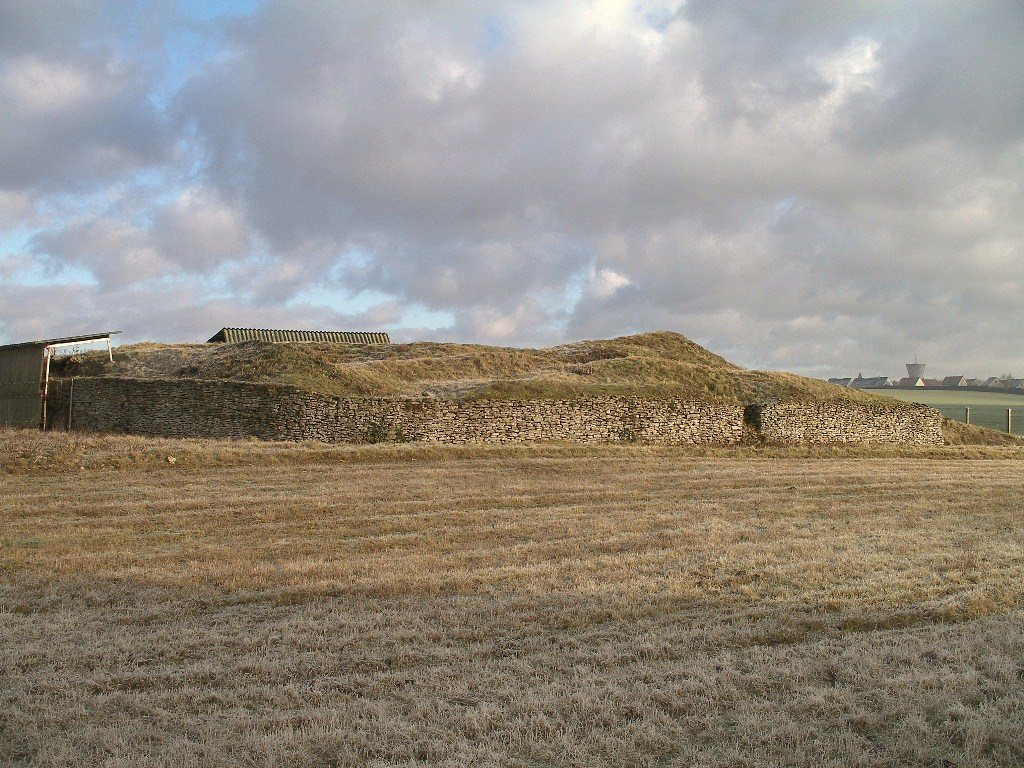
The monument stands among fields on the Jurassic-period limestone of the plain of Caen. Its limestone-and-earth mound has an elongated, roughly oval outline approaching a rectangle and contains 12 roughly circular chambers. Their entrances are arranged around the mound without a fixed orientation. Eleven chambers were reached through covered passages made of stones set without mortar. The chamber roofs were formed by laying successive courses of stone so that each projected inward over the one below.
Mound and burial chambers
Mound and outer facing
The mound measures about 49 metres from north to south and 37 metres from east to west, with a maximum length of roughly 50 metres. It originally stood about 8 to 10 metres high. Stone removal destroyed its northwestern quarter, while the eastern side is its best-preserved exterior.
Chamber interiors
In one chamber, a horizontal limestone slab remained above the entrance passage, supported by two upright pillars. Another chamber had an altar-like arrangement made from slabs.
Chamber A and grave goods
Chamber A is 3.8 metres in diameter. Small limestone slabs set upright divide its interior into compartments. Finds from the chamber include 21 perforated canine teeth, five ivory pendants, one amber pendant, four two-part shells, a fragment of a bone needle, and a small flint flake.
Human remains
Human bones lay without an apparent arrangement in the ten chambers excavated in 1830 and 1831, and some showed traces of burning. Excavation in the late 1960s found that almost none remained in their original bodily arrangement. The soil’s high lime content helped preserve some of the bones.