Tumiac Tumulus: A Neolithic Burial Mound in France
Site at a Glance
- Rating
- 2.5
- Popularity
- Low
- Country
- France
- Primary era
- Stone Age
- Eras represented
- Stone Age
- Civilizations
- Unclassified
- Site type
- Burial
- Remains
- Burial Mound
On this page8 sections
History
The Tumiac tumulus, a mound raised over a grave, is a Neolithic burial monument in France. It belongs to the Carnac-type group of major burial mounds characteristic of the Carnac region and generally dated to around 4000 BCE. The Neolithic was the later part of the Stone Age.
Neolithic origins and Roman tradition
Tumiac is a conspicuous monument in the landscape and has long been known as Caesar’s Mound. A local tradition says Julius Caesar used it as an observation point in 56 BCE during Rome’s war against the Veneti, an ancient Gallic people. From there, he was said to have watched a Roman naval victory, supposedly made possible by a lull in the weather.
Archaeological exploration and protection
Nineteenth-century archaeological works discussed the tumulus in 1825 and 1847, but it had not been disturbed before its exploration in 1853. After a trench on the south side exposed a cavity, the Morbihan Polymathic Society sent antiquarian Louis Galles and physician Alfred Fouquet to investigate. Their work recovered archaeological material.
France designated the tumulus a historic monument in 1923, a legal heritage-protection status. Zacharie Le Rouzic excavated it in 1934 in preparation for an access gallery and work to consolidate the chamber. Extensive restoration followed in 1993.
Remains
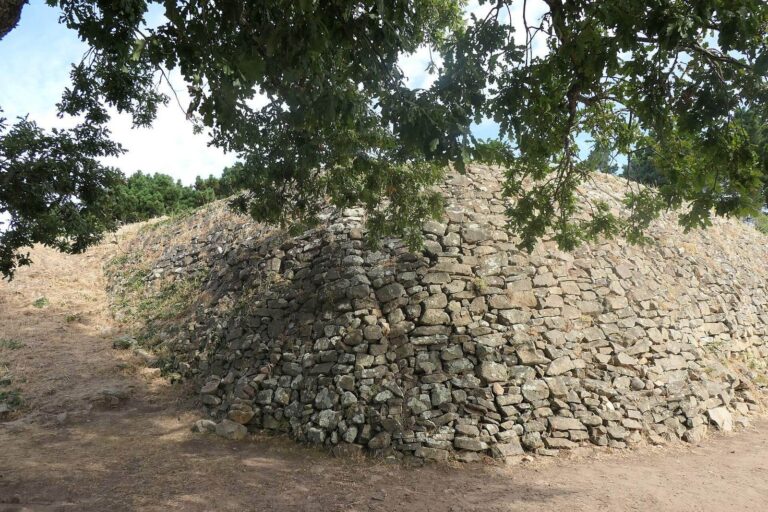
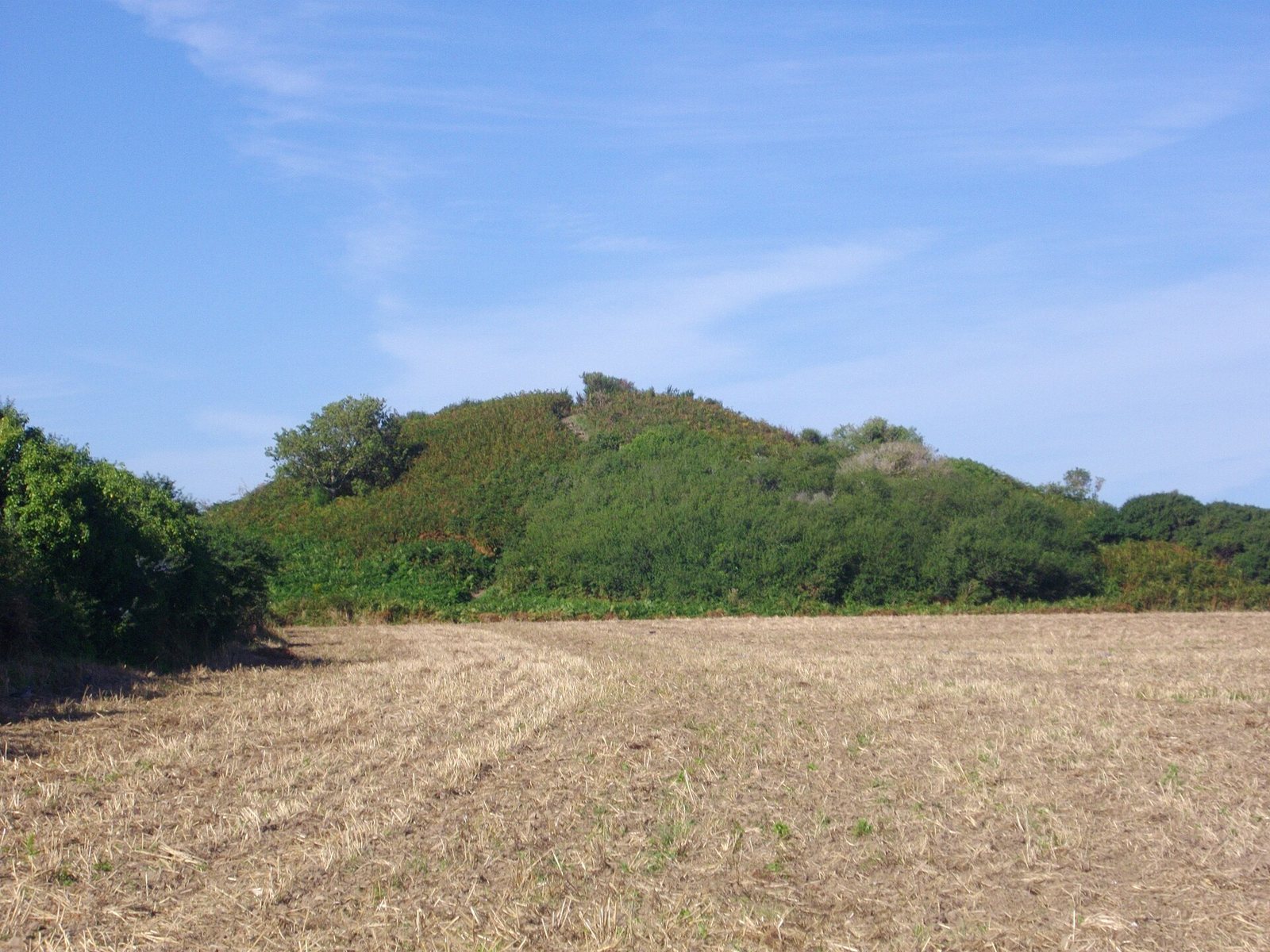
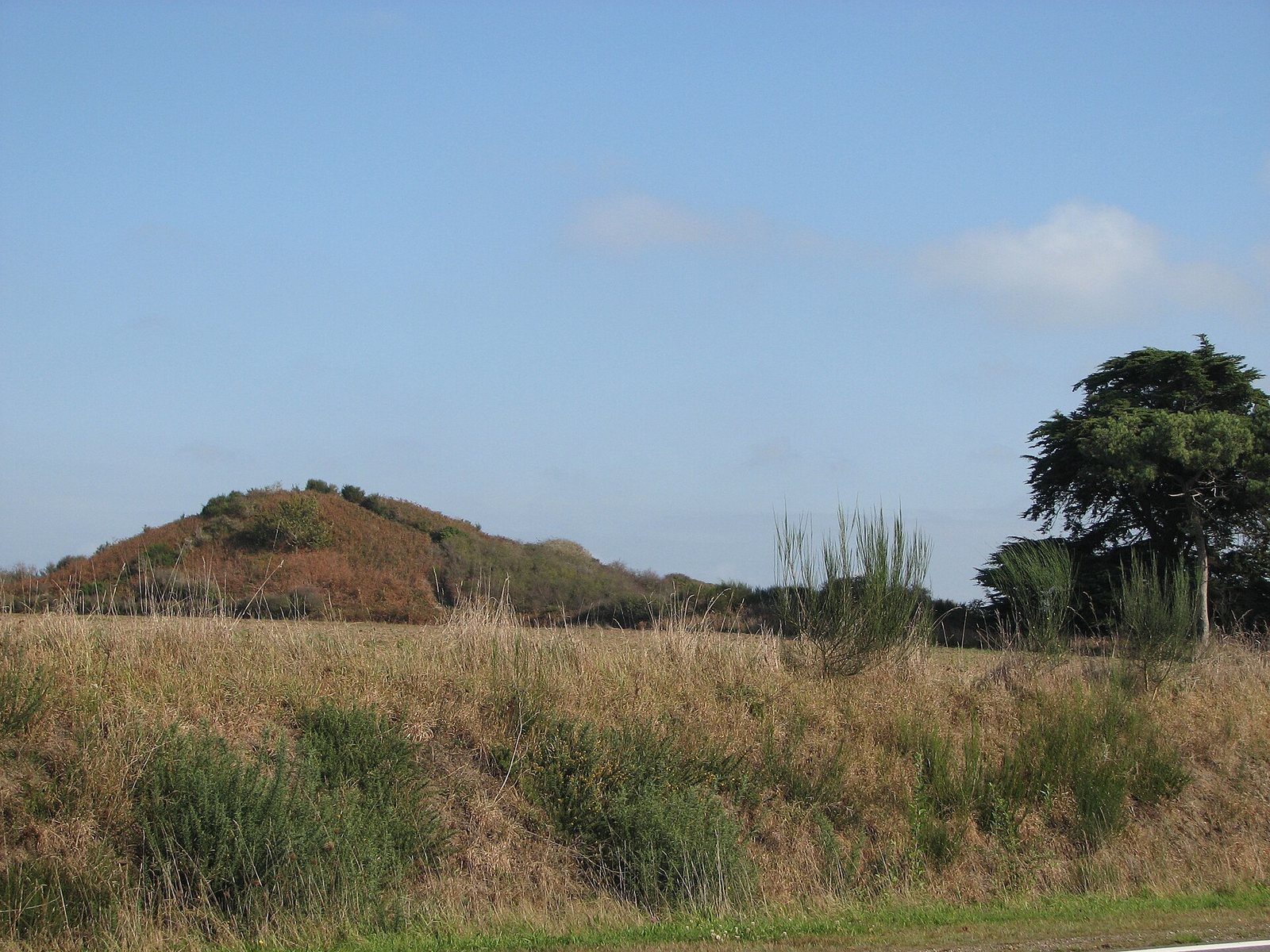
The entirely artificial mound is conical and about 15 metres high. Its base is approximately 55 metres across; its overall dimensions are about 50 by 60 metres, its circumference about 200 metres, and its estimated volume 16,000 cubic metres. A core of large stones is covered by a thick layer of mud, topped with a thinner mixture of earth and stones. The crater at the summit corresponds to a vertical shaft made during exploration.
Burial structures
Main chamber and passage
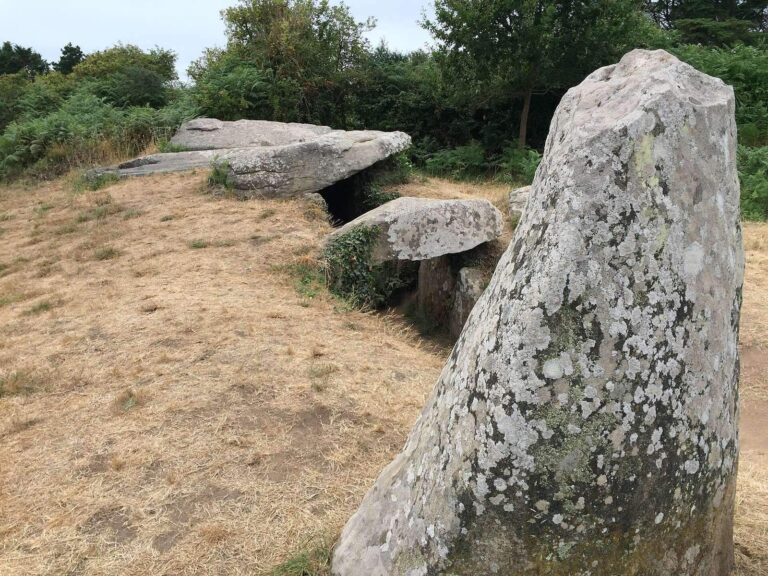
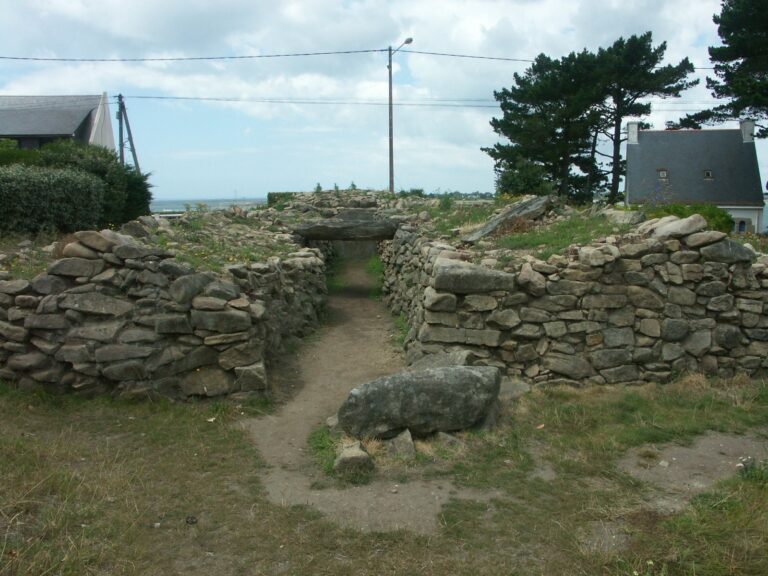
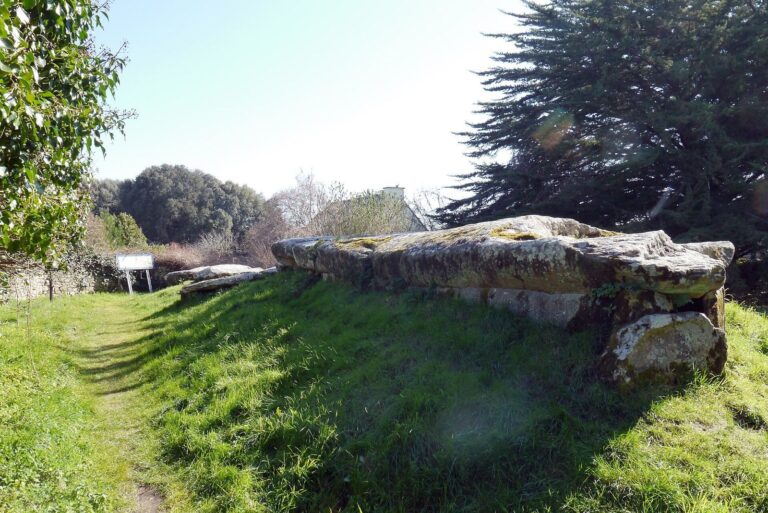
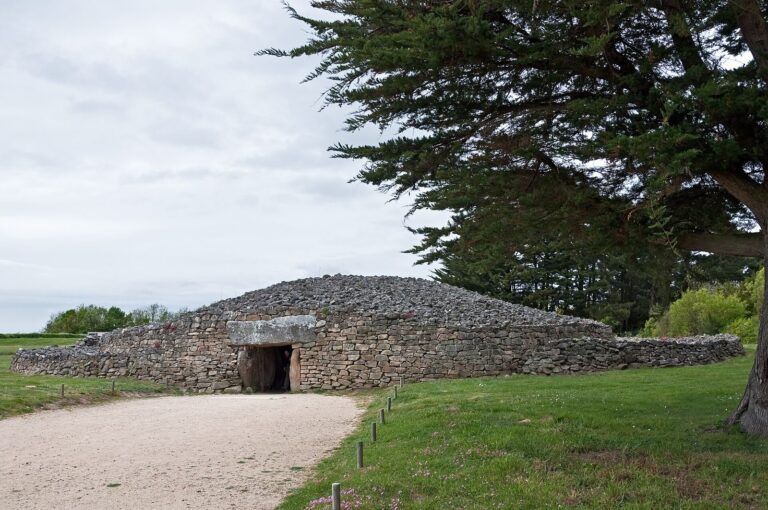
The megalithic chamber lies slightly east of the mound’s central axis. The chamber and its east-south-east-facing passage form a structure about 4.8 metres long. The passage is 1.5 to 1.8 metres wide, while the chamber measures about 2.4 metres square and 1.5 to 1.75 metres high. Three supporting stones are each 2.65 to 2.85 metres long and about 1.3 metres high. Upright slabs enclose the chamber on its west, north, and south sides; one is gneiss and two are granulite. Lines and circles are cut into their surfaces, and a quartz slab covers the chamber.
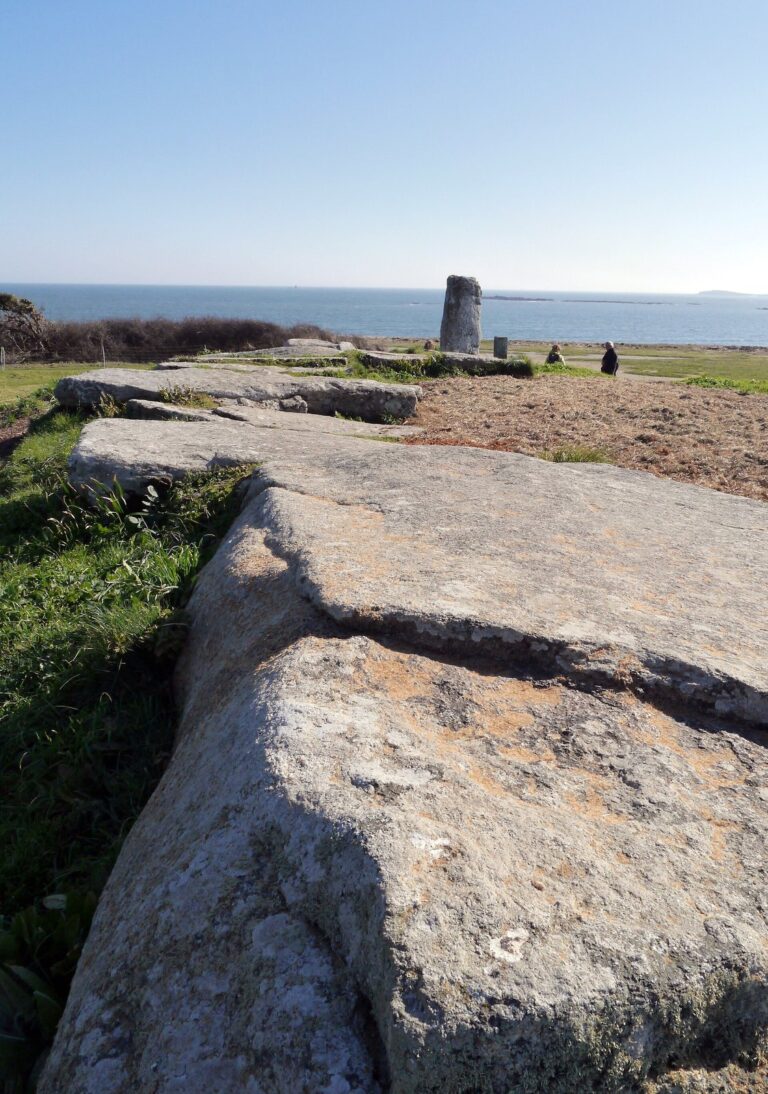
Two slabs rest on mortar-free stone walls to roof the passage. One is broken at its midpoint, corresponding to the cavity noticed in 1853. Galles described rough, flat stones paving the chamber floor, but Le Rouzic did not find this paving in 1934. Since the chamber is enclosed on every side, it is better understood as a large stone chest than as a dolmen, a stone-built burial monument.
Smaller chest
During his 1934 excavation, Le Rouzic found an opening at the outer south-west corner of the main chest that led into a smaller one. This chamber measures 1.6 metres long, 0.8 metres wide, and 1.8 metres high. It is built of dry-stone masonry, made without mortar, and has a roof formed by projecting courses of stone. Le Rouzic considered that other small chests of this type might lie around the cairn. A stairway intended to reach the main chamber was abandoned because of the danger of collapse, and the area was later filled. The unstable mound now prevents interior access.
Archaeological finds
The 1853 exploration and the 1934 excavation yielded 32 polished axes: six of chloromelanite, 24 of fibrolite, one of aphanite, and one of feldspar. Other finds include three necklaces with 237 callaïs beads altogether, pendants of callaïs and variscite, axe flakes, a reworked cattle horn, and two small pottery fragments, one black and one red. The objects are held at the Archaeological Museum of Vannes. An 1867 watercolor by Léon Davy de Cussé depicts an ornament associated with the finds.