Table des Marchands: A Neolithic Passage Tomb at Locmariaquer
Site at a Glance
- Popularity
- Medium
- Country
- France
- Primary era
- Stone Age
- Eras represented
- Stone Age, Modern
- Civilizations
- French
- Site type
- Burial
- Remains
- Tomb
On this page16 sections
History
Table des Marchands is a Neolithic passage tomb at Locmariaquer, France, built around 3900–3800 BCE. Its construction followed the destruction of an earlier line of 16 standing stones, and stones from a monument associated with the Grand Menhir of Er-Grah were reused in it.
Earlier monuments and the tomb
Archaeologist Serge Cassen’s proposed sequence begins with Mesolithic flint and Neolithic pottery from before the first large-stone monuments. The Mesolithic preceded farming, while the Neolithic was marked by farming and widespread monument-building. Postholes point to a row of dolmens dating to the fifth millennium BCE. Cassen suggested that menhirs were later toppled, perhaps in an earthquake, and reused during the Castellic period, a prehistoric culture of Brittany.
The standing-stone alignment beneath the later burial chamber dates to about 4500 BCE. The passage tomb and its stone mound, or cairn, followed around 3900–3800 BCE. The monument was probably used as a tomb for several centuries and may have held a collective burial. It had been abandoned by the end of the fourth millennium BCE. Finds indicate later activity in the Bronze Age, the Gallo-Roman period, when Roman and local cultures interacted in Gaul, and subsequent eras.
The tomb appears to have been disturbed before Joachim Renaud explored it in 1811 at the request of antiquary Maudet de Penhouët. Its condition at that time, together with a nearby Gallo-Roman theatre, points to earlier interference, though its extent is uncertain. Maudet’s published account included an illustration whose proportions were broadly accurate; its small human figures made the monument appear larger.
Descriptions and changing names
The earliest known image of the monument appeared in a work on Brittany’s history and natural history compiled by President de Robien in 1753–1755. A probable early written reference came from Théophile-Malo de La Tour d’Auvergne-Corret, who described a monument without naming it, between Locmariaquer and the woods of Kerantré.
In 1814, Maudet used the names “Dolmarchand” and “Table de César,” and oddly explained the second as “stone of the temple of Mercury.” The antiquarian label does not establish a Roman connection. Bachelot de la Pylaie recorded “Dol-Marchen” and the popular form “Dolmarchande” in 1824. In 1827, the Chevalier de Fréminville rejected “Table de César” but offered no replacement.
The 1830 cadastre called the wider megalithic site “Er Groh,” meaning “the cave,” and the tomb “Er Groh vihan,” or “the little cave,” referring to the chamber’s cave-like appearance. That year, painter Jean-Baptiste-Joseph Jorand used “Table Marchande.” In 1834, writer and historic-monuments inspector Prosper Mérimée used “Table des Marchands,” the form later adopted by other writers. The name encouraged a mistaken connection with a Marchand family. A proposed link between “Dolmarchand” and a Breton phrase meaning “table of the horse camp” remains unverified; Maudet did not speak Breton and may have substituted a familiar-sounding French word for an unfamiliar expression.
Protection and restoration
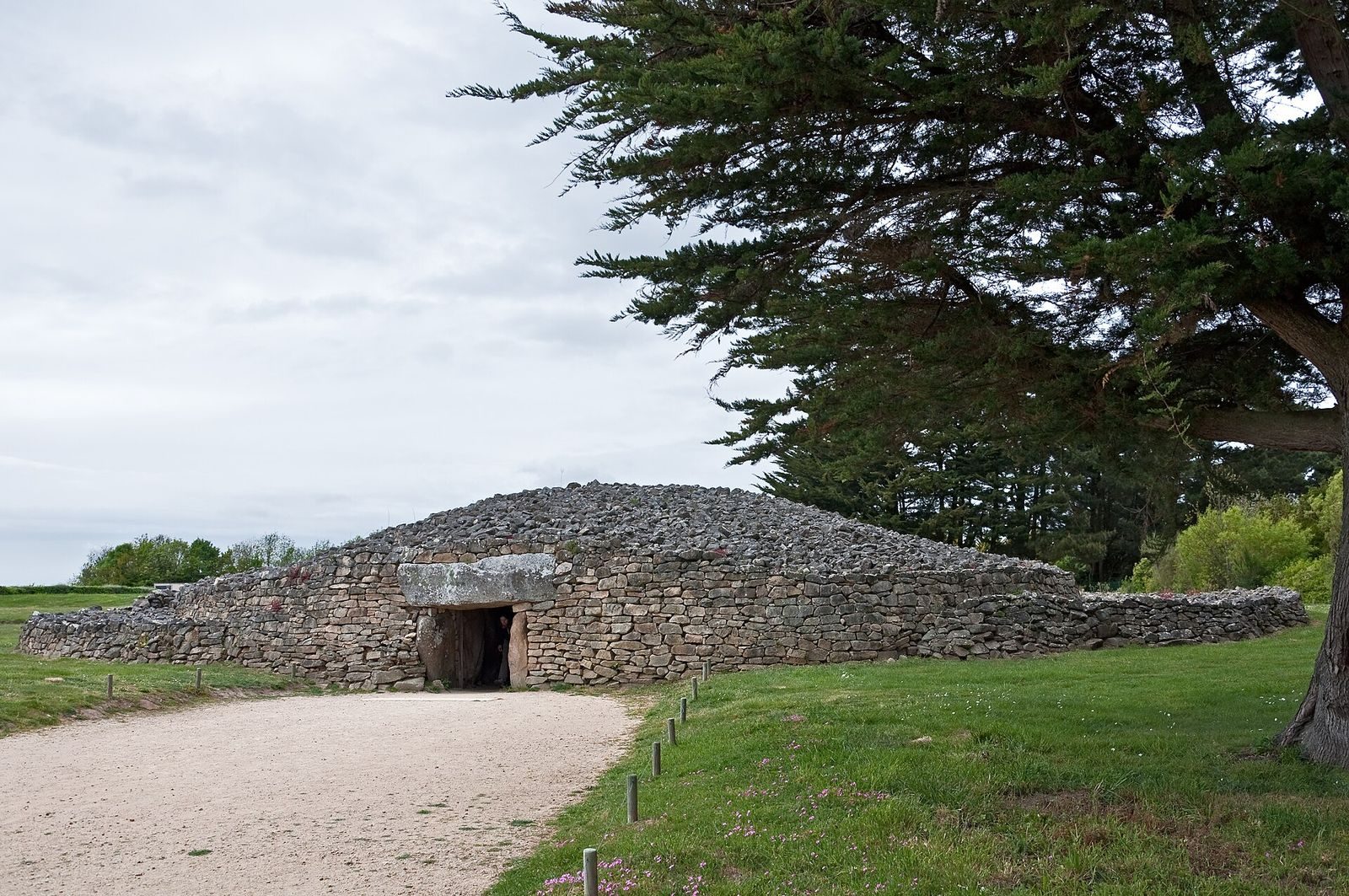
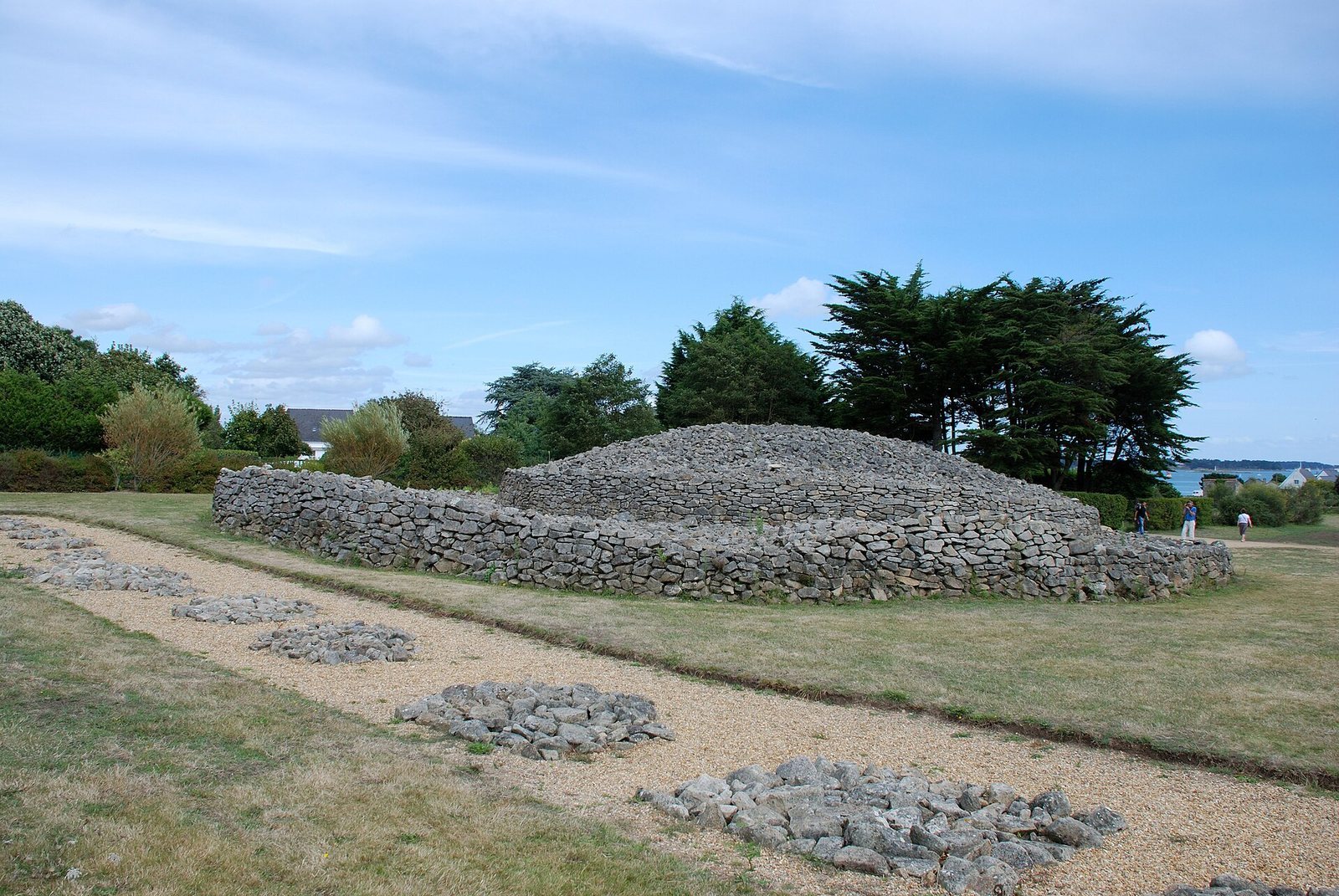
Protective walls were built around the roof slab in 1883 to shield the chamber’s interior. The monument became a French historic monument in 1889. G. d’Ault du Mesnil, who led the Commission of Megalithic Monuments, carried out restoration work in 1905.
At the request of prehistorian Abbé Breuil, the Historic Monuments Commission later assigned further work to archaeologist Zacharie Le Rouzic to protect the engravings. In 1937–1938, Le Rouzic rebuilt a protective cairn. This changed the familiar view of a broad slab resting on slender supports and prompted debate about restoration. Critics objected to the altered appearance, while the Historic Monuments Commission and its Subcommission on Prehistoric Monuments disagreed over the approach.
Investigations took place in 1985, followed by a wider excavation campaign at Locmariaquer beginning in 1987. Jean L’Helgouac’h directed work at the Table des Marchands, while Charles-Tanguy Le Roux led research on the Grand Menhir and Er-Grah. Archaeologists reconsidered the earlier reconstruction by extrapolating from fallen debris, and the cairn was restored again in 1991.
Remains
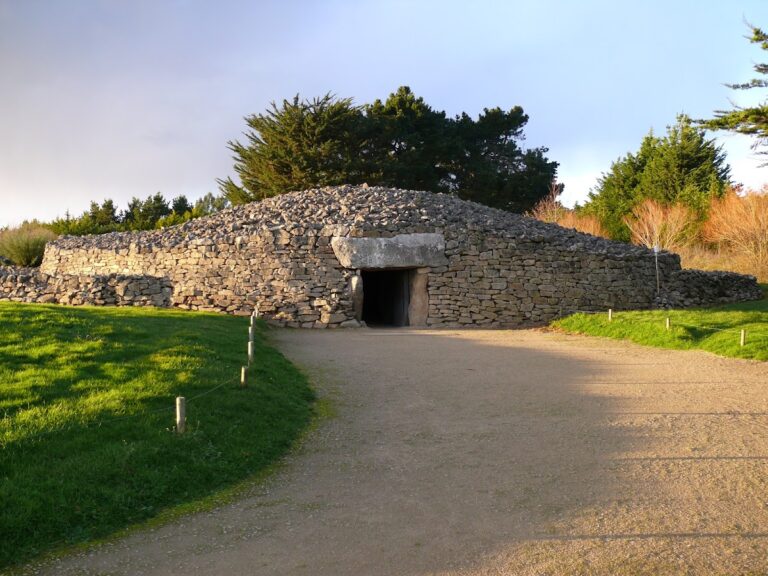
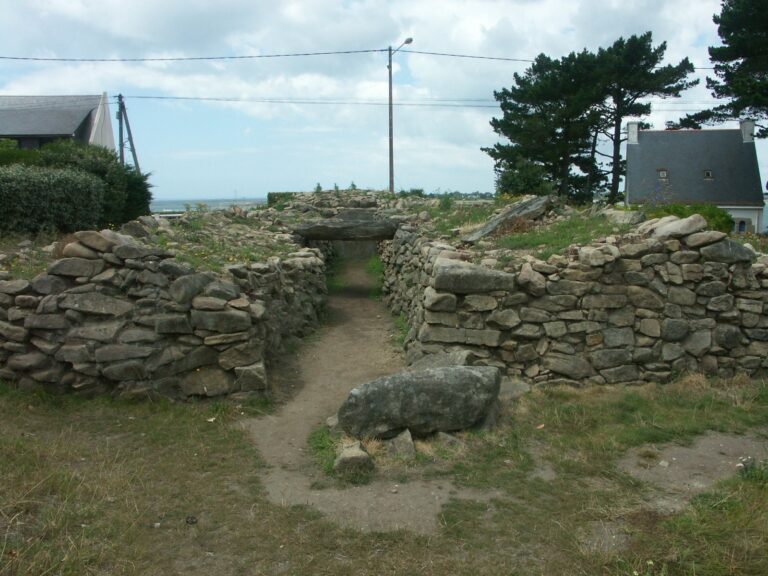
The monument is a north–south passage tomb, a stone-built burial place with an entrance passage leading to a chamber. Its polygonal chamber lies beyond an entrance on the southeast side. The structure is a little over 10 metres long, or about 12 metres overall, with a passage around 7 metres long.
Plan and construction
Passage and chamber
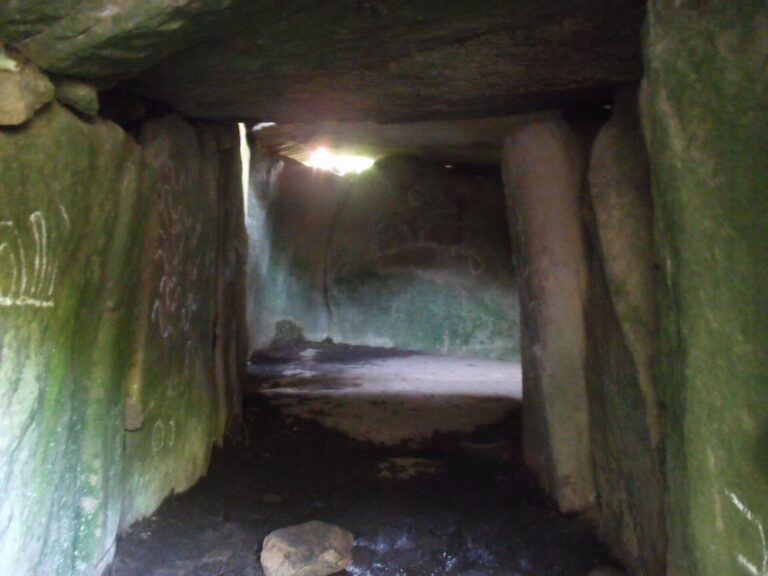
The entrance is about 1.4 metres high, while the chamber reaches roughly 2.5 metres from the present ground to the underside of its roof. The builders arranged 18 upright support stones and three covering slabs. Most of the passage’s original roof slabs and the supports on the chamber’s eastern side no longer form part of the structure.
Cairn
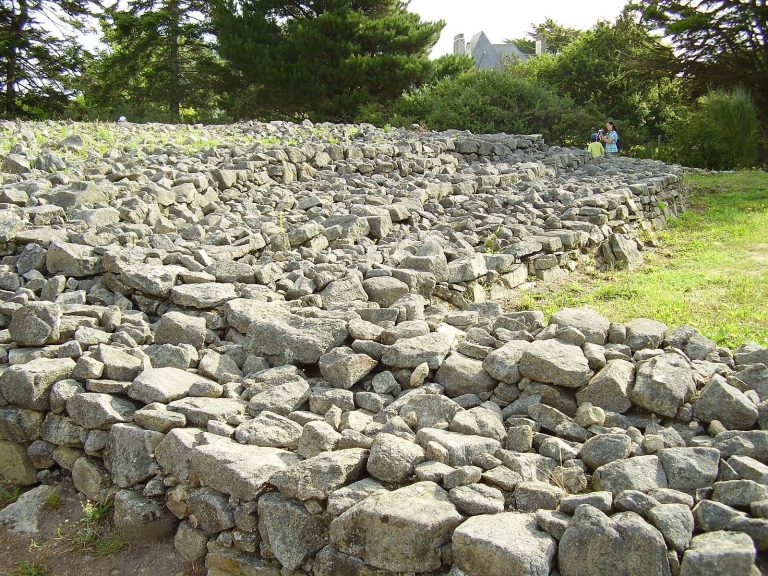
The first cairn measured about 20 metres across, with the chamber at its centre. Its facing wall survives to about 1.75 metres high and slopes markedly inward. A later enlargement brought the mound to about 30 metres in diameter and left the chamber off-centre. The cairn was built in two stages from small rubble. Its covering may have included sand, earth, and grass to keep rainwater out. The monument’s exposed, table-like appearance resulted from the cairn being stripped away long ago; the mound seen today is largely reconstructed.
Building stones
Flint, pebbles, and pottery fragments were mixed into the sandy ground beneath the structure, probably to help it bear the weight without sinking. Local granite supplied most of the building stone. Two passage supports, numbered 4 and 15, are orthogneiss, a metamorphic rock formed from igneous rock. They match as pieces of a larger stone taken from an earlier alignment linked to the Grand Menhir of Er-Grah.
The chamber’s rear stone is sandstone, a material found naturally only in scattered places in the eastern Gulf of Morbihan. It must have been transported at least 10 kilometres. The stone was already upright at the site before the passage tomb was built, and its height determined the chamber’s height.
Carved stones
Roof slab
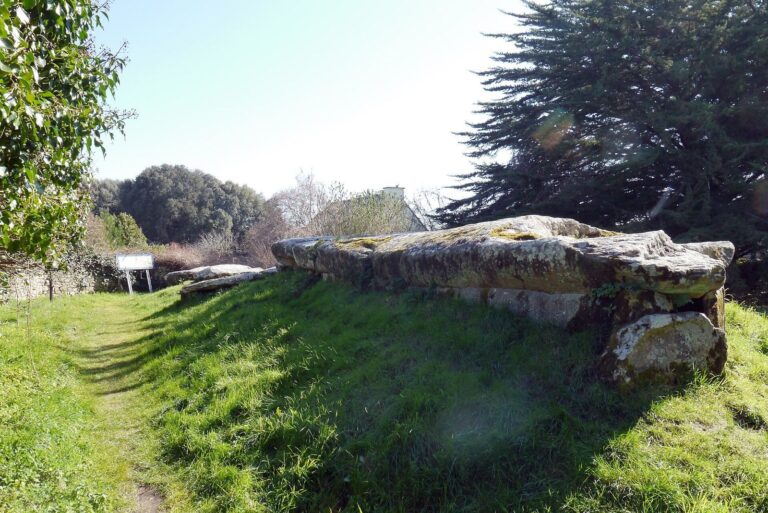
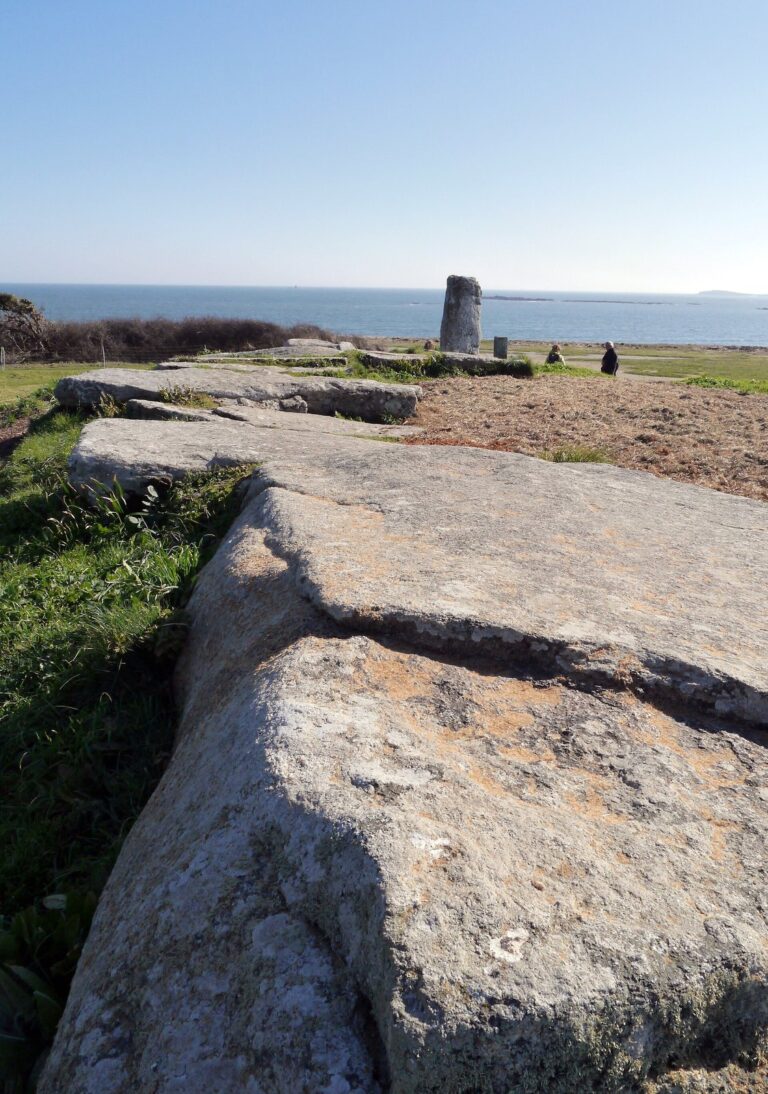
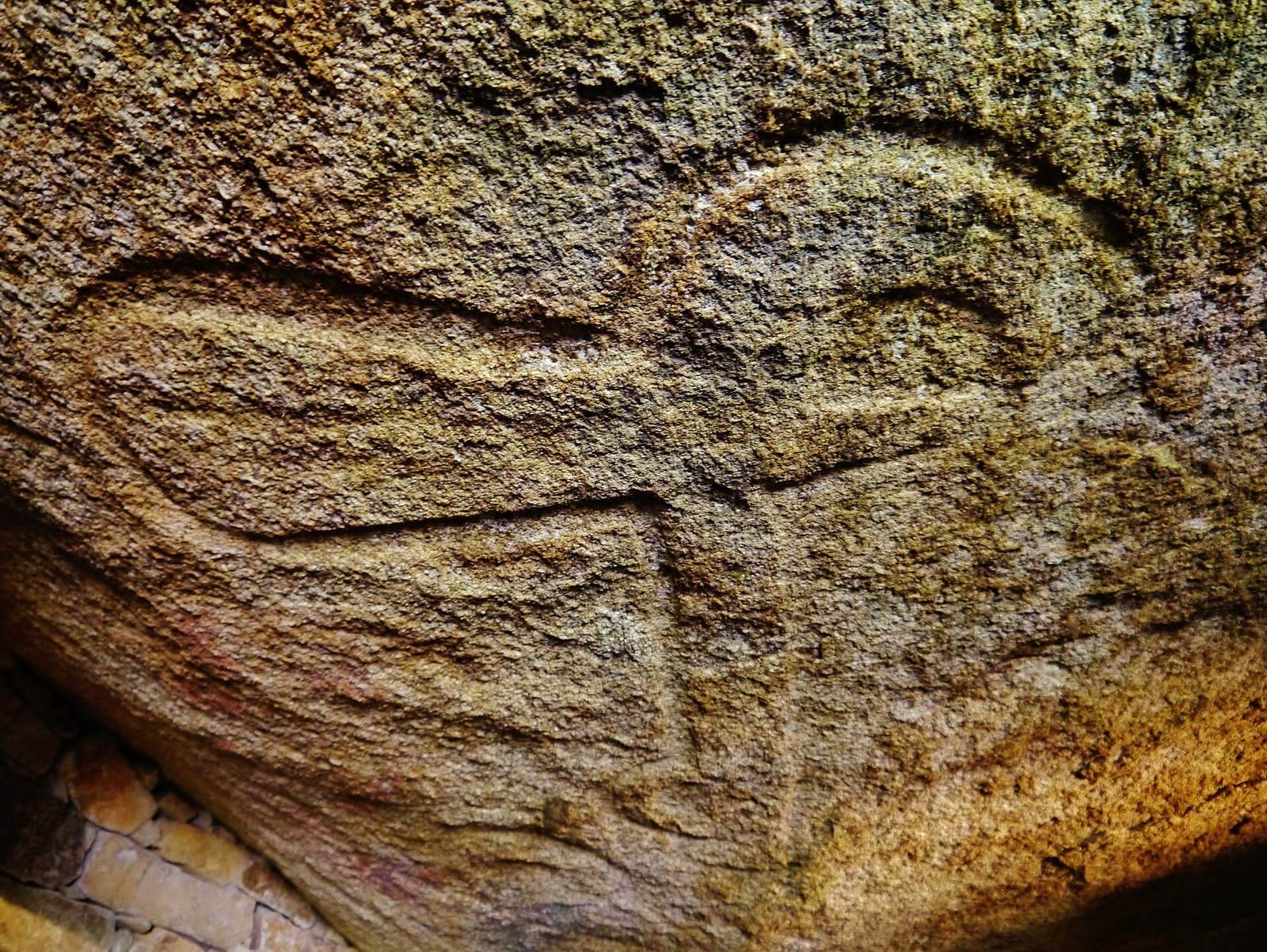
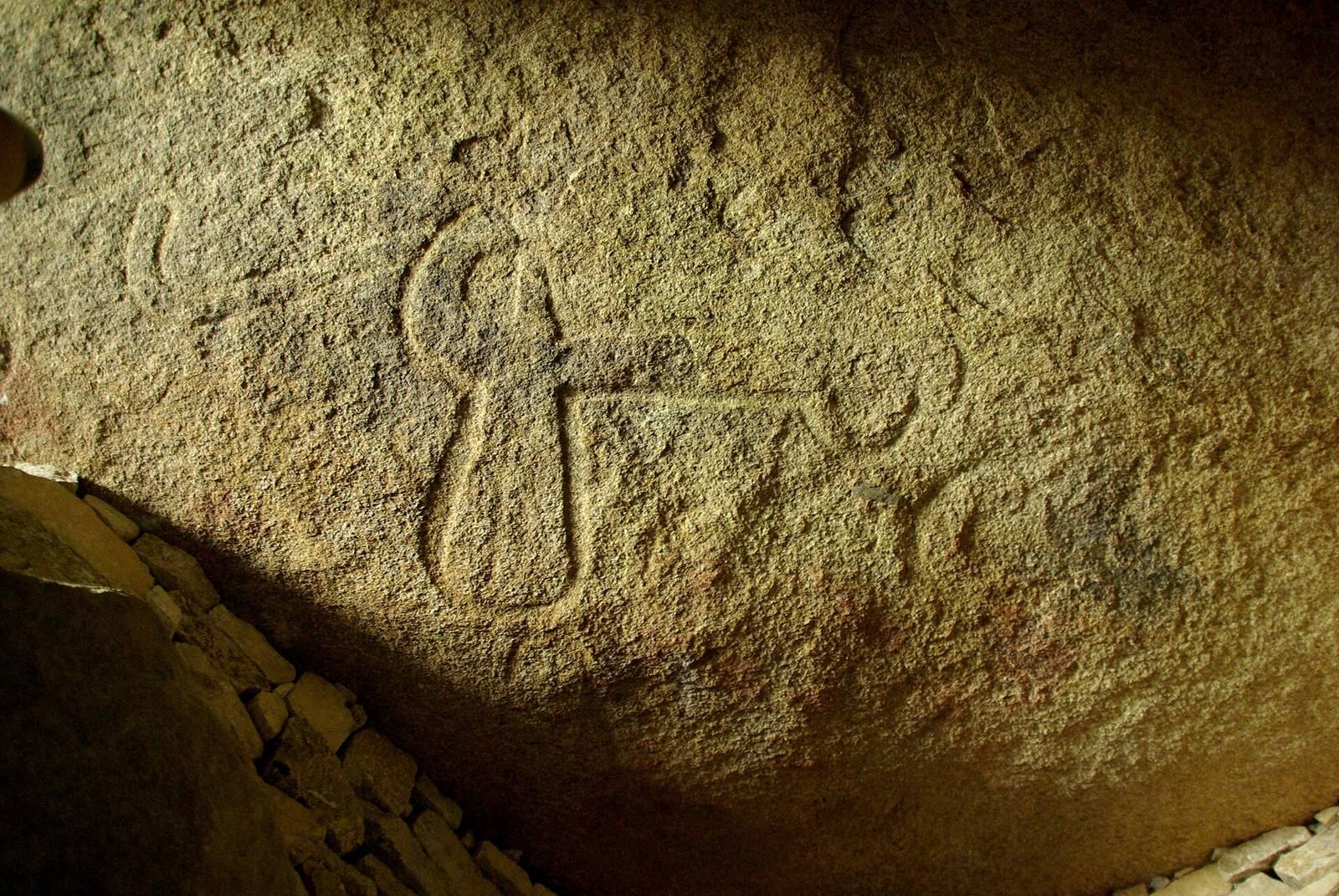
The chamber roof is a fragment of an earlier carved stone, probably a deliberately broken menhir. It is about 5.7 metres long, 4 metres wide, and 0.8 metres thick, weighs roughly 65 tonnes, and is cut short at its western end. Its engravings include a large axe with a handle ending in a curved, strapped grip, an elongated crook, and the front part of a bovine with parallel legs, a neck, and a long muzzle.
A related carved slab reused at Gavrinis, about five kilometres away, bears the animal’s horns and other matching details. A further fragment may have been reused in the Er-Grah mound, although the designs there do not always align precisely. The carving has also been interpreted as including a “plough-axe” or a sperm whale.
Rear chamber stone
The chamber’s rear slab is a nearly triangular sandstone stone about 3.2 metres high, shaped like a pointed arch. It began as a freestanding upright monument before being incorporated into the tomb. Four balanced bands of crook-shaped designs cover its inner face. Archaeologist Le Roux interpreted an outline motif as a human-like “Mother Goddess” with radiant hair; Cassen read it as a phallic symbol. The crooks have been understood as signs of increased power and possibly as a warning to those approaching the peninsula.
The slab’s outer face carries a double radiating arch above a four-sided figure and a crescent. Cassen interpreted the design as a rainbow or sky above an earth-like dwelling, with a boat representing the sea. The stone also bears the faint word “GAZELLE,” which may have been scratched by a sailor aboard a vessel of that name.
Engravings on the passage stones
The second stone on the left when entering the passage, numbered 2, carries very faint lines that seem to outline a four-sided figure. They were recognized in 2005. Stone 3 has a snake-like line and a branch-shaped mark near its top, a group of shallow cup-shaped marks at lower left, and another winding line near the bottom right.
Stones 16 and 17, on the opposite side of the passage, have cup-shaped marks on their outer faces. Their placement across from one another may have been deliberate, though the meaning of the arrangement is uncertain.
Finds and surrounding monuments
Excavated objects
Renaud’s 1811 exploration yielded a flint axe and pottery fragments noted by Maudet; these objects were later lost. De Fréminville also described a ball of gold thread. Work in 1883 recovered three polished stone axes, including examples of fibrolite, a fibrous form of sillimanite, and diorite, an igneous rock. The finds also included a quartz blade, nine flint flakes, a horse bone, and pottery fragments. They are held by the collections of the Société polymatique du Morbihan, a learned society in Morbihan.
In 1905, Ault du Mesnil found two nearly complete black earthenware vessels and 62 flint flakes. These objects are held at the Miln Museum.
Locmariaquer megalithic group
The Table des Marchands forms part of the Locmariaquer megalithic site with the toppled Grand Menhir Brisé and the Er-Grah burial mound. The nearby Er-Grah dolmen is also known as Er Vinglé. About 300–350 metres away are the Mané Rutual passage tomb and Men-Bronso, a menhir broken into four pieces.