Guevavi Mission: A Jesuit Mission Headquarters in Arizona
Site at a Glance
- Popularity
- Medium
- Country
- United States
- Primary era
- Early Modern
- Eras represented
- Early Modern
- Civilizations
- Spanish
- Site type
- Religious
- Remains
- Church
On this page9 sections
History
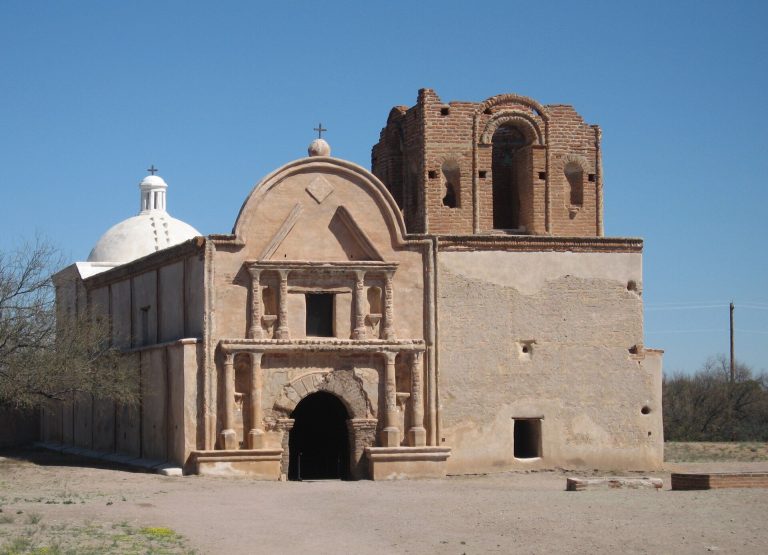
Guevavi Mission is a Spanish colonial mission site in Santa Cruz County, Arizona, United States. Jesuit missionaries Eusebio Francisco Kino and Juan María de Salvatierra founded it in 1691 at an existing Sobaipuri or O’odham settlement. Its architecture is associated with Spanish Renaissance forms and the style used in Spanish colonial missions. Guevavi became the first Jesuit mission headquarters in the southwestern United States.
Jesuit foundation and growth
Kino had visited the settlement in 1690. The mission’s original name was La Misión de San Gabriel de Guevavi, with Saint Gabriel as its patron. Later missionaries also called it San Rafael and San Miguel. The name Guevavi is linked to an O’odham expression for a large water source, perhaps the Santa Cruz River, which flowed through the area.
By the late 1690s, the mission had a church, carpentry workshop, and blacksmithing area. In 1701, Pima laborers built a small chapel from adobe, a building material made of sun-dried earth, using basic tools. Guevavi served as a headquarters overseeing dependent mission stations. Juan de San Martín was its first resident priest; after his departure in the early eighteenth century, Agustín de Campos, Ignacio Xavier Keller, and Luis Xavier Velarde administered the mission remotely. Campos and Velarde visited at times. Juan Bautista de Anza, father of the Spanish colonial explorer of the same name, supported the clergy around 1700.
Missionaries taught local people to grow corn, wheat, and peaches, raise cattle and sheep, practice Catholicism, and work in saddlery, tallow production, meat processing, and mineral extraction. O’odham people continued their ceremonies and pottery-making, and fermented cactus and wild fruits into alcoholic drinks, practices that the priests opposed.
Church building and mission network
Jesuit priest Juan Bautista Grazhoffer arrived in 1732 and established a second church. The clergy who served in the following decades included Philipp Segesser in 1734; Alexandro Rapicani from 1737 to 1740; Joseph de Torres Perea from 1740 to 1744; Ildefonso de la Peña from 1744 to 1745; Joseph Garrucho from 1745 to 1751; and Francisco Xavier Pauer from 1751 to 1760. There were intervals without a resident priest, including 1734–1737 and 1760–1768.
In 1751, Garrucho commissioned architect Joaquín de Casares of Arizpe to direct Pima laborers in building a larger church. The Pima Revolt, an uprising involving Pima communities that year, damaged the building. Pauer oversaw its renovation in 1754. By 1767, the mission’s dependent stations included San Ignacio de Sonoitac, San José de Tumacácori, and San Cayetano de Calabazas; San Luis Baconacos was attached to Guevavi at times.
Franciscan administration and abandonment
After the Jesuits were expelled from the Americas in 1767, Franciscan priest Juan Crisóstomo Gil de Bernabé arrived the following year. The Franciscans, like the Jesuits, were a Catholic religious order that sent missionaries to Spain’s North American borderlands. Gil de Bernabé lived at Guevavi with about fifty families. In 1769, Apache attackers killed all but two of the small number of Spanish soldiers guarding the mission. Further attacks in 1770 and 1771 led officials to move the headquarters to Tumacácori. Guevavi had no priest by 1773 and was officially abandoned by 1776. The Pima Revolt, Apache raids, and instability after the Jesuit expulsion all contributed to its abandonment.
Mining and preservation
The Guevavi Gold Mine operated from 1814 to 1849, reopened in 1864, and closed in 1888. Its reopening followed the 1854 Gadsden Purchase, the transfer of territory from Mexico to the United States. Miners later used part of the mission cemetery.
The mission ruins became part of Tumacácori National Historical Park in 1990, the same year Guevavi was designated a National Historic Landmark. It had been listed on the National Register of Historic Places, the federal register of historic properties, in 1971. The site is also included in the Juan Bautista de Anza National Historic Trail, a federally designated route commemorating historic travel and events.
Remains
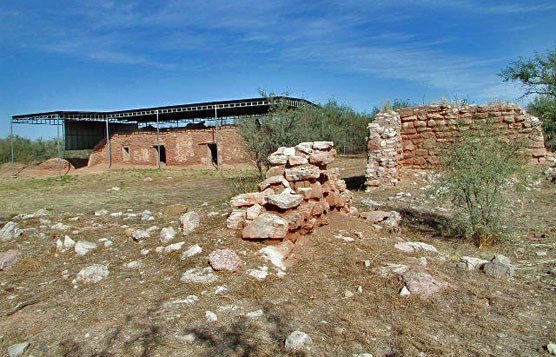
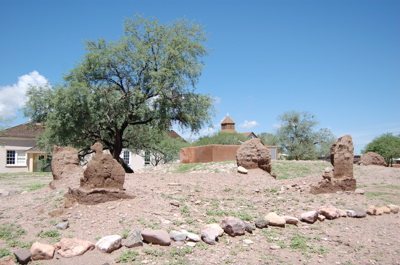
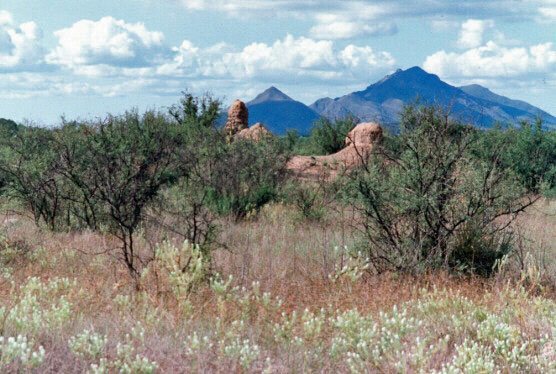
The church ruins lie amid the remains of the Sobaipuri or O’odham settlement, about 10 km north of present-day Nogales. San Cayetano Mountain and the Sierra Santa Rita form part of the surrounding landscape. The mission’s recorded architectural styles are Spanish Renaissance and Spanish Mission.
Mission complex
Church
The larger church, built in 1751, measured 15 by 50 feet. Its walls were three feet thick and six feet high. Workers plastered the interior and whitewashed it with lime. The church survives as ruins. María Rosa Bezerra Nieto, Juan Bautista de Anza’s mother, was buried in front of its altar.
Settlement and mission buildings
Excavations have covered the church and mission residence, as well as part of the Indigenous settlement. Remains identified as Father Kino’s small house and church have also been excavated. The church ruins and these excavated features preserve evidence of both the mission and the settlement where it was established.