Tre Fontane Abbey: A Historic Monastery and Trappist House in Rome
Site at a Glance
- Popularity
- Very High
- Country
- Italy
- Primary era
- Medieval
- Eras represented
- Classical, Medieval, Early Modern, Modern
- Civilizations
- Byzantine, Italian, Papal States, Roman
- Site type
- Religious
- Remains
- Monastery
On this page15 sections
History
Tre Fontane Abbey is a monastic complex in Rome, Italy, whose written history begins in the mid-sixth century, when Narses established a Greek monastery and a church dedicated to Paul. The site is also associated with Christian traditions about Paul’s execution and the appearance of three springs.
A valley associated with Paul
The abbey lies in a valley along the ancient Via Laurentina, known by at least the sixth century as Aquae Salviae, a Latin name traditionally interpreted as “healthy waters.” The name may refer to local springs or to the Salvii, a family that owned land there. The valley was also called Campo di Erode, or “Herod’s Camp,” possibly because Herod Agrippa II, a client king in the Roman Empire, had a country residence nearby.
Christian tradition says that Paul of Tarsus, an early Christian missionary and apostle, was beheaded in the valley on June 29, in either AD 65 or 67. In the story, his head bounced three times, and a spring appeared at each place where it struck. This account appears in the fifth-century Acts of Peter and Paul and in a letter written by Pope Gregory the Great in 604. Another tradition places Paul’s execution on the Via Ostiense, where he was buried and where the Basilica of Saint Paul Outside the Walls was later built. An ancient oratory at Aquae Salviae nevertheless commemorated his beheading.
A separate Christian tradition holds that Zeno, a Roman military officer, and 10,203 soldiers were executed at Aquae Salviae on June 9, AD 298, on the orders of Emperor Diocletian because they were Christians.
The early monastery
Narses, a Byzantine general and imperial official who governed Ravenna, established a Greek monastery and a church dedicated to Paul. In the seventh century, Greek and Armenian monks fleeing Arab conquests in Cilicia joined the community; Armenian monks remained associated with the site into the early fourteenth century. Byzantine Emperor Heraclius gave the monastery relics of Anastasius of Persia, a Christian martyr, including his head.
In 649, George, abbot of the Cilician monastery at Aquae Salviae, attended a council convened by Pope Martin I. A catalogue compiled the following year describes the monastery as holding Anastasius’s head and identifies the place as the site of Paul’s beheading.
Fire, restoration, and changing monastic rule
A fire damaged the monastery and its church in the late eighth century. Pope Adrian I supported their restoration. A purported grant dated January 22, 805, and attributed to Pope Leo III and Charlemagne, endowed the monastery with estates in Tuscany, including lands around Ansedonia, Orbetello, Monte Argentario, and Isola del Giglio. A related legend says that Anastasius’s relics were brought to Charlemagne during the siege of Ansedonia and that the town’s walls then collapsed miraculously. As the monastery declined, it eventually lost the estates.
Around 1080, Pope Gregory VII placed the abbey and its possessions in the care of Cluniac monks, members of a Benedictine movement centered on Cluny. By 1140 the monastery had been abandoned, possibly because its marshy surroundings encouraged malaria. That year, Pope Innocent II transferred it from the Cluniacs to the Cistercians, a monastic order that developed from the Benedictine tradition. The transfer followed Bernard of Clairvaux’s support for Innocent against Anacletus II, a rival claimant to the papacy.
In 1138, while celebrating a funeral mass at the monastery, Bernard reportedly saw a ladder by which angels carried souls from purgatory to heaven. A church associated with this vision was dedicated to Mary as Santa Maria Scala Coeli, meaning “Saint Mary of the Stairway to Heaven.” The Cistercian community developed the monastery. Its first abbot, Peter Bernard Paganelli, was elected pope in 1145 and took the name Eugene III, becoming the first Cistercian pope. Because of malaria, he allowed the monks to spend the summer at Nemi.
Medieval growth and later decline
By the time of Pope Alexander III, three churches at the monastery were associated with Anastasius, Paul, and Mary. Pope Honorius III consecrated the completed church of St. Anastasius in 1221, and the monastery itself was completed in 1306. In 1370, relics of Vincent of Zaragoza, a Christian martyr venerated in the Western Church, came to the abbey. Its principal church then took the names of both Vincent and Anastasius. After Anastasius’s relics were stolen, they were found in the sacristy of Santa Maria in Trastevere and returned to the abbey in 1418.
The abbey flourished in the fourteenth century and established five dependent monasteries, but later entered a prolonged decline. In 1418, Pope Martin V placed it under a commendatory abbot, who held the abbey’s title and revenues without necessarily directing its community. This arrangement limited the resident abbot’s control of property and income.
Suppression and Trappist restoration
French authorities suppressed the monastery in 1808, forcing the Cistercians to leave. Its property was looted and dispersed, its books and archives were transferred to the Vatican Library and the Casanatense Library, and the buildings fell into ruin. Pope Leo XII transferred the site to the Franciscan Friars Minor in 1826, but malaria prevented them from establishing a community there.
Pope Pius IX first proposed a Trappist restoration in 1855, but the expense proved too great. He renewed the plan in 1867, and in 1868 transferred the abbey to the Trappists by papal decree. Trappists belong to a reform branch of the Cistercian order known as the Order of the Strict Observance. A community from La Grande Trappe arrived to restore the buildings and reclaim the land. Cardinal Giuseppe Milesi Pironi Ferretti, appointed commendatory abbot in 1867, also worked to improve the surroundings.
The monks drained marshes, dug channels to carry away water, and planted eucalyptus. After the Papal States joined the Kingdom of Italy in 1870, they remained at the abbey and secured control of about 450 hectares from the state, on condition that they plant at least 125,000 eucalyptus trees. The reclamation also included filling a pond associated with malaria. The work was complete by the early twentieth century, and malaria was eliminated locally.
The abbey today
Tre Fontane is an Italian national monument and remains a Catholic Trappist monastery, the only Trappist abbey in Rome. In 1981, Pope John Paul II ended its territorial jurisdiction and placed the abbey under the Diocese of Rome. Its former territories were divided among the dioceses of Sovana-Pitigliano, including Orbetello, Capalbio, Monte Argentario, and Isola del Giglio; Nepi, including Monterosi; and Civita Castellana, including Ponzano Romano and Sant’Oreste.
Since 2010, the church of St. Paul has served as a titular deaconry, a church assigned to a cardinal-deacon. The abbey also raises lambs whose wool is used to make the pallium, a woolen vestment presented by the pope to metropolitan archbishops. The pope blesses the lambs on January 21, the feast of Saint Agnes, and presents the vestments on June 29, the feast of Saints Peter and Paul.
Remains
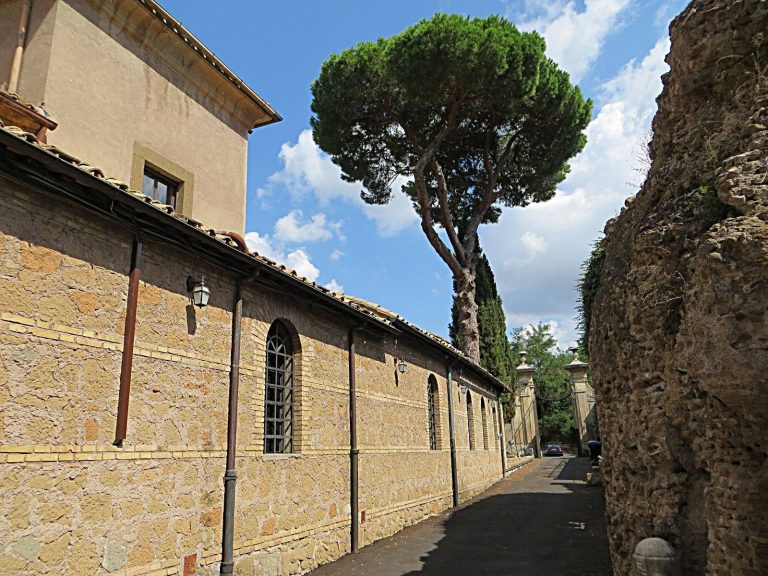
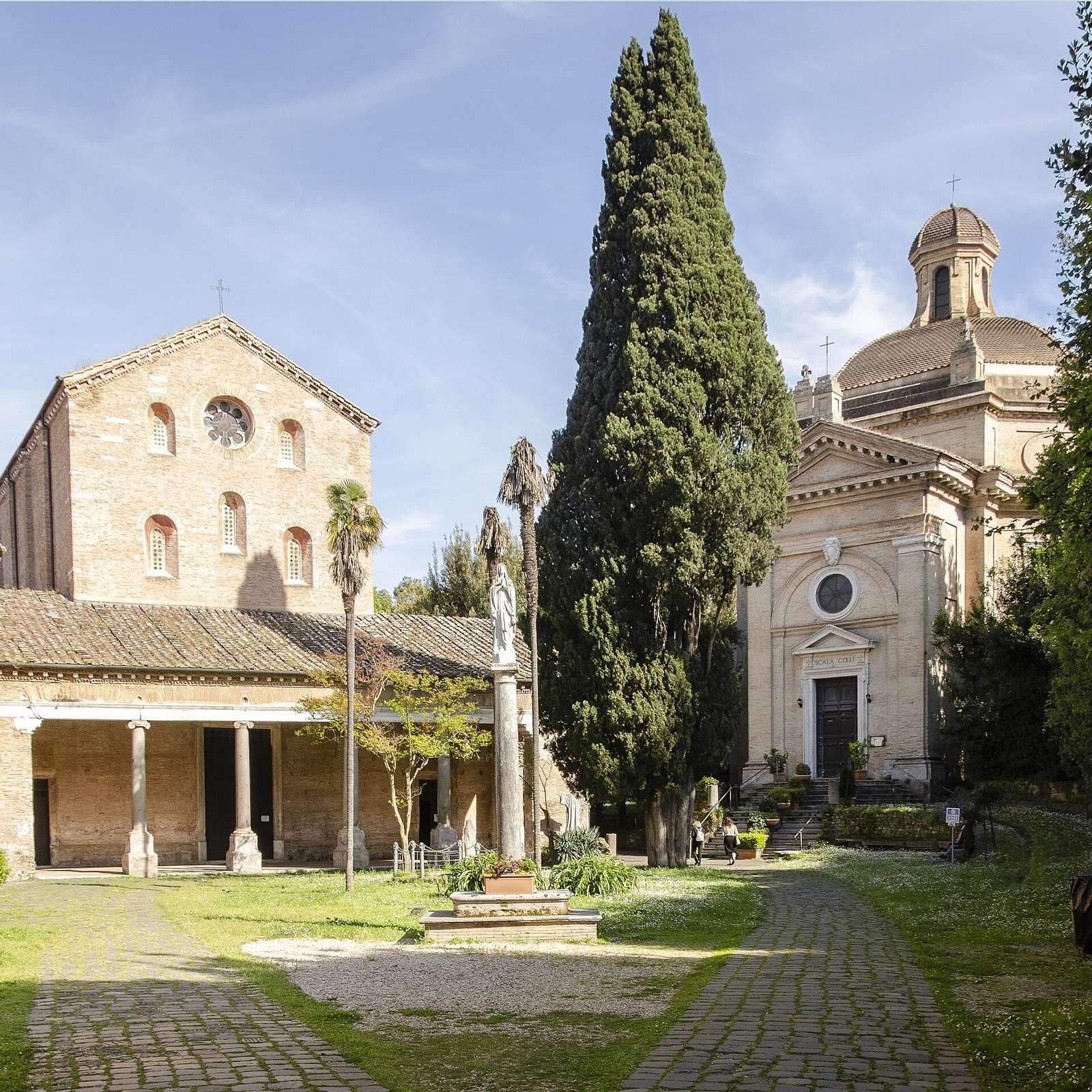
The abbey occupies a valley crossed by the ancient Via Laurentina. Its buildings and cloister stand to the left of a church within the complex. The original enclosure had fortifications, of which the entrance arch is the sole fully preserved element. The surviving buildings include medieval brickwork and churches rebuilt in later centuries.
Early archaeological remains
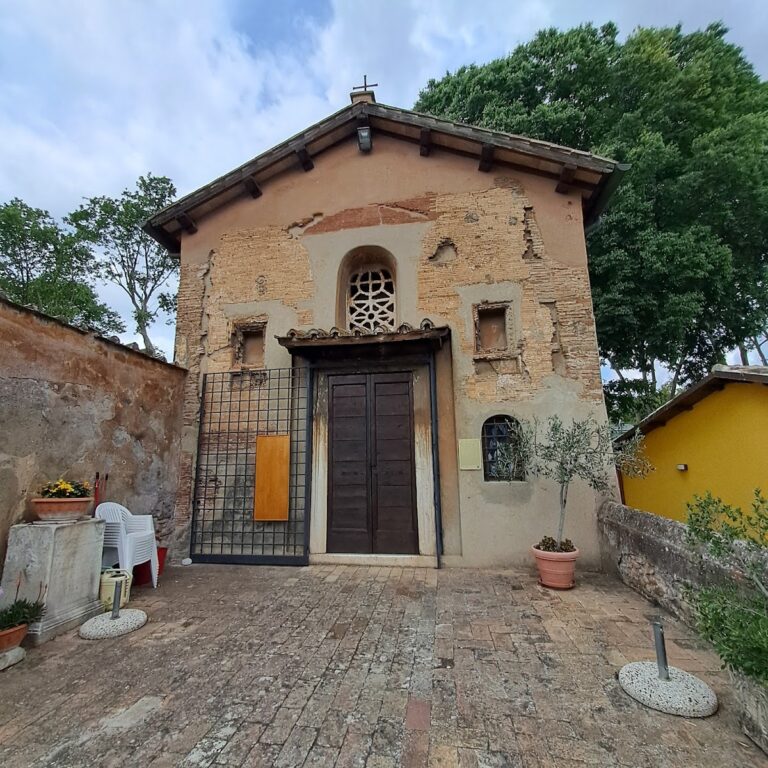
Excavations in 1867 by Italian archaeologist Giovanni Battista de Rossi identified a small sixth-century place of worship and a cemetery at Aquae Salviae. They also revealed a small church built in 687 under Pope Sergius I, a date preserved in an inscription. The church had two chapels: one held two of the three springs, while the other held the third.
Fortifications and medieval church
The entrance arch
The entrance arch, known as the Arch of Charlemagne, probably dates to the thirteenth century. Its portal has been compared with that of the Basilica of the Four Crowned Saints in Rome. A fresco cycle inside the arch recounted the purported grant of Tuscan estates to the monastery in 805; watercolors recording the paintings are held in the Vatican Apostolic Library. A later painting on the vault showed Christ Pantocrator with the four evangelists.
Church of Saints Vincent and Anastasius
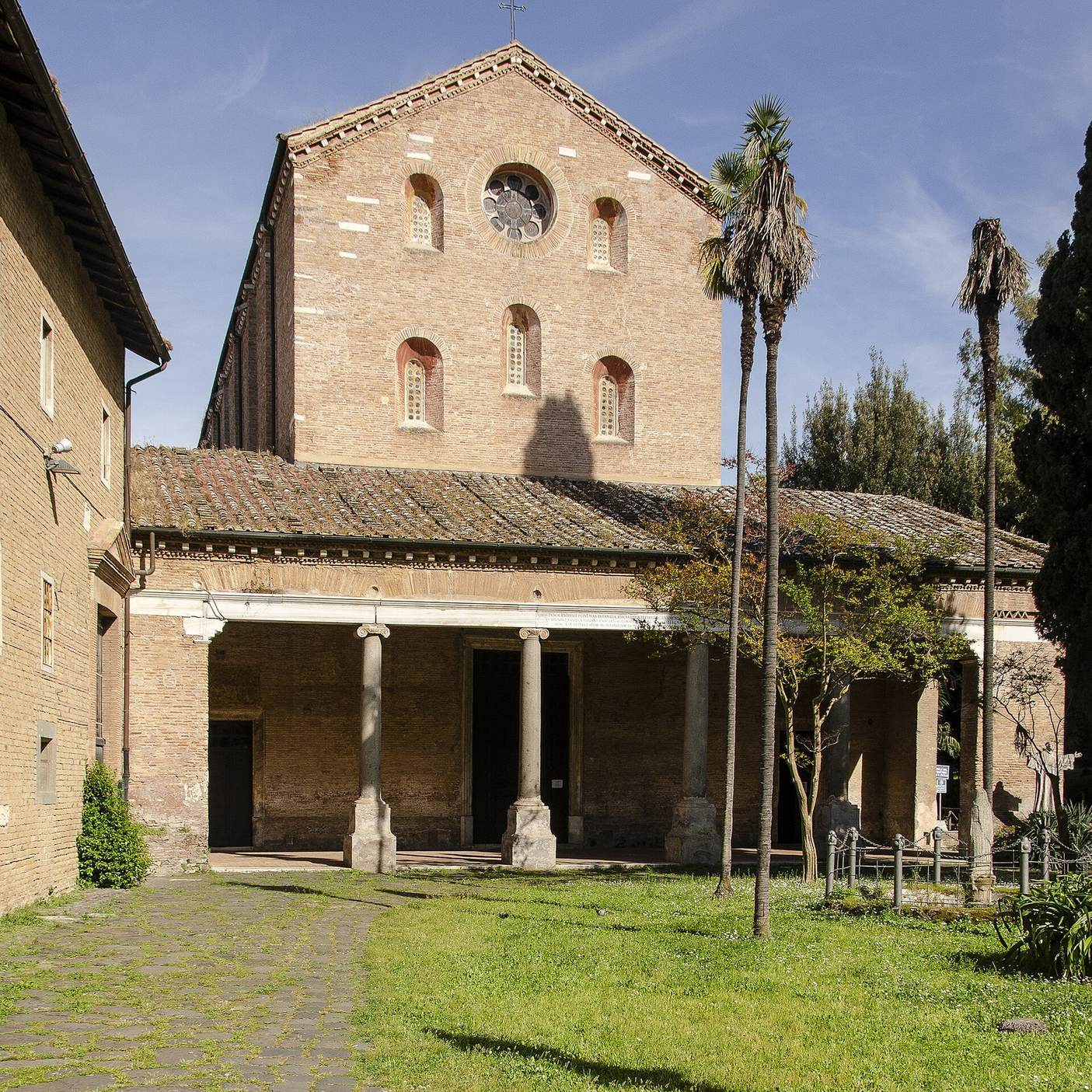
The abbey church of Saints Vincent and Anastasius largely retains the form of its thirteenth-century construction. It is a three-aisled church, with a central nave, two side aisles, and one apse, a projecting end of the building. A shallow transept, the crosswise part that intersects the main space, contains four side chapels. Bell-gables, wall structures with openings for bells, rise above the apse.
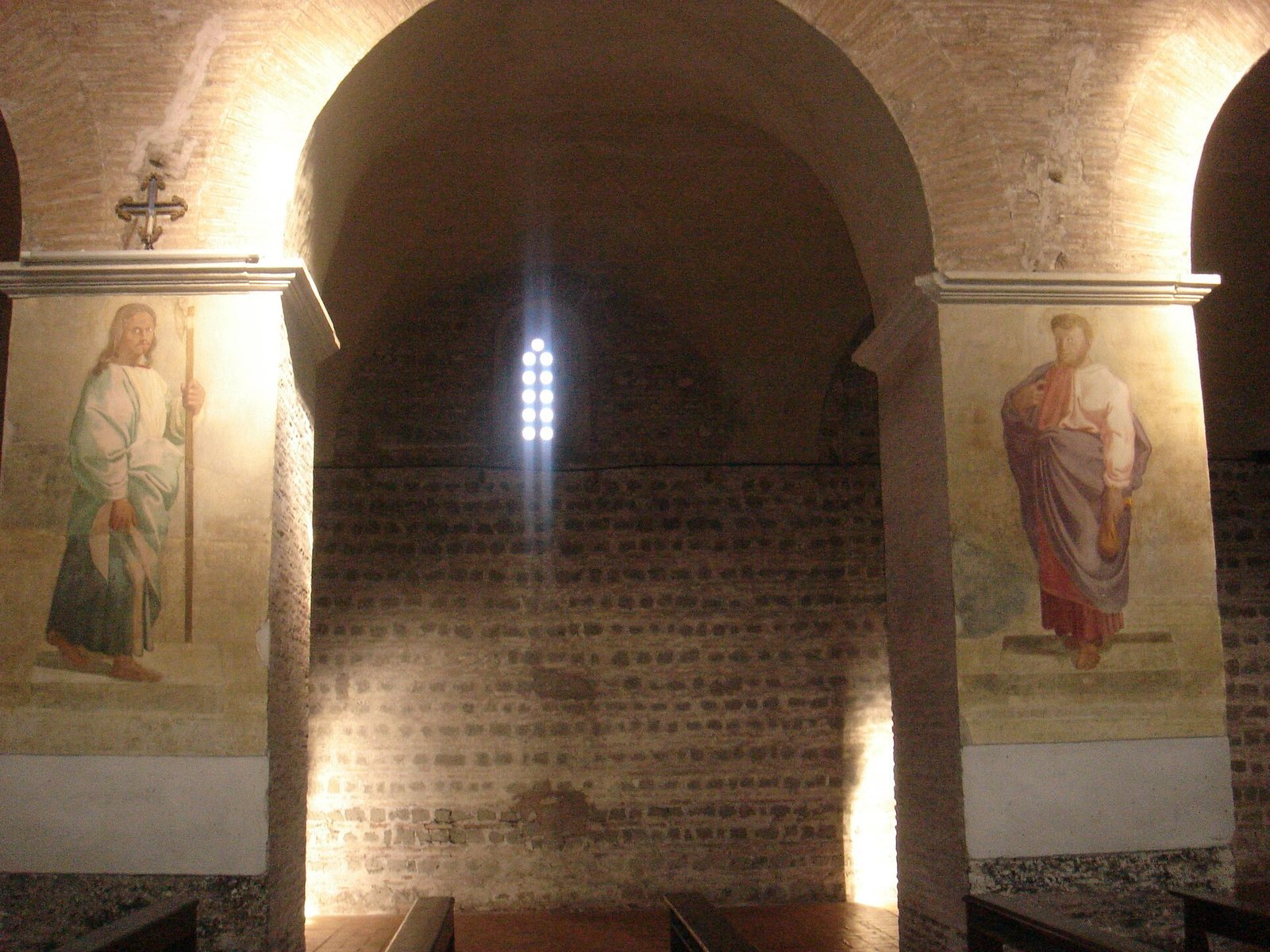
Massive piers along the sides are joined by round arches. Pointed-arched ceilings once covered the church; the vaults over the side chapels survive, while the ruined nave ceiling was replaced by exposed wooden trusses. Large figures of apostles on the nave piers provide the church’s interior decoration. It is built almost entirely of brick, with little reused material. Its pointed vaulting was then uncommon in Rome, and its construction is attributed to Cistercian and Lombard craftsmen, possibly from the contemporary abbey of Chiaravalle near Milan.
Churches rebuilt in the early modern period
Santa Maria Scala Coeli
The present Santa Maria Scala Coeli replaced an earlier oratory, which collapsed late in the sixteenth century. Giacomo della Porta designed the octagonal church, built from 1582 to 1584 for Cardinal Alessandro Farnese. It has three apses, or projecting sanctuary ends. The main altar is dedicated to Mary, the altar on the right to Zeno and his companions, and the one on the left to Bernard of Clairvaux. Its floor uses Cosmatesque work, a medieval Italian style of patterned inlays of colored stone.
Francesco Zucchi’s dome mosaic, made in 1591, depicts Mary and the Child with Bernard of Clairvaux, Robert of Molesme, Vincent of Zaragoza, Anastasius of Persia, Pope Clement VIII, and Cardinal Pietro Aldobrandini. The half-dome above the sanctuary also carries mosaics based on designs by Giovanni de’ Vecchi, presented to the church by Pope Clement VII and Cardinal Aldobrandini.
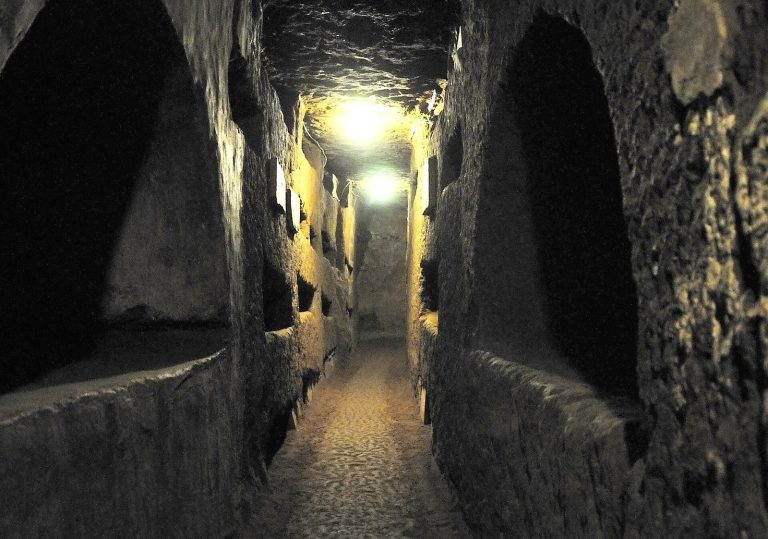
A crypt, an underground chamber, lies beneath the church. An altar there holds the relics of Zeno and his companions. Local tradition identifies the crypt as the place where Paul spent his final hours. A small opening to the left of the altar reveals a pagan altar dedicated to Dia, a Roman agricultural goddess worshipped by the Arval Brethren, an ancient Roman priestly college. An opening to the right reveals remains of an ancient Christian cemetery, traditionally identified as Paul’s final prison.
Church of St. Paul of Three Fountains
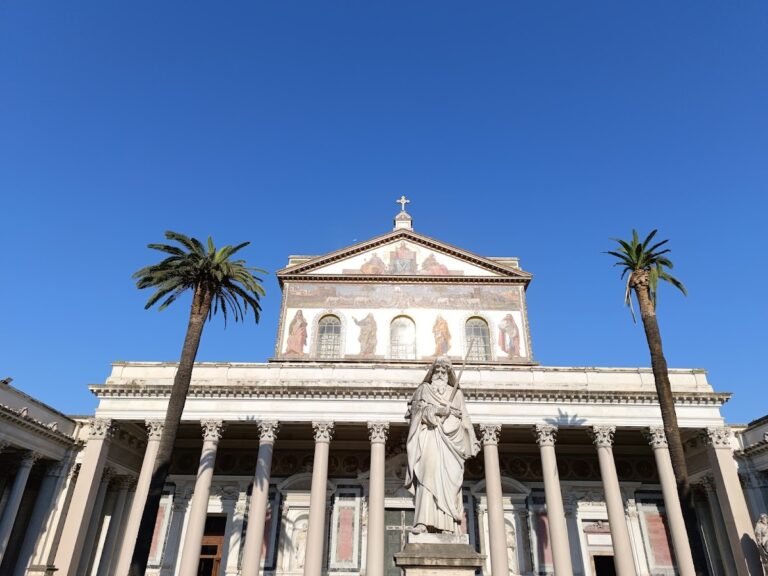
Giacomo della Porta designed this church, rebuilt from 1599 to 1601 with funding from Cardinal Pietro Aldobrandini. The single-nave church has a small vestibule opening into the center of the main space, along with a main altar and two side chapels. A copy of Guido Reni’s Crucifixion of Peter is in the left chapel, and Bartolomeo Passarotti’s Beheading of Paul is in the right. French authorities took Reni’s original painting to Paris in 1797; after its recovery, it was placed in the Vatican Picture Gallery.
The three springs stand along the right wall of the nave, each beneath a marble tabernacle, a small architectural shrine. Nicola Cordier’s reliefs of Paul’s head once decorated the tabernacles and were later stolen. Beside the first spring is a remnant of a column traditionally identified as the one to which Paul was tied. A second-century floor mosaic from Ostia Antica, given to the abbey by Pius IX, depicts the Four Seasons as four female faces wearing seasonal head coverings. Inscriptions name spring, summer, autumn, and winter. An older mosaic, predating the church’s sixteenth-century rebuilding, remains in the vestibule.