Palazzo Margherita d’Austria: Civic Palace of L’Aquila


Site at a Glance
- Rating
- 4.6
- Popularity
- Very Low
- Country
- Italy
- Primary era
- Modern
- Eras represented
- Medieval, Early Modern, Modern
- Civilizations
- Italian, Kingdom of Naples, Kingdom of the Two Sicilies, Spanish
- Site type
- Civic
- Remains
- Palace
On this page9 sections
History
Palazzo Margherita d’Austria is a historic civic palace in Italy, originating in the thirteenth century as the Royal Curia of the Captain, the administrative and judicial seat associated with L’Aquila’s city captain. The wider civic complex took shape around 1302 in the medieval city center, while its adjacent civic tower already stood at the time of L’Aquila’s second foundation in 1254. The complex became an important counterpart to the religious authority concentrated around Piazza del Duomo.
The medieval civic center
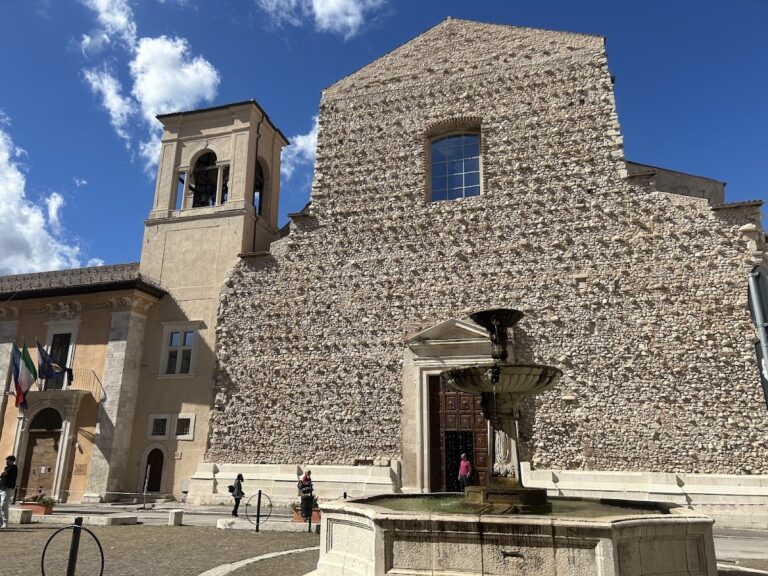
The area around the present Piazza del Palazzo originally brought together the Palazzo del Comune, the Palazzo della Camera, and the residence of the Captain of Justice, a municipal judicial authority. This arrangement expressed the city’s civic organization during a period shaped by the rivalry between Guelphs and Ghibellines, rival medieval factions broadly associated with papal and imperial authority. Civic autonomy was also challenged by the Franciscan complex at the opposite end of the square. The statutes of L’Aquila were kept in the now-vanished church of San Francesco a Palazzo.
The civic tower formed part of the fourteenth-century Palazzo del Capitano and was closely connected with the palace complex. In 1310 it rose more than 20 canne, a historical unit of length, or approximately 52 meters. Repeated earthquake collapses later reduced it to nearly half that height. Its removal was proposed during the nineteenth-century restoration, but the tower survived.
Margaret of Austria and the sixteenth-century redesign
During the sixteenth century, L’Aquila experienced economic decline under Spanish domination and lost control over the surrounding rural territory. Margaret of Austria, the daughter of Emperor Charles V and governor of the Abruzzi, returned to the region during a period associated with renewed economic and cultural activity and the settlement of territorial disputes.
Margaret entered L’Aquila in May 1569 after spending a short period at Cittaducale. The inhabitants received her triumphantly, and she later decided to establish her court in the city. The administration then adopted the architect Girolamo Pico Fonticulano’s plan for a radical renovation of the former Captain’s Palace. The work cost 17,000 ducats and required the demolition of houses along adjoining streets.
Fonticulano’s redesign shifted the city’s urban focus toward the renovated residence. Its principal entrance faced south toward Piazza del Duomo, bringing the palace into closer spatial and political relationship with the religious center. The building consequently became an emblem of civic authority and reduced the earlier separation between civic and religious power.
Margaret took up residence as governor of L’Aquila on 16 December 1572 and remained in office until her death in 1586. The palace acquired its present historical name from her.
Nineteenth-century transformation and municipal ownership
The present building differs substantially from the palace designed by Fonticulano, although its plan was retained. Damage caused by the earthquake of 1703 led to a further restoration between 1838 and 1846. That intervention substantially changed the building, including its entrance. The palace later became the seat of the Gran Corte degli Abruzzi, a regional judicial institution, and was subsequently known as the Palace of Justice.
Another renovation in 1974 moved the entrance definitively to Piazza del Palazzo and enabled the municipality to resume ownership. A dispute followed with the province, which had financed the 1838 works and claimed ownership of the palace. In 2011, the Court of Cassation ruled in favor of the Municipality of L’Aquila.
Earthquake damage and reconstruction
The palace and its adjacent civic tower were severely damaged by the 2009 earthquake, which produced numerous shear cracks. Reconstruction of the palace began on 4 November 2016. The work took longer than initially projected, with completion originally expected in 2019, and ended with the building’s reopening in 2023. Palazzo Margherita d’Austria again serves as L’Aquila’s municipal seat. The tower was excluded from the reconstruction, remains supported by temporary shoring, and awaits consolidation and restoration.
Remains
Palace layout and civic setting
Palazzo Margherita d’Austria stands between Piazza del Palazzo and Piazza Santa Margherita in central L’Aquila. Its position was planned around three open spaces: the two existing squares to the east and west, and a southern opening toward Piazza del Duomo. That southern space was partly built over during urban restoration between the seventeenth and nineteenth centuries, when Via Sallustio was created. The building’s fourth side runs parallel to Via Roma, the east-west principal street in L’Aquila’s Angevin-derived urban plan.
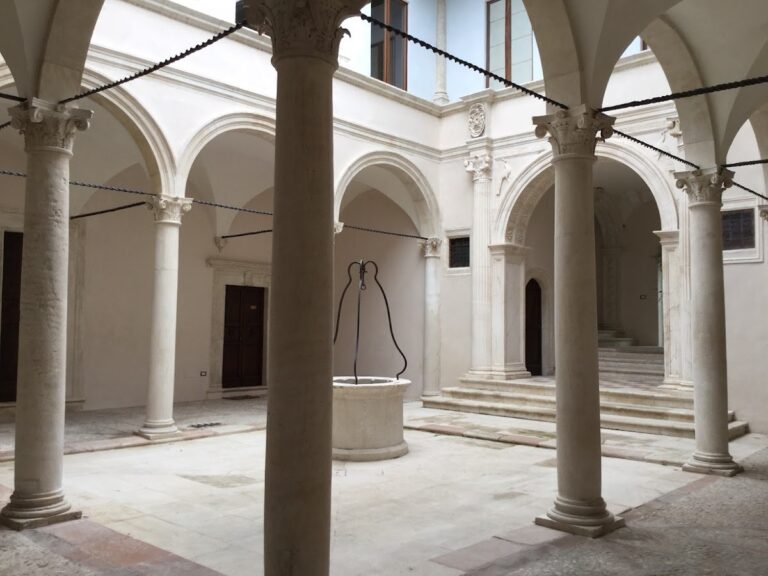
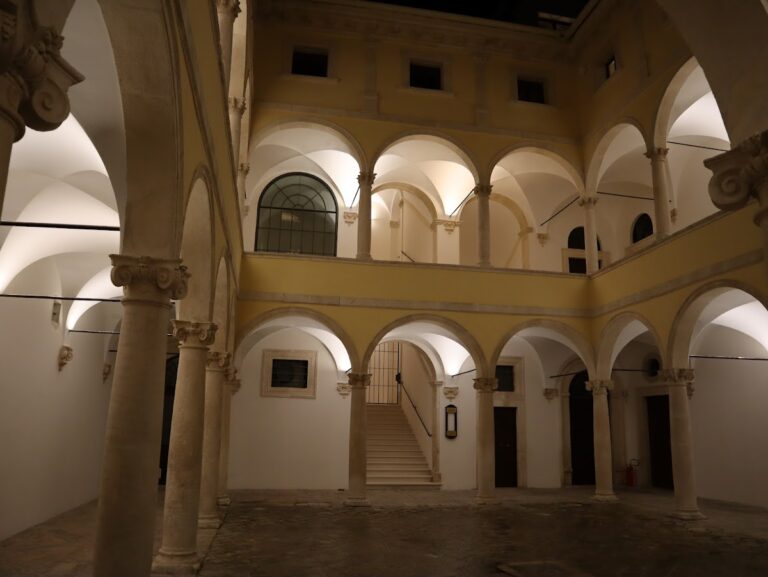
The palace is arranged around a central courtyard reached through three wings directed toward the surrounding squares. In its original configuration, porticoes occupied the northern, eastern, and western sides. The southern side contained the principal entrance and two rising stairways that diverged as they approached the courtyard, while a fountain stood at the center. Together, these elements formed a staged approach to the residence. The entrance was later transferred first to Via Roma and then, after the palace returned to municipal use, to the eastern side facing Piazza del Palazzo, where it remains.
The civic tower
The adjacent civic tower forms a single complex with the palace and is the last surviving element of the fourteenth-century Palazzo del Capitano. Its original height exceeded 20 canne, approximately 52 meters, in 1310. Earthquake collapses repeatedly reduced the structure, leaving it at nearly half its former height. At the base, on the side facing Piazza del Palazzo, the tower preserves the earliest known example of L’Aquila’s coat of arms, dating from the late thirteenth century.
The Madonna degli Angeli chapel
The lower floors of the tower contain the chapel dedicated to the Madonna degli Angeli. It was established to offer religious consolation to condemned prisoners whose prisons occupied the underground levels of the former palace before their sentences were carried out.
The chapel preserves the Bull of Forgiveness, the document through which Pope Celestine V granted a plenary indulgence in exchange for an annual pilgrimage to the Basilica of Santa Maria di Collemaggio. A plenary indulgence is the remission of temporal punishment traditionally understood to remain after sin has been forgiven. The document is removed from the tower only for the Celestinian Forgiveness celebration held each year on 28 August.
Nearby sites