Tornabuoni Chapel: The Principal Chapel of Santa Maria Novella
Site at a Glance
- Popularity
- High
- Country
- Italy
- Primary era
- Medieval
- Eras represented
- Medieval, Early Modern, Modern
- Civilizations
- Duchy of Florence, Holy Roman Empire, Republic of Florence
- Site type
- Religious
- Remains
- Chapel
On this page22 sections
History
The Tornabuoni Chapel is the principal chapel in the apse, the rounded or polygonal end of Santa Maria Novella, in Florence, Italy. Dedicated to the Virgin Mary, it became the setting for a Renaissance fresco cycle painted by Domenico Ghirlandaio between 1485 and 1490.
Earlier paintings and changing patronage
Andrea Orcagna first painted the chapel around the middle of the fourteenth century. By the later fifteenth century, those frescoes had deteriorated. The Ricci family held rights to the chapel walls and choir, but the financial collapse of Florentine companies in 1348 left them unable to maintain the decoration.
The Sassetti, Florentine bankers associated with the Medici, had long-standing rights to decorate the church’s main altar. After the Ricci transferred the choir’s patronage rights to them, Francesco Sassetti proposed a cycle about St Francis of Assisi, founder of the Franciscan order. The Dominican friars opposed placing stories of a Franciscan saint in their church’s principal chapel. A legal dispute ended in their favor, and Sassetti moved his commission to Santa Trinita. The Ricci later transferred the Tornabuoni Chapel’s patronage rights to Giovanni Tornabuoni.
Ghirlandaio’s commission
On 1 September 1485, Tornabuoni commissioned Ghirlandaio to paint episodes from the lives of the Virgin and John the Baptist. John was the patron saint of both the family’s head and Florence. The contract prescribed subjects and settings, required costly blue pigments and gilding, and gave Tornabuoni the right to require changes to preparatory designs. It set a fee of 1,100 florins.
Ghirlandaio devised the cycle’s overall design and supervised work by his workshop from 1485 to 1490. His brother Davide, his brother Benedetto, and his brother-in-law Sebastiano Mainardi took part. The adolescent Michelangelo Buonarroti, later a major Renaissance artist, was also an apprentice there, though no scene can be securely assigned to him. Ghirlandaio designed the chapel’s stained-glass windows as well as its paintings. Florentine diarist Luca Landucci noted the frescoes’ unveiling on 22 December 1490. The altarpiece was installed after Ghirlandaio’s death.
The cycle places portraits of Florentine families and public figures within sacred narratives. The arrangement presented the patron and his circle in a religious setting and linked their social position with Christian virtue. The paintings also vary in finish: the lower scenes are generally more carefully worked, while the upper parts rely more visibly on workshop assistance. This unevenness influenced judgments of Ghirlandaio’s work, whose reputation was reassessed during the second half of the twentieth century.
Alterations and restoration
The principal chapel was remodelled in 1804, and the Tornabuoni altarpiece entered the antiquities market before being divided between museums in Munich and Berlin. In 1861, the basilica’s main altar was moved forward from its former position against the wall. Its new location aligned with the intended viewing position for the frescoes.
Agostino Veracini probably worked on the paintings in the eighteenth century. Restoration in the 1940s revealed remnants of Orcagna’s earlier decoration beneath the later cycle. The discoveries included Old Testament figures in the vault, and some fragments were detached for display in the former refectory of the Santa Maria Novella museum.
Remains
The chapel occupies Santa Maria Novella’s central apse. Its painted decoration covers three walls: each side wall has three rows of rectangular scenes beneath a large arched panel. The narratives are read from the bottom upward and from right to left, an arrangement already regarded as old-fashioned when the cycle was made. Painted frames divide the scenes, and the ribbed vaulted ceiling carries further figures. The main fresco cycle is generally well preserved, though much of the central plaster in the Adoration of the Magi has been lost.
Scenes on the side walls
Joachim, Mary’s birth, and her presentation
In Joachim expelled from the Temple, the rejected Joachim stands among people bringing animals for sacrifice. The scene unfolds in an open-sided gallery with four equal-length arms, a deep succession of arches, and an eight-sided altar bearing a fire. Contemporary Florentines flank the biblical action. Lorenzo Tornabuoni and Piero di Lorenzo de’ Medici may be among those on the left; the identities of other figures there are also uncertain. At the right, the group includes Ghirlandaio, his brother Davide, and Sebastiano Mainardi. A more elderly figure has been identified either as Ghirlandaio’s father, Tommaso Bigordi, or as his teacher Alesso Baldovinetti. The gallery recalls the nearby Hospital of San Paolo, while the flanking buildings use a more general Florentine appearance, with rough-faced masonry and upper galleries.
The Nativity of Mary takes place in a richly furnished room. St Anne rests in bed as attendants care for the newborn Mary, while another pours water into a basin. A staircase shows Anne and Joachim embracing at Jerusalem’s Golden Gate. A procession of well-dressed women includes their daughter Ludovica Tornabuoni, shown in profile. She had died in childbirth shortly before the fresco was painted, at about fifteen. Beneath a classical-style relief of putti, a cabinet bears an inscription about the joy Mary’s birth brought to the world and Ghirlandaio’s signatures, Bighordi and Grillandai. A preparatory drawing for the attendant pouring water is held in the Uffizi.
In the Presentation of Mary at the Temple, Mary carries a book as she climbs toward the priest and looks out toward the viewer. The elaborate classical-style setting incorporates a simple Florentine street. Anne and Joachim appear in the scene, along with two young women hurrying from the Temple and a seated nude man holding a flask. In the Marriage of the Virgin, a priest places a ring on Mary’s hand as she and Joseph marry in a courtyard with niches, vaulted recesses, and recessed ceiling panels. The other suitors break their staffs or raise their fists in protest. Joseph’s staff, painted onto dry plaster, is now faint; a drummer and flautist appear behind the central action. An ink study for the composition is also in the Uffizi.
The Adoration of the Magi and the Massacre of the Innocents
Mary and the Child sit beneath a broken triumphal arch in the Adoration of the Magi. Its inscription and ruined form refer to the rise of Christianity after paganism, while a peacock alludes to immortality and Christ’s victory over death. The procession includes richly simulated jewels and metals, ruined buildings, hills, and a giraffe. The animal recalls one brought to Florence in 1486 as a gift to Lorenzo de’ Medici. Men at the right may represent Florentines dressed as foreign ambassadors. The central plaster has suffered substantial loss.
The Massacre of the Innocents sets a composed classical background against a violent foreground. A military-decorated triumphal arch occupies the center, with side arches leading toward palaces where people watch from terraces. Mothers try to shield their children from soldiers as dead and injured infants lie on the ground. Near the center, a soldier falls from his horse; the horse lands on a man who raises a shield marked with the letters SPQR in gold.
The death and assumption of the Virgin
In the upper arched panel, Mary’s body lies on grass among apostles and Church Fathers who mourn, pray, and pay their respects. Angels carry torches, and one apostle holds a palm associated with the Resurrection. Above them, the youthful Virgin appears within an almond-shaped halo supported by angels as God welcomes her. The landscape includes Tuscan hills, castles, fortified settlements, and the Villa Medici at Fiesole. The painting is more loosely finished than many of the other scenes, probably reflecting extensive workshop involvement.
Scenes from the life of John the Baptist
Zechariah, Elizabeth, and the Baptist’s birth
In the Apparition of the Angel to Zechariah, the priest burns incense in the central apse of a Renaissance church open to the exterior. Painted classical-style reliefs continue into the neighboring Visitation. Six groups of figures occupy different levels; the humanists at the left include Marsilio Ficino, Cristoforo Landino, Agnolo Poliziano, and Demetrius Chalcondyles. An inscription on the arch marks the cycle’s completion in 1490 and quotes Poliziano.
Mary and the elderly Elizabeth meet in the Visitation, framed by the receding lines of a wall and a ravine. The background joins a relief-covered classical building to a landscape, with a wooden passage crossing an opening. Its imagined city includes features resembling the tower of the Palazzo Vecchio, Santa Maria Novella’s bell tower, and Rome’s Colosseum; the city gate loosely recalls Florence’s Porta San Miniato. The women include Giovanna degli Albizzi, wife of Lorenzo Tornabuoni, and Dianora Tornabuoni. Vasari mistakenly identified Giovanna as Ginevra de’ Benci.
The Birth of John the Baptist echoes the Nativity of Mary in its domestic interior and centrally placed bed. Elizabeth reclines with a book while nurses tend the baby; a servant enters carrying fruit and a water jug. Bottles, embossed tableware, a box, a vase, and two pomegranates furnish the room. One visiting woman may be a Tornabuoni relative, and another may represent Giovanni’s deceased sister, Lucrezia Tornabuoni. In Zechariah writes his son’s name, the father writes on a sheet while looking toward the infant in Elizabeth’s arms. The broad portico opens onto a distant landscape; a preparatory study of two women is in the Uffizi.
The Baptist’s preaching, baptism, and death
John stands on a rock in the Preaching of the Baptist, dressed in animal skins and pointing to a cross as a crowd gathers. Jesus listens from a path above and to the left. In the Baptism of Christ, a rocky rise divides the landscape behind Christ. God the Father blesses him from above, with angels nearby, while a young man at the right kneels to remove his shoes. Some nude figures have been attributed to the young Michelangelo, but the identification remains uncertain.
Herod’s Banquet fills the upper arched panel with a classical-style hall, its vaulted ceiling and painted arch joined visually to the chapel’s real architecture. The setting recalls Rome’s Basilica of Maxentius. Side tables organize the scene, with women at the left and men at the right; vessels of precious metal and musicians add to the display. Herod sits at the central table, beyond which a balustrade opens onto a landscape. Salome dances in front as a servant presents John the Baptist’s head on a dish.
Rear wall and window
Paintings and donor portraits
The rear wall combines the Coronation of the Virgin and saints with scenes of St Dominic testing books in a fire, the killing of St Peter Martyr, the Annunciation, and John the Baptist in the desert. In the Annunciation, the angel and Mary occupy a room open to a landscape. The desert scene places the youthful Baptist in green countryside beside a rocky path, cliff, and port city. He has sometimes been proposed as a portrait of the adolescent Michelangelo, an identification that is not certain. Giovanni Tornabuoni and his wife, Francesca Pitti, kneel as donors on this wall.
Stained glass
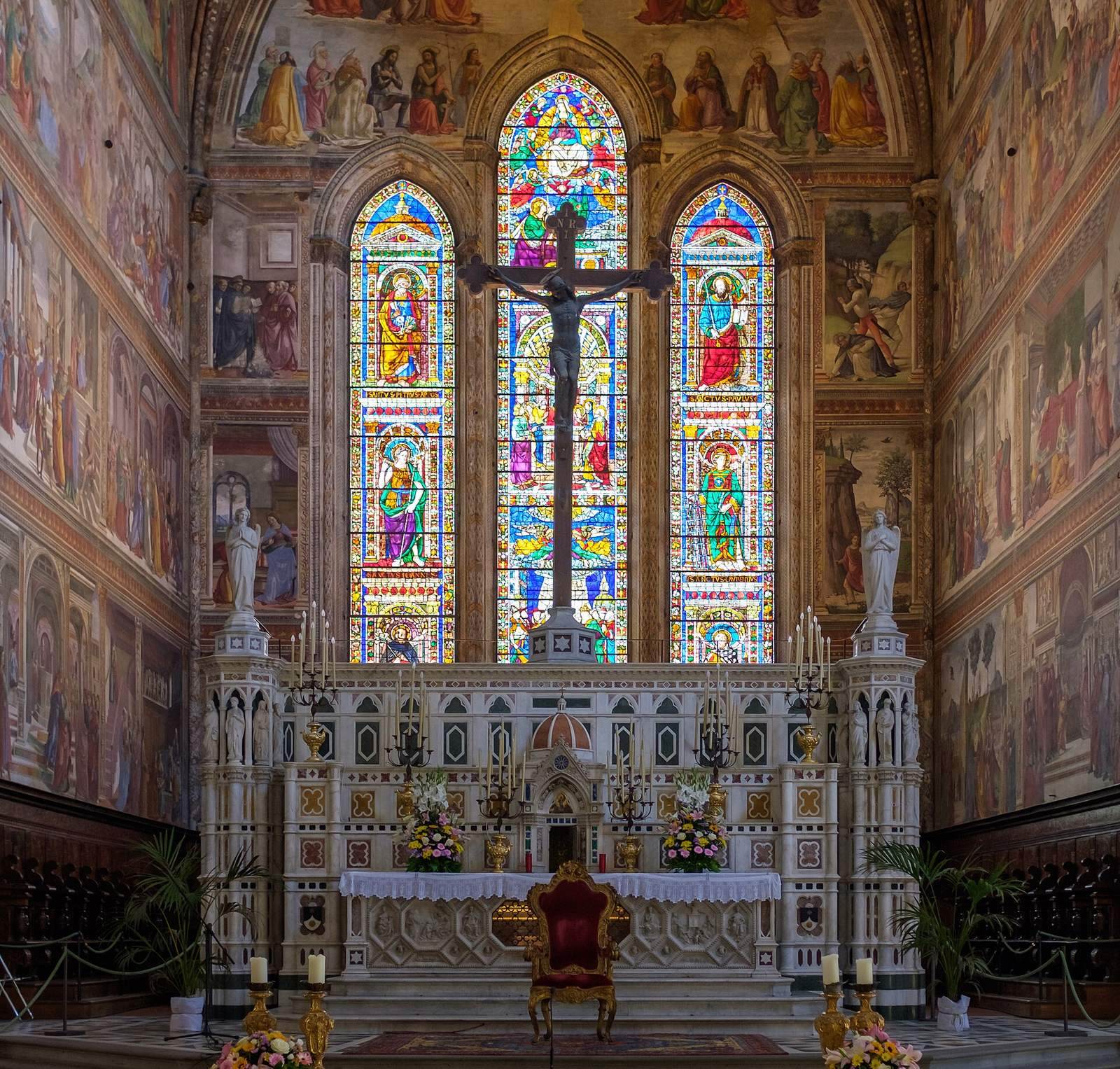
A large three-light window fills the rear wall. Alessandro Agolanti made its polychrome glass in 1492 to Ghirlandaio’s design. It shows Peter and Paul, John the Baptist and Lawrence, and the Dominican saints Dominic and Thomas Aquinas. At the center are two Marian subjects: the Holy Girdle, a relic traditionally associated with Mary, and the Miracle of the Snow, a medieval story about snowfall identifying the site of a church in Rome.
Vault and earlier painting
The four Evangelists
The four compartments of the ribbed vault contain the Evangelists with their traditional symbols: John with an eagle, Matthew with a human or angelic figure, Luke with an ox, and Mark with a lion. They write or display their work. Mark sharpens his pen with a knife, and the figures, including the ox, are carefully rendered.
Orcagna’s surviving fragments
Remnants of Orcagna’s earlier painting survive beneath the later decoration, particularly figures from the Old Testament in the vault. Some detached fragments are displayed in the former refectory of the Santa Maria Novella museum.
Choir, altar, and furnishings
Wooden choir and lectern
Baccio d’Agnolo carved and inlaid the wooden choir around 1485 to 1490. Two panels on its back, showing John in the Desert and St Lawrence, are attributed to Filippino Lippi. Giorgio Vasari remodelled the choir in 1566, remaking its armrests, seats, and shelves in the first tier. A large sixteenth-century wooden lectern, used for illuminated liturgical books, bears the arms of the Minerbetti family.
Altar furnishings
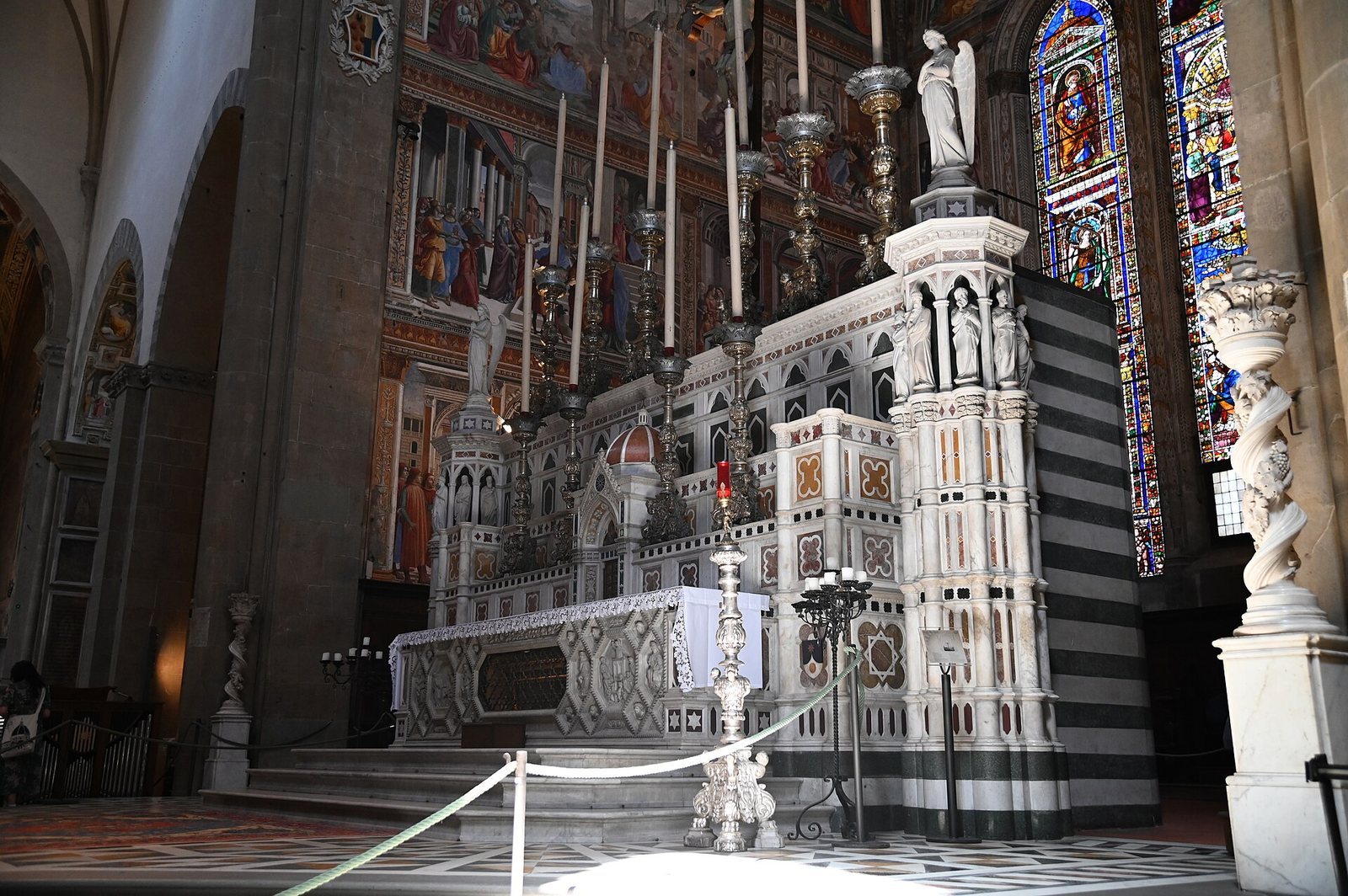
The central altar is a nineteenth-century Neo-Gothic work, and its central crucifix is by Giambologna. The right-hand candle holder for the Easter liturgy has a twisted column and is attributed to Piero di Giovanni Tedesco in the late fourteenth century. Its counterpart on the left is a modern reproduction.
The dispersed altarpiece
The former multi-panel altarpiece comprised a Nursing Madonna in Glory with an Angel and Saints, flanked by panels showing St Catherine of Siena and St Lawrence. Its reverse depicted the Resurrection of Christ. The panels are now divided between museums in Munich and Berlin.