Tomb of Zhu Ran: An Eastern Wu Burial in Ma’anshan, China
Site at a Glance
- Popularity
- Medium
- Country
- China
- Primary era
- Classical
- Eras represented
- Classical
- Civilizations
- Unclassified
- Site type
- Burial
- Remains
- Tomb
On this page17 sections
History
The Tomb of Zhu Ran is an Eastern Wu burial built in 249 CE in Ma’anshan, Anhui, China, for the general Zhu Ran. Eastern Wu was one of three rival states during China’s Three Kingdoms period. Zhu Ran (182–248) held the military offices of Left Grand Marshal and Right Army Advisor and the noble title Marquis of Dangyang. Among Eastern Wu tombs excavated by 2013, his was the one whose occupant held the highest status.
The cemetery reflects a Six Dynasties custom of burying family members together. The Six Dynasties is a broad grouping of successive regimes in southern China.
Discovery and associated burials
The tomb came to light in early June 1984, when the Shanghai-Anhui Textile Joint Company expanded a warehouse. The Anhui Provincial Institute of Archaeology and the Ma’anshan Municipal Archaeological Survey Team excavated it. It had already been looted in antiquity.
Four roughly contemporary brick-chamber tombs were found south of Zhu Ran’s in 1996. The largest, more than 30 metres to the southwest, has been tentatively identified as the burial of Zhu Ran’s son Zhu Ji, though Zhu Zhi has also been proposed. The other three were badly damaged and yielded few objects. Their forms and brick patterns resemble Western Jin burials. The Western Jin dynasty followed the Three Kingdoms, and these tombs may not have belonged to Zhu Ran’s family.
Protection and museum
In 2001, the Zhu Ran Family Cemetery was designated a Major Site Protected at the National Level in China.
The cemetery museum was developed as a principal part of the site’s protection project and as a specialist museum devoted to Eastern Wu history and culture. It was partly completed in 1988. Exhibition halls for the tomb chambers and excavated objects were added in 1995, and the museum was renovated in 2001.
Remains
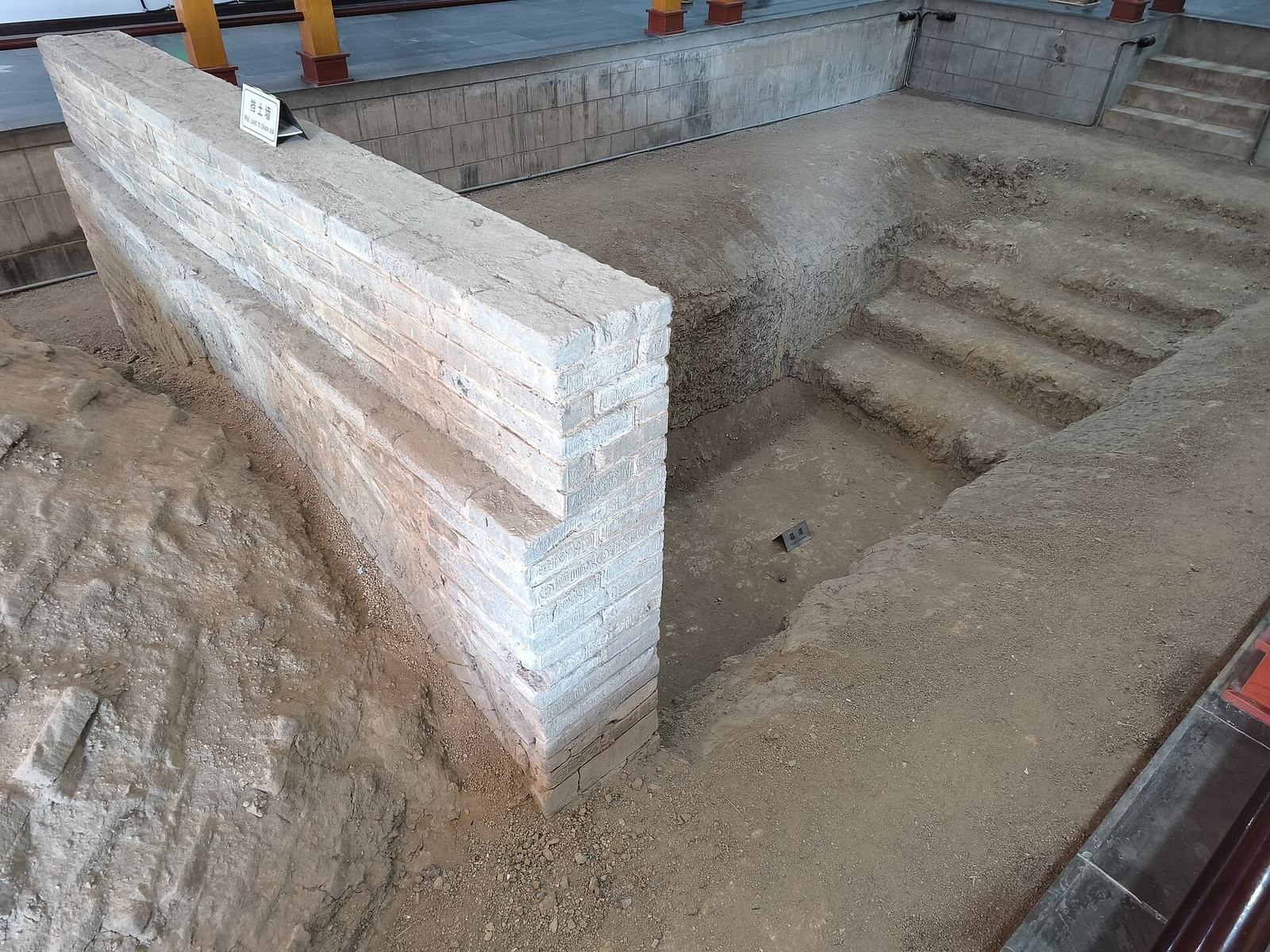
The tomb stands on level ground south of Yushan and is aligned north to south. Its earthen mound is about two metres high, and the burial extends 8.78 metres. From south to north, its spaces comprise a stepped passage, a connecting corridor, a front chamber, another passage, and a rear chamber. A blocking wall separates the entrance passage from the corridor. Blue-gray bricks form the chambers.
The main tomb
Chambers and burials
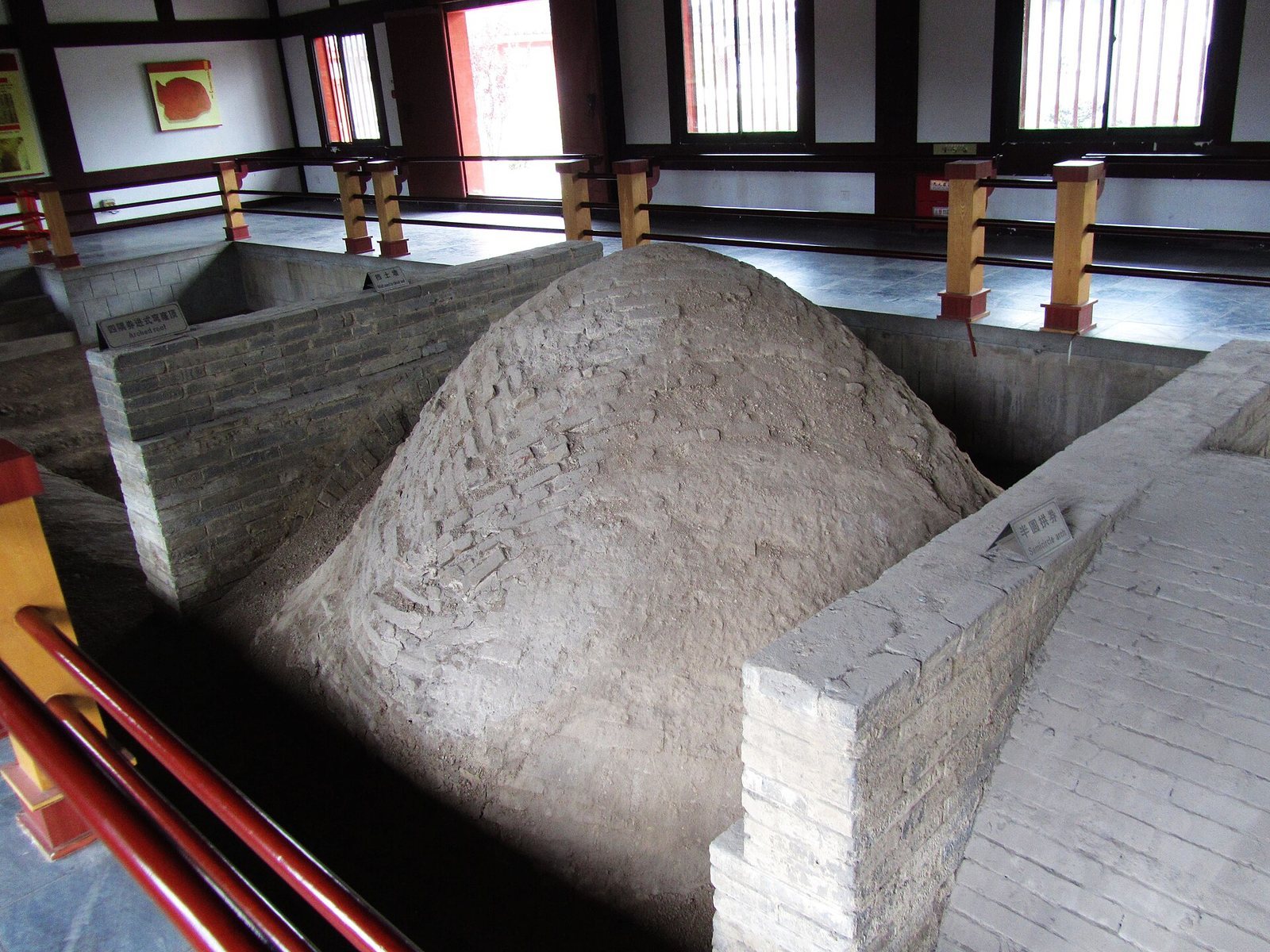
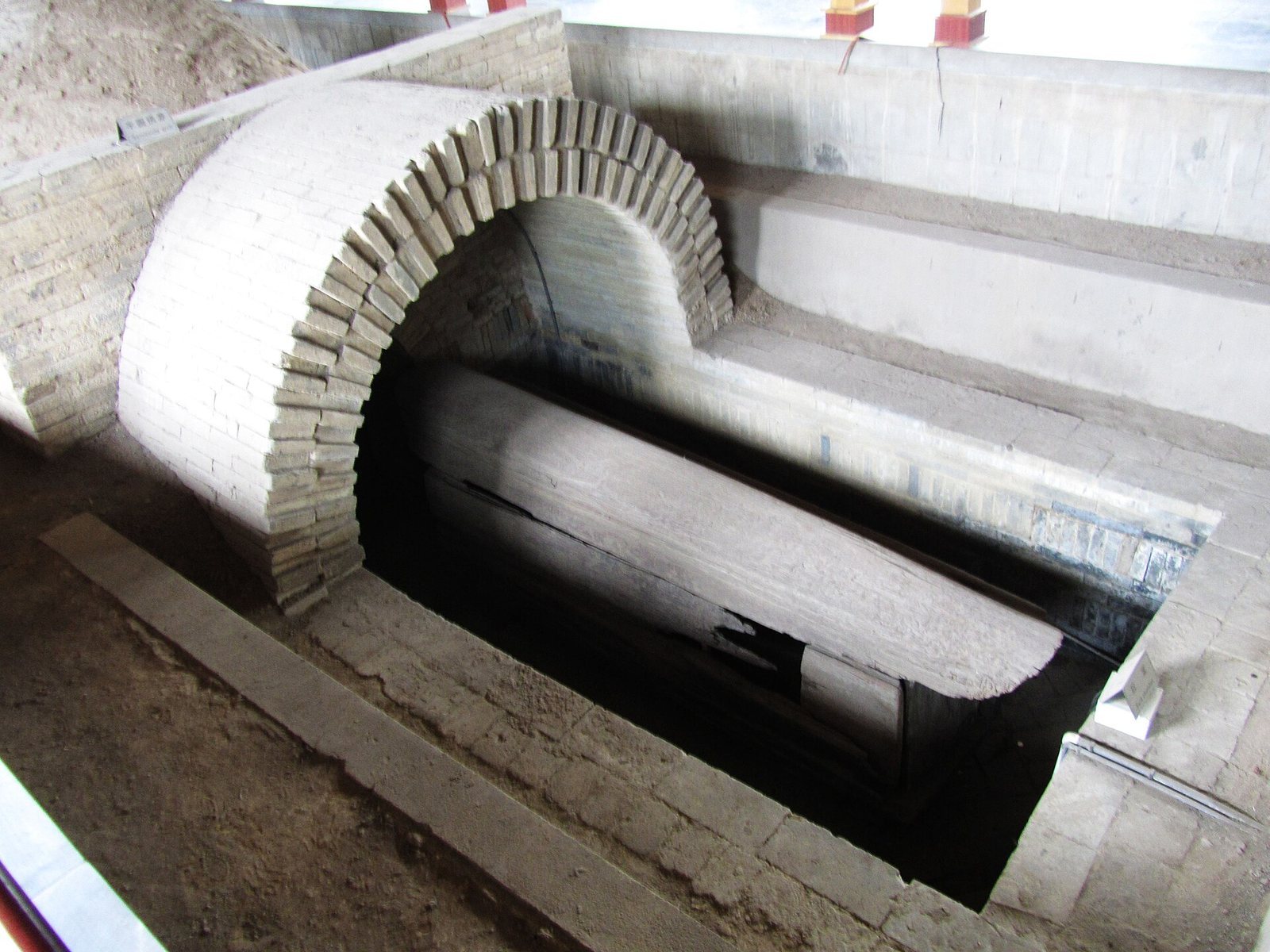
The nearly square front chamber has a domed ceiling formed by arches rising from its four corners and meeting overhead. A lacquer coffin for an accompanying burial stood inside, while two-tier brick altars ran along the chamber’s rear side walls. The rectangular rear chamber has a double-layered barrel vault, a continuous arched ceiling built with two layers of brickwork. It held Zhu Ran’s lacquer coffin.
Brickwork and floor
The bricks are laid in a repeating pattern of three showing their long faces for each one showing its short end. Moulded inscriptions in seal script, an early formal Chinese writing style, include wishes for wealth and noble status lasting ten thousand generations, as well as shorter versions. The floor consists of two brick layers, mostly arranged in a herringbone pattern.
Other cemetery burials
One of the nearby brick-chamber tombs lies more than 30 metres southwest of Zhu Ran’s. A stone door is set within its blocking wall. The other nearby chambers are heavily damaged.
Excavated objects
More than 140 objects were recovered from the family cemetery, chiefly from rear chambers and passages. They include ceramics and pottery, bronze, lacquerware, bamboo and wooden objects, and jade. Some are held at the Ma’anshan City Museum.
Lacquered wooden objects
Lacquered wooden pieces make up more than half of the excavated finds. The varied collection includes trays, tables, cosmetic boxes, spoons, ladles, bowls, and wooden clogs, many painted with designs. Inscriptions on the backs of some objects say “made in Shu Commandery,” linking them to the Chengdu region. The objects provide evidence for painting in the Three Kingdoms period, particularly in Wu and Shu.
Painted scenes
The painted subjects range from historical stories and everyday activities to auspicious images, plants and animals, immortals, and religious beliefs. Historical narratives and daily scenes predominate. Their economical but vivid treatment reflects a move away from the rougher manner associated with Han-period painting toward greater refinement and realism in the Three Kingdoms period. One tray depicts Jizha, a prince of Wu during the Spring and Autumn period, making an offering at the tomb of Xu Jun, ruler of Xu, and hanging his sword on a cypress there. Its figures have elevated status and composed expressions. Another tray shows two children facing one another with sticks in an open area below a mountain, their sturdy poses conveying a lively game. Other notable pieces include a tray showing aristocratic life and a table depicting palace women at a banquet with music. The wooden clogs, the two trays, and a leather-bodied ear cup with rhinoceros-hide-pattern lacquer and gilt-bronze buckles are among the objects prohibited from being taken abroad for exhibition.
Celadon objects
Representative ceramic finds include a celadon sheep, a celadon vessel of the you type, and celadon tomb guardians. Celadon is glazed ceramic with a green or blue-green finish, and the examples have clear glazes and finely made forms. Their presence has been interpreted as evidence that celadon was becoming more common in social life and beginning to displace lacquerware and pottery.
Coins
About 6,000 coins were scattered across the chamber paving and inside the coffins. They include Han-dynasty half-liang and wuzhu coins; daquan wushi, huoquan, and buquan coins associated with Wang Mang, ruler of the short-lived Xin dynasty between the Western and Eastern Han; Eastern Wu daquan wubai and daquan dangqian; and Shu zhibai wuzhu. This range points to currency circulation and exchange between the states, as well as developed trade.
Wooden identification tablets
The tomb yielded 14 wooden calling-card slips and three larger, formal introduction tablets that identify Zhu Ran. All are rectangular, with the formal tablets wider and thicker than the slips. One formal tablet begins with the inked word “introduction” and records Zhu Ran’s name, titles, and respectful presentation. The calling-card inscriptions give his name and courtesy name and include a wish for the recipient’s well-being. Their writing combines clerical script, a formal Chinese writing style, with features of regular script, a more standardized style.
Museum and cultural park
Cemetery museum
The cemetery museum imitates Han-period architecture. Its displays include the chambers of Zhu Ran’s tomb and the tomb attributed to Zhu Ji, along with selected excavated objects. A relief corridor depicting Zhu Ran’s life runs along the museum’s eastern side. The Ma’anshan City Museum also holds a model of Zhu Ran’s tomb.
Zhu Ran Culture Park
Zhu Ran Culture Park lies south of the family cemetery. Its features include a memorial square dedicated to Zhu Ran, a Three Kingdoms culture square, the protected cemetery area, a recreation area, a communal forest, and a Three Kingdoms culture exhibition hall.