Tomb of the Scipios: A Republican Family Tomb in Rome
Site at a Glance
- Popularity
- Very High
- Country
- Italy
- Primary era
- Classical
- Eras represented
- Classical
- Civilizations
- Roman
- Site type
- Burial
- Remains
- Tomb
On this page19 sections
History
The Tomb of the Scipios is a Roman rock-cut family tomb in Rome, Italy. Founded in the early third century BC, probably around 280–270 BC, it was likely established by Lucius Cornelius Scipio Barbatus for his family. Its use across generations and its commemorative inscriptions made it a public record of the Cornelii’s service and achievements.
Foundation and Republican use
Barbatus was a leading member of the Cornelii, a patrician family, and served as consul in 298 BC. His reasons for establishing the tomb are unknown. A burial place intended for several generations could express aristocratic status, and he may have sought to establish a new branch of the family.
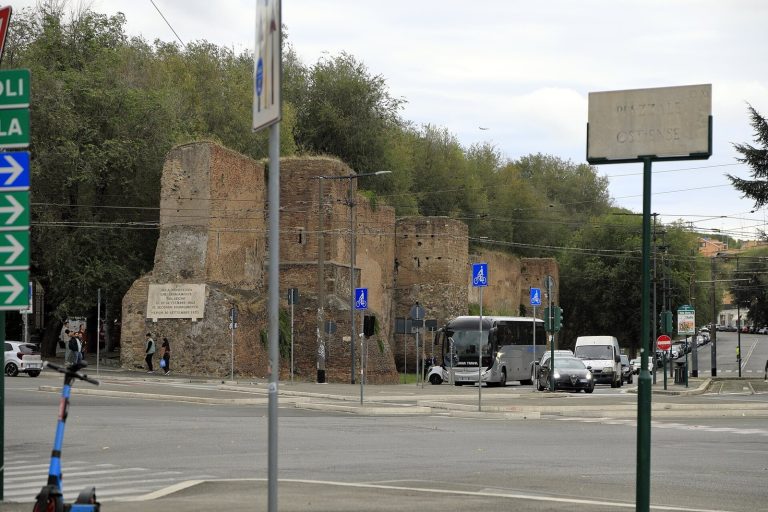
The tomb stood in a cemetery for prominent families near the junction of the Appian and Latin Ways, on a connecting road just beyond their division. It lay about one Roman mile, approximately 1,470–1,490 metres, outside the Servian Wall, an early Roman fortification, and the Porta Capena gate. Roman law, including the Twelve Tables, prohibited burials within the city. Hygiene and the fire risk of funerary rites may also have contributed to the restriction.
The main burial chamber had reached capacity by the middle of the second century BC. A separate chamber was added between about 150 and 135 BC, probably on the initiative of Scipio Aemilianus, a Roman general and statesman. He was buried there first, beside his wife Sempronia. Aemilianus probably also commissioned the monumental façade during the second century BC. It may have presented the family’s history as a public display or asserted its standing amid competition between aristocratic houses.
Inhumation, or burial of the body, was unusual among the Cornelii during the Republic, whose members rarely chose cremation. The first patrician Cornelius known to have been cremated was Sulla, at his state funeral in 78 BC. The family’s preference for burial may help explain the tomb’s provision for several generations. The poet Quintus Ennius, who was not a Scipio, was also buried there. The best-known Scipios, including Scipio Africanus, Scipio Asiaticus, and Scipio Hispanus, were buried at their villa at Liternum, according to Livy and Seneca.
Imperial use and the changing city
Burials continued after the main chamber had filled. During the imperial period, members of the Lentuli, another branch of the Cornelii, were interred in the tomb after inheriting it when the Scipio branch became extinct. They were buried in urns holding cremated remains. The last known burials belong to the Claudian-Neronian period, the reigns of emperors Claudius and Nero, when a daughter and grandson of Gnaeus Cornelius Lentulus Gaetulicus were laid to rest there. Their burial may have asserted a connection to the Scipios. Repairs to the monument continued into the fourth century AD.
As Rome expanded, the tomb shifted from a position beyond the city to one within it. It became part of the Augustan district of Porta Capena, named for the period associated with Rome’s first emperor, Augustus. Around AD 270, the Aurelian Wall enclosed a wider area and brought the tomb within the city’s fortifications. By then, burial use had ended about two centuries earlier. Christian Romans apparently ceased maintaining the monument, and its location was eventually forgotten.
Cicero, Livy, and Suetonius referred to the tomb and placed it within the first Roman mile beyond the Porta Capena. Their writings preserved clues to its location even after it had been lost from public knowledge.
Rediscovery and modern investigation
The tomb was rediscovered in a vineyard in 1614 and opened, but its entrance was apparently concealed again. Two sarcophagi were found, and an inscription belonging to Lucius Cornelius Scipio, Barbatus’s son, was removed and sold. Giacomo Sirmondo published the inscription in 1617; the name elogia Scipionum came to be used for the family’s group of commemorative inscriptions.
In May 1780, the vineyard owners, the Sassi brothers, broke into the tomb while enlarging their wine cellar. The chambers were excavated by 1782, but the work damaged the site. Covering slabs were broken, masonry was added, inscriptions were misplaced or sold, and human remains were removed or discarded. The remains of Barbatus’s son were taken by the Venetian senator Angelo Querini to Villa dell’Altichiero near Padua. Finds were also handed to the Vatican under Pope Pius VI, including a gold signet ring taken from a finger bone attributed to Barbatus.
Francesco Piranesi published an account of the tomb in 1785, completing work begun by his father, Giovanni Battista Piranesi. Their plans and drawings were not always accurate. The rediscovery also inspired Alessandro Verri’s novel Le notti romane al sepolcro de Scipioni, first published in 1792 and expanded in 1804, and a poem by Wilhelm Friedrich Waiblinger, written during his stay in Rome from 1826 to 1829.
Pietro Campana investigated the tomb in 1831 and found the nearby Columbarium of Pomponius Hylas. Rome acquired the site in 1880 on the initiative of archaeologist Rodolfo Amedeo Lanciani. Around 1900, Eugen Petersen recorded the original sarcophagi and inscriptions alongside copies displayed against the walls.
From 1926 to 1929, Rome undertook systematic excavation and restoration, removing masonry added in the seventeenth and eighteenth centuries and attempting to recover the earlier arrangement. Repairs followed in 2008 and 2011.
Remains
The tomb is cut into a ledge of Cappellaccio tuff, a local rock formed from consolidated volcanic material. Its main complex has a nearly square plan measuring about 15 by 17 metres. The underground chambers, rock-cut façade, and later brick-built work form the principal parts of the monument.
Chambers and access
Main burial complex
Four large rock pillars support the ceiling of the principal chamber. Four lengthwise passages cross two transverse passages to create a grid-like plan. The southernmost pillar is associated with the smaller chamber and follows a somewhat different alignment. Sarcophagi were placed around pillars or against the walls, with some accommodated in recesses cut into the rock.
Separate chamber and arcade
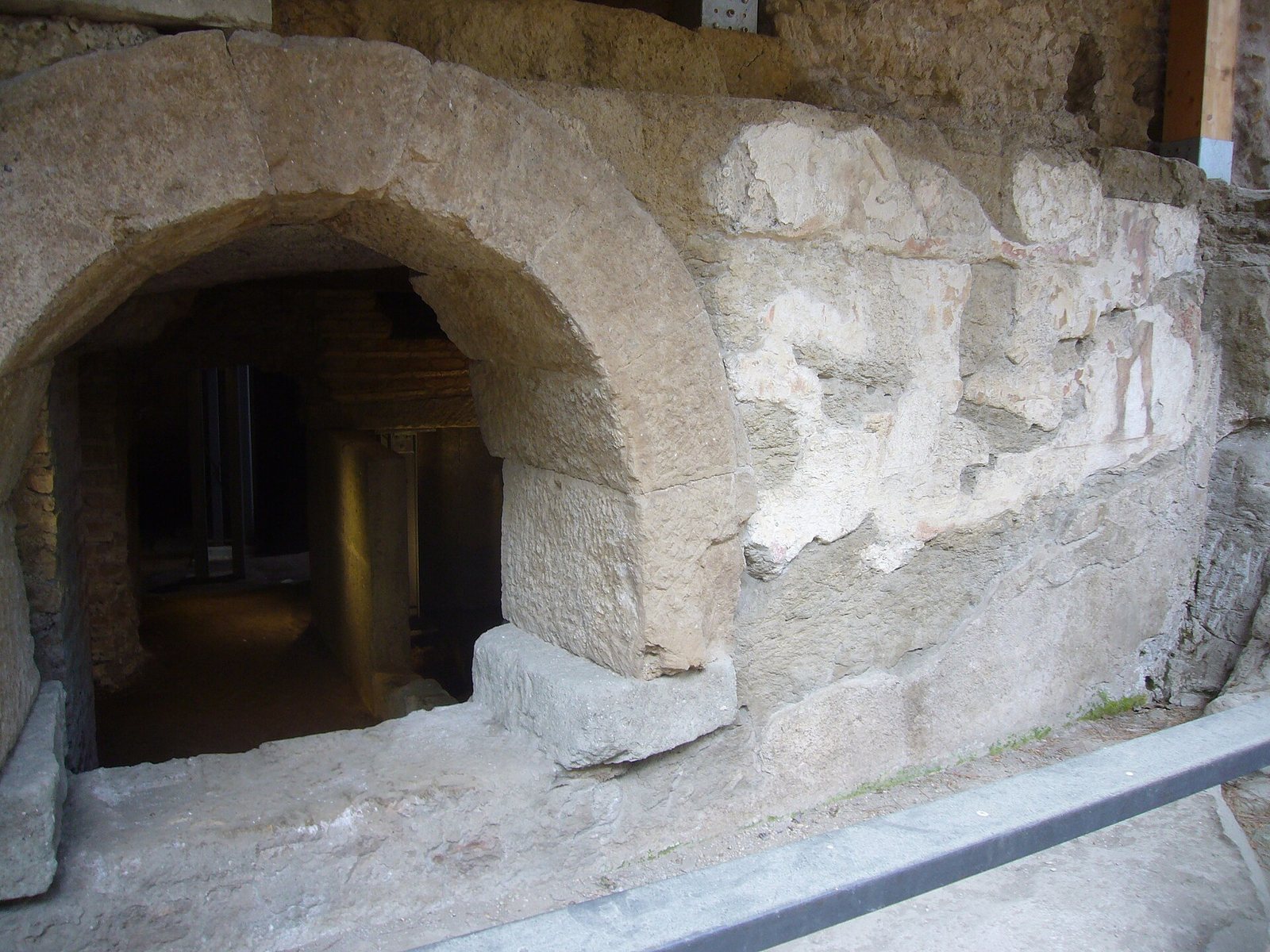
The smaller burial chamber is square and has its own entrance, with no passage connecting it to the main underground complex. A later brick-built arcade with a vaulted roof forms another distinct part of the monument and also has a separate entrance. The present entrance is an arched opening in the hillside rather than the original main entrance. Steel pins or beams support sections considered at risk of collapse.
Monumental façade
The façade faced northeast and was cut into the rock. Its high raised base had three arches made of Aniene tuff. The central arch led to the main chamber, the right-hand arch to the newer burial chamber, and the left-hand arch was blind. Above, three niches were framed by half-columns. Livy associated the niches with statues of Scipio Africanus, his brother Scipio Asiaticus, and Ennius. A small part of the façade’s right end survives, with traces of painted decoration.
The base carried three successive layers of painted decoration. The two earlier layers, dating to around the middle of the second century BC, included historical scenes with recognizable soldiers. A later layer from the first century AD used a simpler red design with stylized wave patterns. Small fragments of these paintings remain.
Burial places and inscriptions
Burial arrangement
The tomb provided about 30 burial places. Two main forms are represented: sarcophagi carved from single blocks of tuff, and constructed burials made with slabs or rock-cut wall recesses. The recesses remain in the tomb, while most original slabs and surviving sarcophagi were transferred to the Vatican collections. Nine sarcophagi from the larger chamber survive wholly or in part.
Barbatus’s sarcophagus and epitaph
The sarcophagus of Lucius Cornelius Scipio Barbatus, dated to about 280–270 BC, is the sole fully intact example and the best-preserved of the Scipio sarcophagi. Carved from tuff, it measures 2.77 metres long, 1.41 metres high, and 1.11 metres wide. It stood opposite the entrance. Its shape draws on a Greek altar form used in the Greek-settled regions of southern Italy. The body narrows downward and carries a band of grooved blocks alternating with panels; a Doric-style band runs along the top. The lid resembles a cushion and ends in scroll-shaped ornaments preceded by acanthus leaves. Some decorative details have been restored.
A short name inscription, painted red, appeared on the lid, while a longer verse epitaph was carved on the sarcophagus. It identifies Barbatus as consul, censor, an official overseeing the census and aspects of public conduct, and aedile, a civic officer. The epitaph praises his courage and wisdom and credits him with taking Taurasia, Cisauna, and Samnium, subduing Lucania, and taking hostages.
The long epitaphs on the sarcophagi of Barbatus and his son are known as the Scipio elogia, or commemorative inscriptions. The father’s text is dated between about 270 and before 150 BC, while the son’s is placed between about 230 and 150 BC. A prevailing reconstruction holds that the son’s inscription came first and that a longer text for his father later replaced a shorter one. Both use Saturnian verse, an early Latin poetic metre, and are among the earliest known Latin verse texts. They connect public office and achievement with the preservation of family reputation. Barbatus’s inscription describes campaigns in Samnium and Lucania, an account that does not align neatly with Livy’s account of a campaign in Etruria or the triumphal record for Barbatus’s consular colleague. The discrepancy remains unresolved.
Sarcophagus of Barbatus’s son
The sarcophagus of Lucius Cornelius Scipio, Barbatus’s son, survives in fragments. A piece of its lid bears his name in red letters, and a fragment of a slab carries his epitaph. The inscription records his consulship in 259 BC and censorship the following year. It credits him with capturing Corsica and Aleria and dedicating a temple to the Tempestates, Roman deities associated with storms.
Other family inscriptions
An inscription for Publius Cornelius Scipio says that he wore the distinctive headgear of the Flamen Dialis, the priest of Jupiter. It laments that his early death prevented his abilities from reaching their potential. He may have been the elder son of Scipio Africanus, whom Cicero described as frail and prematurely deceased.
Another text names Lucius Cornelius Scipio, son of Gnaeus and grandson of Gnaeus, who died at 20. It praises his abilities and virtues despite his lack of public office. He was the brother of Gnaeus Cornelius Scipio Hispanus. A separate inscription concerns Lucius Cornelius Scipio, son of Lucius and grandson of Publius, who died at 33 after serving as quaestor, an officer with financial and other public duties, and military tribune. The inscription says his father defeated King Antiochus; the deceased is probably the second-generation Scipio Asiaticus. An inscription for his son, Cornelius Scipio Asiagenus Comatus, records his death at 16, probably before 160 BC.
The inscription of Gnaeus Cornelius Scipio Hispanus lists service as praetor, a senior magistrate, curule aedile, quaestor, military tribune twice, and member of two decemviral boards, or ten-member panels. One board handled legal disputes concerning status and the other sacred rites. The text presents his career as a defence of his ancestors’ reputation and a means of continuing the family line. It is the only inscription in elegiac couplets, paired longer and shorter verse lines; the others use Saturnian verse.
Paulla Cornelia’s inscription identifies her as the daughter of Gnaeus and wife of Hispallus. Her burial lay behind Barbatus’s sarcophagus. Her coffin had no separate front slab, and its inscribed lid rested directly against the rear wall of his sarcophagus. She was probably the mother of Lucius Cornelius Scipio, who died at 20, and Gnaeus Cornelius Scipio Hispanus.
Lentuli urns
Whole and fragmentary urns held the cremated remains of members of the Lentuli, the Cornelian branch that later used the tomb.
Sculpted head and relocated objects
A sculpted head found in the tomb in 1780 is 24 centimetres high and made of Aniene tuff. Its traditional identification as Ennius is almost certainly incorrect because the statue of Ennius was described as marble. The head’s precise findspot within the tomb is unknown; it may portray another occupant and may have belonged to a reclining figure on a sarcophagus lid. Its rounded face, broad nose, prominent lips, large eyelids, lightly rendered hair, and laurel wreath are probably features of a work from the late second century BC. The head is now in the Vatican Museums.
Original sarcophagi and inscriptions from the tomb are held in the Vatican collections, while copies were installed in the monument during the twentieth-century restoration. Barbatus’s inscription was reunited with his sarcophagus, and fragments of other sarcophagi and inscriptions were also transferred. Some of these objects were displayed in the Pio-Clementino Museum in 1912.
Other archaeological remains in the grounds
Additional burial structures
The grounds include the Columbarium of Pomponius Hylas, a burial structure with niches for urns, as well as a small catacomb and additional graves.
Third-century residence
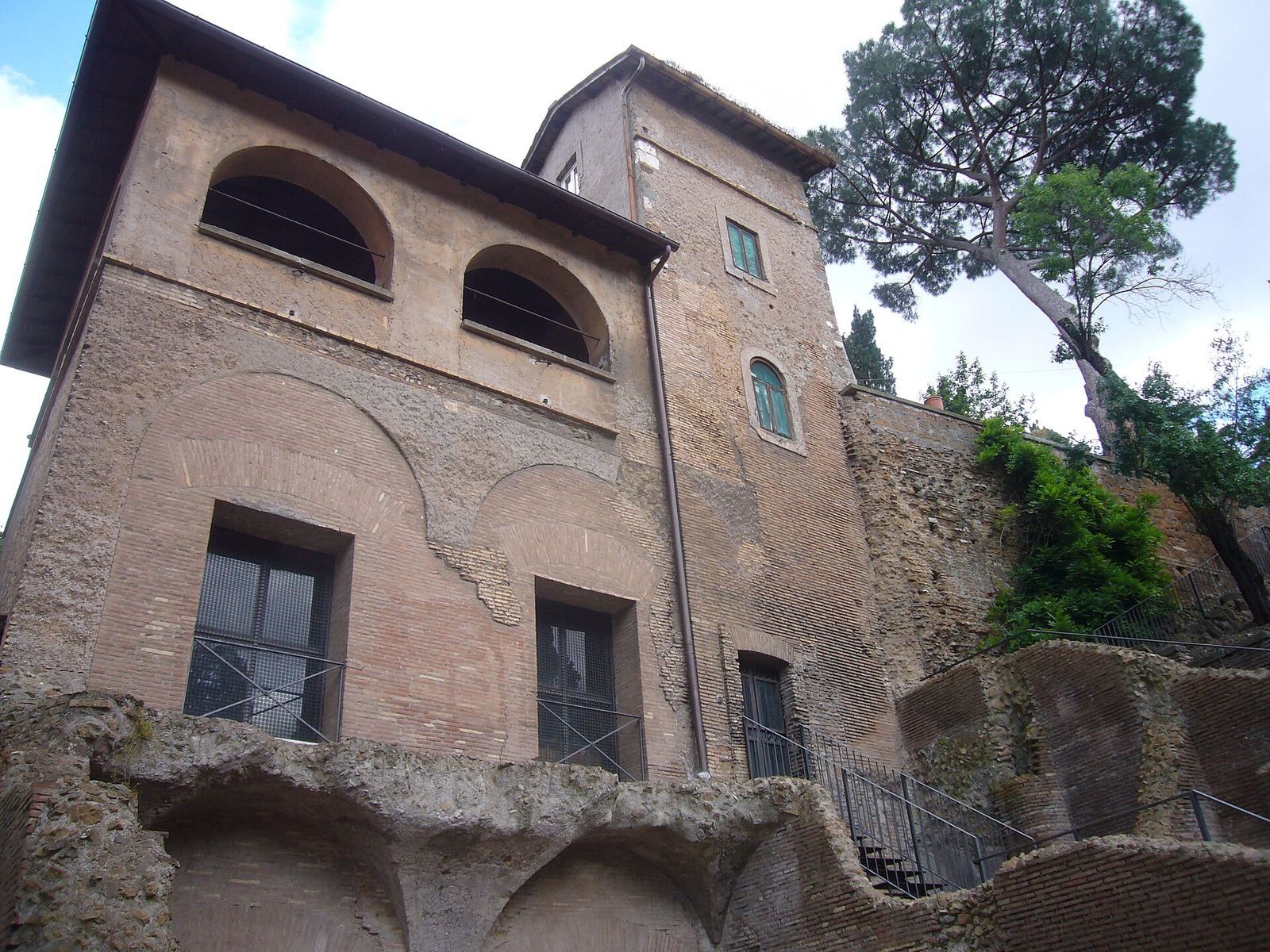
The remains of a multistorey residential building from the third century AD lie above the tomb. Its construction damaged the burial monument.