Tomb of the Bulls: An Etruscan Burial Tomb near Tarquinia
Site at a Glance
- Rating
- 4.6
- Popularity
- Low
- Country
- Italy
- Primary era
- Iron Age
- Eras represented
- Iron Age
- Civilizations
- Etruscan
- Site type
- Burial
- Remains
- Tomb
On this page7 sections
History
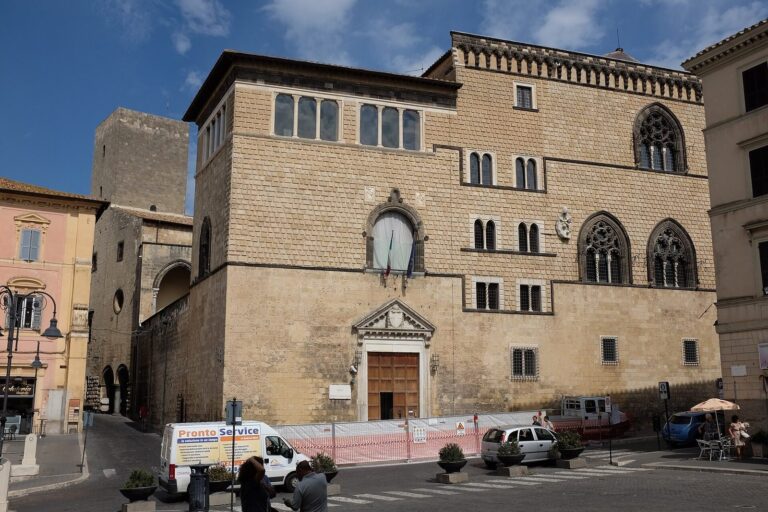
The Tomb of the Bulls is an Etruscan burial tomb at the eastern end of the Monterozzi cemetery near Tarquinia, Italy. Its builders were the Etruscans, an ancient people of central Italy whose culture flourished before Roman rule. The tomb dates to about 530 BC, within the Etruscan Archaic period, an early phase of Etruscan and Greek art and history; proposed date ranges are 540–530 or 530–520 BC. It is the cemetery’s earliest tomb with complex frescoes, and its explicit sexual imagery is rare in Etruscan art, where such scenes were less common than in ancient Greek art.
Discovered in 1892, the tomb bears an inscription that names Arath Spuriana as its owner and appears to credit him with commissioning its construction. Its painter has been associated with the Pontic group of vase painters, artists linked to Vulci and active from the mid-sixth century BC. The tomb’s images and decorative details share features with that group.
The decoration belongs between the middle and later phases of the Etruscan Archaic period. Its emphasis on painting the triangular fields beneath the roofline recalls the Tomb of the Panthers. The Tomb of the Bulls predates later Tarquinian painting represented by the Tomb of the Augurs and the Tomb of the Lionesses, while sharing Greek stylistic elements associated with Ionia with the latter. Like other Etruscan tombs, it probably once held numerous grave goods, particularly Etruscan pottery; those objects have since been removed.
Remains
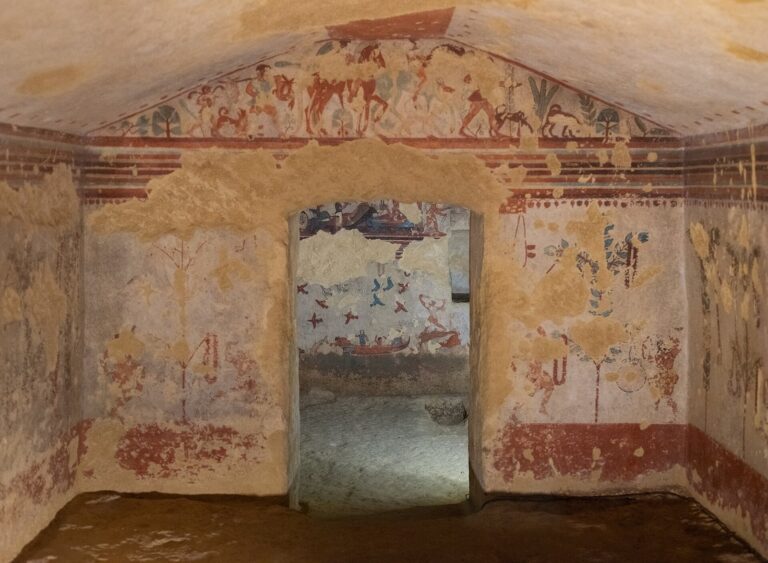
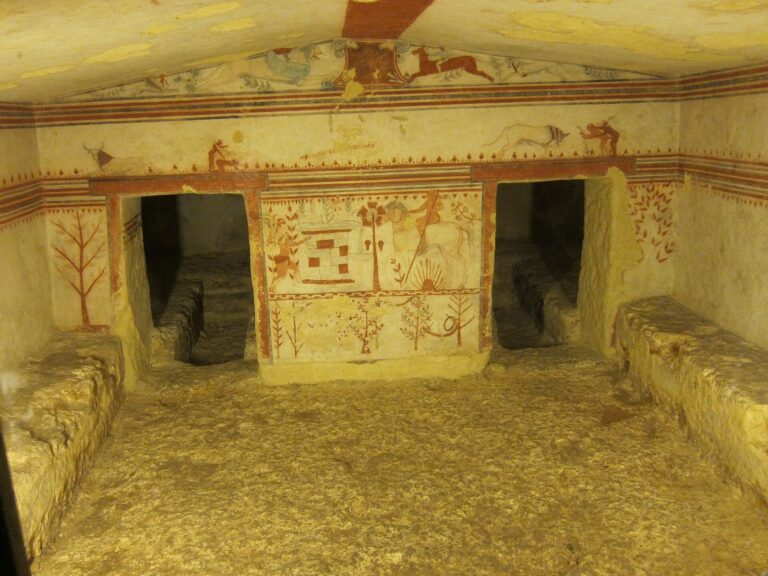
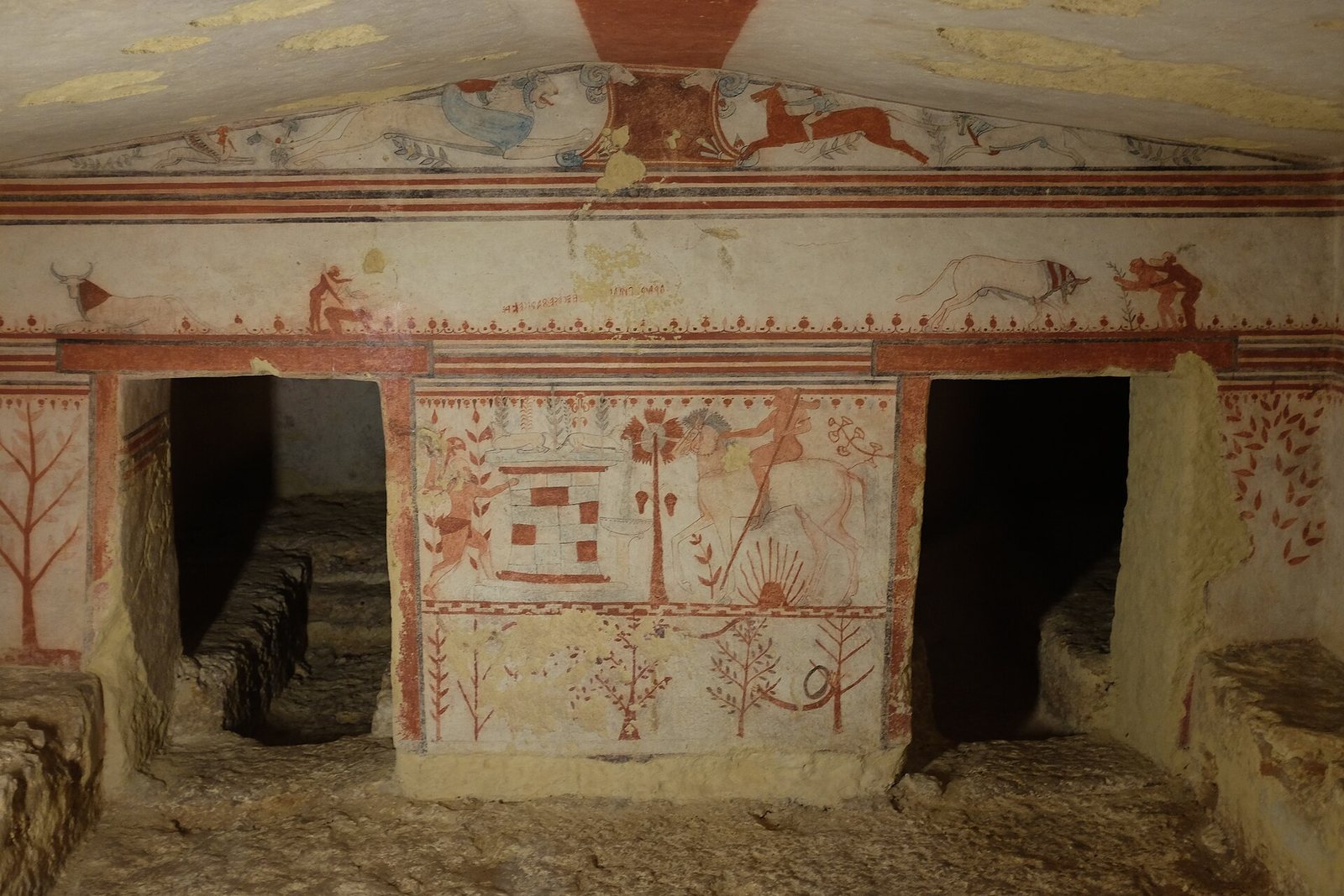
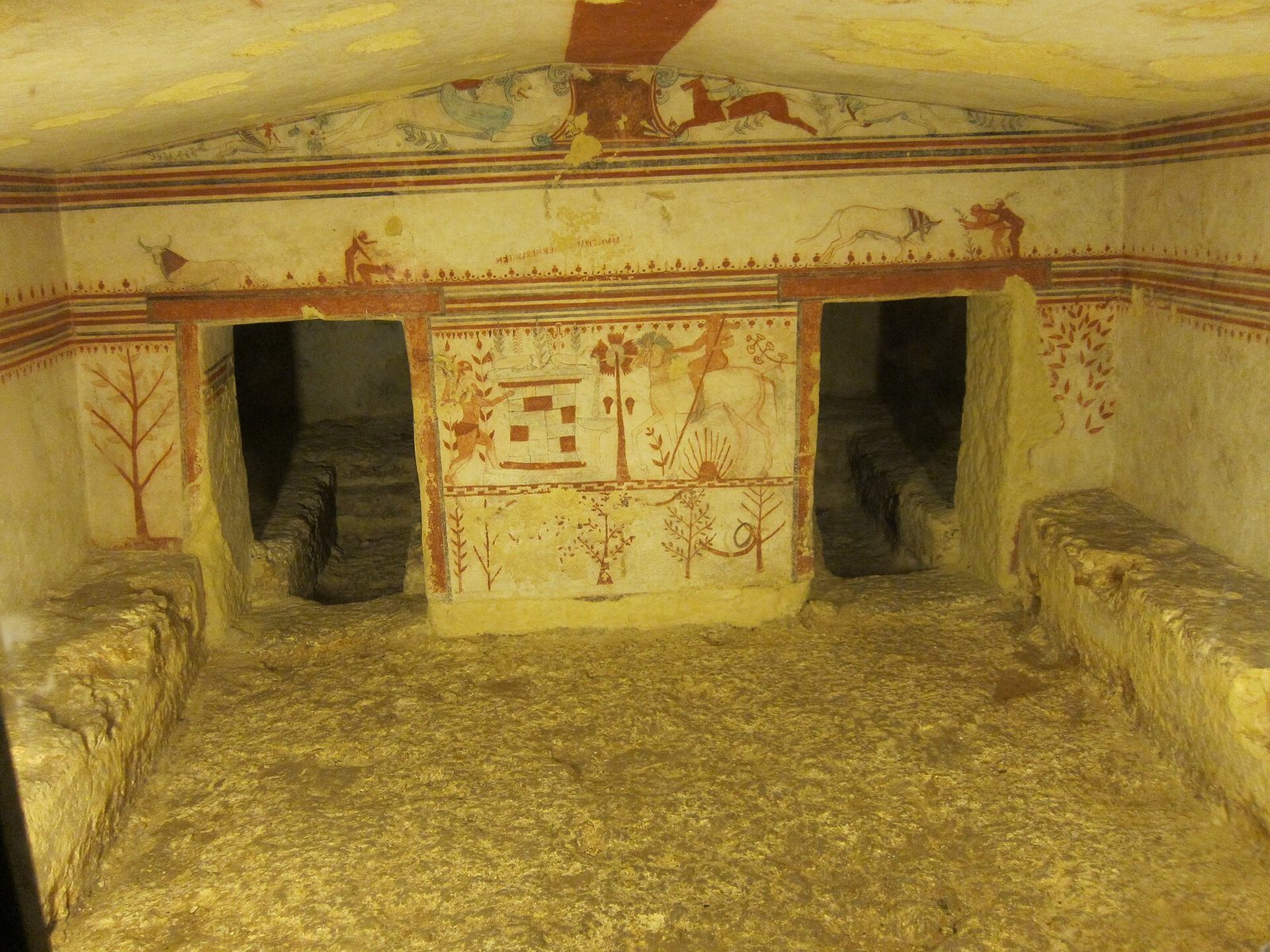
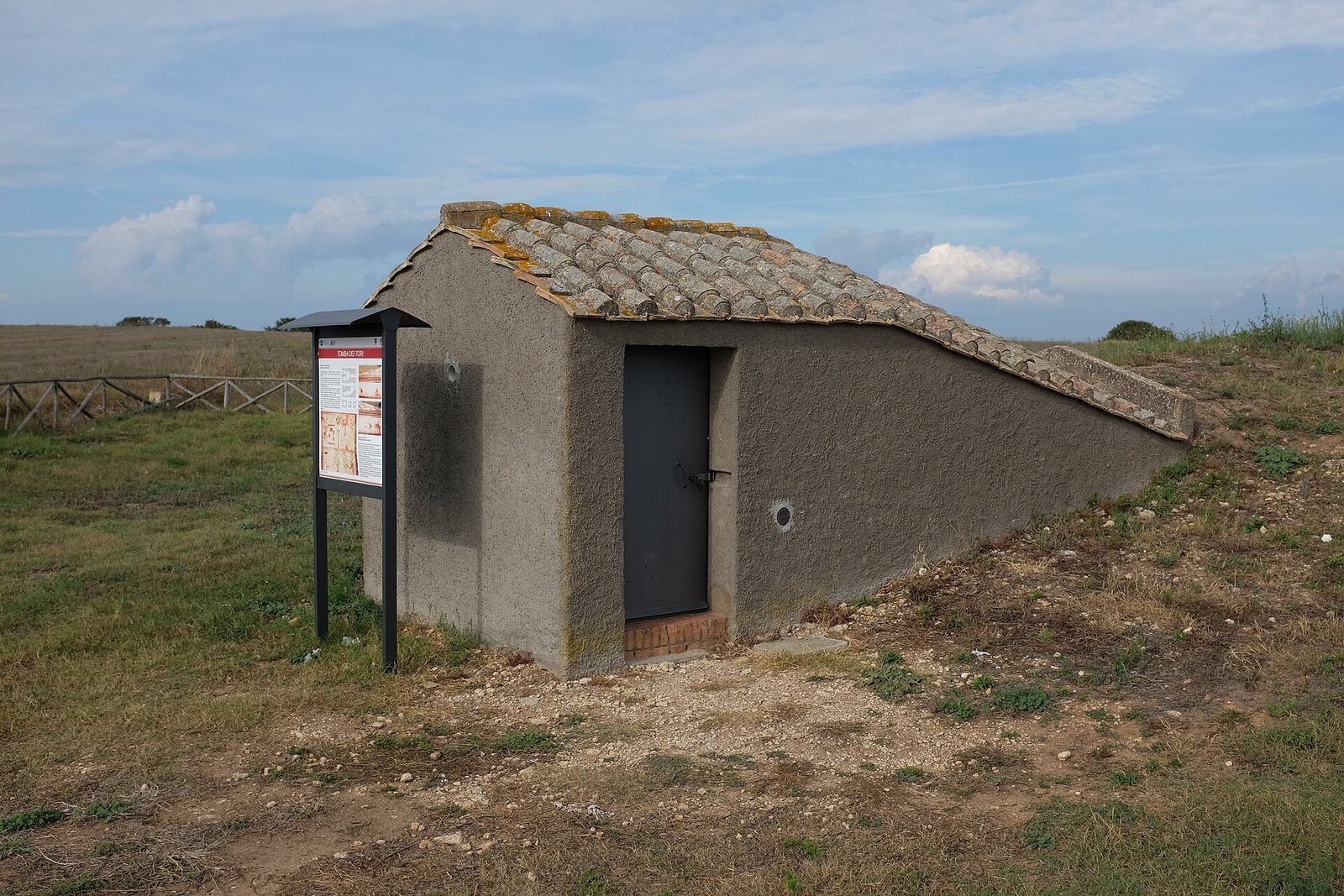
Cut into local macco, a type of limestone, the tomb has a stepped entrance passage leading into a broad main chamber. Two parallel openings in the rear wall connect this chamber to smaller burial rooms, each with benches along its sides for placing the dead. The painted surfaces extend across the main chamber’s rear wall and the gables, the triangular upper sections beneath the ceilings, of the smaller rooms.
Painted decoration
Painting technique
The walls were smoothed and coated with pale clay. Impressions made with cord marked out divisions in fresh lime, and the painter incised the preparatory drawing, making few corrections and following an existing model. Some incised lines were traced again in red or black. The pigments included red ochre, vegetable black, Egyptian blue and malachite for blue-green; painters sometimes mixed them with one another or with white. Work proceeded from the upper parts downward, with decorative bands added last. In some places a band ends at a figure, and parts of the initial drawing were altered or left unused.
Main chamber rear wall
Facing the entrance, the rear wall is the main chamber’s only wall painted below its gable. The upper triangular field shows a rider at the right facing a Chimera, a composite monster, on the left. The rider has been identified either as Bellerophon, the hero associated with the Chimera, or as Troilus. Supporters of the Troilus reading point to his Phrygian cap, a soft cap associated with ancient Phrygia, and his large knot of hair. They interpret his ride as a journey to the underworld after a sacrificial death, paralleling the tomb owner’s passage after death.
Below the upper field, two erotic scenes sit above the chamber doorways, with a horizontal band showing the two bulls that give the tomb its name. In the left scene, a woman lies on her back as a man kneels facing her and another man has intercourse with her from behind; a calm bull stands farther left. In the right scene, two men have intercourse as a bearded bull with a human head and phallus charges from the left. One man looks toward the bull while his partner holds him and faces away. A painted inscription occupies the centre of the horizontal stone member above the openings.
The scenes have been read as connected to the Troilus story, as humorous or life-affirming images, or as protective pictures intended to ward off the evil eye. Another interpretation identifies the bulls as the sacred animals of Helios, the personification of the sun, with one watchful and the other angered by a reenactment of sacrilege at the sanctuary of Apollo, a Greek god. A different reading identifies the human-headed bull as Achelous, a Greek river deity, and treats the horns and phallus as protective signs. The figures have also been understood as separate, non-narrative groups placed over the doors for protection. Some readings link the erotic scenes to later versions of the Troilus story in which Achilles desires him. In those versions Troilus dies after a violent assault or after rejecting Achilles. This connection has been questioned because the Roman commentator Servius lived centuries after the paintings, and because one of the tomb’s scenes depicts a woman and men rather than Achilles and Troilus.
Achilles ambushing Troilus
A horizontal fresco between the doorways depicts Achilles waiting to ambush Troilus beside a large, monumental fountain. Achilles hides among plants on the left, armed and wearing a helmet, lower-leg armor and a loincloth. Troilus approaches on horseback from the right, unaware of him. In the Trojan myth cycle, this episode comes before Achilles pursues and kills Troilus at an altar to Apollo. It is the only mythological scene identified in the Archaic tombs of Tarquinia.
A central tree divides the composition into two panels. Beneath the scene are nine small trees decorated with ribbons and garlands; their differing sizes and foliage have been interpreted as references to the changing seasons. The drawing’s apparent simplification and the rider’s larger scale have been read as shifting attention from the action to Troilus in his final moments. The figures have a distinctly Etruscan drawing style, and the fountain’s unusual form may also reflect a local design.
Interpretations of the ambush differ. One reading sees the fresco as an Etruscan adaptation of Greek mythology and argues that its painter knew the myth itself, not only images of it. Another treats Troilus’s death as a sacrifice meant to honor and appease the dead, noting that Achilles carries a single-edged sacrificial knife rather than a double-edged sword. The violent death of a young figure has also been connected with protective imagery. Plants near Achilles, including growth between the horse’s forelegs and above its tail, appear in other Archaic Etruscan tomb paintings, sometimes with dark-blue berries. They may suggest rebirth or transformation associated with the underworld.
Under Troilus’s horse is a dark-red semicircle with ten thin rays. It has been interpreted as a setting sun marking his death, in contrast to a rising sun as an image of rebirth, or instead as an unidentified or poorly drawn plant. The sunset reading has been challenged because Etruscan sun gods appear in human form. The Troilus interpretation of the rider above the ambush also connects the scene to the deceased’s journey after death.
Burial-room gables and animal figures
The two smaller chambers have ceilings with two sloping sides and six gables decorated with animals or heraldic figures. Their painted creatures include felines and hippocampi, mythological beings with a horse’s upper body and a fish’s tail, as well as bulls, birds, a panther, a lion and a goat. The animal imagery has been understood as protective. One gable includes a third bull to the right of a painted bracket that appears to support the ridge beam. Further bulls appear in the entrance gable of the left-hand chamber. On the opposing gable, a young rider on a hippocampus travels toward an island; this rider, too, has been interpreted in connection with the deceased’s journey to the underworld.