Primož Trubar Evangelical Church: A Lutheran Church in Ljubljana
Site at a Glance
- Rating
- 4.7
- Popularity
- Low
- Country
- Slovenia
- Primary era
- Modern
- Eras represented
- Modern
- Civilizations
- Austria-Hungary, Austrian Empire, Habsburg
- Site type
- Religious
- Remains
- Church
On this page10 sections
History
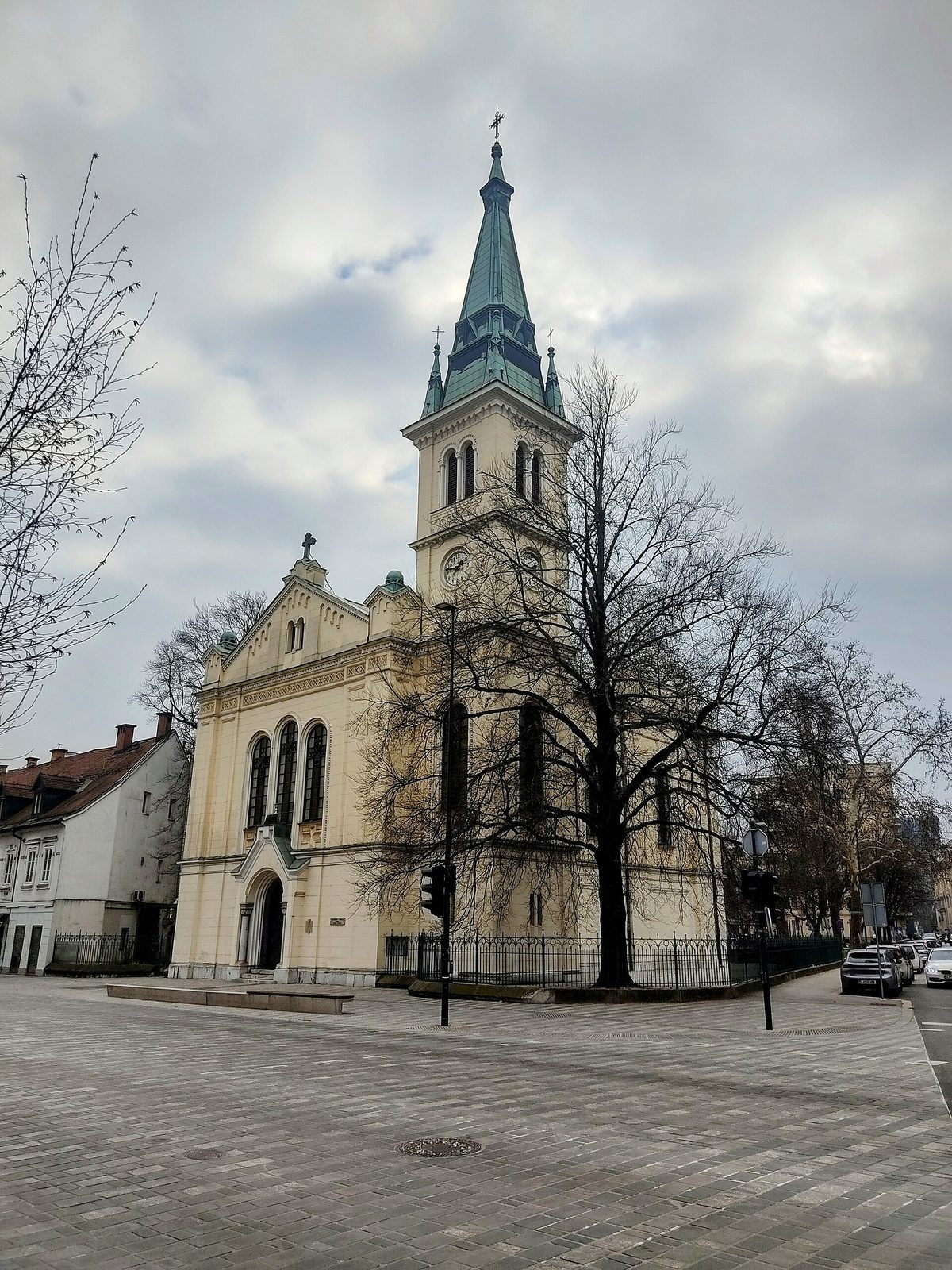
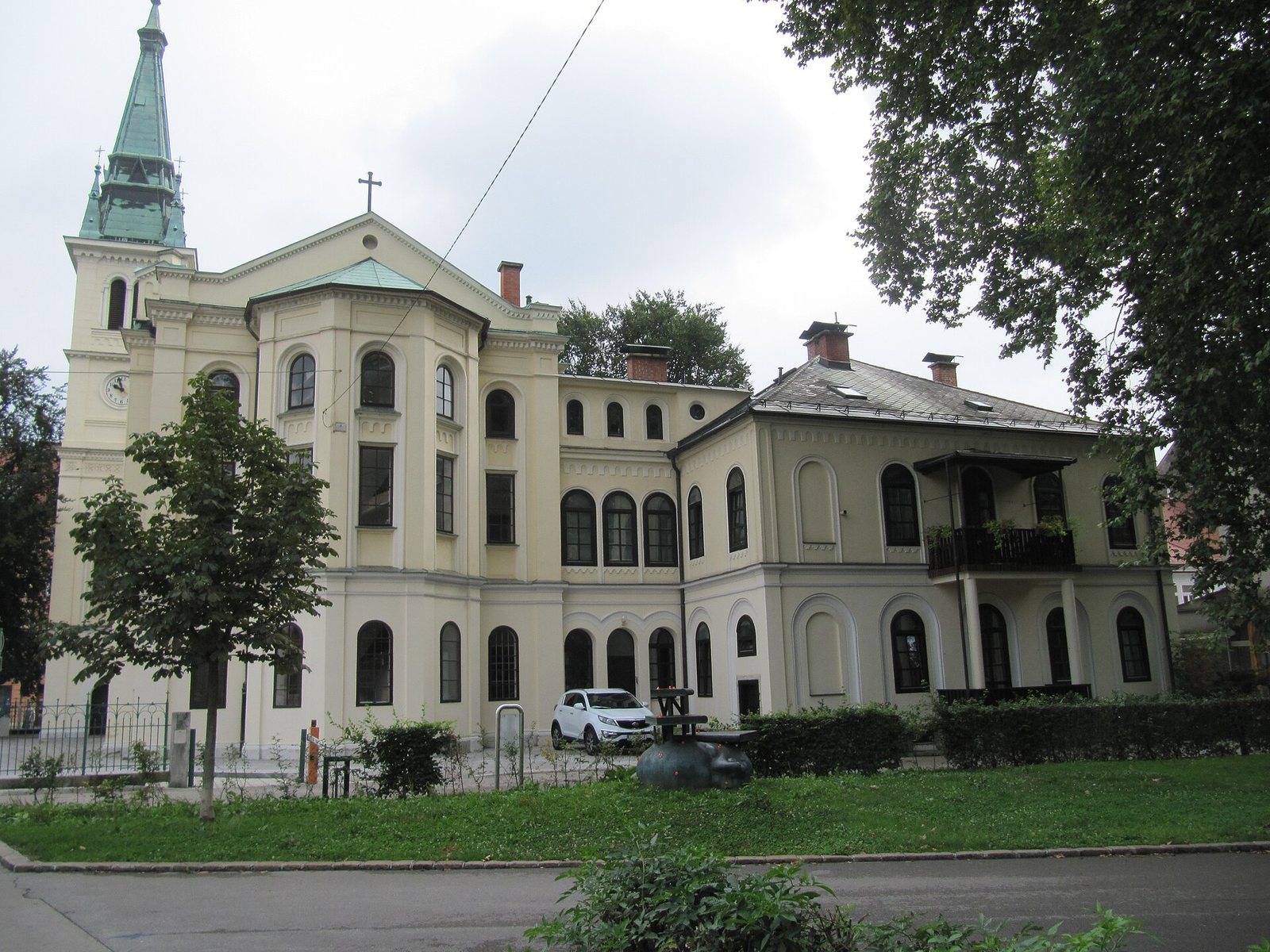
Primož Trubar Evangelical Church is a Lutheran church in Ljubljana, Slovenia, and the city’s only church building belonging to the Evangelical Church of the Augsburg Confession, a tradition based on a 1530 statement of Lutheran belief. Built in 1851 in Neo-Romanesque style, a nineteenth-century revival of forms associated with medieval Romanesque buildings, it gave a renewed Evangelical congregation a permanent place of worship.
Reformation roots and renewed worship
Ljubljana’s Evangelical community looked back to the Reformation and the work of Slovene reformers Primož Trubar and Jurij Dalmatin. Trubar’s Slovene catechism appeared in 1550, and Dalmatin’s Slovene Bible translation followed in 1584. Protestantism had gained influence among Carniola’s nobles and townspeople, but the Counter-Reformation, the Catholic effort to restore its authority and suppress Protestant movements, brought its decline. By the eighteenth century, no Protestants remained in Ljubljana. Joseph II’s 1781 Toleration Patent broadened legal provision for religious practice.
Protestants, including German-speaking merchants and military personnel, began moving to Ljubljana in the early nineteenth century. Pastor L. E. Blume held services in private homes in 1818, but the authorities prevented regular public worship. When Pastor Wolf was barred from conducting a Protestant funeral for Swiss coffeehouse owner A. Capretz, an Evangelical service took place in the Teutonic Order’s hall. It was Ljubljana’s first public Protestant service in more than two centuries. Authorities suppressed public services again, and the community continued to gather privately, including at merchant Gustav Heimann’s home.
Congregation and church, 1848–1895
In 1848 the Evangelical Church in Austria gained equal standing and the right to build churches with portals and bell towers. Heimann acquired land for the Ljubljana congregation in 1849 on the road now called Gosposvetska cesta. About 200 Protestants who had belonged to the Trieste congregation received permission to form their own congregation on 8 October 1850 and established it later that month at the Virant house. Permission to build the church had been granted on 10 August, and architect Gustav Lahn was commissioned to design it.
The church was completed on 25 September 1851. During the cleanup, a worker fell from the scaffolding and died. By the end of the year the congregation had 332 members, and the Protestant aid organization Gustav-Adolf-Werk contributed the largest share of the building costs. The church was consecrated on 6 January 1852 as Christ Church. On that day Ludwig Theodor Elze, elected pastor in April 1851, was installed. The service drew such a crowd that many people stood outside in the cold.
Work on a rectory and school as an extension to the church began in 1853. The school opened in 1855, with August Mebus as its first teacher. The congregation acquired land at Navje in 1856 and opened an Evangelical cemetery there in April 1857. Elze wrote about Slovene Protestant literature and its authors, and examined the influence of the University of Tübingen on them. Following a dispute with Heimann, he resigned on 19 February 1865.
Friedrich Otto Schack served as pastor from December 1866 until he left for Vienna in 1880. His successor, August Knieszer, resigned in 1892 over irregularities in office. The school had closed in 1890 during Knieszer’s tenure. Hans Jaquemar became pastor in 1892. After the 1895 Ljubljana earthquake damaged the church, he raised money in Germany for repairs and enlargement.
Expansion and disruption, 1895–1945
An Evangelical kindergarten opened on 31 March 1901, the same year a separate congregation was founded in Celje. Jaquemar left Ljubljana for St. Pölten in 1902, and Ottmar Hegemann became pastor in 1906. A clock was added to the bell tower in 1907.
During the First World War, the bells were requisitioned for military use in 1916. Hegemann served at the front as a military chaplain and died there in September 1917. Erwin Schneider became pastor in September 1918. The establishment of the Kingdom of Serbs, Croats and Slovenes brought a severe crisis for the congregation. An influenza epidemic forced the kindergarten to close in 1918, and 35 Evangelical families left the country in 1919. Schneider was transferred to Zagreb. Anton Chraska led services in Slovene in 1919, although German remained the congregation’s main language until 1945. Of its associations, only the Ljubljana Evangelical Women’s Association continued through that year.
Confiscation, restitution, and renaming
Socialist authorities confiscated the church and rectory under an AVNOJ decree dated 21 November 1944. AVNOJ, the Anti-Fascist Council for the National Liberation of Yugoslavia, was a wartime political body whose decisions formed a basis for postwar measures. The authorities regarded the congregation as an institution of the German minority. The church became a carpentry workshop producing scenery for the Ljubljana Drama, while tenants moved into the rectory.
The church remained state-owned even after Evangelicals were again permitted to worship there in 1953. Services were initially irregular; from 1976, pastors from congregations in Prekmurje held them regularly on Sundays and holidays. Migration from that region helped the Evangelical population in Ljubljana grow again. Geza Filo was sent to the congregation as pastor in 1985 and formally installed in 1989. In 1988 the congregation rented an office and hall in the nationalized rectory. The church and rectory were returned through restitution on 11 August 1992 and renovated by 1997. In 1999 the church was renamed in honor of Primož Trubar.
Remains
Exterior and church complex
The church stands at the southwest corner of Gosposvetska cesta and Župančičeva ulica, with the Park of the Slovenian Reformation behind it. Its rectangular plan has a basilica form and Neo-Romanesque detailing. A square bell tower stands beside the nave, the main body of the church. The original tower was small; a larger tower with three bells was completed in 1897. The tower received a clock in 1907. A small domed structure on the roof held documents about the Evangelical congregation’s establishment. The wider church complex also included the rectory and school.
Interior
Pulpit and painting
A wooden pulpit stands at the center of the interior, with stairs approaching it from both sides. Behind it hangs an oil painting by Pavel Künl dated 1852. It depicts Jesus with the Samaritan woman at Jacob’s Well; the woman’s facial features resemble those of one of Gustav Heimann’s daughters. The painting survived the church’s postwar conversion to a workshop.
Organ
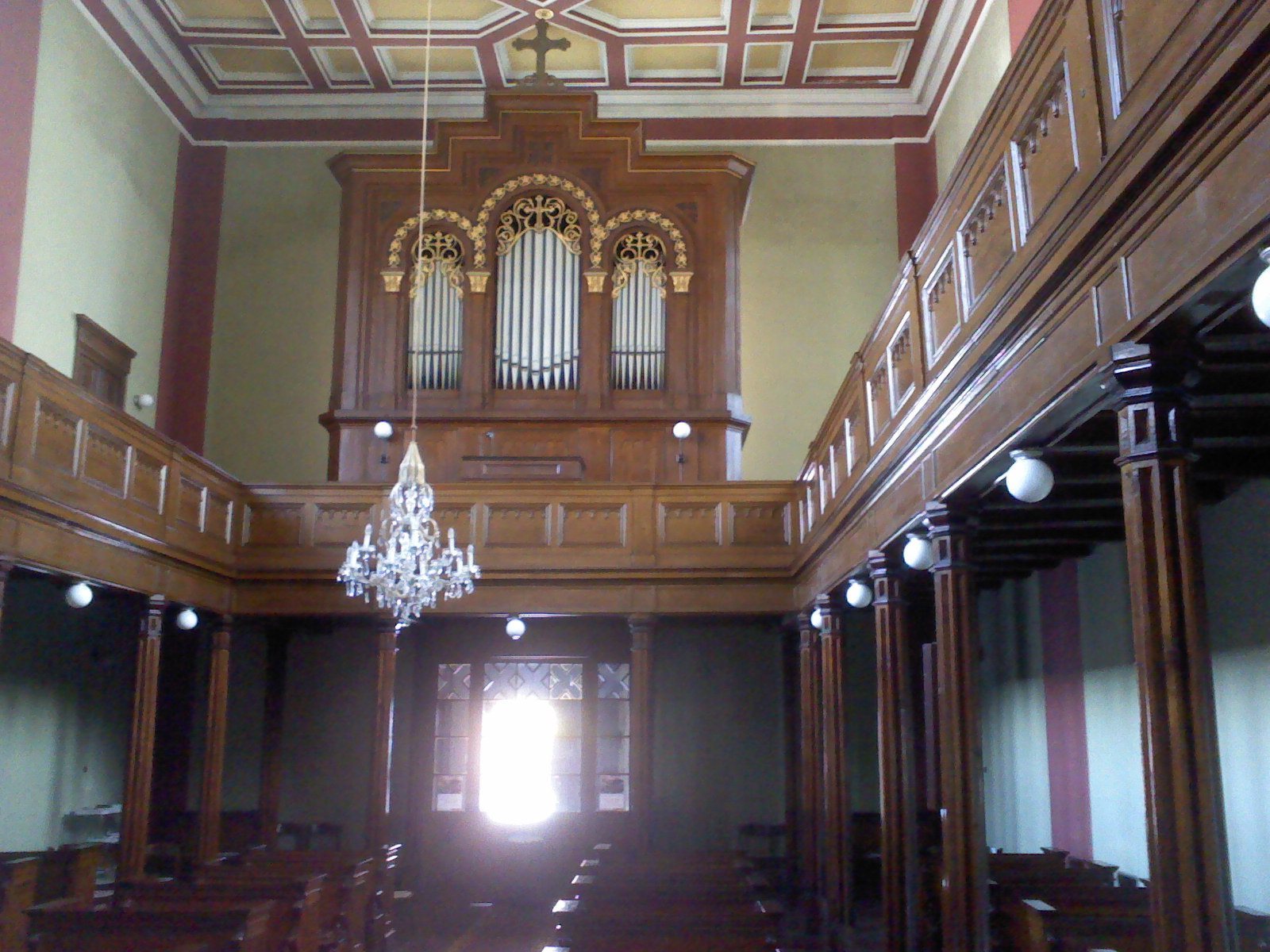
France Goršič made the organ in 1888. It has 12 stops, controls that select sets of pipes, and two keyboards. The organ also survived the postwar conversion.