Timangarh Fort: A Jadaun Rajput Stronghold in Rajasthan, India
Site at a Glance
- Rating
- 4.4
- Popularity
- Very Low
- Country
- India
- Primary era
- Medieval
- Eras represented
- Medieval, Early Modern
- Civilizations
- Mughal, Rajput
- Site type
- Military
- Remains
- Fort
On this page11 sections
History
Timangarh Fort is a ruined medieval fort in Rajasthan, India, commissioned by Tahanpal, a ruler of the Jadaun Rajputs and the associated Shoorsainis, probably during his reign from 1093 to 1140. The fort was also known as Tribhuvangiri, Tahangarh, and Tawangarh. Tahanpal, whose names included Tribhuvanpala and Tawanpal, belonged to a lineage that claimed descent from the legendary king Yadu. Timangarh later became a major religious, intellectual, military, and administrative center in northern India.
Jadaun Rajput Foundations
Tahanpal’s father, Vijayapal, moved from Mathura to the Mani Hills near Bayana after repeated invasions, including campaigns associated with Mahmud of Ghazni, the eleventh-century ruler of the Ghaznavid Empire. Vijayapal ruled from Vijayagarh, a fort he had repaired, and was killed in a conflict with the Ghaznavids. His successors subsequently made Timangarh their seat of power.
During the twelfth century, Timangarh became an important center of Shaivism, the Hindu tradition devoted to Shiva, especially the Pashupata sect, an early Shaiva movement associated with ascetic practice and devotion to Shiva. Jain texts also describe the settlement as a prosperous center of learning and temples.
Ghurid Conquest and Later Rule
One of Tahanpal’s successors, Kumarapal, also called Kunwarpal, lost the fort to Muhammad of Ghor, a twelfth-century Ghurid ruler whose conquests helped establish Muslim rule in northern India. The Tajul-Ma’asir by Hasan Nizami and the Tabaqat-i Nasiri by Minhaj-i Siraj Juzjani state that Muhammad spared Kumarapal and appointed Bahauddin Tughril to administer the fort. Kumarapal’s successors became subordinate rulers rather than independent monarchs, and the Jadon rulers of Karauli State later claimed descent from them.
Timangarh continued to serve as a military outpost and administrative center under the Delhi Sultanate, the succession of Muslim-ruled dynasties that governed much of northern India, and later under the Mughal Empire. Additional gates were built during the Mughal period, adding to the fort’s earlier entrances.
Losses and Archaeological Surveys
Local tradition holds that idols from different places were brought to Timangarh and buried to protect them from desecration during attacks by Muslim invaders. After Indian independence in 1947, illegal excavators, including members of former royal families, removed and smuggled many ancient idols. In 1985, smugglers used helicopters, with assistance from local residents, to take several artifacts from the site.
Alexander Cunningham, founder of the Archaeological Survey of India, surveyed the fort in 1882 and 1883. Vinod Kumar Singh of the Indian History Congress conducted further surveys in 1993 and 1998, recording four Sanskrit inscriptions and several ruined structures that Cunningham had not listed. Singh could not locate two Persian inscriptions or a mosque previously recorded by Cunningham. Approximately 50 temples, including 10 large temples, have been destroyed and excavated by local villagers. The Archaeological Survey of India and the state and central governments of India have taken no preservation measures.
Remains
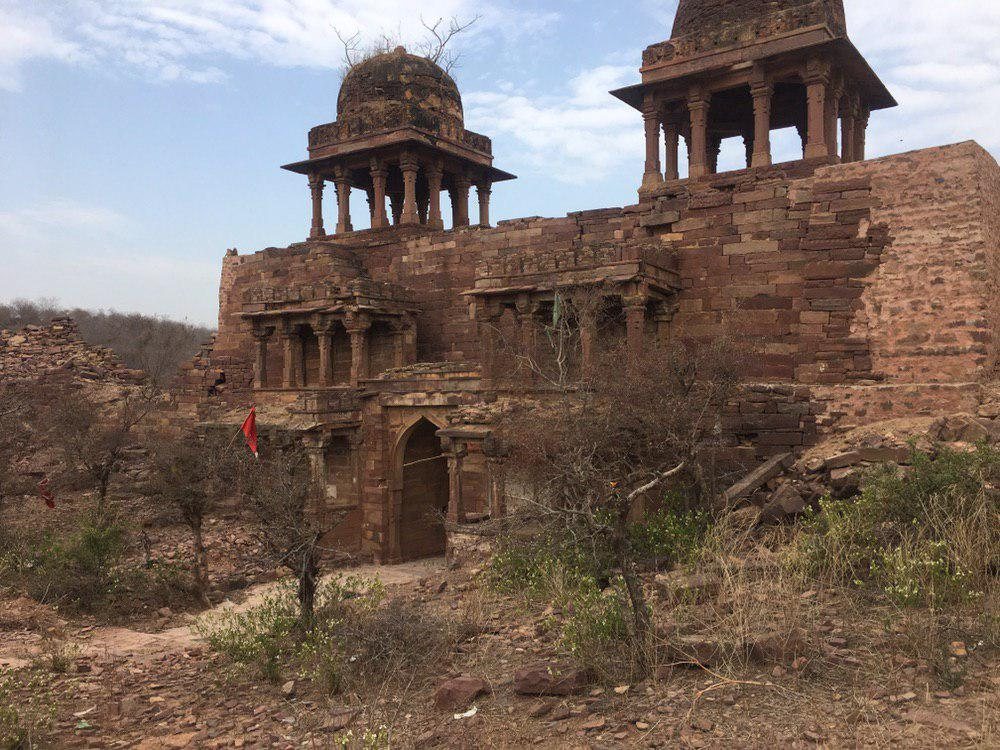
Timangarh Fort covers approximately 51.5 hectares and survives in a ruined condition, although its former extent was greater. The complex includes the remains of an ancient township, with palaces, bazaars, houses, and temples arranged within the fortified area. Its surviving architecture combines defensive entrances with religious and civic structures whose carved surfaces preserve evidence of the site’s artistic and devotional life.
Fortifications and Township
Entrances and Gates
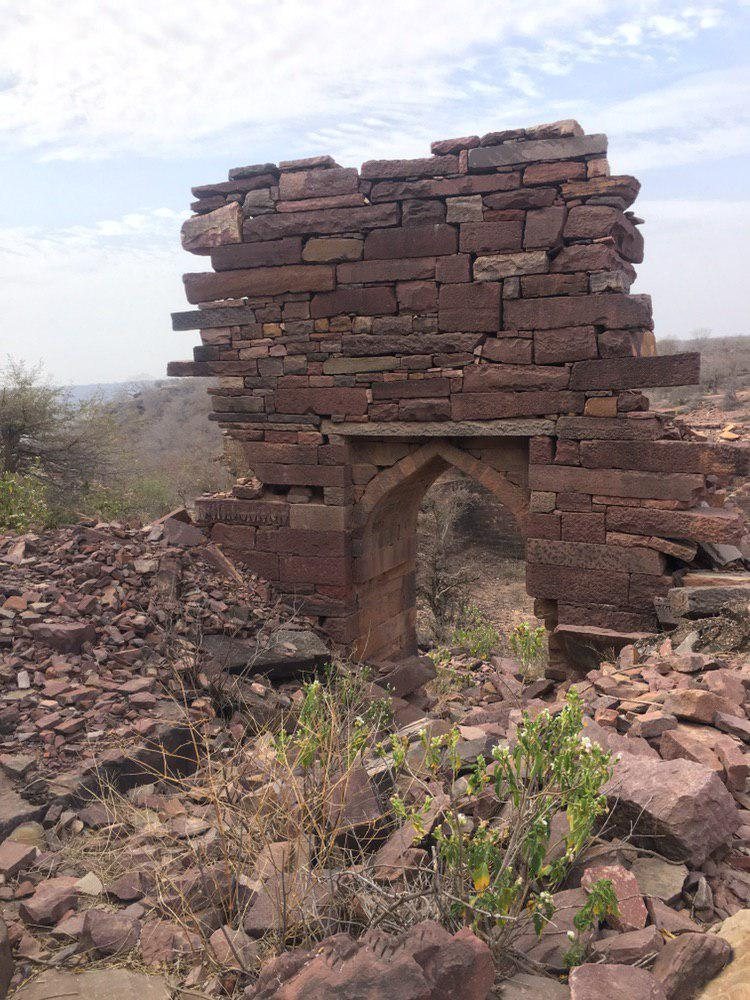
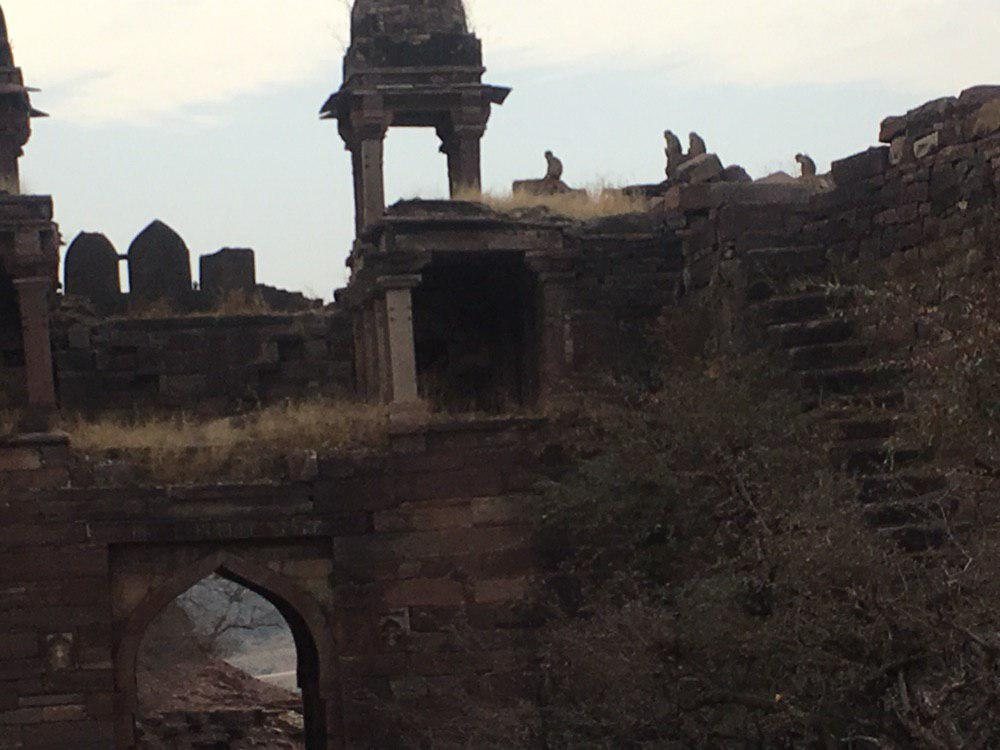
The original fort had five entrances. Further gates were added during the Mughal period, using stone blocks of different colors and varieties. Some of the stone slabs incorporated into these gates bear inscriptions, linking the later defensive work with written evidence preserved in the fort fabric.
Palaces, Markets, and Houses
Within the fort are ruined remains of palaces, bazaars, and houses belonging to the ancient township. The surviving structures have rooftops and pillars decorated with geometric, religious, and floral carvings. Their pillars also carry sculptures of gods, goddesses, and tantric counterparts, preserving elements of the settlement’s religious imagery alongside its domestic and public architecture.
Temples, Inscriptions, and Images
Temple Remains
The fort complex formerly contained approximately 50 temples, including 10 large temples. Many have been destroyed and dug up by local villagers. Other surviving architectural fragments retain carved roofs and pillars, while recovered idols are associated with Hindu and Jain communities and consist mostly of images of Ganesha and Vishnu.
Written Evidence and Mosque
Four Sanskrit-language inscriptions were recorded during the 1993 and 1998 surveys. Two Persian-language inscriptions noted by Cunningham could not be located during those later investigations. Cunningham also recorded a mosque within the fort, but it could not be traced during the later surveys.