Teufelsstein: A High-Medieval Rock Castle in Germany


Site at a Glance
- Rating
- 4.5
- Popularity
- Very Low
- Country
- Germany
- Primary era
- Medieval
- Eras represented
- Medieval
- Civilizations
- Holy Roman Empire
- Site type
- Military
- Remains
- Castle
On this page9 sections
History
Teufelsstein is a former high-medieval rock castle in Germany, located in the municipality of Pfarrweisach below Lichtenstein Castle. Built during the high Middle Ages, it occupied a naturally defensive sandstone rock on the slope of a ridge above the Weisach valley. The castle had been abandoned by the High Middle Ages, and its original name and precise history remain uncertain.
The Stein Family and Lichtenstein
Some historians have identified Teufelsstein, also known as Teufelstein or Höllenstein, as the ancestral seat of the Stein family, a medieval noble lineage. This family probably divided around 1200 into the Stein zu Lichtenstein and Stein zu Altenstein branches. The Lichtenstein branch later established nearby Lichtenstein Castle, while the Altenstein line founded Altenstein Castle about six kilometres farther north along the same ridge.
Another interpretation places an under-vassal of the Stein family at Teufelsstein. Members of the family served the bishops of Würzburg, who were both major ecclesiastical authorities and territorial lords in the region. These nobles could hold military and administrative responsibilities. Neither interpretation can be treated as certain, and the castle’s original name is unknown.
A Possible Outwork
Teufelsstein stood close to Lichtenstein Castle, but its position was vulnerable because attackers on the plateau could bombard it. This disadvantage has led to the possibility that it served as an outwork of Lichtenstein, a forward defensive position supporting a larger stronghold. Lichtenstein Castle is said to have been established later, however, so the relationship between the two sites remains unresolved.
Landscape Park and Modern Interpretation
During the nineteenth century, the castle site was incorporated into the landscaped park below Lichtenstein and made accessible. It now forms a station on the Haßberge district’s castle-history educational trail. The Bavarian State Office for Monument Protection registers it as a medieval motte archaeological monument under designation D 6-5830-0012. A motte is a fortified mound, usually associated with a tower and a defensive ditch.
Teufelsstein has also attracted esoteric interpretations and related tourism. Its rock-cut features, however, are associated with the high-medieval castle complex. Systematic archaeological and castle-historical research at Teufelsstein and the nearby rock-castle site of Rotenhan remains to be undertaken; Joachim Zeune called for this work in 1992.
Remains
Rock Setting and Defenses
The castle stood at about 400 metres above sea level on the slope of a long ridge above the Weisach valley, roughly 500 metres south of Lichtenstein Castle. Unlike the larger nearby rock castle of Rotenhan, its core castle occupied one freestanding rock mass. The sandstone formations at both sites slid down a clayey geological layer thousands of years ago and reached their present positions before the castles were built. These layers belong to the transition between the Upper Triassic and Lower Jurassic periods.
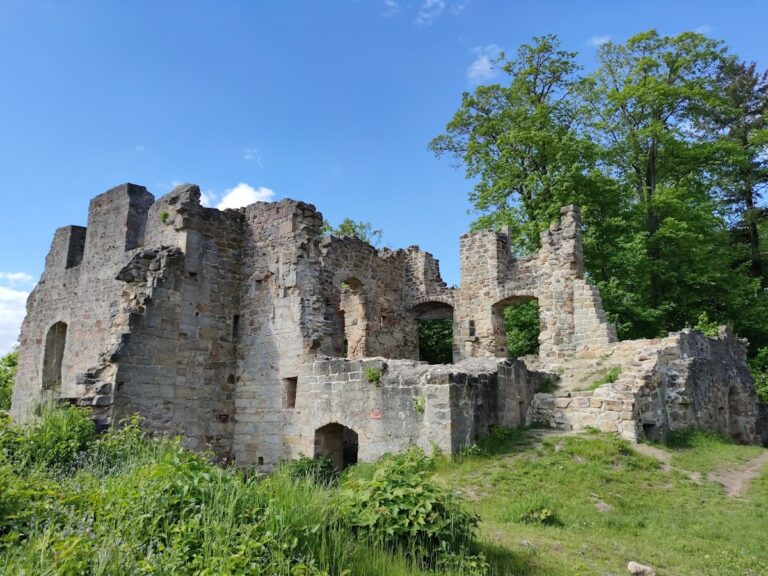
Teufelsstein’s horseshoe-shaped rock is separated from the uphill ground by a shallow neck ditch, now about one to two metres deep. Additional rock groups above the main formation bear traces of artificial working, suggesting that the original complex may have extended beyond the principal rock. The locally available sandstone supplied building material for the castle and may have been divided artificially so that the resulting rubble could be reused.
Entrance and Access
A narrow, angled stair corridor leads to the rock plateau. Two wooden doors formerly secured this approach. Before the first door, a stylized guardian’s face was carved into the soft sandstone, probably to deter attackers. Its pointed helmet is consistent with an eleventh- or twelfth-century date, and the carving is considered medieval. The corridor was probably originally reached by wooden ladders about two metres high that could be pulled up during an attack. Several steps were cut into the rock during the nineteenth century to create a more level approach.
Plateau Construction
The plateau preserves clear evidence of substantial construction, including holes for wooden beams and ledges cut for foundations. On the valley side, a wall apparently closed the rock group. Several nearby steps end abruptly, probably because the castle courtyard was covered by a wooden floor or ceiling supported by this wall. Numerous irregular small sandstone blocks around the rock indicate that parts of the castle had stone superstructures. Similar small blocks at nearby Lichtenstein Castle may have come from Teufelsstein, although that connection is uncertain.
Southern Entrance and Game Board
A small stairway led to the rear, southern part of the castle rock, where another wooden door probably provided security. A mill board, the medieval strategy game also known as Nine Men’s Morris, is carved into the floor of the entrance rock. In this game, players form lines of three pieces in order to capture opposing pieces. Castle historians regard the carving as medieval.
The game board is directly connected with the present name Teufelsstein. Local legend says that a knight of Lichtenstein defeated the Devil by trickery during a game played at the rock. The legend helps explain the name, but it does not establish the castle’s original identity or prove its connection with the Stein family.
Nearby sites