Terebovlia Castle: A Historic Fortress in Ukraine


Site at a Glance
- Rating
- 4.5
- Popularity
- Medium
- Country
- Ukraine
- Primary era
- Early Modern
- External website
- Open
- Eras represented
- Medieval, Early Modern
- Civilizations
- Kingdom of Poland, Polish–Lithuanian Commonwealth
- Site type
- Military
- Remains
- Castle
On this page9 sections
History
Terebovlia Castle is a historic fortress in Terebovlia, Ukraine, built and rebuilt by medieval Rus’ and Polish authorities from the ninth or tenth century onward. The hill held at least three successive fortresses, and the settlement reached its greatest power under Prince Vasylko Rostyslavych, a ruler of the medieval Rus’ polity centered on Halych and Terebovlia.
Medieval Rus’ fortress
Vasylko Rostyslavych died in 1124. Terebovlia then became part of the Principality of Halych and later the Principality of Halych-Volhynia, two medieval Rus’ states in the region of present-day western Ukraine. Under Prince Vladimir Igorevich of the Izyaslavich family, the settlement regained independence. In 1211, Vladimir was captured and executed with his brothers and father after a battle with the Magyars, the medieval Hungarian people.
During this period, the castle’s wooden walls began to receive stone facing. The fortress and settlement were completely destroyed by the forces of Batu Khan, the Mongol ruler, in 1241. Terebovlia was later recorded as conquered by the Poles in 1341.
Polish rebuilding and repeated attacks
A stone fortress was built or rebuilt in the mid-fourteenth century under Casimir III the Great, the Polish king whose reign included the consolidation of Polish rule in the region. The castle was expanded in 1534 by Andrzej Tęczyński, castellan of Kraków. A castellan was a senior official traditionally associated with command of a castle and administration of its surrounding district. The fortress declined during the fifteenth and sixteenth centuries amid repeated Tatar attacks, although Tęczyński rebuilt it at his own expense within several months. The need for repairs had already been recognized in a privilege issued under King Stephen Báthory on 30 November 1576.
Severyn Nalyvaiko captured Terebovlia in 1594 or July 1595, but the castle was not damaged. Between 1605 and 1625, it endured fifteen attacks by Crimean Tatars and again fell into decline. The present fortress was rebuilt in 1631 under the leadership of Aleksander Bałaban, the Terebovlia starosta, a royal administrative official in the Polish-Lithuanian political system.
Cossack, Ottoman, and later history
Cossacks captured the castle in 1648. After an armistice, Polish forces occupied it again, and the fortress subsequently resisted attacks by Cossacks, Turks, and Tatars. Following the Ottoman occupation of Podolia in 1671, it became an important border stronghold.
During the Polish-Ottoman War, a Turkish-Tatar army of 10,000 men commanded by Pasha Ibrahim Shyshman began besieging Terebovlia on 20 September 1675. The attackers failed to capture the castle and withdrew south on 11 October because winter arrived early. The defense helped prevent further attacks in Podolia and Galicia.
During the eighteenth and nineteenth centuries, the castle received no maintenance and fell into ruin. Before 1939, a monument to Zofia Chrzanowska was established among the ruins. Terebovlia Castle is now an immovable monument of national significance in Ukraine and a monument of local architectural significance. It is owned by the Ukrainian state and associated with the Castles of Ternopil Oblast National Reserve.
Remains
Fortress setting and surviving walls
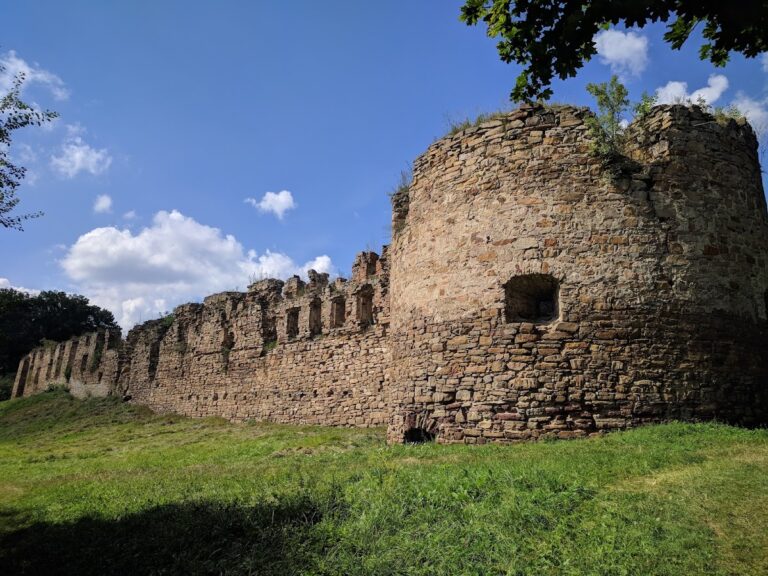
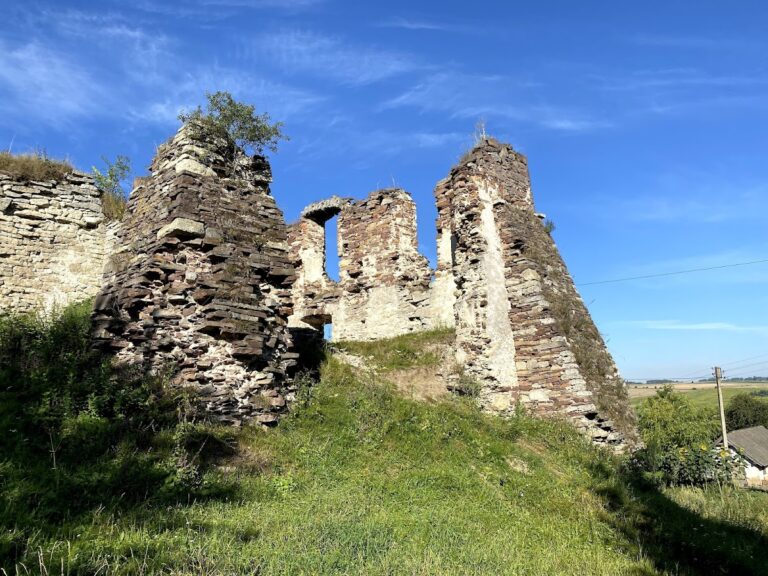
The ruins occupy the edge of the Gniezny Canyon near its mouth at the Seret River. The surviving fortress is represented principally by the lower sections of its walls. The mid-fourteenth-century stone walls were approximately 1 to 2 metres thick, while the seventeenth-century rebuilding produced walls 3.5 to 5 metres thick and up to 18 metres high.
Earlier medieval enclosure
The fortress associated with Vasylko Rostyslavych was a wooden enclosure protected by a palisade and several defensive lines. Its castle church was built of stone, and cellars lay beneath the castle. The enclosure had no well. Water may have been brought through an underground route or stored in reservoirs. Unlike the surviving fortress, this earlier castle was entered from the north, toward the area of the modern park, rather than from the east.
Seventeenth-century fortress
The seventeenth-century fortress had an entrance about 3 metres above ground level, accessible only by a special platform. The church containing the grave of Prince Vasylko Rostyslavych was probably destroyed during this rebuilding. Among the surviving features are a plan of the castle, the ruins of the main gate, and a damaged plaque on a castle tower.
Memorial features
A monument pedestal stands among the ruins, and a pre-1939 monument to Zofia Chrzanowska was established in the surrounding area. An associated plaque commemorates the Polish aviators Żwirko and Wigura.