Temple of Confucius, Qufu: A National Sanctuary of Confucianism
Site at a Glance
- Rating
- 4.5
- Popularity
- Very Low
- Country
- China
- Primary era
- Early Modern
- Eras represented
- Medieval, Early Modern, Modern
- Civilizations
- Chinese, Jurchen Jin, Ming, Qing, Yuan
- Site type
- Religious
- Remains
- Temple
On this page17 sections
History
The Temple of Confucius, Qufu, is a Confucian sanctuary in Qufu, Shandong, China, founded by the people of the Lu state in 478 BC, the year after Confucius’s death. Confucius was an ancient Chinese philosopher and educator whose teachings on ethics, ritual, social relationships, and government became the foundation of Confucianism. The temple developed from his former residence and became the central place for studying, interpreting, ritualizing, and preserving his teachings.
Foundation and Early Shrine
The Duke of Lu, the ruler of the state in which Confucius lived, consecrated the philosopher’s former house as a temple. An early tradition preserved in the Records of the Historian instead attributes the shrine’s establishment to Confucius’s disciples. The first sanctuary consisted of three rooms within the former residence. It held Confucius’s clothing, cap, zither, carriage, books, and other possessions, together with an altar where sacrifices could be offered by his senior direct descendants.
The house stood close to the residences of Confucius’s descendants and to his burial place. The temple, cemetery, and Kong Family Mansion later formed the Qufu complex known as the Three Confucian Sites. As Confucianism became an ethical, philosophical, and ritual tradition centered on moral conduct, learning, social order, and reverence for ancestors, the temple attracted pilgrims and acquired a wider religious and political role.
Imperial Recognition and Dynastic Expansion
In 195 BC, Liu Bang, the first emperor of the Han dynasty, made a grand ancestral sacrifice at Confucius’s tomb with the assistance of Confucius’s senior descendant. This ceremony established an imperial model for honoring the philosopher and began the continuing elevation of his ritual status. Under later dynasties, the temple became the principal national sanctuary of Confucianism.
Imperial ceremonies grew increasingly elaborate. Shrines were added for Confucius’s wife, parents, three immediate ancestors, and distinguished disciples, while the number of formal ceremonies eventually reached 196. Emperors issued rules for the rituals, supported maintenance, granted privileges and property, and sometimes visited after enthronements or military victories. Eleven emperors are recorded as making nineteen personal visits, while imperial deputies attended on approximately 196 official occasions.
The complex was repeatedly enlarged and reorganized. During a major rebuilding in 611, Confucius’s original three-room house was moved east of the principal sanctuary. Expansions in 1012 and 1094 created four inner courtyards and eventually more than 400 rooms. These changes transformed a small memorial shrine into a large ceremonial institution with distinct areas for Confucius, his ancestors, and his parents.
Destruction and Reconstruction
Fire and warfare destroyed the temple in 1214, during the Jurchen-ruled Jin dynasty. The complex was restored to its earlier extent by 1302 under the Yuan dynasty, established by the Mongols. In 1331, an enclosing wall was built in imitation of the imperial palace. The wall and other ceremonial elements adopted colors and insignia associated with imperial buildings and the worship of the highest divine rank.
A fire devastated the temple again in 1499. Reconstruction during the following years gave the complex the general form that has characterized it since the Ming period and strengthened its deliberate resemblance to the imperial residence in Beijing. Another major fire in 1724 severely damaged the principal sanctuary and its sculptures. A Qing government restoration completed in 1730 repaired the damage. Across its history, the temple underwent approximately fifteen major reconstructions, thirty-one large repairs, and numerous smaller building campaigns.
Twentieth-Century Damage and Revival
Ceremonies dedicated to Confucius were abolished in 1928. During organized destruction in November 1966, the temple and cemetery suffered extensive damage. Statues, shrines, tablets, plaques, offering tables, books, and other cultural objects were destroyed or removed, some stelae were broken, and a passage was cut through the complex near Dazhong Gate.
Repairs began on damaged buildings from the 1970s onward, including Dacheng Hall, the Apricot Platform, Qishengwang Hall, and the Resting Hall. The temple was restored during the 1980s. Public sacrifices to Confucius resumed in 1984, and an annual ceremony was restored in 1986.
The temple became a major national cultural monument of China in 1961. In 1994, it was included in the UNESCO World Heritage property Temple and Cemetery of Confucius and the Kong Family Mansion in Qufu. The inscription recognizes its exceptional artistic achievement, architectural significance, and association with Confucian traditions and thought.
Remains
The surviving temple is an extensive enclosed complex arranged along a strict north-south central axis. It contains nine courtyards, five halls, one tower, one platform, two galleries, two additional halls, seventeen stele pavilions, and more than 400 rooms. The buildings extend for approximately 1.1 to 1.3 kilometers and divide the historic city into eastern and western parts.
Axis, Gates, and Courtyards
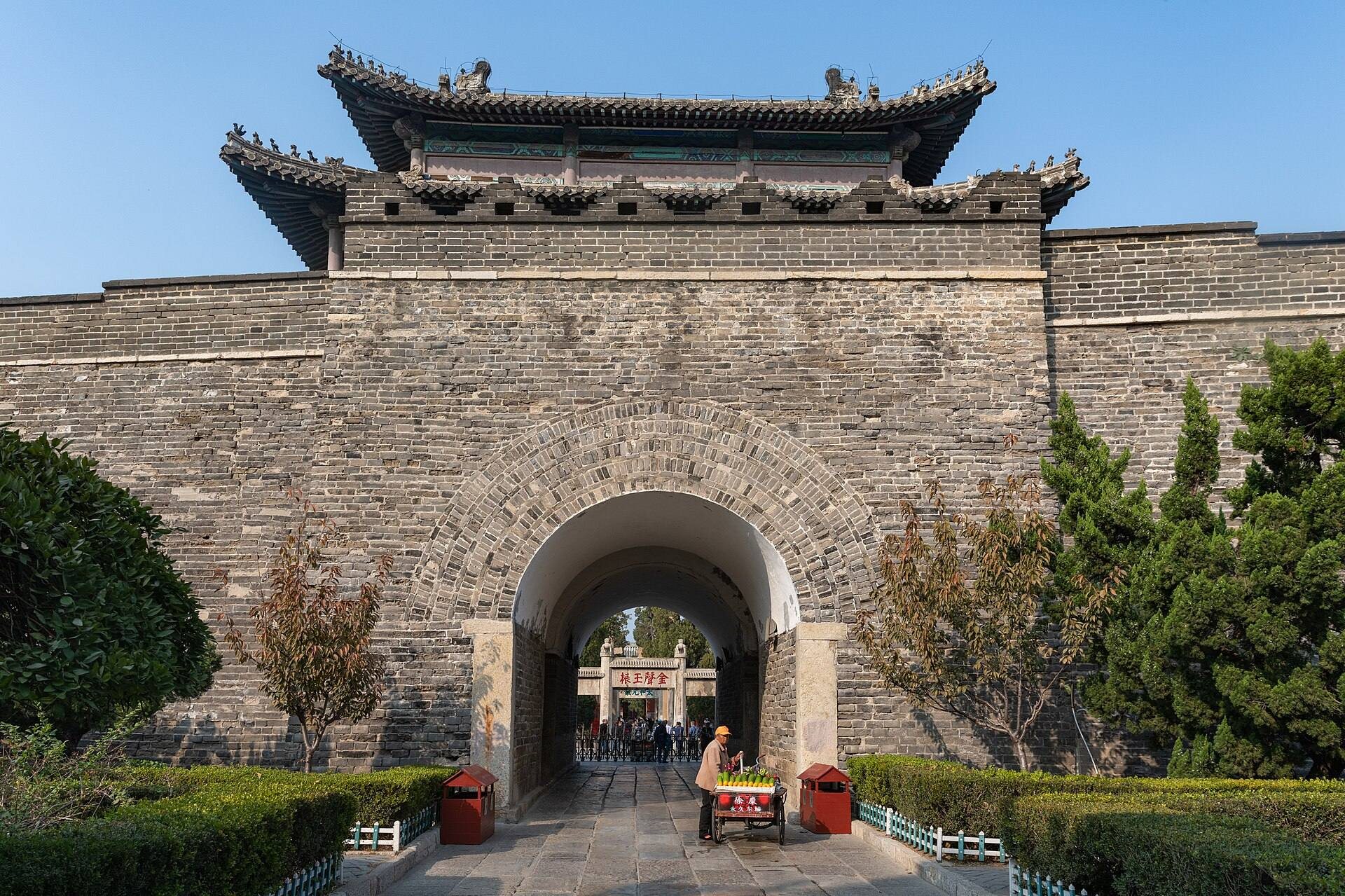
The layout follows imperial palace planning through bilateral symmetry, successive gates and courtyards, high enclosing walls, corner towers, red walls, yellow glazed roof tiles, and painted timberwork. Mature trees stand within the complex, whose surviving buildings belong to the Jin, Yuan, Ming, Qing, and Republican periods. Timber, clay, stone, and glazed architectural components make up the principal physical materials.
The southern entrance is Lingxing Gate. Beyond it stand Shengshi Gate, Hongdao Gate, and Dazhong Gate, followed by the Kuiwen Pavilion and the Thirteen Stele Pavilions. Hongdao Gate was built in 1377 and received its designation from a Qing emperor in 1730. It had previously served as the principal entrance to the temple.
Past the principal gate, the complex divides into three functional groups. The central group is dedicated to Confucius and earlier Confucian sages. The eastern group commemorates Confucius’s ancestors, while the western group is dedicated to his parents. This arrangement places the principal teaching and commemorative spaces between areas devoted to family ancestry and parental remembrance.
Central Ceremonial Buildings
Dacheng Hall
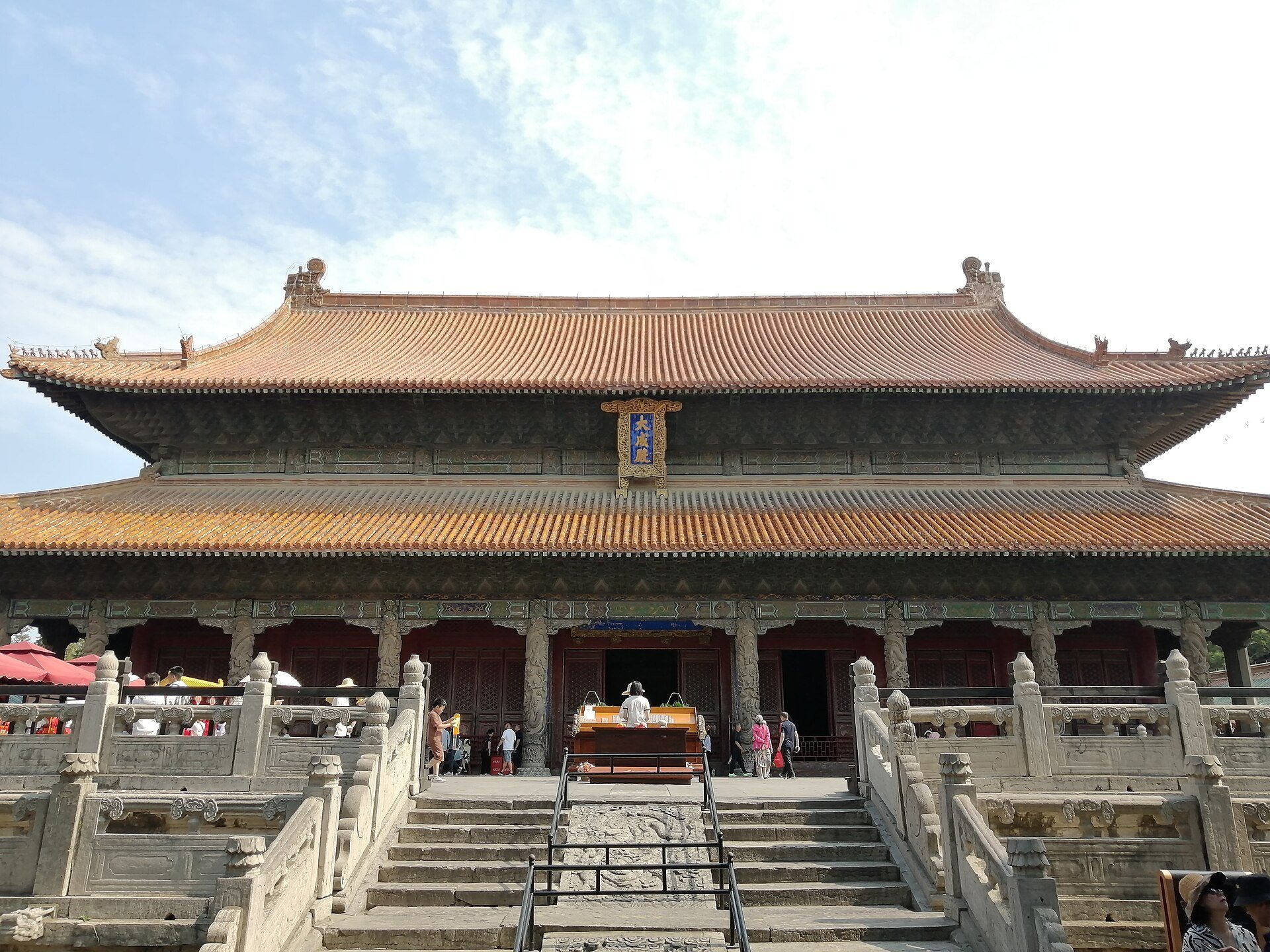
Dacheng Hall, the architectural center of the present complex, was constructed during the Qing period. Its name means Hall of Great Perfection or Hall of Great Achievement. The building measures approximately 54 by 34 meters and stands slightly less than 32 meters high. Twenty-eight richly decorated stone columns support it, each about 6 meters high and 0.8 meters in diameter. The ten columns along the front façade carry carved coiled dragons. A tradition holds that these columns were covered during imperial visits so that the emperor would not be provoked to envy.
The hall was the principal place for sacrifices commemorating Confucius. Its position within the axial sequence and its scale reflect the ceremonial importance that the temple acquired under successive dynasties.
Apricot Platform
The Xing Tan, or Apricot Platform, stands in the courtyard before Dacheng Hall. It commemorates the tradition that Confucius taught his students beneath an apricot tree. An annual ceremony commemorating Confucius’s birth takes place there on September 28.
Resting Hall and Related Shrines
The Resting Hall is dedicated to Confucius’s wife. Other named structures in the central group include Dacheng Gate, the De Mu Tian Di Arch, and the two Liangwu galleries. Together with the principal hall and platform, these buildings form the central ceremonial sequence devoted to Confucius and the earlier sages.
Eastern and Western Groups
Eastern Ancestral Group
The eastern group includes the Poetry and Rites Hall, an old well, the Lu Wall, Chongsheng Shrine, and the family shrine. These structures belong to the part of the complex dedicated to Confucius’s ancestors.
Western Parental Group
The western group contains Qisheng Gate, Jinsi Hall, and Qishengwang Hall. It is dedicated to Confucius’s parents and forms the western counterpart to the ancestral group on the east.
Pavilions and Inscribed Stones
Approximately 500 stone stelae stand on the temple grounds, although the inventory is not considered complete. A stele is an upright inscribed stone monument used to record a ruler’s decree, a building campaign, a religious dedication, or a historical event. The temple’s stelae commemorate reconstructions and repairs, praise Confucius, and record imperial grants of honorary titles. Some were moved from other places in Qufu in modern times for preservation.
Thirteen Stele Pavilions
The Thirteen Stele Pavilions occupy a narrow courtyard between the Kuiwen Pavilion to the south and Dacheng Gate to the north. They are arranged in two rows. The five pavilions in the northern row contain large imperial stelae carried on bixi, traditional Chinese monument bases shaped as tortoises, and crowned with dragons.
These northern-row monuments were erected during the Qing reigns of Kangxi, Yongzheng, and Qianlong between 1683 and 1748. They measure approximately 3.8 to 4 meters high. Their bixi bases reach up to 4.8 meters in length, and complete monuments weigh as much as 65 tons.
The southern row contains eight pavilions with smaller stelae. Four house monuments from the Jin and Yuan dynasties, while the others contain Qing-period stelae. Additional small stones without tortoise bases stand in open areas around the pavilion complex.
Ming Imperial Stelae
Four important Ming imperial stelae stand south of the Kuiwen Pavilion. They date from 1371, 1417, 1468, and 1504. Their inscriptions concern deities associated with geographical directions, the reconstruction of the temple, and later repair projects. Dozens of smaller stelae are also located in this area.
Most inscriptions are in Chinese. Some Yuan-period stelae also carry Middle Mongolian written in the Phags-pa script, while several Qing-period examples contain Manchu inscriptions. Together, the monuments preserve evidence of the temple’s long relationship with imperial patronage, building work, and the changing cultural settings of successive dynasties.