Tellico Blockhouse: A United States Military and Diplomatic Outpost in Tennessee
Site at a Glance
- Rating
- 4.6
- Popularity
- Very Low
- Country
- United States
- Primary era
- Early Modern
- External website
- Open
- Eras represented
- Early Modern
- Civilizations
- Unclassified
- Site type
- Military
- Remains
- Fort
On this page11 sections
History
Tellico Blockhouse was a United States military outpost completed in 1794 near present-day Vonore, Tennessee, on the Little Tennessee River. Established after the Cherokee-American wars, it was intended to maintain peace between the Overhill Cherokee towns and Euro-American settlers entering East Tennessee. The site became a military station, government liaison office, trading center, and important place for negotiations between the United States and the Cherokee Nation.
Foundation after the Cherokee-American wars
Settlement in East Tennessee had intensified conflict with the Cherokee, an Indigenous people whose historic homeland included parts of the southeastern United States. Violence reached a crisis in 1793 with the attack on Henry’s Station, the destruction of Tallassee by settlers, and the killing of several Cherokee headmen during a peace delegation led by the Cherokee chief Hanging Maw. The delegation was meeting Governor William Blount when the killings occurred.
Hanging Maw then persuaded Blount to establish a fort near the Overhill towns, Cherokee communities along the upper Little Tennessee River, and donated the land for it. Federal troops from Knoxville occupied the completed post. John McKee became its first United States Indian Agent, an official responsible for communication and relations between the federal government and an Indigenous nation.
A treaty signed on November 8, 1794, brought the Cherokee-American wars to an end. Hanging Maw represented the Upper Cherokee and Colonel John Watt represented the Lower Cherokee in negotiations with Governor William Blount. The agreement recognized boundaries established by earlier treaties and helped establish the diplomatic role that Tellico Blockhouse would play during the following decade.
Expansion and diplomatic activity
The federal Factory Act of 1795 created supported trading posts, known as factories, to encourage trade and promote agricultural and mechanical skills in relations with Indigenous peoples. In response, Tellico Blockhouse expanded to nearly twice its original size. The enlarged complex included a civilian section with lodging for travelers and delegates, a trading post, and the two-story Tellico Factory. Cherokee people could learn skills such as spinning, weaving, and other mechanical work there.
The post became a major venue for official relations between the United States government and the Cherokee. Several treaties negotiated there transferred extensive areas of present-day Tennessee and Georgia to the United States. These agreements offered financial payments and other guarantees intended to preserve peace, although the cessions steadily reduced Cherokee control of their homeland.
The First Treaty of Tellico was negotiated in 1797 and signed on October 2, 1798. It compensated the Cherokee for land occupied by illegal settlers and included a guarantee that the Cherokee Nation would “exist forever.” James Robertson, Lachlan McIntosh, Thomas Butler, and James White represented the United States under instructions from Governor John Sevier.
The Second Treaty of Tellico, signed on October 24, 1804, placed the Wafford settlements in northern Georgia under United States control in exchange for financial compensation to the Cherokee. Colonel Return J. Meigs negotiated the agreement for the United States. The Third Treaty of Tellico followed on October 25, 1805, and the Fourth Treaty was signed on October 27. Together, the latter treaties transferred the area between the Cumberland and Duck Rivers, including much of the Cumberland Plateau, to the United States. Their stated purpose was to connect East Tennessee with Nashville. Meigs negotiated both agreements, while Cherokee negotiators Doublehead and Tollunteeskee were later criticized for secret provisions that gave them personal incentives.
Political episodes and later decline
Tellico Blockhouse was also connected with the exposure of the Blount Conspiracy. In April 1797, merchant James Carey gave government trader James Byers a letter in which Senator William Blount proposed that Britain attack and capture Spanish-controlled New Orleans. Byers passed the letter to Colonel David Henley in Knoxville, who delivered it to Secretary of State Timothy Pickering. Blount was later expelled from the Senate partly because of the letter.
On December 25, 1797, the federal garrison and Silas Dinsmoor held a Christmas dinner on the frozen Little Tennessee River. The gathering followed the river’s freezing and is described as one of Tennessee’s earliest recorded Christmas celebrations.
Activity at the post probably reached its height around 1799, when its position on the Old Federal Road brought travelers and officials through the area. Louis-Philippe, Duke of Orleans, visited that year before later becoming Louis-Philippe I, king of France. In 1800, Cherokee leaders met at the blockhouse to debate whether missionaries should be admitted to Cherokee towns. The discussion was partly connected with the hope that missionaries would educate Cherokee children.
As Cherokee communities moved south toward the Hiwassee River and farther into Georgia in response to Euro-American encroachment, the Overhill towns along the Little Tennessee dispersed. Tellico Blockhouse consequently lost influence. In 1801, Return J. Meigs became Cherokee agent and effectively transferred the agency to Fort Southwest Point, where he was based. The final Tellico treaty, signed in 1805, called for the garrison to move south toward the Hiwassee River. The military outpost continued to operate until 1807.
Excavation and preservation
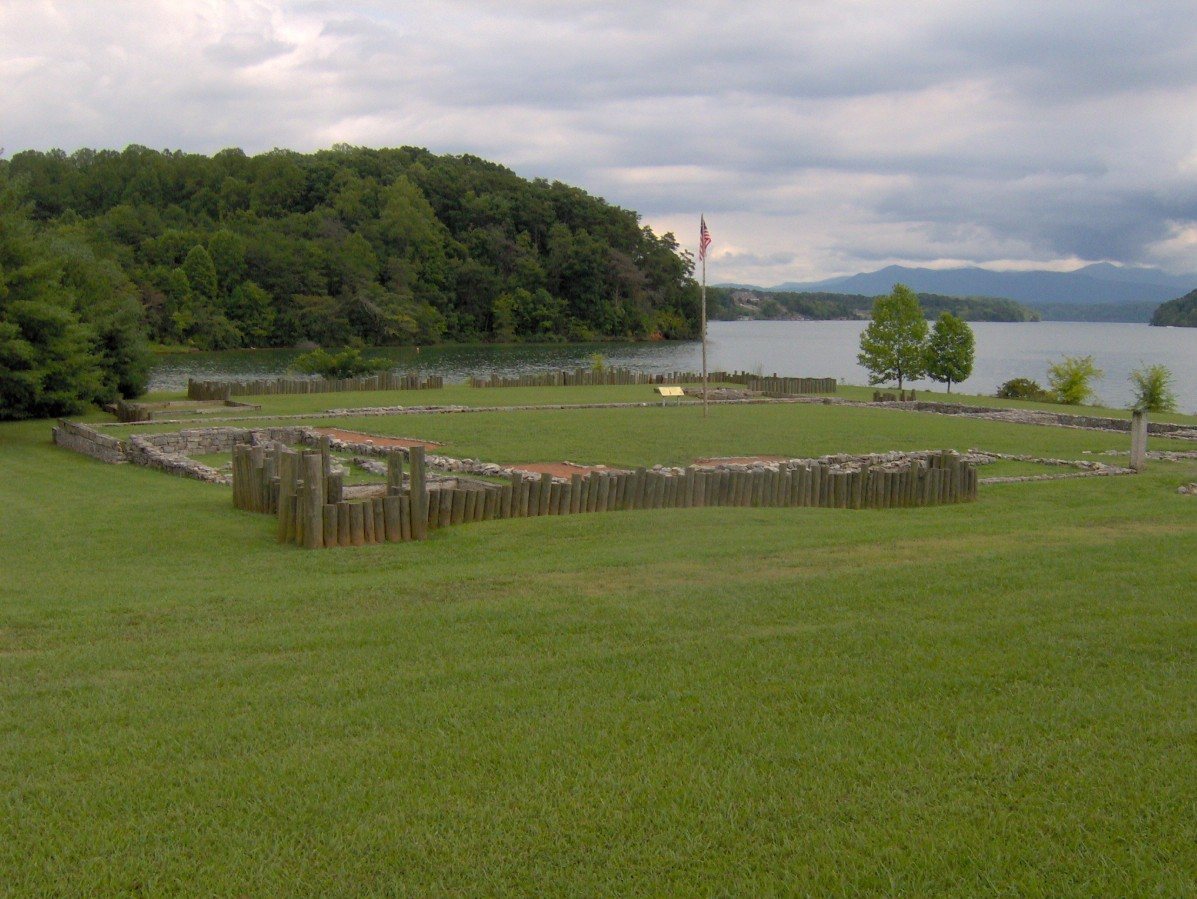
University of Tennessee archaeologists excavated Tellico Blockhouse during the 1970s, locating the fort’s foundations and recovering many artifacts. Because the surviving historical records did not provide enough information for an accurate reconstruction, the site was stabilized and interpreted in place rather than rebuilt. The Tellico Blockhouse State Historic Area preserves the remains, which are administered by staff of the nearby Fort Loudoun State Historic Area. The site was added to the National Register of Historic Places in 1975, the register of American places recognized for historical, architectural, archaeological, engineering, or cultural importance.
Remains
Tellico Blockhouse stood where Nine Mile Creek met the Little Tennessee River, on a high bluff overlooking the river valley between present-day Maryville and Vonore. The river is now impounded as Tellico Lake, created by the completion of Tellico Dam in 1979, and the modern shoreline lies within a few meters of the site. Fort Loudoun stood across the river to the west and had already fallen into ruins when Tellico Blockhouse was built.
Fort enclosure and military buildings
Defensive enclosure
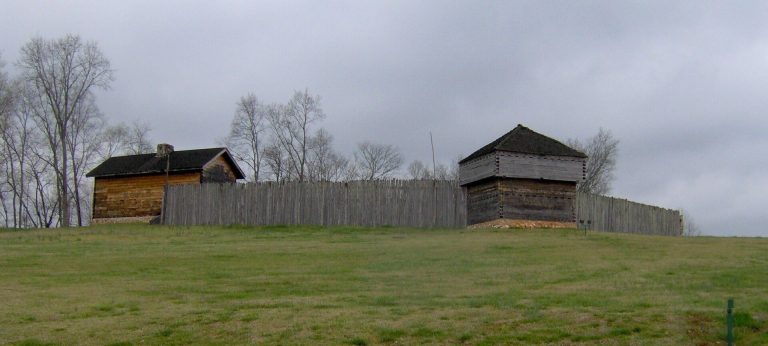
The original fort covered approximately 120 by 100 feet. An earthwork-and-timber palisade, a defensive fence made from upright posts, enclosed the compound and rose about 16 feet high. Projecting corner structures contained loopholes, or small gun ports, allowing defenders to fire from protected positions. The arrangement was considered capable of resisting a small-arms siege. Earth and timber formed the principal construction materials, while sawed planking was shipped upstream from Knoxville.
Interior buildings
The entrance gate stood in the north wall. Immediately inside were the captain’s quarters and guardhouse. Two barracks, a well, and a parade ground occupied the enclosure, while a watchtower stood at the northeast corner. These buildings and open spaces formed the military core of the post.
Expanded civilian and commercial section
The later enlargement divided the military section from a civilian half with an internal wall. This expanded area provided lodging for travelers and visiting delegates, a trading post, and the two-story Tellico Factory. The factory supported instruction in mechanical skills, spinning, and weaving as well as federally directed trade with the Cherokee.
Roads, crossings, and archaeological interpretation
Tellico Blockhouse occupied a position near the Overhill towns of Chota and Great Tellico, which lay within a day’s journey to the south. It also stood near Morganton, then called Portville, while Knoxville lay downstream on the Little Tennessee and then upstream on the Tennessee River. The Old Federal Road began at the blockhouse and connected Knoxville with Cherokee settlements in Georgia. The Unicoi Turnpike also began there, following a Cherokee trading route toward North Carolina and northern Georgia.
Before bridges crossed the Little Tennessee, officials used Niles Ferry to cross the river. Its crossing later corresponded to the ends of the modern U.S. Route 411 bridge. Archaeological work revealed the fort’s foundations and associated artifacts. The foundations were reinforced with authentic fill so that the ground plan could be viewed in place, and short posts mark the former walls. Interpretive signs identify the arrangement of the compound. Artifacts from the excavations are displayed at the Fort Loudoun museum and the Frank H. McClung Museum in Knoxville.