Sukovo Monastery: An Orthodox Monastery in Serbia
Site at a Glance
- Rating
- 4.8
- Popularity
- High
- Country
- Serbia
- Primary era
- Modern
- Eras represented
- Modern
- Civilizations
- Ottoman
- Site type
- Religious
- Remains
- Monastery
On this page14 sections
History
Sukovo Monastery is an active Serbian Orthodox monastery beside Sukovo village in Serbia, about 18 km east of Pirot; its present church was built in 1857–1859.
Early references and rebuilding
A document from 1019 places the monastery within the Sredets Eparchy, the Orthodox diocese of medieval Sofia, under the Ohrid Archdiocese, an Orthodox jurisdiction centered at Ohrid. The monastery’s founder and original foundation date are unknown, although it is also dated to the 15th century. It was demolished several times, including during Ottoman rule, and rebuilt in the 17th century. An earlier church was painted in 1606.
The nineteenth-century church
Local tradition connects the present church to a discovery in 1857. The land was said to belong to Sali-beg of Pirot, a local landholder with an Ottoman-era title. A shepherd named Velja reportedly dreamed that the Virgin Mary told him to uncover a monastery there. When he and local villagers dug, they found an old icon and a vigil lamp. The story says that Sali-beg’s son Emin fell ill after trying to halt the work, then recovered when his father allowed the excavation and the priest Jovan prayed. Sali-beg is credited with building the present church in gratitude.
The church was built between 1857 and 1859. An inscription gives 1857 as the beginning of construction and 1858 as its completion. Inscriptions name Mincho and Goga as builders, while the masonry is attributed to Mateja Nešić of Izatovac, assisted by Delko Jovanović, Milko Veselinović, and Ranđel Pejčić. Nun Efimija of Pirot made the principal contribution and travelled to Jerusalem on the occasion. A record dated 31 August 1859 notes a donation from the potters’ guild. The church was painted in 1869 by Vasil Pophristov of Samokov, whose name appears in an inscription near the entrance.
Monastic life and modern changes
The monastery came under Serbian rule in 1878. In 1882 it had an abbot and one hieromonk, a monk ordained as a priest, but no parish district. Its abbot in 1888 was Partenije Jocić, who served with a deacon. In the early 20th century, the monastery ran a model farm that raised pedigree geese and other poultry and won exhibition prizes. Bulgarian forces looted the monastery in 1915 during the First World War. Russian monks lived there in 1925 and followed the Athonite Typikon, a monastic rule and liturgical order associated with Mount Athos. An annual gathering took place around the monastery on the eve of a feast.
Father Varnava headed the monastery in 1937. In January 1942, the Russian monk Archimandrite Varnava, a senior monastic titleholder, managed it. The monastery had few properties but maintained an orchard of 30 decares, or 30,000 square metres, and a vineyard; poor harvests in the preceding two years had caused financial difficulty. In 1946, communist authorities arrested the Serbian Orthodox monk and theologian Justin Popović at the monastery.
The church’s entrance area collapsed and was rebuilt in 1947 through the efforts of the nun Cherubima. The entire church was reconstructed in 1974. The monastery has been state-protected since 1968 and is classified as a cultural monument of great importance. It belongs to the Niš Eparchy, an Orthodox diocese, within the Serbian Orthodox Church.
Remains
Church layout and construction
Plan and exterior
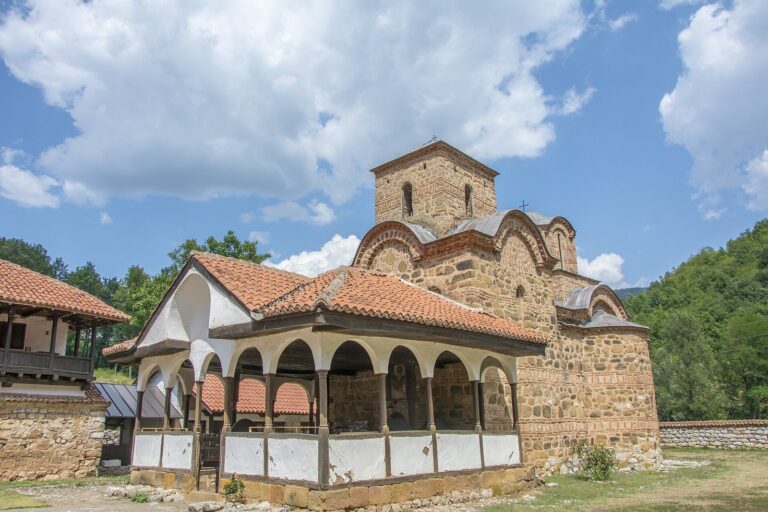
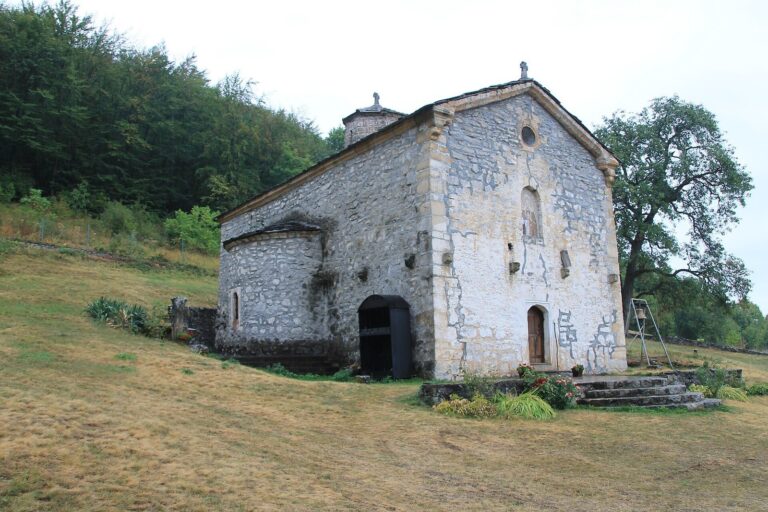
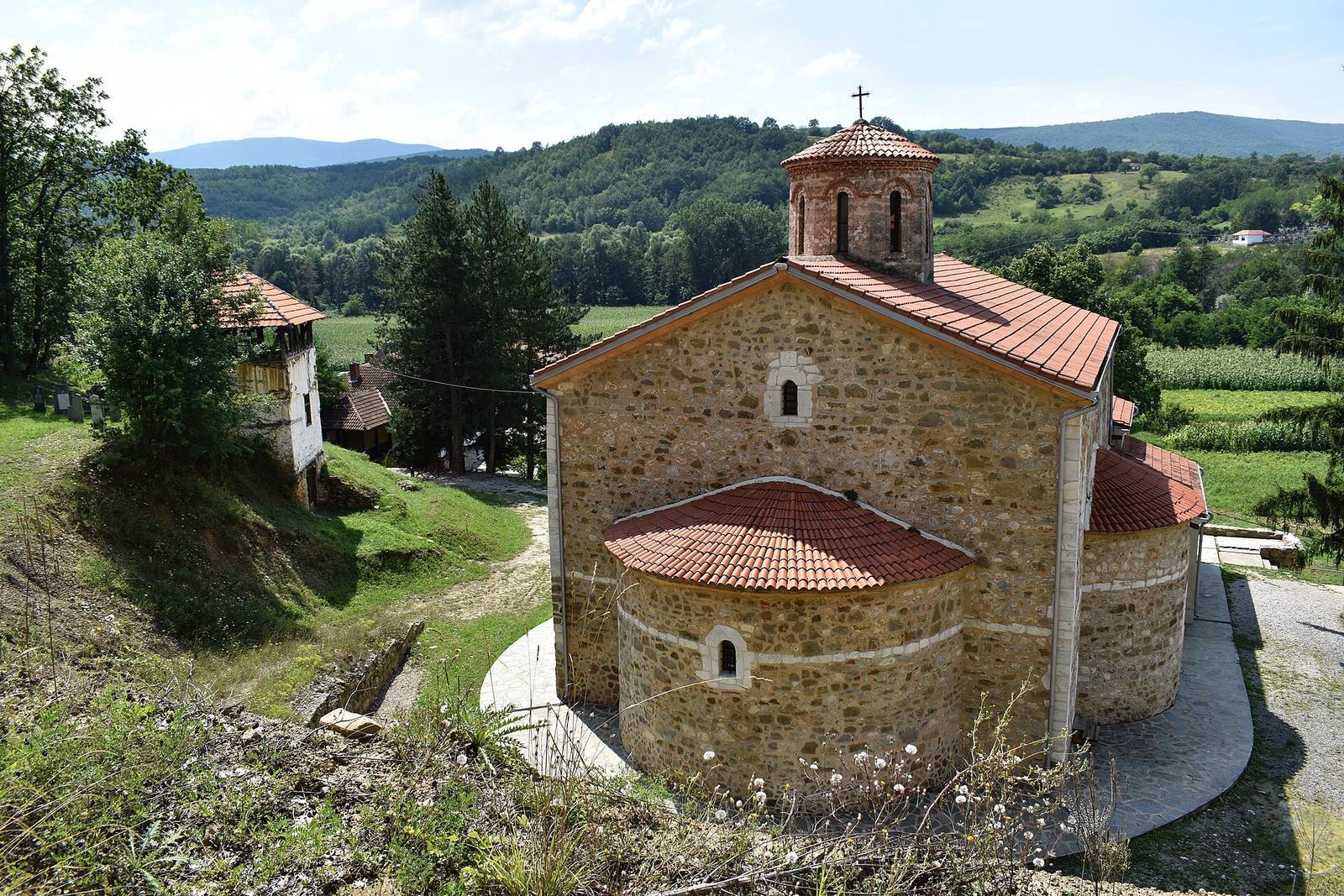
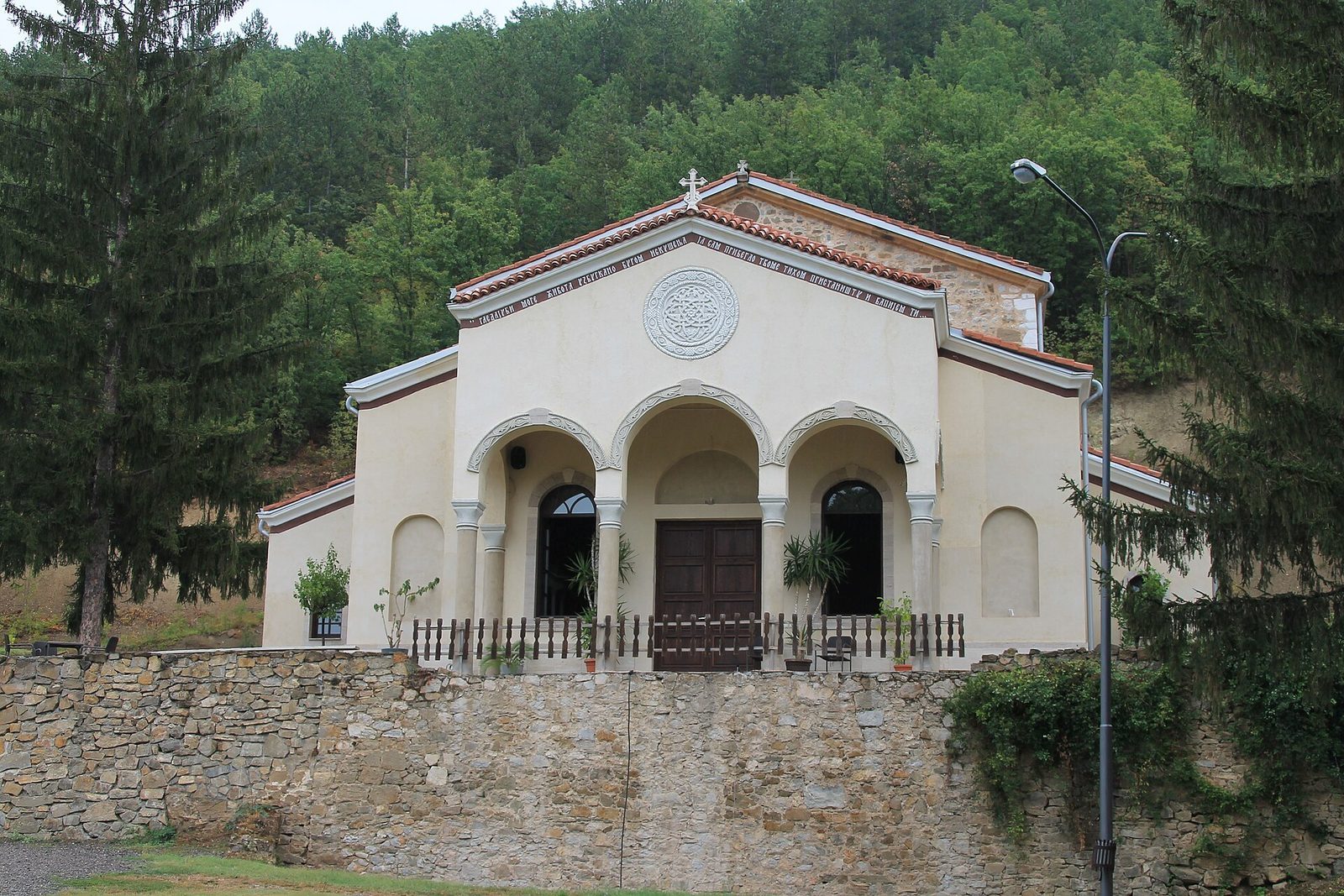
The monastery stands on the right bank of the Jerma River, at the foot of a hill known as Emperor’s Stone. Its church has a slightly asymmetrical, cross-shaped plan, with a dome above the crossing of the arms. Three apses, or semicircular recesses, project from the taller central body: the eastern one serves as the altar, while the northern and southern ones provide choir spaces. Dressed gray stone set in lime mortar forms the walls, and tiles cover the roof. A single dome rises above it, topped by a cross. The church is dedicated to the Dormition of the Virgin Mary, an Eastern Orthodox feast commemorating her death and bodily assumption into heaven.
Entrance and tomb
A spacious narthex, the entrance area at the west end of a church, leads into the building. The church has three doors; its central doors are opened only for the monastery’s patronal feast and major religious holidays. Just inside the entrance, on the left, a shared tomb holds the remains of the monastery’s discoverers and founders, the priest Jovan and the monk Benjamin.
Frescoes and furnishings
Frescoes
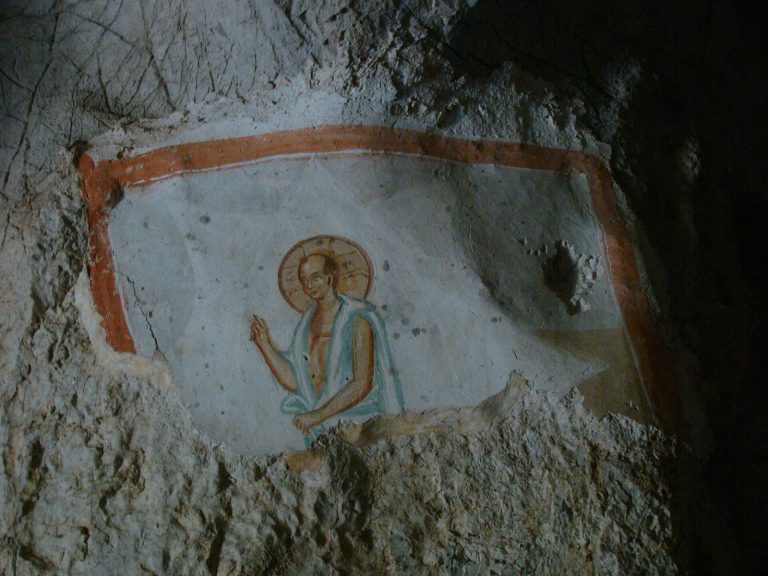
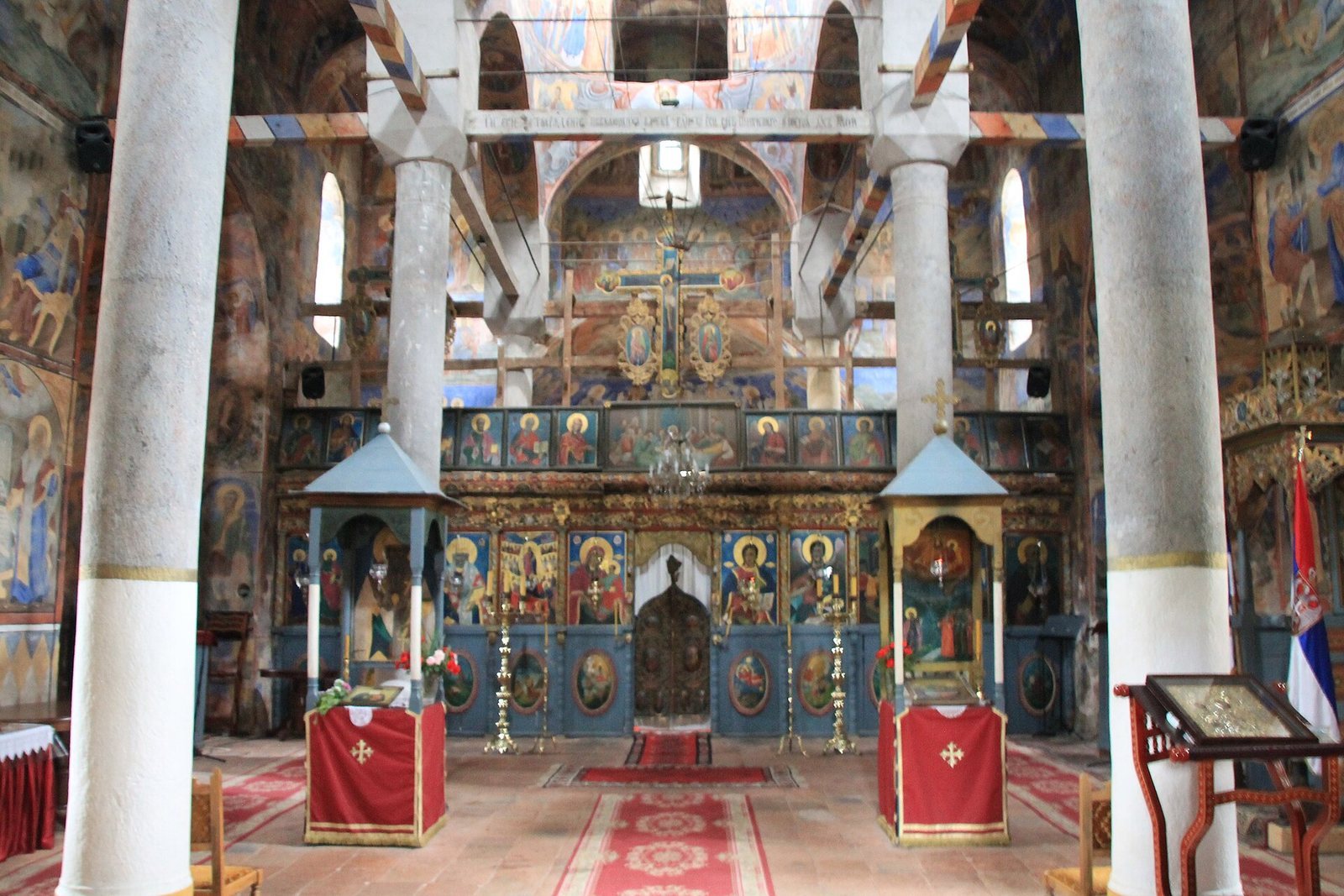
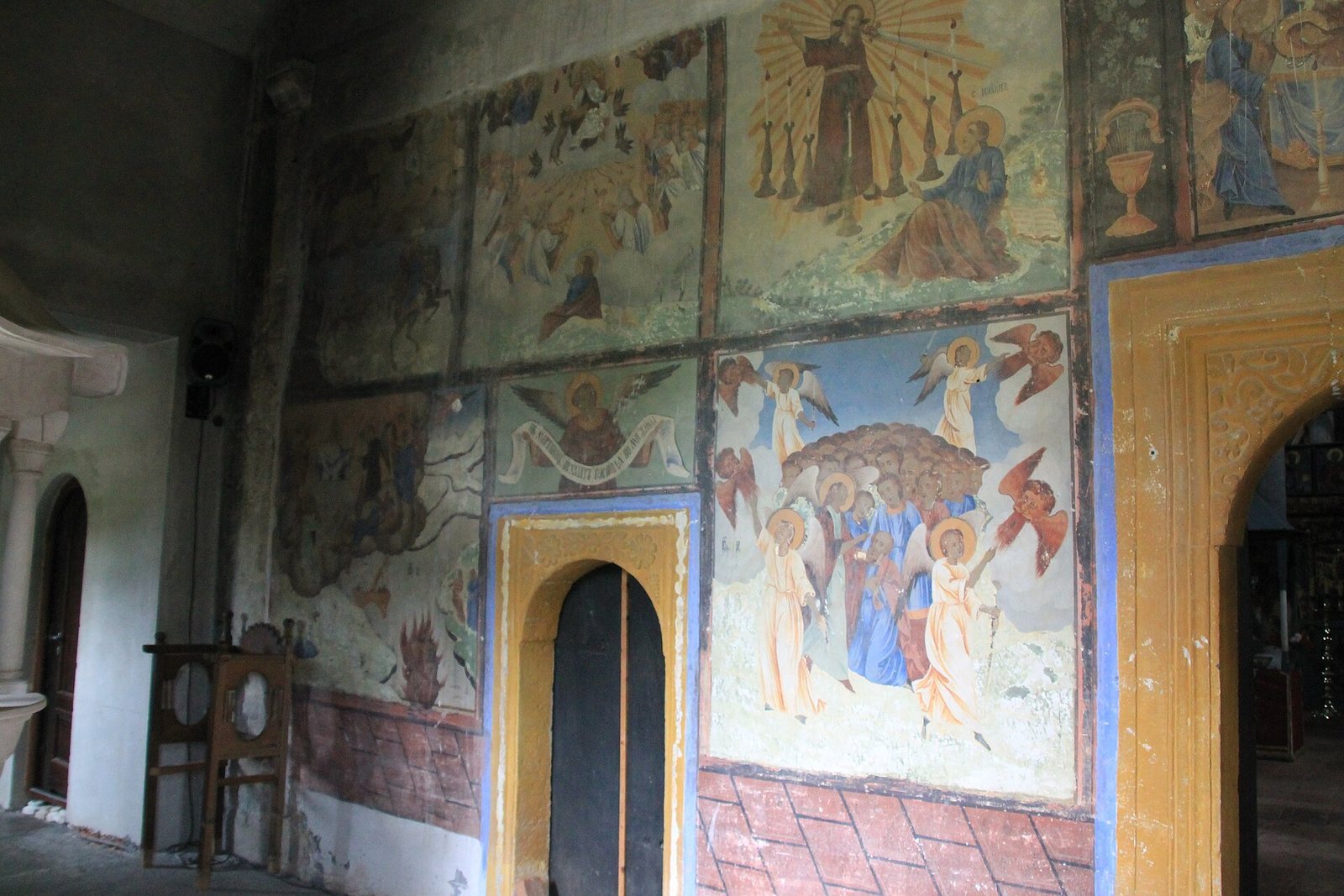
Frescoes cover the church walls. The Last Judgment shows Saint Peter leading the righteous toward paradise while the devil takes sinners to hell. A large scene of the struggle between good and evil occupies the eastern wall near the entrance. The narthex contains Old Testament scenes and less common subjects. The paintings are simply executed; many are damaged, but their colors remain vivid.
A niche in the right choir contains a fresco of Saint Christopher with an animal-like head resembling a dog or horse, accompanied by an identifying inscription. This rare strand of Eastern Christian imagery associated him with the Cynocephali, a legendary dog-headed people. Another notable painting depicts the Virgin Mary with wings.
Iconostasis
The large iconostasis, the screen of icons separating the sanctuary from the main worship space, has three parts and a carved wooden frame. Its decorated icons follow Bulgarian National Revival Baroque, a Baroque-influenced style associated with Bulgaria’s 19th-century cultural revival. Old Testament scenes appear in the row below the throne icons. A donor inscription on an icon of the Virgin Mary dates the iconostasis to 1859.
Earlier remains and objects
Archaeology and estate remains
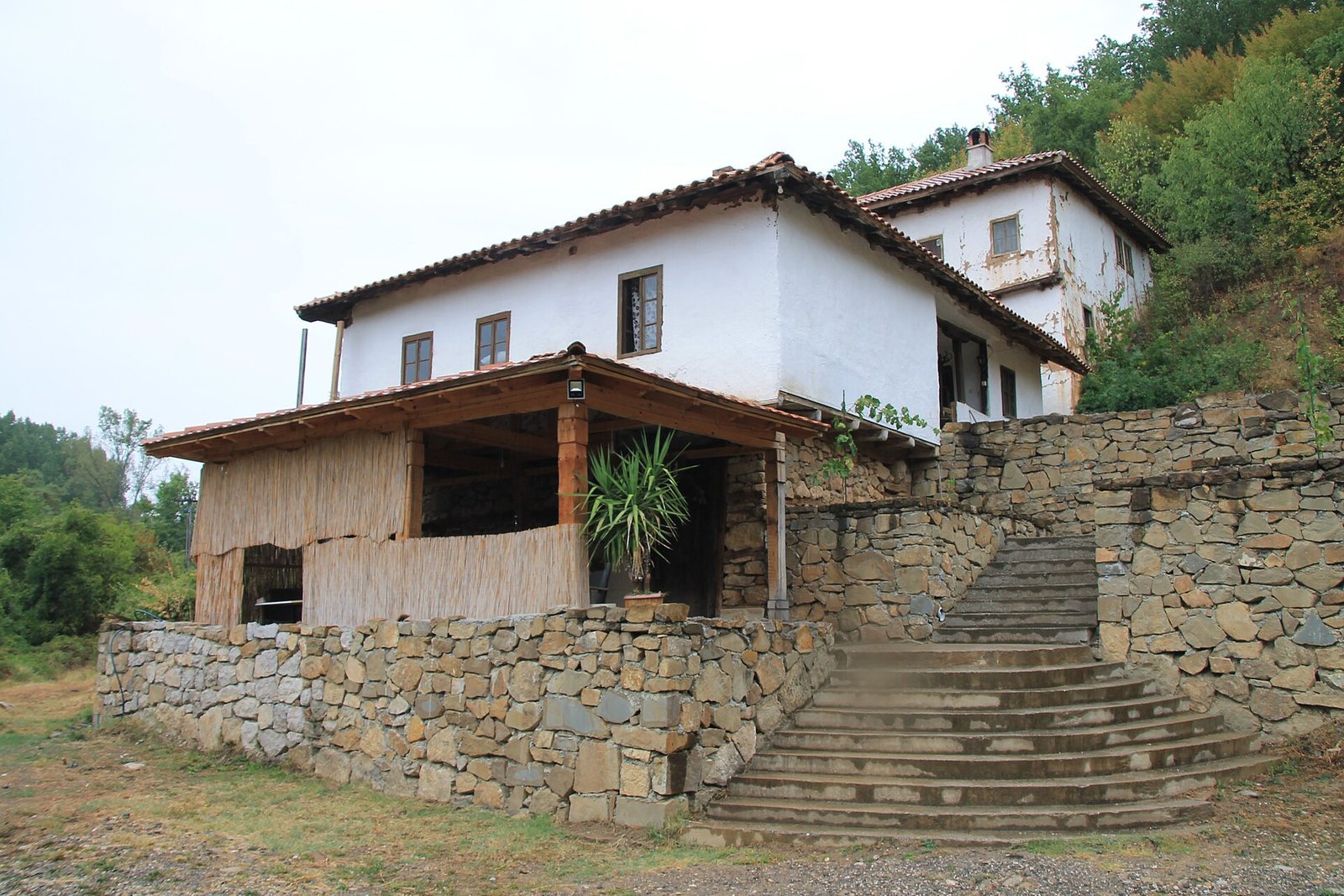
Early medieval building remains lie beneath the church. The site also preserves outlines of Sali-beg’s tower. Local tradition says that two watermills once stood on the estate.
Relics and monastery objects
Objects uncovered during the church reconstruction in 1974 were transferred to the Ponišavlje Museum in Pirot. The monastery preserves valuable icons and old books. It also keeps the skull of Velja, revered as a relic believed to have healing powers.