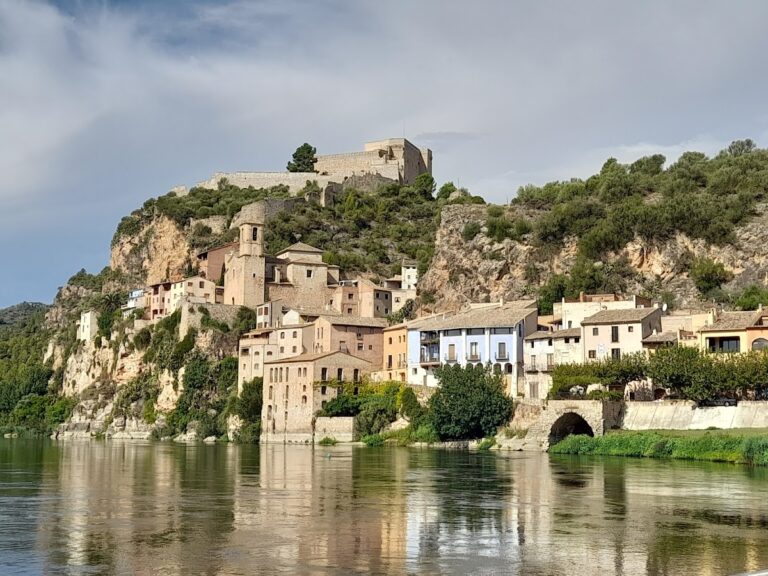
Suda de Tortosa: A Medieval Defensive Complex in Spain


Site at a Glance
- Rating
- 4.4
- Popularity
- Medium
- Country
- Spain
- Primary era
- Medieval
- External website
- Open
- Eras represented
- Classical, Medieval, Early Modern
- Civilizations
- Crown of Aragon, Roman, Spanish, Umayyad
- Site type
- Military
- Remains
- Castle
On this page7 sections
History
Suda de Tortosa is a medieval defensive complex in Tortosa, Spain, whose first fortifications date from the Roman period and whose fortress was later developed by Muslim rulers. It is one of the city’s oldest structures and is associated with Tortosa’s earliest settlers. The name “Suda” derives from an Arabic word for a castle or fortress.
Roman and Muslim origins
The site began as a fortified position during the Roman period. Muslim authorities later expanded and strengthened it, particularly during the rule of Abd al-Rahman III, the Umayyad caliph of Cordoba whose tenth-century reign represented a powerful phase of Muslim government in Iberia. A Muslim cemetery was established at the entrance to the castle.
Conquest and divided lordship
During the Christian conquest of Tortosa, the fortress was divided into three parts, or possibly functioned as three independent castles. After Ramon Berenguer IV, count of Barcelona, captured Tortosa in December 1148, he granted one section to Guillem Ramon I de Montcada and another to Pere de Torrelles i Sentmenat, while retaining the third for himself. The castle later became a residence of the Montcada, a prominent Catalan aristocratic family, and of the Templars, a medieval military-religious order that combined monastic discipline with military service.
King James I of Aragon, known as James the Conqueror, preferred the castle as a residence and used it as a base while preparing the conquest of Morella, Peníscola, and Burriana. During the Middle Ages, the complex also housed the period’s court of justice.
Royal palace and later fortifications
In 1294, Tortosa came under royal control and the Suda became a royal palace. New rooms and defensive features were added. The castle later passed to Infante Ferran, a close male member of the Aragonese royal family who was not the reigning monarch, when he held the marquisate of Tortosa. In 1363, King Peter IV recovered the castle along with jurisdiction over the city. Major renovation and enlargement followed.
Fortification works in the seventeenth and eighteenth centuries substantially obscured the medieval structures. The later defenses fortified two adjacent hills and joined them into a single defensive system. In 1972, an epitaph from the tenth century was recovered from the Muslim cemetery at the entrance. It refers to a governor. A funerary chest or coffin lid carved with Quranic verses in Kufic, an angular early form of Arabic script used for monumental and religious inscriptions, was also recovered from the castle’s rubble. It is preserved in Tortosa’s municipal collection.
Suda de Tortosa is designated in Catalonia as a Cultural Asset of National Interest and a historic monument. Its Spanish BIC registration code is RI-51-0006747.
Remains
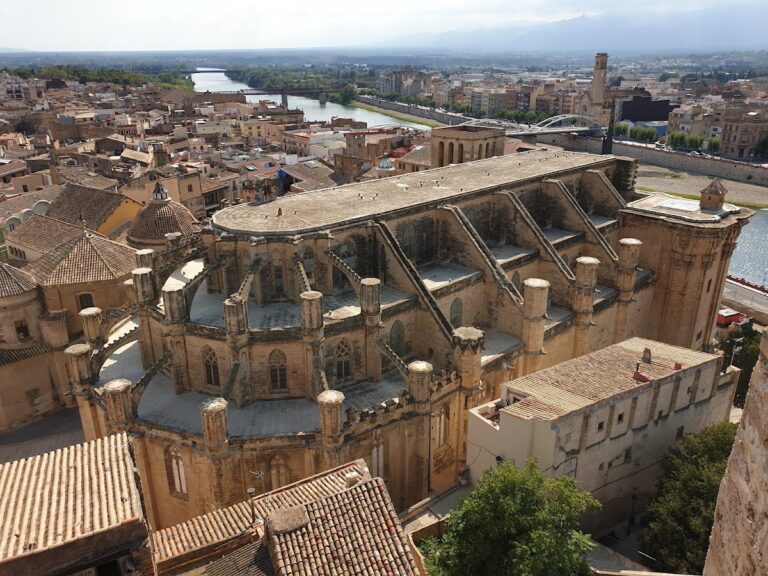
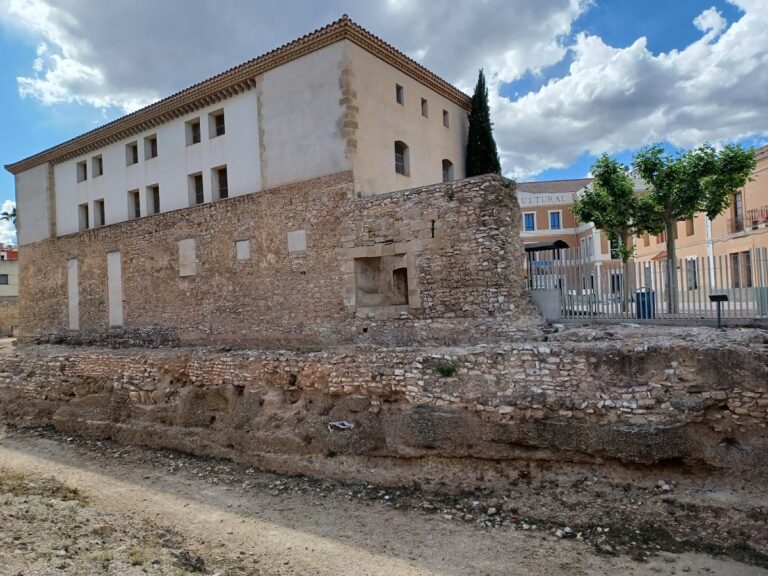
The surviving castle forms a defensive complex whose attached houses belonged to the earliest urban development protected by the fortress’s rear defenses. The later fortifications extend across two neighboring hills, which were linked into one defensive system. Medieval fabric remains within a complex that was reshaped by seventeenth- and eighteenth-century military construction.
Muslim-period infrastructure
The Muslim-period complex included a deep, large-diameter well. Underground galleries were arranged around it and preserve the remains of an ancient mill and two ovens. At the entrance, the Muslim cemetery provides archaeological evidence of the site’s use during the Islamic period.
Palace and military features
The present Parador de Turismo, a hotel belonging to Spain’s state tourism network and housed within the castle, preserves three historic fireplaces and four large windows characteristic of Catalan Gothic. The complex also retains a powder magazine, a military storehouse for gunpowder and explosive ammunition.
The funerary chest or coffin lid found in the castle rubble is carved with Quranic passages in Kufic script. Together with the tenth-century epitaph from the cemetery, it forms part of the surviving material evidence for the Muslim history of the fortress.