Stratford-upon-Avon Guildhall: A Medieval Guild and Civic Hall
Site at a Glance
- Rating
- 4.7
- Popularity
- High
- Country
- United Kingdom
- Primary era
- Medieval
- Eras represented
- Medieval
- Civilizations
- English
- Site type
- Civic
- Remains
- Town Hall
On this page8 sections
History
Stratford-upon-Avon Guildhall is a medieval guild and civic building on Church Street in Stratford-upon-Avon, United Kingdom. Built for the Guild of the Holy Cross from 1417 and completed in the early 1420s, it later became a seat of local government and a school building.
From religious guild to town government
The Guild of the Holy Cross, a religious association devoted to shared worship and charity, had a common hall by 1292. Work on a replacement began in 1417 and finished in the early 1420s. Tree-ring analysis of most sampled timbers, felled between 1410 and 1435, supports identifying this building as the present Guildhall.
In 1547, during the reign of Edward VI, the guild was dissolved. Stratford’s inhabitants petitioned to take control of its building and gained ownership in 1553, after the town received a charter of incorporation. The newly established town corporation continued to meet in the Guildhall, which, with its associated buildings, represented the town’s self-government.
The building also hosted local courts. The manorial court leet, a local court serving the manor, was held there by the time the corporation was established, probably continuing an earlier custom. The town charter provided for a court of record, whose proceedings had formal legal standing, and it probably met in the Guildhall as well. After the corporation received permission to hold quarter sessions in 1601, these periodic courts with county-level judicial responsibilities probably also convened there.
Performances, schooling and later changes
From the sixteenth century, the Guildhall was associated with travelling theatre companies. Performers were required to give a command performance before local authorities to obtain permission to play in a town, and Stratford’s corporation probably hosted such shows here. Companies visited Stratford more than 30 times from 1568, including the Queen’s Men, the Earl of Worcester’s players and Leicester’s Men. John Shakespeare, William’s father, held the offices of bailiff and alderman and would have attended.
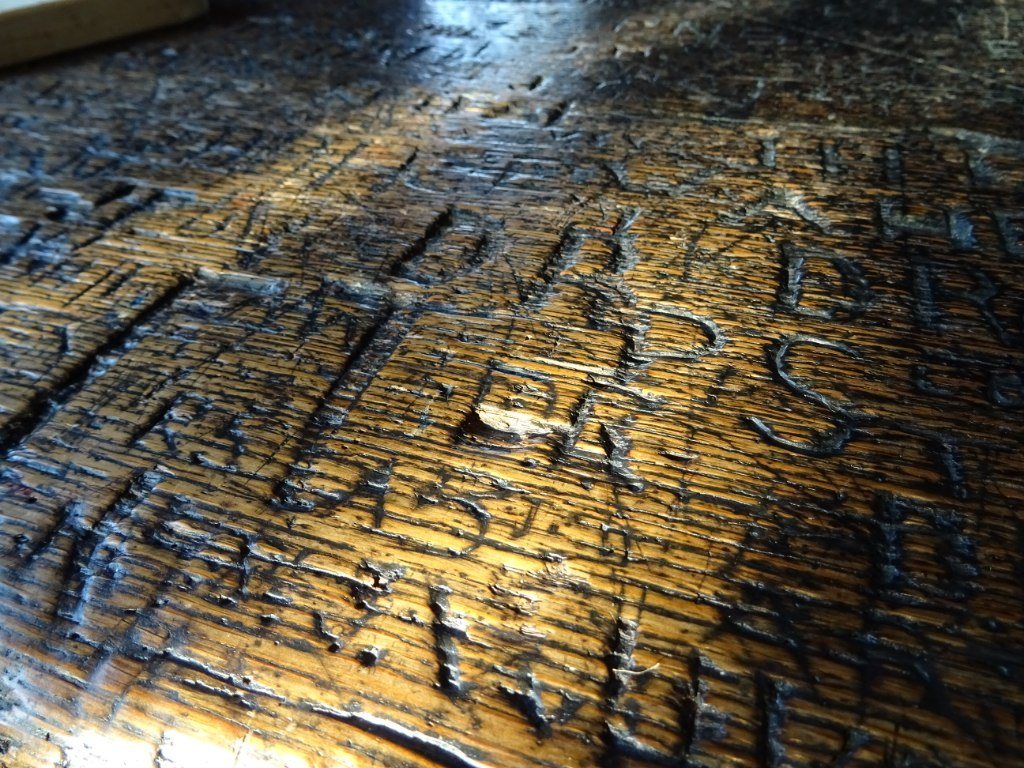
In 1602 the corporation banned plays in civic buildings, including the Guildhall, setting a penalty of 10 shillings. It briefly raised the fine to £10 in 1612, then fixed it at 40 shillings. The upper floor probably became home to King Edward VI School as early as the 1560s and was certainly used by the school by the eighteenth century. William Shakespeare almost certainly attended as a child in the 1570s. The school continues to use the building. Corporation meetings moved to the town hall in 1868.
A nineteenth-century restoration brought medieval painted decoration in the lower hall to light. Work in 2015 and 2016 treated the timber and conserved the paintings; the 2016 restoration also revealed a figure of John the Baptist. The Guildhall was listed at Grade I in 1951, the highest category of listed-building protection in England.
Remains
Halls and south wing
Main hall and upper floor
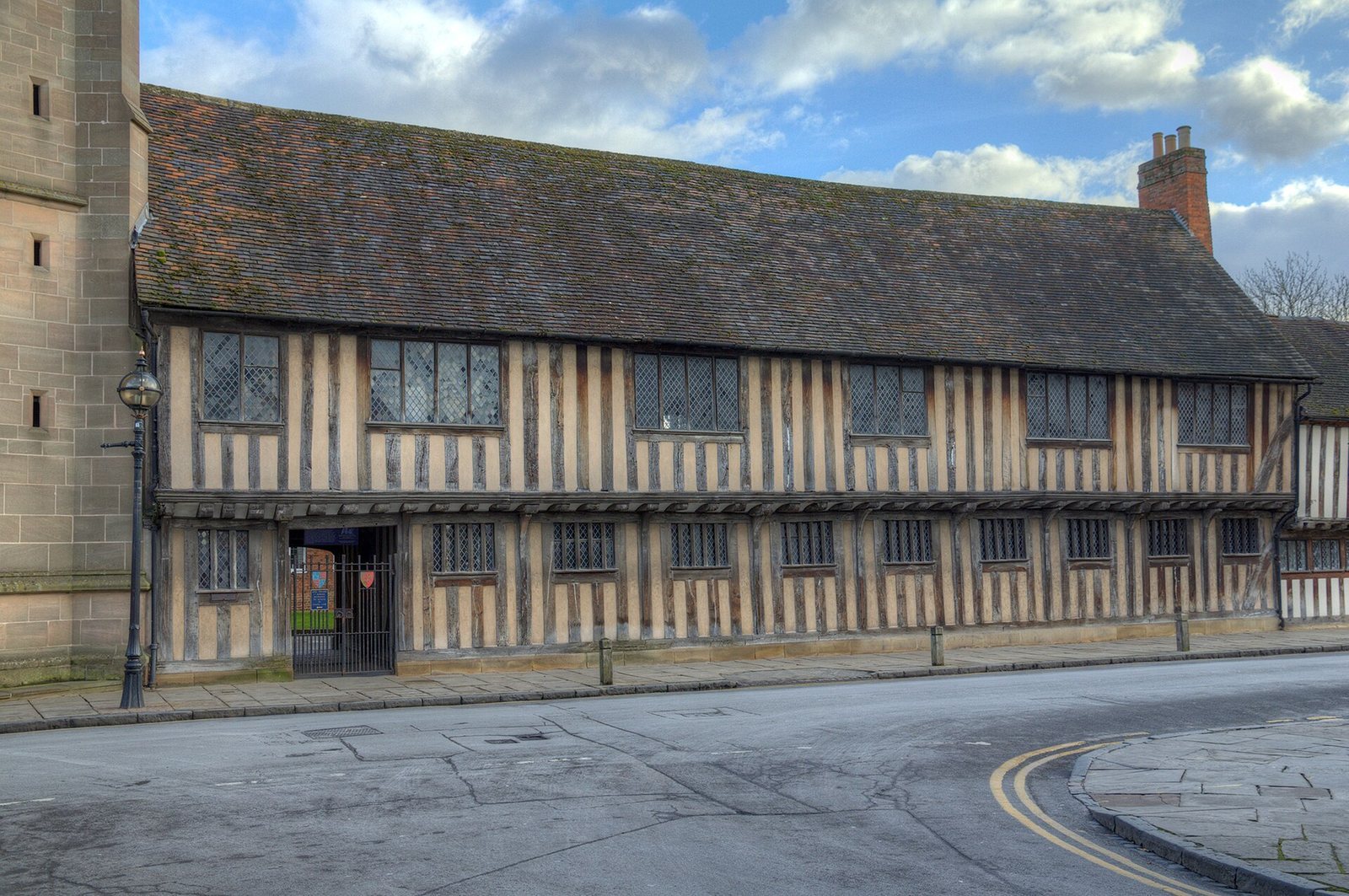
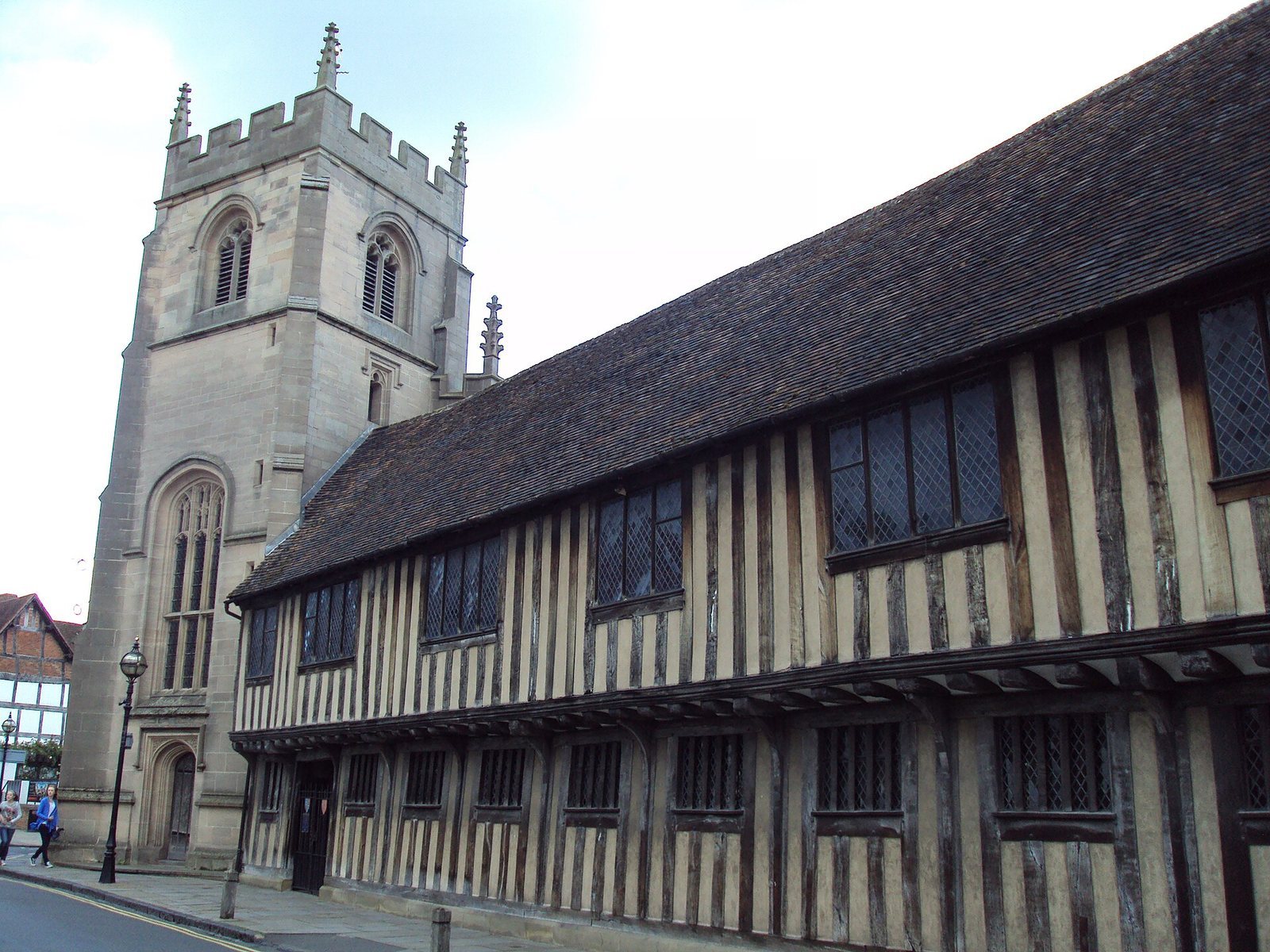
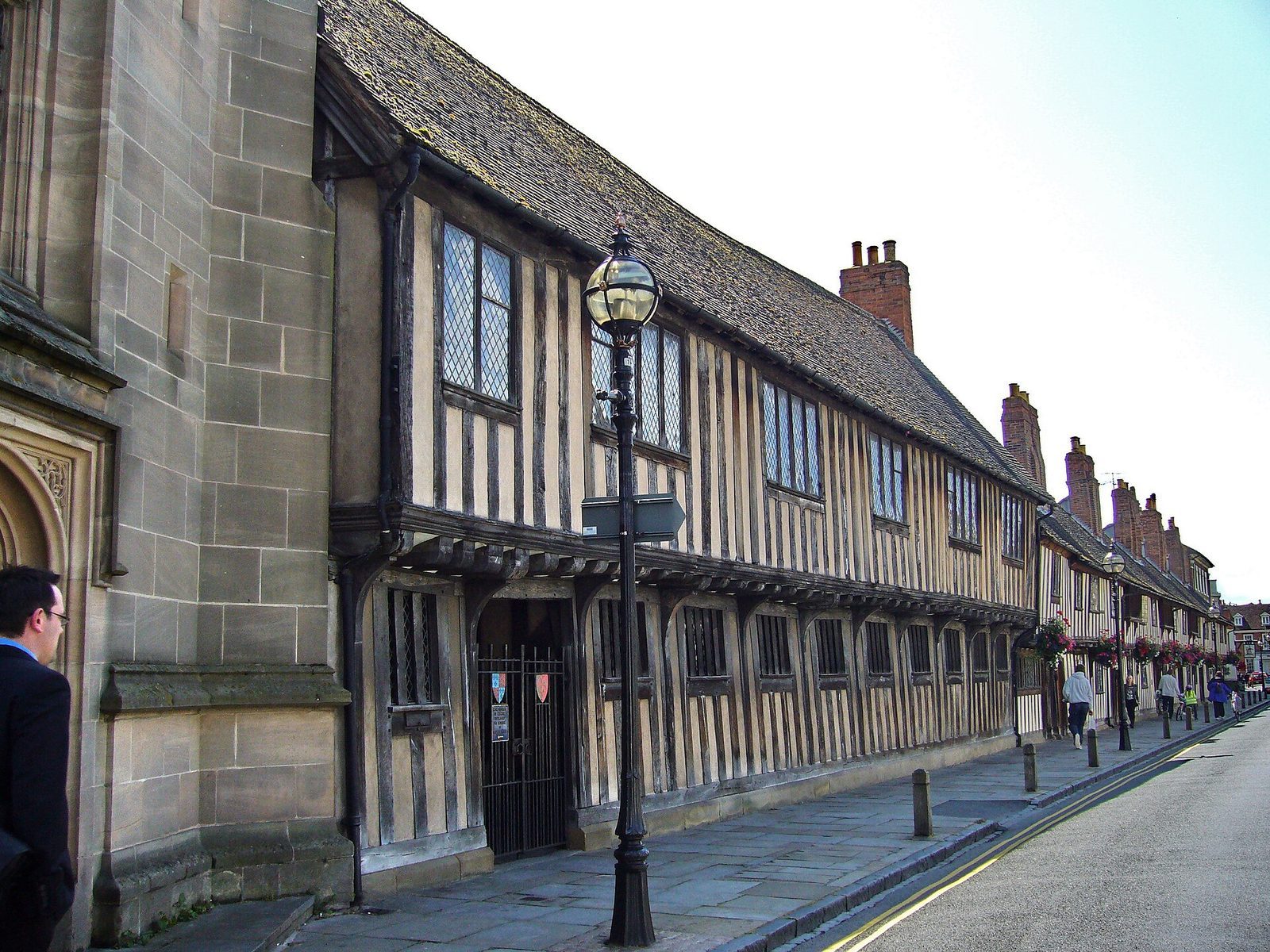
The Guildhall has a lower hall and an upper floor, with extensive timber framing in which the upper storey projects beyond the wall beneath. The main hall occupies the ground floor and has a stone floor and ceiling beams with bevelled edges. Two first-floor rooms have spine beams, which run lengthwise through a room.
South wing
A lengthwise partition on the south side of the upper hall points to this as its lower-status service end, possibly containing a buttery and pantry. A corridor gave access to these spaces and to the adjoining south wing, which extends to the southeast. The wing is thought to have served as a meeting room for the guild’s leading members. Its upper floor was used as an armour chamber in the late sixteenth century.
Exterior and painted chapel
The exterior has an entrance at the left-hand end, iron gates at ground-floor level and six leaded windows on the first floor. A small chapel occupied part of the lower hall. Its painted panel behind the altar, on the south wall, drew on the Guild of the Holy Cross’s seal: Christ on the cross stands at the centre, with God behind him and figures thought to represent Mary and John the Evangelist at either side. To the right is a more clearly defined figure of John the Baptist. It may have been painted directly on a timber stud rather than on a panel between the timbers.
The decoration also includes the quartered royal arms of England and France, reflecting England’s fifteenth-century claim to sovereignty over France, and the arms of the Beauchamp-Despenser family. The Beauchamps included the Earls of Warwick, who wielded considerable influence in Stratford.