Stolzenberg Castle: A Hilltop Fortress in Germany



Site at a Glance
- Rating
- 4.4
- Popularity
- Low
- Country
- Germany
- Primary era
- Medieval
- External website
- Open
- Eras represented
- Medieval, Modern
- Civilizations
- German, Holy Roman Empire
- Site type
- Military
- Remains
- Castle
On this page7 sections
History
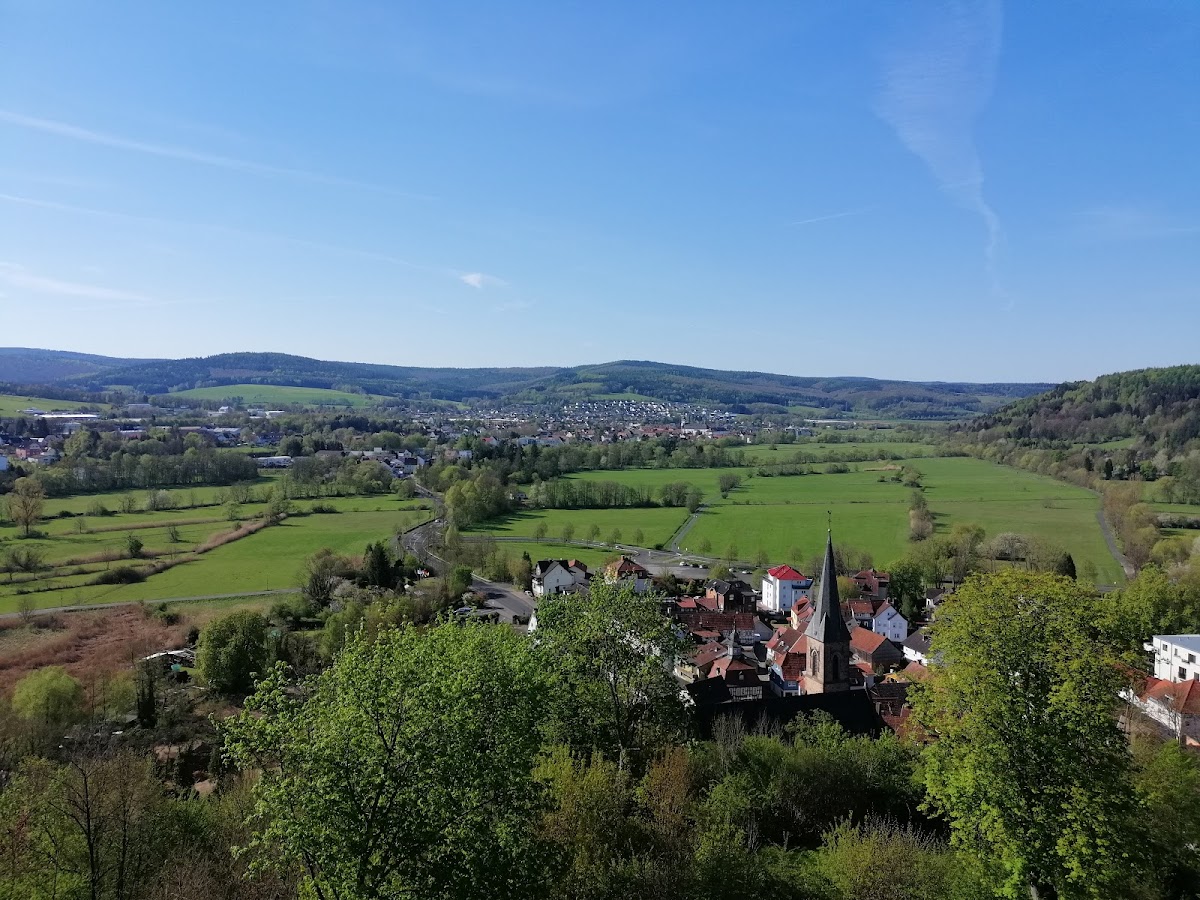
Stolzenberg Castle is a hilltop fortress in Germany, above Bad Soden-Salmünster in Hesse. It stands on the 277-metre Stolzenberg at the southern edge of the Büdinger Forest. Its foundation date is unknown, but a first fortification may have been built in the eleventh or twelfth century to overlook the Via Regia, a major medieval long-distance route across central Europe. The fortress may also have helped protect the salt springs in the Salztal, although that purpose remains uncertain.
Fulda Abbey and the settlement of Stolzenthal
The castle first appears by name in a charter issued in 1252 by King William of Holland. The document authorized Heinrich IV of Erthal, abbot of Fulda, to rebuild a fortress recently destroyed by what it called “enemies of the Church.” The attackers may have been the Counts of Rieneck or Gerhard of Dhaun, Archbishop of Mainz, but their identity is uncertain. William’s confirmation of Fulda’s possession rights points to earlier disputes over the castle and reflects a political alliance between the king and the abbot.
After 1252, the keep was probably rebuilt and the complex developed in stone. The extent of the surrounding fortified boundary at this stage is uncertain, particularly whether it had already been enlarged around the settlement that had grown at the foot of the hill. In 1296, the Fulda abbot secured town rights from King Adolf of Nassau for this settlement, which the charter called Stolzenthal. It later took the name Soden from an incorporated hamlet associated with salt boiling.
In 1299, Hermann von Hutten was named as the official administering Stolzenberg. He was an early member of the Hutten family, which later became prominent in the region, and probably held the castle fief as a bailiff for the lords of Hanau. The castle chapel was consecrated, or possibly reconsecrated, in 1319. It served both the castle and the inhabitants of Stolzenthal until a separate church was built on the slope between the castle and the town. That church was replaced by St. Lawrence Church in 1896.
The Hutten fief and the Knights’ War
The Stolzenberg fief passed through numerous exchanges and re-exchanges before the Hutten family established a permanent connection with the castle. By the fifteenth century, the branch living there used the additional name “zu Stolzenberg.” The complex deteriorated during the early sixteenth century. Part of the residential building collapsed in 1512, and another building required complete rebuilding in 1519.
The castle was drawn into the Knights’ War, an early-sixteenth-century conflict in which Franz von Sickingen and allied knights fought opposing territorial rulers, including Philip of Hesse. Frowin von Hutten supported Sickingen. On 24 October 1522, troops commanded by Philip of Hesse attacked Frowin’s ancestral seat and bombarded Stolzenberg until it could no longer be defended. Repairs followed, but Lucas von Hutten moved his residence around 1536 to the new Huttenschloss farther down the valley. That building was probably constructed on the site of an older service farm belonging to Stolzenberg.
Decline and preservation
The castle chapel remained in Protestant use by the Hutten family in 1597. This practice angered the Catholic priest Martin Göbel, who described it in his records. The last documented resident was the castellan Cord Gaull. Parish records place the births of his children at the castle until 1609, while another son was born in nearby Eckardroth in 1611.
By 1734, a donation document referred to Stolzenberg as a dilapidated castle. Most of its buildings were later dismantled, and their stones were reused in surrounding construction. A dance hall built below the former castle-yard plateau at the end of the nineteenth century altered the hill further. In 1970, the surviving masonry was secured and the keep was adapted as a viewing tower. The ruin is protected as a cultural heritage monument in Hesse.
Remains
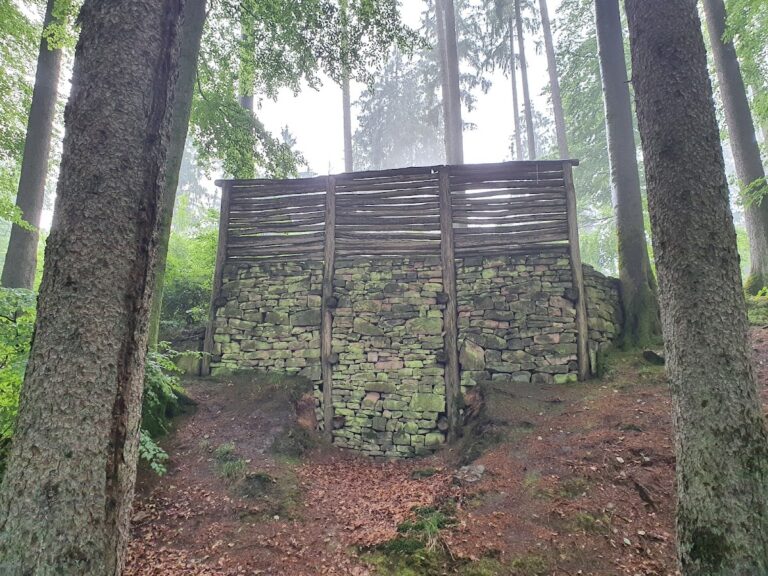
Stolzenberg survives as a hilltop ruin organized around a castle plateau. Its principal standing structure is an approximately 20-metre-high keep, while the former enceinte, the enclosing defensive wall or fortified boundary, is traced by a surrounding double ditch and bank system. A substantial masonry block in front of the keep probably formed the substructure or rear wall of earlier buildings in the castle yard.
Keep and fortified boundary
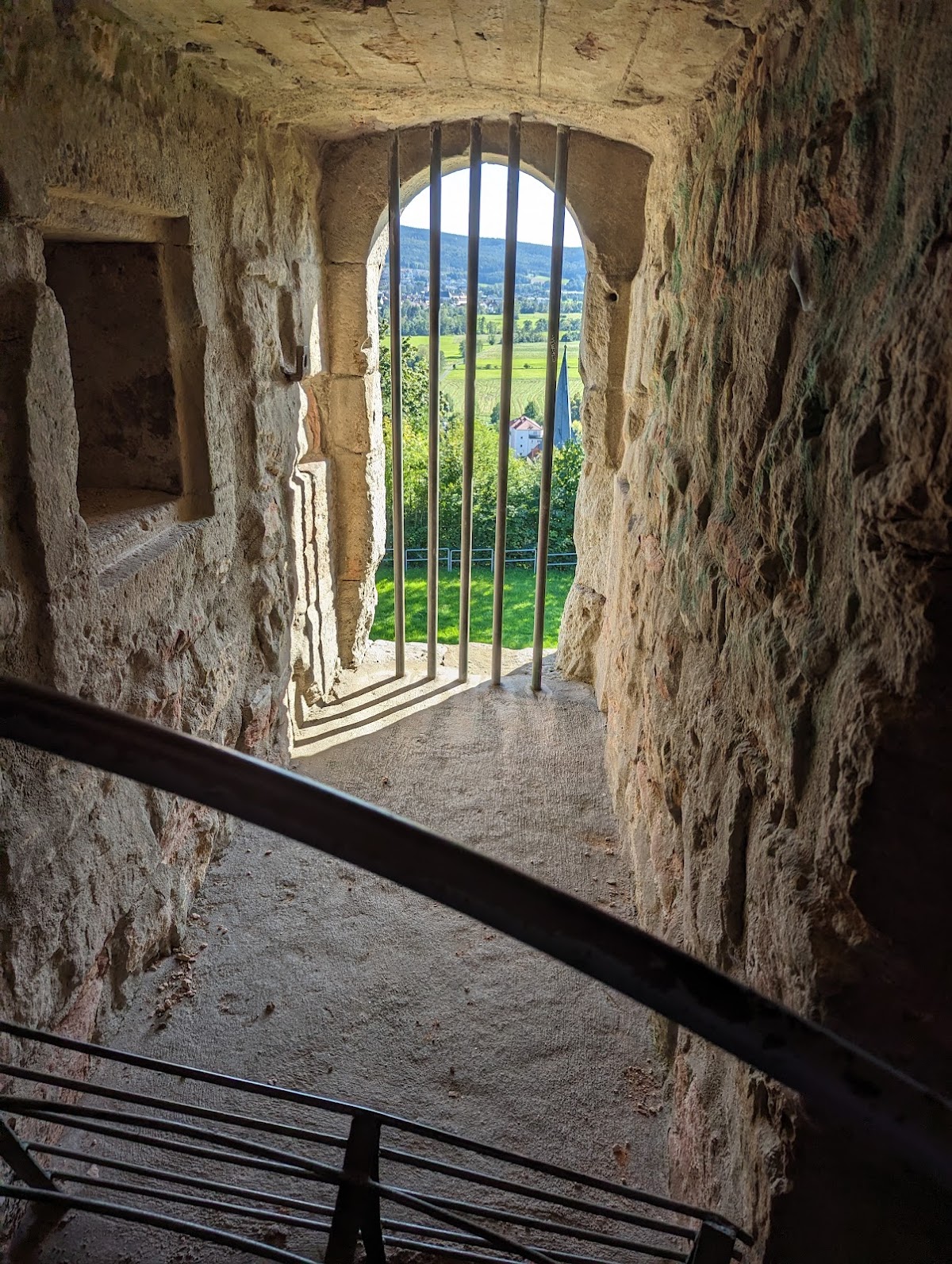
The keep protected the side of the fortress most vulnerable to attack. Its former elevated entrance remains visible about 10 metres above ground level, where access was originally provided by a stairway. The tower now has a ground-level entrance leading to a viewing platform by 88 steps. The surviving masonry was secured during the 1970 adaptation, leaving the keep as the principal standing element of the ruin.
The enceinte once enclosed the full castle plateau. Its course is represented by the double ditch and bank system surrounding the site. Stolzenberg stands above the historic long-distance route later recalled by the name Maustor, a worn form of Mauttor, meaning a toll-collecting gate. The town gate at the foot of the hill has since been removed.
Chapel and lower slope
The castle chapel stood within the fortified complex. A vineyard was planted around it in 1335, adding a cultivated area to the castle precinct. The separate church built on the slope below connected the fortress settlement with religious life outside the castle. It was replaced in 1896 by St. Lawrence Church.