St. Valentin: A Late-Gothic Basilica in Kiedrich, Germany


Site at a Glance
- Rating
- 4.5
- Popularity
- Low
- Country
- Germany
- Primary era
- Medieval
- External website
- Open
- Eras represented
- Medieval, Early Modern, Modern
- Civilizations
- Holy Roman Empire
- Site type
- Religious
- Remains
- Basilica
On this page18 sections
History
St. Valentin, formally the Basilica of Saints Dionysius and Valentinus, is a Catholic church in Kiedrich, Germany. Built by the medieval Christian community of the region, it developed from a fourteenth-century church into a major late-Gothic pilgrimage church, with its principal rebuilding completed in the 1490s. Its preserved architecture and furnishings form an unusually coherent example of late-Gothic church art.
Pilgrimage and medieval rebuilding
Relics of Saint Valentine were brought from Eberbach Abbey to Kiedrich around 1350. Their presence made the church a destination for pilgrims who sought the saint’s aid, particularly in the healing of epilepsy. Offerings made by pilgrims helped finance the church’s construction. Additional relics arrived in 1454, increasing the flow of pilgrims and encouraging a more ambitious rebuilding in the late-Gothic style.
An earlier church was completed around 1380, and its side aisles remain part of the present building. The principal rebuilding took place in the late fifteenth and early sixteenth centuries, reaching completion in the 1490s, traditionally associated with the year 1493. A hospital was founded beside the church in 1417. Between 1434 and 1444, the cemetery chapel of Saint Michael was built, and the relics of Saint Valentine were transferred there. An exterior pulpit on the chapel wall allowed the relics to be displayed to the faithful.
Music, burial, and later history
The church’s medieval Latin choral tradition is documented from 1333 in a distinctive Germanic form of the Mainz chant. The Kiedrich Chorbuben continue this tradition during the Sunday choral high mass, apart from the summer holiday period. The choir has included the singers Andreas Scholl and Elisabeth Scholl, who was the first girl admitted to the schola, the group of singers serving the liturgy.
St. Valentin also served as a burial place. Gernand von Schwalbach, the chief administrative official of Königstein, was buried there in 1601. The tomb slab of Conrad Breder von Hohenstein, a knight who died in Kiedrich in 1505, remained inside the church until 1962, when it was moved to the exterior cemetery area.
The medieval rood screen, a partition between the nave and the choir, was demolished after 1682 and reconstructed in the mid-nineteenth century. The nineteenth-century restoration of the church was undertaken at the initiative of Sir John Sutton, an English baronet and patron of historic organs. The church’s four historical bells survived both world wars without damage.
Protection and restoration
St. Valentin was designated a Basilica minor in 2010 by Pope Benedict XVI. This is an honorific Catholic title for a church of particular historical, devotional, or liturgical importance, without making it a cathedral. Since 2016, the church has been a subsidiary church of the Parish of St. Peter and Paul Rheingau. It belongs to the Pastoraler Raum Eltville together with the churches of St. Peter and Paul in Eltville, St. Mark in Erbach, and St. Vincentius in Hattenheim.
A major restoration of the interior and exterior began in 2012 and continued until 2018. Work completed by November 2014 included the interior architectural shell, the choir, the stained-glass windows, and their protective glazing. Later phases addressed the organ, high altar, Crucifixion group, sculptures, paintings, seating, Saint Michael’s Chapel, the church surroundings, and the enclosing wall. The protected historic monument status reflects the survival of the late-Gothic architecture and its unusually complete interior ensemble.
Remains
Church and churchyard
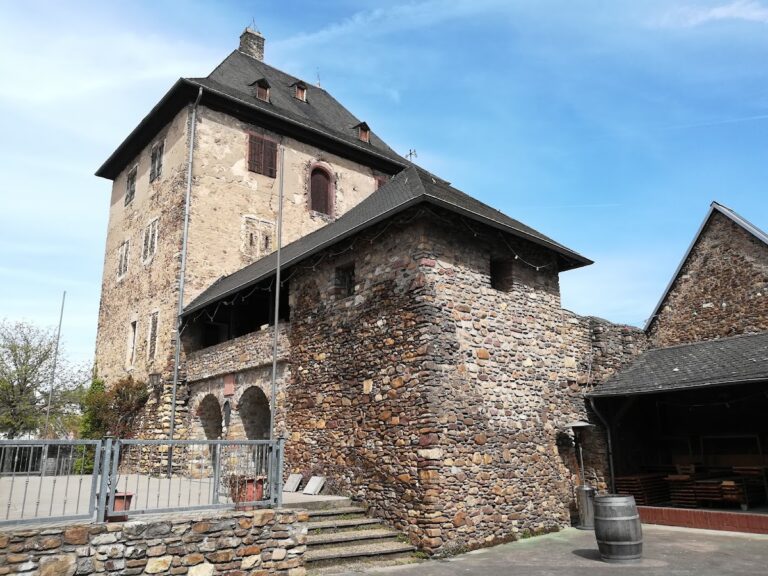
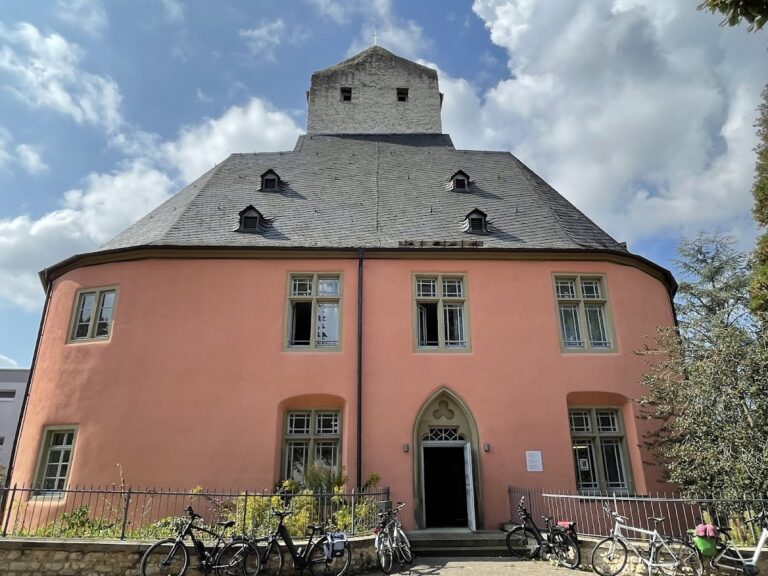
St. Valentin is a three-aisled Gothic hall church with galleries in the side aisles and a single tower. Its churchyard is enclosed by a wall and contains Saint Michael’s Chapel, a late-Gothic cemetery chapel incorporating an ossuary. The chapel stands immediately beside the church and remains part of the historic arrangement of the site.
Western portal
The principal western portal dates from around 1450. It includes a figure of Saint Valentine, while its tympanum presents the Annunciation and the Coronation of Mary. These sculptural elements belong to the late-medieval devotional character of the entrance.
Rood screen
A rood screen separates the nave from the choir. The present screen is a nineteenth-century reconstruction of the medieval structure dismantled after 1682, and it was made somewhat less slender than the original.
Late-Gothic furnishings
Lay stalls
The carved lay stalls were made in 1510 by Erhart Falckener, a late-Gothic woodcarver known for elaborately carved church furnishings. Eighty-one bench cheeks and twenty-three breast panels survive. Their decoration includes ornaments, flowers, vines, Gothic-letter inscriptions, and the Spiral of Justice, an inscription arranged in a spiral form.
Kiedrich Madonna
The Kiedrich Madonna is a gilded wooden sculpture from the mid-fourteenth century. Influenced by French Gothic art of the Rhineland and Cologne, it shows the young Mary turning with a smile toward the child.
Altars and devotional sculpture
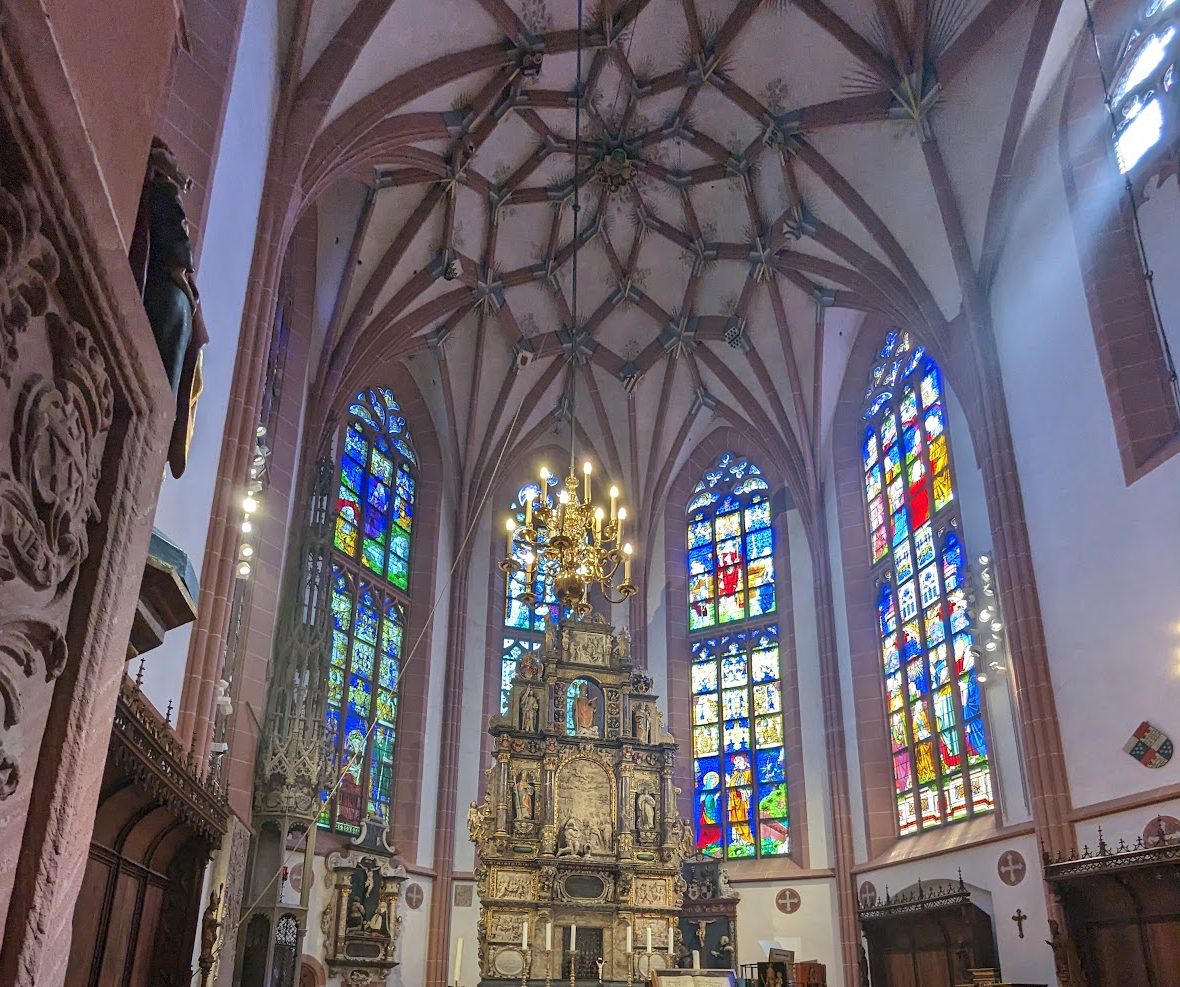
The high altar dates from 1619 and serves as the tomb altar of Caspar zu Eltz-Langenau, a member of the Eltz noble family. Made of marble, alabaster, and stucco, it has a central relief of the Adoration of the Magi.
The side altar of Saint John dates from around 1500. Its figures are attributed to the so-called Master with the Breastplate and include Saint Anne with the Virgin and Child. The Saint Catherine altar, which also serves as the epitaph of Juliane von Schwalbach, dates from 1620 and contains a reliquary of Saint Valentine.
The southern gallery contains an altar of the Virgin Mary and Saints Peter and Paul from around 1480. The northern gallery contains a Saint Margaret altar rebuilt in the nineteenth century, with figures dating from the late fifteenth century. Further Gothic altars, sculptures, vestments, paintings, and a Crucifixion group contribute to the church’s preserved interior ensemble.
Stations of the Cross
The churchyard contains fourteen monochrome white figurative reliefs forming the Stations of the Cross. Stations 1 through 14 are arranged clockwise, while the movement represented within stations 3 through 11 runs counterclockwise. In this unusual arrangement, Christ carrying the cross and his tormentors move away from Golgotha rather than toward it.
Bells and organ
Historical bells
The main tower contains four historical bells. One was cast in 1389, two were cast in 1513, and the youngest dates from 1868, when it was recast from an older cracked bell. Their principal notes are c′, d′, e′, and f′. A separate small bell in the roof turret, sounding d3, can be rung from the choir.
Medieval organ
The organ is one of the oldest playable organs in Germany and the oldest playable organ in Hesse. Its early history remains complex. An older organ work possibly dating from around 1380 and pipes allegedly marked 1313 have not been confirmed and are considered unlikely. The enlargement of the westernmost bay in 1491 created space for the present instrument.
Around 1500, an anonymous builder created the organ as a Swallow’s Nest organ, an instrument mounted on a projecting gallery or bracket high on a church wall. It probably had one manual. Johannes Wendel Kirchner rebuilt the windchest in 1652 and 1653 and probably renewed part of the pipework. A second-manual positive may have been added later, and repairs were carried out in 1686 and 1692.
Elias Salvianer extensively renovated the instrument in 1710. His contract lists eight stops in the upper organ and six in the rear positive. An independent pedal division was added in 1722. The exterior was given a Baroque appearance in 1760 through carving and faux-marble painting, and a singers’ gallery was built in front of the positive. By 1790 at the latest, the organ was unplayable, while proposed replacements were abandoned because funds were unavailable.
Nineteenth-century restoration
Sir John Sutton financed the organ’s nineteenth-century restoration. From 1858 to 1860, August Hooghuys of Bruges carried out historically informed work that restored the presumed late-Gothic appearance while substantially changing the disposition and introducing equal temperament, a tuning system that divides the octave into twelve equal semitones. The Baroque positive and pedal were placed behind the organ in the tower. Older registers were reworked and recombined, and much of the decorative woodwork was reconstructed, including Gothic Revival finials, side spandrels, wing doors, painted decoration, and a neo-Gothic front platform.
The organ retains parts of its Gothic facade, which carries at least five superimposed paint schemes. The wing doors are probably original. Its metal pipes belong to ten different material and manufacturing groups. The iron stop action and the main-work windchest date from 1653, while the sixteen-key pedal keyboard and the shortened octave in the manual were made in 1860. Hooghuys created the positive layout and pedal stop action, while the pedal includes pipes from older periods as well as nineteenth-century work.
Twentieth-century conservation
Orgelbau Kuhn restored the organ between 1985 and 1987 to its last monument-protection state of 1860. The main-work tracker action and the entire wind system were reconstructed to the 1653 state, and a modified meantone temperament was applied. Meantone temperament is a historical tuning system that favors the purity of selected intervals. The resulting instrument combines late-Gothic and Gothic Revival elements.