St Trophimus’ Church, Eschau: A Romanesque Abbey Church
Site at a Glance
- Rating
- 4.5
- Popularity
- Medium
- Country
- France
- Primary era
- Medieval
- Eras represented
- Medieval, Early Modern, Modern
- Civilizations
- French, Holy Roman Empire
- Site type
- Religious
- Remains
- Church
On this page11 sections
History
Abbey foundation and relics
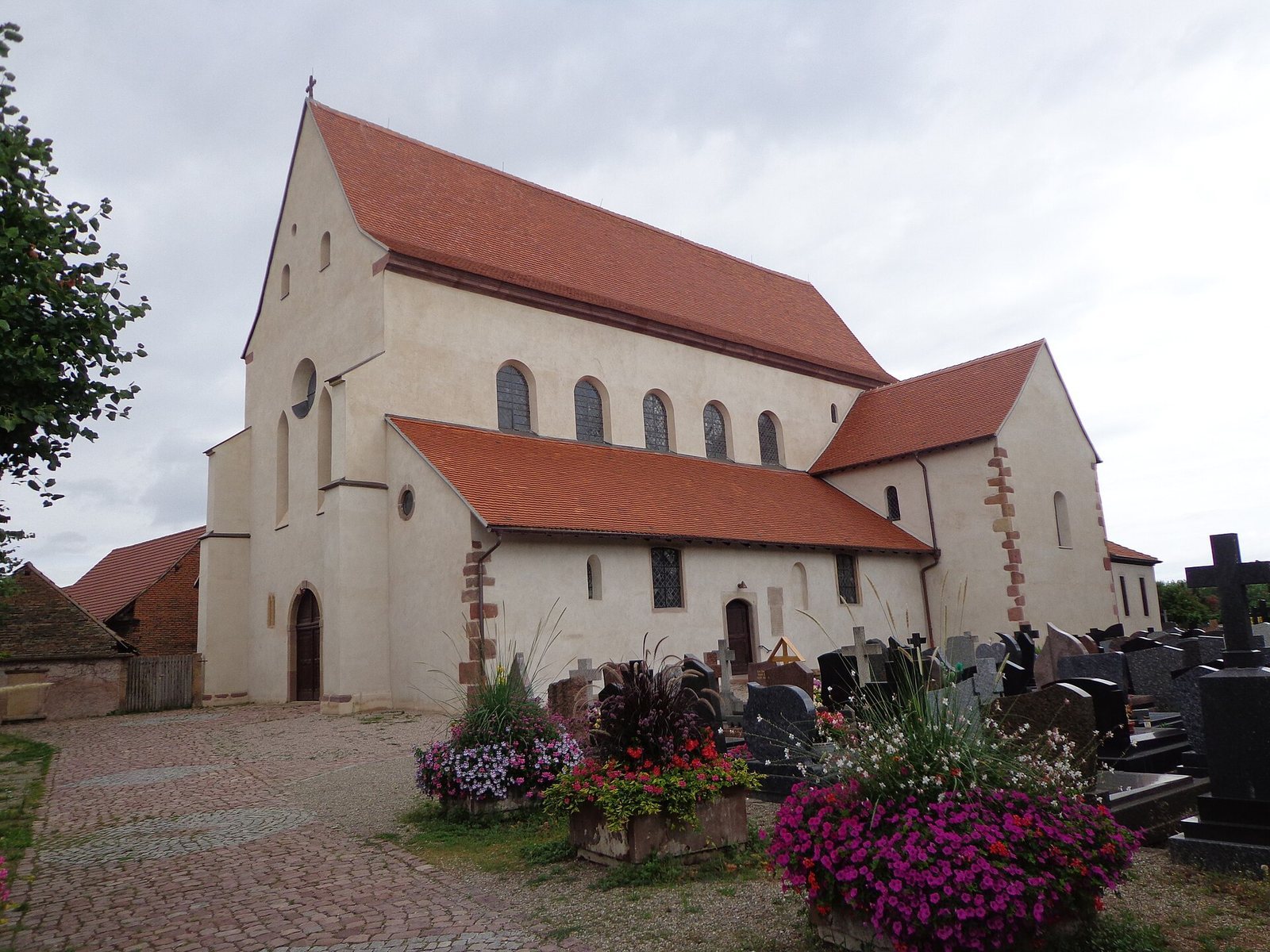
St Trophimus’ Church is a Romanesque church in Eschau, France, associated with a Benedictine abbey founded around 770 by Remigius, later bishop of Strasbourg. Romanesque architecture is a medieval tradition associated with round arches and heavy masonry. The church also reflects Carolingian and Ottonian influences, styles linked respectively with Frankish and German periods. Its present building is generally dated to the first half or middle of the 11th century. It is regarded as Alsace’s second-oldest church, after the Dompeter at Avolsheim.
Remigius’s nieces, Adale and Rodune, daughters of Count Bodole, helped establish the abbey. The church was dedicated to Saint Trophimus of Arles, an early Christian saint associated with that city, and Mary; the abbey later took the name of Saint Sophia. On 10 May 777, Remigius brought relics of Sophia and her daughters from Rome. Pope Adrian I had given them to him, and Remigius deposited them in the abbey church. A will dated 15 March 778 transferred the island and abbey to the church of Strasbourg. Remigius arranged for his tomb to be built in the church, where he was buried after his death in 783.
Rebuilding and pilgrimage
Hungarian forces destroyed the church in 926. Bishop Wilderod began rebuilding it in 991, and 996 is traditionally named as its consecration date, although that date is often questioned. In 1028, Bishop William I of Strasbourg granted the abbey the church of Saint Helena near Strasbourg; Bishop Hetzelon expanded the grant in 1047.
Pilgrimage to the relics had grown by 1143, when Chunegundis, the abbey’s female head, founded a hospice beside an ancient Roman road. In 1180, Pope Alexander III issued a bull confirming donations to Eschau and the rule followed by its community.
Conflict and the end of the abbey
In 1298, conflict over the succession to the title of King of the Romans partially damaged the church and destroyed its Romanesque cloister. The church façade was rebuilt soon afterward, while the monastery was reconstructed in the Gothic style. After the German Peasants’ War, a widespread uprising in German-speaking lands in 1524–25, the abbey passed to the bishopric of Strasbourg. It was dismantled in 1526 amid the Reformation.
In 1615, Archduke Leopold V of Austria sold the abbey buildings to the Grand Chapter of Strasbourg Cathedral for 20,942 guilders. The chapter used the residential buildings as a winery. Swedish troops under General Horn plundered the church in 1632 during the Thirty Years’ War, the major European conflict fought from 1618 to 1648.
Parish church and modern pilgrimage
French revolutionaries confiscated the buildings in 1792 and turned the church into an inn. They dispersed the relics of Saint Sophia and her daughters. In 1822, all the buildings except the church were demolished, and the church became the parish church of Eschau.
Russian Orthodox pilgrimage to the church took hold in the 1930s. An early visitor was Archimandrite Andronik, a senior monastic figure in Eastern Christianity, who came in 1937. In 1938, Bishop Charles Ruch of Strasbourg brought relics of Saint Sophia from Rome, authenticated by Cardinal Francesco Marchetti Selvaggiani. The church remains a pilgrimage destination, particularly for members of the Russian Orthodox Church.
The church suffered damage in 1944–45 during the Second World War and underwent a thorough restoration from 1958 to 1969. Its 18th-century bell tower was demolished in 1947 and replaced by a concrete tower in 1987. The hospice’s medicinal garden was also restored in 1987. The church is Catholic and belongs to the Archdiocese of Strasbourg, a major church jurisdiction led by an archbishop. It has been protected as a French historic property since 1898, a designation that covers the church and four statues.
Remains
Plan and architectural fabric
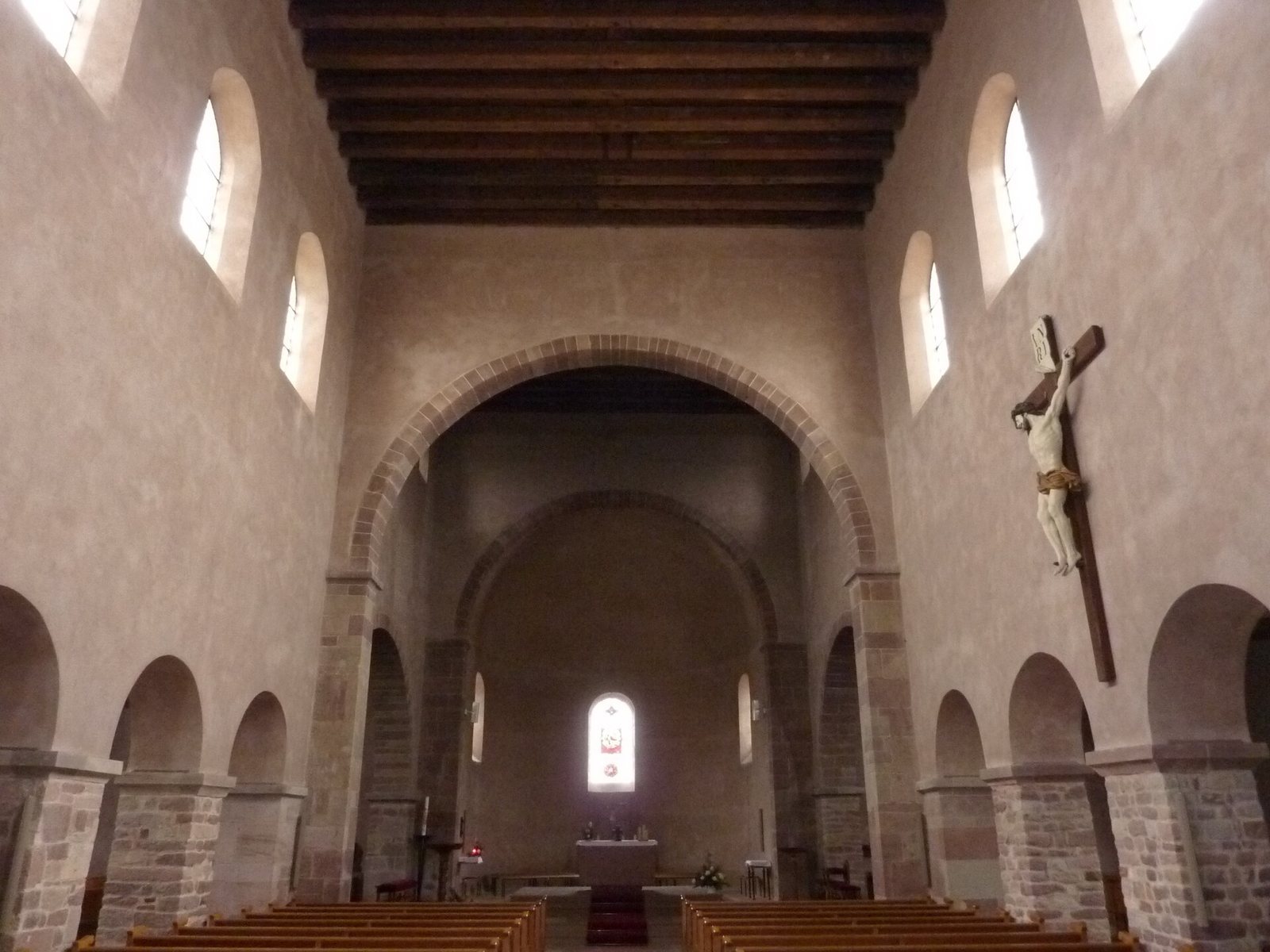
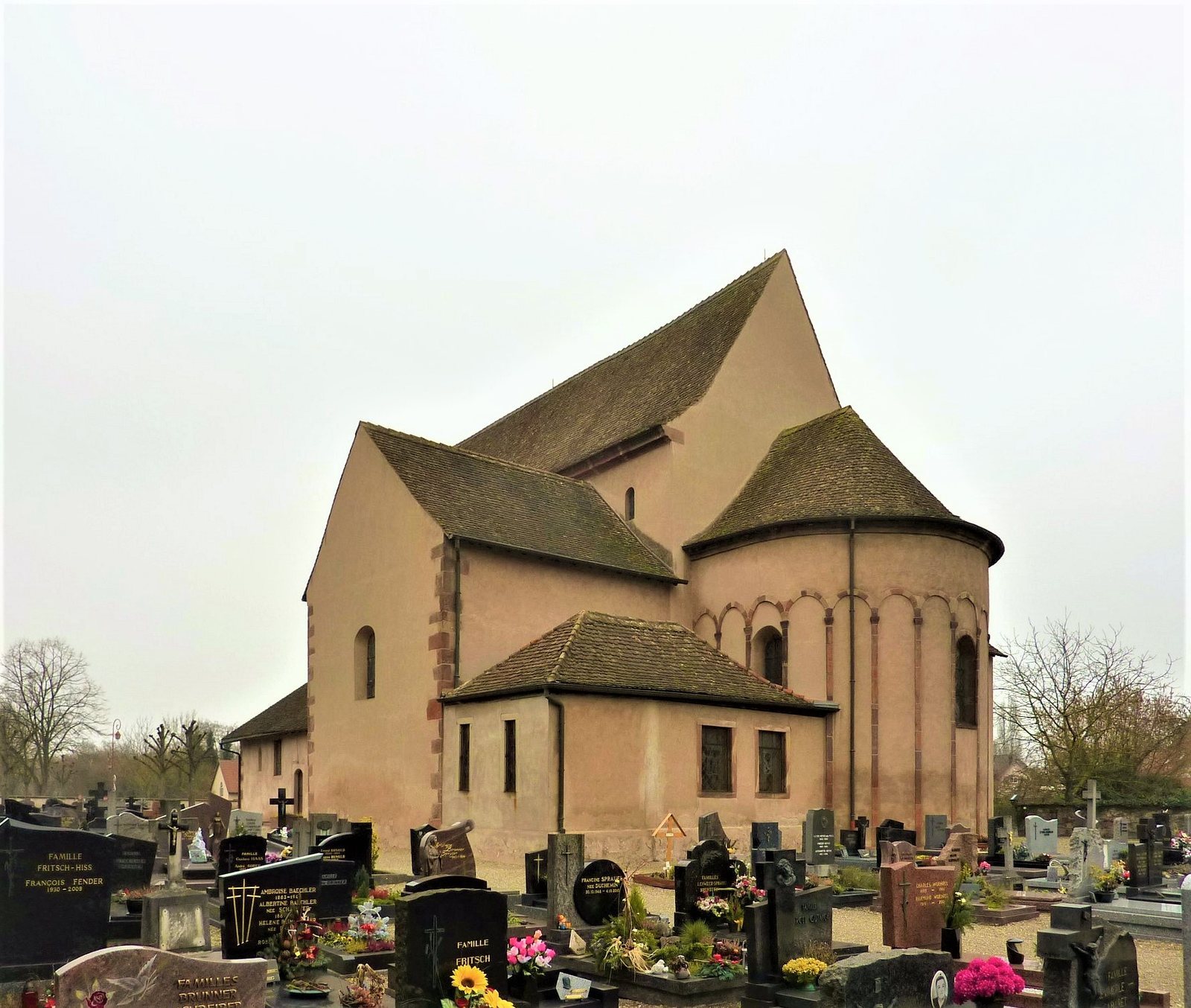
The church’s interior measures 32 m long, 18 m wide, and 12 m high. Its simple basilica plan has a central nave flanked by side aisles, a broad transept crossing the main axis, and a semicircular apse at the eastern end. The nave is nearly square in plan, and the transept is lower than it. Six square masonry supports carry the rows of arches separating the central and side aisles. A flat wooden ceiling covers the nave. The building’s layout and proportions have been compared with the abbey church on Reichenau, a historic monastic site on Lake Constance, and St Godehard in Hildesheim.
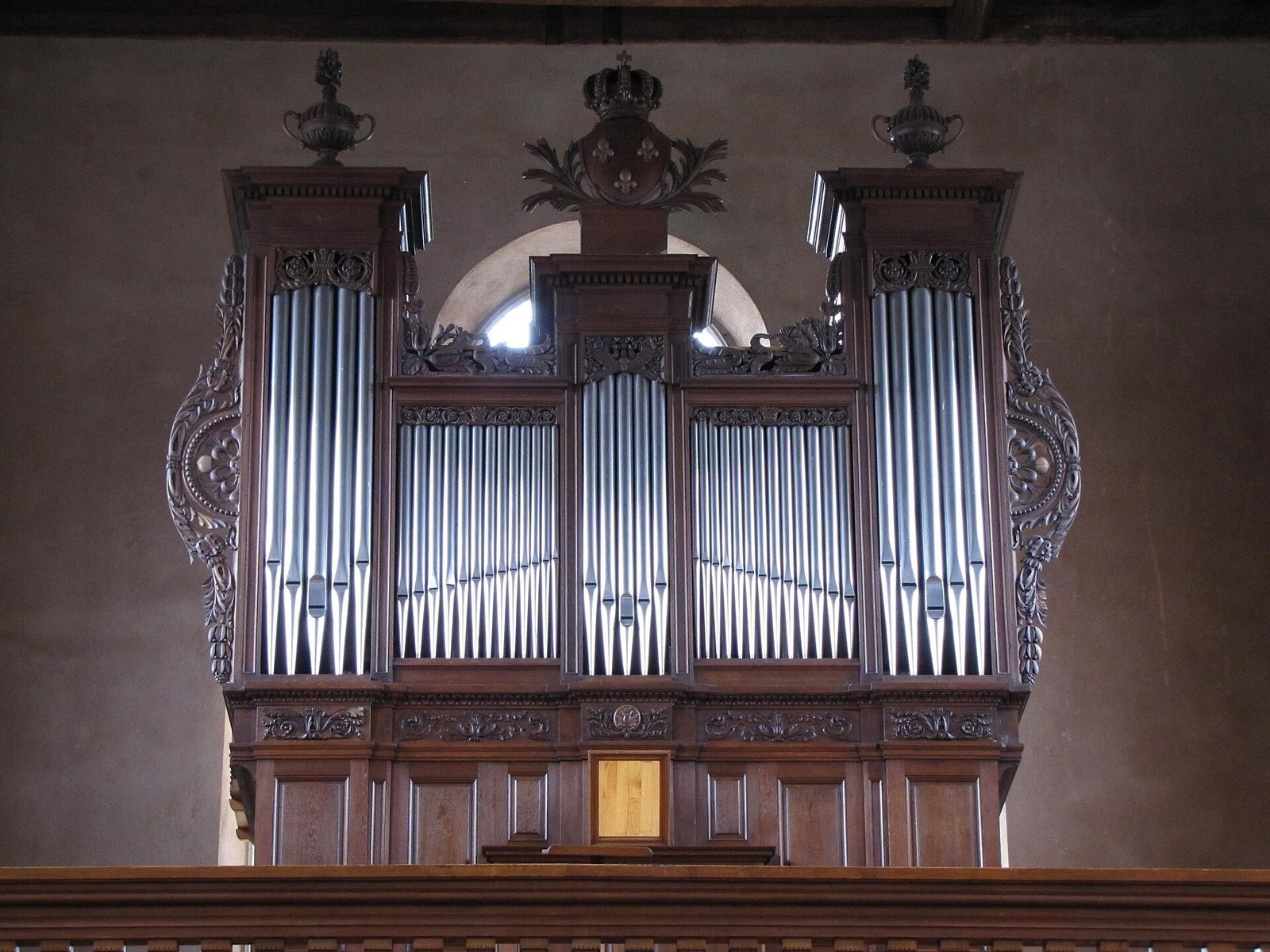
The raised semicircular apse has shallow vertical wall bands and decorative blind arches, which have no openings and are picked out in a darker color. It has retained its form for roughly a millennium. The nave floor was originally about 1.25 m lower, and its windows were once much smaller. In the 14th century, builders raised the roof structure, west façade, and walls along the eaves. The interior was altered in the Baroque style in 1747.
Relics and statues
A 14th-century container for Saint Sophia’s relics stands in the transept, with a sculpted group of Sophia and her three daughters, dated to 1470, hanging above it. The church also contains a statue of Saint Trophimus of Arles from the 18th century and a 15th-century statue of Saint Remigius. Other works include a wooden Saint Christopher from around 1500, a Saint Barbara from the 15th or 16th century, and a Saint Catherine of Alexandria from around the turn of the 16th century. The wooden sculptures also include a Gothic Christ.
Glass, sculptures, and memorials
The choir window incorporates a Gothic stained-glass panel reused from Strasbourg’s former Dominican church, destroyed in 1870. Other interior works include Gothic and Baroque statues, Renaissance sculptures, and memorial floor slabs from the 16th to 18th centuries. One Renaissance sculpture depicts the head of John the Baptist on a platter.
Cloister and excavated remains
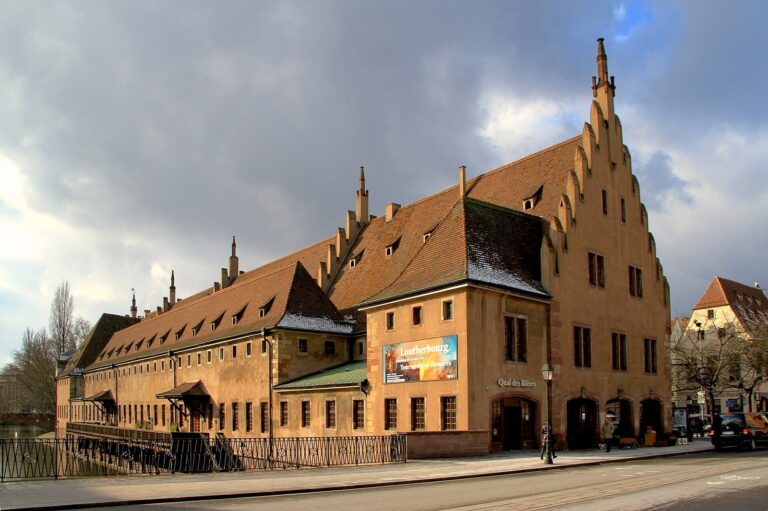
Excavations in 1866, 1917, 1919, and 1929 uncovered remains of the 12th-century cloister, with further fragments found in 1987. Some cloister remains, including figural reliefs from around 1130, are now in Strasbourg’s Musée de l’Œuvre Notre-Dame. The museum also holds a baptismal basin, a baptismal font, a Madonna from the first half of the 12th century, and a group of Saint Anne with the Virgin Mary and the infant Jesus from the early 16th century. The cloister’s carved capitals and other sculptures are associated with the workshop known as the Master of Eschau. Fragments found in 1987 are kept at Eschau town hall. Work to install underfloor heating in 1995 uncovered two sarcophagi.
Bell tower and medicinal garden
A separate concrete bell tower stands about 80 m southeast of the church. The restored medicinal garden associated with the abbey’s hospice lies opposite the church.